
What should electricians include in their monthly marketing budget?

- Besides ad spend, what goes into an electrician's monthly marketing budget?
- Why isn't ad spend the whole monthly marketing budget?
- Line 1: Ad spend for Google search ads
- Line 2: Local Services Ads lead charges
- Line 3: Management fees for ads, SEO and your Google profile
- Line 4: SEO and content work
- Line 5: Website hosting, updates and small changes
- Line 6: Call tracking and reporting
- Line 7: Review requests and quote follow-up tools
- Line 8: Your own time, or a staff member's
- How should those lines be split?
- How do I judge the whole budget each month?
- What's different about an electrician's monthly marketing budget
- A worked example: one electrician's full monthly budget
- Frequently asked questions
- Key takeaways
- More in this section
- Sources
The short version
- Ad spend and Local Services Ads lead charges, billed by Google.
- Management of ads, SEO and your Google profile, billed by whoever does it.
- Website hosting and upkeep, call tracking and reporting.
- Review requests, quote follow-up tools and your own time.
- Judge the full total by cost per booked job, not the ad line alone.
For electrical contractors who have a rough budget number and want to know every line it has to cover, not just the ad spend.
Get a free visibility audit · Book a growth call
Besides ad spend, what goes into an electrician's monthly marketing budget?
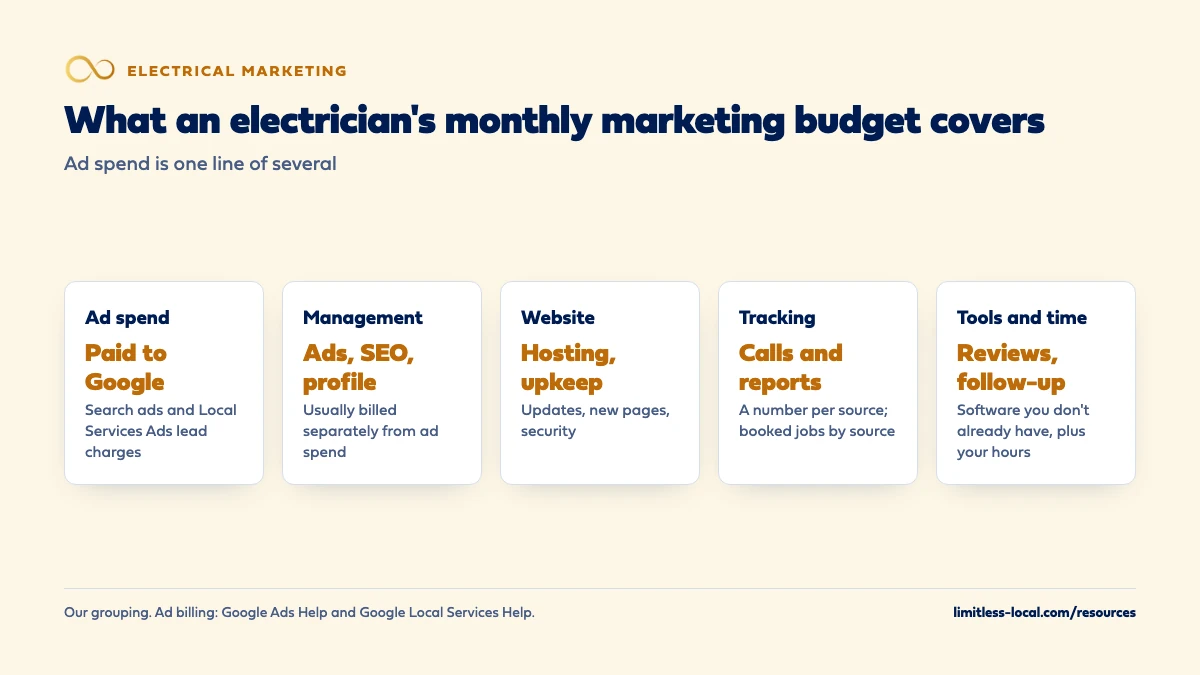
A complete monthly marketing budget for an electrician has more lines than ad spend: the ad spend itself, Local Services Ads lead charges, management of the ads, SEO and Google profile, website hosting and upkeep, call tracking and reporting, review and follow-up tools, and the owner’s or staff’s time. Ad spend is usually billed by the platform and management by whoever does the work, so keep them on separate lines. Then judge the whole total, not just the ad line, by what each booked job cost.
Our packages are priced the same way: one monthly fee for the management, tracking and reporting, with ad spend paid directly to Google or Meta and a budget recommended after a quick audit. The packages page shows which lines each tier covers, our electrical contractor marketing page explains how we work with electricians, and the rest of the electrical marketing questions library covers budgets from other angles.
Why isn't ad spend the whole monthly marketing budget?
Ad spend is the line owners see first, because Google charges a card for it. But the ads don’t run themselves, the calls they bring need tracking, the website they send people to needs hosting, and somebody has to ask for reviews and follow up on quotes. Each of those costs money or time every month.
In our judgement, leaving those lines out is the main reason owners think their marketing costs less per job than it does. A budget that lists every line also makes it easier to compare options, such as an agency against a freelancer plus software, because you’re comparing the same total. Setup costs like a website build or truck wraps belong in a separate line; our page on which electrical marketing costs are one-time and which are monthly sorts those out.
Line 1: Ad spend for Google search ads
This is the money paid to Google for clicks. You set an average daily budget, and Google’s page on average daily budgets explains how that turns into a monthly number: on any one day you might spend up to two times your average daily budget for most campaigns, but in any month you won’t be charged more than 30.4 times it, the monthly spending limit for most campaigns.
So budget the ad line as a monthly figure, divide by 30.4 to set the daily budget, and expect some days to run higher than others. Our page on how much an electrician should spend on Google Ads each month covers how to size it.
Line 2: Local Services Ads lead charges
Local Services Ads charge per lead instead of per click. Google’s page on how leads work says you’re charged for each valid lead, that lead prices may vary depending on your location, the job type, the type of lead and your bidding mode, and that a missed call during business hours counts when the caller stays on the line for more than 20 seconds. Accounts on the original setup use an average weekly budget, with a monthly max of that budget times the average number of weeks in a month.
That setup is changing. Google’s page on the move to Performance Max names electrical among the select advertisers in the first phase of moving Local Services Ads into Google Ads, starting August 2026, and that on transition day weekly budgets become daily budgets, with monthly spend capped at the daily average times 30.4. Either way, keep this as its own line, because it rises and falls with lead volume. Our page on whether Local Services Ads are worth it for electricians covers when it pays.
Line 3: Management fees for ads, SEO and your Google profile
Someone has to run the ads, do the SEO work and keep your Google Business Profile current. That might be an agency, a freelancer, an employee or you. Whoever it is, the fee is usually separate from the ad spend it manages.
When you budget this line, write down exactly what it covers: which channels, how many locations, how much ad spend it manages, whether reporting is included, and the contract terms. Two quotes with the same price can cover very different work. Our page on what a marketing agency costs an electrician goes through how agencies price that work.
Line 4: SEO and content work
If SEO is part of the plan, it’s a monthly line, not a one-time one. Ongoing work usually includes new and improved pages for the jobs and towns you want, links from other local sites, and keeping your business listings consistent. Sometimes it’s bundled into a management fee and sometimes it’s billed on its own; either way, give it its own row so you can see what it costs.
Budget it knowing the payoff comes later: in our planning, SEO typically takes 3-6 months to show meaningful organic growth, while ads can generate leads within days of launch. A budget that stops SEO after two months usually stops it before it pays.
Curious what your marketing is actually booking?
Get a free visibility audit — no obligation, no sales pitch.
Line 5: Website hosting, updates and small changes
A website keeps costing after it’s built. An article from Canada’s BDC on small business marketing budgets says the cost of your website includes the original design and build as well as monthly hosting, plus paying to keep the content fresh and up to date, and recommends building in analytics so you can see who’s coming and from where.
For an electrician, this line usually covers hosting, security updates, and small edits: a new service page for EV chargers, updated photos, a changed phone number or service area. In our judgement, it’s a small line that causes big problems when it’s skipped, because an outdated or broken site wastes every ad dollar that sends people to it.
Line 6: Call tracking and reporting
Without tracking, you can’t tell which line of the budget produced which job. Call tracking belongs on the monthly line, not the setup line. CallRail’s source tracking help recommends one source tracking number per campaign to prevent inaccuracies in your reports, so expect a few numbers: one for the Google profile, one for the website, one for ads, and one for anything printed, such as truck signs.
Reporting belongs on the same line: whoever runs your marketing should show calls, booked jobs and cost per booked job by source each month. Our page on whether an electrical business needs call tracking numbers covers the setup.
Line 7: Review requests and quote follow-up tools
Your Google Business Profile itself doesn’t cost anything; Google’s getting started guide says you can manage how your business shows up on Maps and Search at no charge. What can cost money is the tooling around it: review request texts and emails, automatic quote follow-up, and appointment reminders.
Check what your field software already does before you pay for another tool. Field software such as Jobber, Housecall Pro or ServiceTitan may already handle some of this, and in our judgement paying twice for the same feature is common. If you do need a separate tool, put it on this line so it’s counted in the cost per job.

Line 8: Your own time, or a staff member's
Owners rarely budget their own time, but it’s real. Evenings spent adjusting ads, writing posts or chasing reviews are hours that could have gone to estimates or to being home. If an office manager handles reviews and follow-up, part of their wages belongs here too.
In our judgement, put an hourly value on that time, even a rough one. It changes the comparison between doing it yourself and paying someone, and it shows whether the cheapest-looking option is really the cheapest.
How should those lines be split?
There’s no standard split for electricians, and anyone quoting one is guessing about your market. The BDC article suggests allocating your marketing budget across categories, such as your website, online advertising and traditional media, and adjusting the amounts over time based on what’s most effective. A 2019 SBA blog post on getting the most from a marketing budget gives similar advice: focus on the marketing that has gotten the best results, and track results so you know which that is.
In our judgement, a useful starting rule is that the ad lines should be big enough to produce a meaningful number of calls, and the support lines (management, website, tracking) should be enough to make those calls count. If the support lines are bigger than the ad lines, check that they’re doing more than keeping the lights on.
How do I judge the whole budget each month?
Add every line, divide by the booked jobs you can trace to marketing, and compare that cost per booked job against what the jobs are worth. Do it by job type where you can, because a booked service call and a booked panel upgrade can carry very different marketing costs.
Then look at the lines one by one. If a line can’t show its share of booked jobs, such as a tool nobody uses or a channel with no tracked calls, it’s the first candidate to cut. Our page on what a good cost per booked job looks like for electrical marketing covers how to set your target.
Want to see where your company stands?
A free visibility audit shows where you show up on Google, Maps and AI answers, and what it's costing you in calls.
What's different about an electrician's monthly marketing budget
Service calls and project work need separate math. A small service call can’t carry much marketing cost; panel upgrades, EV chargers and generators can carry more. In our judgement, track the ad lines by job type so one doesn’t hide the other.
Seasonal work moves the ad lines, not the support lines. In our judgement, generator and surge protection demand often rises around storm season, so the ad spend for those jobs may rise and fall during the year, while hosting, tracking and management stay roughly flat.
Commercial work leans on lines that aren’t ads. Builders and property managers tend to check your website, references and project photos, so the website and content lines matter more if commercial work is part of the plan.
Licensing shows up in the website line. Keeping your license number, insurance and service areas current on the site is part of the upkeep budget.
A worked example: one electrician's full monthly budget
These numbers are made up to show the math, not a benchmark for your market. Say an electrician’s monthly marketing looks like this:
- Google search ad spend: $2,000
- Local Services Ads lead charges: $600
- Management of ads, SEO and Google profile: $1,800
- Website hosting and upkeep: $100
- Call tracking: $90
- Review and follow-up software: $150
- Owner time: 6 hours at a made-up $75 an hour, $450
The total is $5,190. If marketing traces to 25 booked jobs, that’s about $208 per booked job. Counting only the two ad lines, $2,600, the same jobs would look like they cost $104 each, half the real figure.
For comparison, our own Essentials package is $3,500 a month and covers Google Business Profile management, SEO content, link building, Google Ads management up to $2,500 a month in ad spend, call, web and form tracking, and a monthly report; ad spend is paid to Google separately. Local Services Ads management starts in our Growth package, at $4,500 a month.
Frequently asked questions
How much should my total monthly marketing budget be?
That’s a different question from what it includes. Our page on how much an electrical contractor should spend on marketing covers the percentage-of-revenue and job-math approaches.
Is ad spend usually included in an agency's fee?
In our judgement, often not: a management fee is commonly billed separately, with ad spend paid to the platform directly. Ask for both numbers in writing before you sign.
Should my website build be in the monthly budget?
Only if you’re paying it off monthly. A build is a one-time cost; hosting and upkeep are the monthly part.
Do I need to budget for my Google Business Profile?
Not for the profile itself, which Google lets you manage at no charge. Budget for the time, or the person, who keeps it current and asks for reviews.
What line do electricians most often forget?
In our judgement, their own time, followed by software they pay for twice because their field software already does the same thing.
How often should I review the budget?
Monthly for the cost per booked job, and the BDC article suggests checking your marketing budget against actual spending quarterly and annually.
Key takeaways
- Ad spend is one line; management, website, tracking, tools and time belong in the monthly budget too.
- Google charges up to 30.4 times your average daily budget in a month for most campaigns.
- Local Services Ads charge per valid lead, so keep them on their own line.
- Your Google Business Profile is free to manage; the time and tools around it aren’t.
- Judge the full total by cost per booked job, by job type where you can.
Not sure what's working right now?
Start with a free visibility audit: rankings, Google profile, reviews and tracking, checked against your service area.
More in this section
- How much should an electrical contractor spend on marketing?
- Which electrical marketing costs are one-time and which are monthly?
- How should I market a small electrical business on a tight budget?
- How much does a marketing agency cost for an electrician?
- What is a good cost per booked job for electrical marketing?
Sources
- About average daily budgets — Google Ads Help
- How leads work — Google Local Services Help
- Local Services Ads transition to Performance Max campaigns with pay-per-lead goals — Google Ads Help
- What is the average marketing budget for a small business? — BDC (Business Development Bank of Canada)
- How to Get the Most From Your Marketing Budget — U.S. Small Business Administration
- Get started with Google Business Profile — Google Business Profile Help
- Source tracking basics — CallRail Help Center