
What percent of revenue should an HVAC company spend on marketing?

- What share of yearly revenue should an HVAC company put into marketing?
- Is there a standard marketing percentage for HVAC companies?
- What do general small-business rules of thumb say?
- Should I base the percentage on revenue or gross profit?
- What counts as marketing spend for an HVAC company?
- Should a new HVAC company spend a bigger share?
- How do I set a marketing budget from booked jobs instead?
- When does it make sense to spend above the usual range?
- When should I spend less than the usual range?
- How should an HVAC marketing budget be split between channels?
- Should my marketing percentage change with the seasons?
- How do I know if my marketing percentage is working?
- What's different about marketing budgets for HVAC companies
- A worked example: a percentage, checked against booked jobs
- Frequently asked questions
- Key takeaways
- More in this section
- Sources
The short version
- No single percentage fits every HVAC company; general rules of thumb are a starting point.
- One common rule: 2 to 5% of revenue for business-to-business, often 5 to 10% for consumer businesses.
- Count everything: ad spend, agency fees, software, website, wraps and mailers.
- Check any percentage against booked jobs and what each one costs you.
For HVAC owners setting a yearly or monthly marketing budget who want a percentage to start from, and an honest view of where a percentage falls short.
Get a free visibility audit · Book a growth call
What share of yearly revenue should an HVAC company put into marketing?
There’s no single right marketing percentage for an HVAC company, so treat any figure you see as a starting point, not a rule. General small-business rules of thumb put marketing at about 2 to 5% of revenue for companies that sell to other businesses and often 5 to 10% for companies that sell to consumers, which is where most residential HVAC work sits. Where you land inside or outside that range should depend on your growth goals, how full your schedule is, your margins, how much work already comes from repeat customers and referrals, and what a booked job costs you in each channel.
We’d rather set a budget from booked jobs than from a percentage, and the prices of our Essentials and Growth marketing packages are public, so you can run that math yourself, with ad spend kept separate from our fee. The HVAC marketing page shows what those packages cover for HVAC companies, the HVAC marketing cost guide breaks down what each channel tends to cost, and the rest of the HVAC marketing questions library goes question by question.
Is there a standard marketing percentage for HVAC companies?
Not one we can point you to with a checkable source. You’ll find HVAC percentages quoted online, but we couldn’t find one backed by published data on HVAC companies, so we don’t repeat any here.
A Small Business Administration blog post on marketing budgets, published in 2019, puts it plainly: there’s no hard and fast answer to how much your marketing budget should be. Many businesses use a percentage of revenue as a guide, but the range is wide. The same post suggests contacting your industry trade association or reading trade publications to see whether they offer benchmarks, which is worth doing if you belong to one.
What do general small-business rules of thumb say?
BDC, the Business Development Bank of Canada, gives a common rule of thumb in an article updated in 2023: business-to-business companies should spend between 2 and 5% of revenue on marketing, and for business-to-consumer companies the share is often higher, between 5 and 10%. Its reason is that consumer businesses typically need more marketing channels to reach different customer groups. The SBA blog post makes the same point, that consumer-facing companies generally need to budget more than business-to-business ones.
Keep the scope in mind. That’s general guidance for small businesses of every kind, not a measured HVAC average. Residential HVAC sells to homeowners, so in our judgement the consumer range is the closer starting point, while a mostly commercial HVAC company may sit nearer the business-to-business range.
Should I base the percentage on revenue or gross profit?
Rules of thumb are quoted as a share of revenue, so use revenue to compare your number with them. But in our judgement, decide on gross profit, because that’s what actually pays for marketing.
Two HVAC companies with the same revenue can have very different room to spend. A company heavy on replacements may book fewer, bigger jobs with different margins than one heavy on service calls and maintenance plans. The same percentage of revenue can be comfortable for one and a strain for the other. Use the percentage as a sanity check and the profit on each booked job as the decision.
What counts as marketing spend for an HVAC company?
Everything you pay to get the phone to ring, or the percentage will look lower than it really is. BDC suggests budgeting across categories such as your website (build, hosting and keeping content fresh), social media, online advertising, traditional media, email newsletters, video and training.
For an HVAC company, in our judgement, the full list also includes:
- Ad spend on Google, Local Services Ads and social media.
- Agency or freelancer fees.
- Pay-per-lead platforms.
- Call tracking, review and marketing software.
- Truck wraps, yard signs, door hangers and mailers.
- Sponsorships and home shows.
Add them up for the past year before you compare yourself with any percentage.
Should a new HVAC company spend a bigger share?
Usually, yes. The SBA blog post says you’ll need to budget more for marketing when your business is just starting out, because you’re still building awareness and attracting customers, and that a startup should base the percentage on projected revenue. Once a business is established with a steady customer base, it says you can reduce the budget, but not stop marketing altogether.
In our judgement, that matches how HVAC companies grow: a new company has no maintenance-plan customers or referral base yet, so more of its work has to be bought, while an older company gets a share of its calls from customers who already know it.
Curious what your marketing is actually booking?
Get a free visibility audit — no obligation, no sales pitch.
How do I set a marketing budget from booked jobs instead?
Work it backward from the jobs you want. The SBA’s break-even calculator uses a simple formula: fixed costs divided by price minus variable costs gives the number of units you need to sell to break even. Applied to marketing, divide a month’s marketing spend by the gross profit on an average booked job, and you get the number of extra jobs that month’s marketing has to book just to pay for itself.
Then run it the other way. Decide how many more booked jobs your crews can take, multiply by what a booked job costs you in your best channels, and that’s your budget. If that number lands far above or below a rule-of-thumb percentage, trust the booked-jobs math and find out why. How many booked calls an HVAC company needs helps with the first half of that.
When does it make sense to spend above the usual range?
In our judgement, an HVAC company can justify spending above a rule-of-thumb percentage for a while when it has a clear reason and the numbers to check it:
- You’ve hired another tech or crew and need to fill their schedule.
- You’re opening a new location or pushing into new towns.
- Your cost per booked job is well below what those jobs earn, and the schedule still has room.
The SBA blog post also warns about a chicken-and-egg trap: sales drop, you cut marketing, and sales drop further. It says that if you see sales slowing, it might be the right time to increase marketing. Whether to fill the schedule first or hire first is covered in whether to market before or after hiring another HVAC tech.
When should I spend less than the usual range?
In our judgement, spending below a rule-of-thumb percentage is the right call when more marketing can’t turn into more booked jobs:
- Your crews are booked out for weeks.
- Calls are going unanswered, so extra leads would be wasted.
- Your tracking is broken, and you can’t tell what’s working.
- Your cost per booked job keeps climbing even after you’ve fixed follow-up and the website.
Fix the bottleneck, then spend again. The signals to watch, and how to raise or lower spend without starting over, are in when to raise, lower or pause HVAC ad spend.
How should an HVAC marketing budget be split between channels?
The SBA blog post’s advice is to focus on the methods that have gotten the best results in the past, include a mix of methods, and, if the budget is tight, lean on low-cost or free methods and be very selective about the costly ones.
In our judgement, for an HVAC company that usually means paying for the basics first, such as your Google profile, reviews, a website that works on phones, and call tracking, because every paid channel performs better on top of them. Then fund the paid channels that can be turned up and down, such as Google Ads and Local Services Ads. How to size the Google Ads share is covered in how much an HVAC company should spend on Google Ads.
Should my marketing percentage change with the seasons?
The yearly percentage can stay put while the monthly spend moves. HVAC demand climbs in the first heat wave and the first cold snap, and in our judgement the marketing that can follow demand, mostly paid ads, should rise and fall with it, while the steady work like reviews and your Google profile continues year-round.
If you budget by the month, Google Ads works in daily budgets: Google says to multiply your average daily budget by 30.4, the average number of days in a month, to get the monthly figure. How an HVAC company should scale up ads for peak season covers the timing.
How do I know if my marketing percentage is working?
Track where every job came from, then compare spend with booked jobs by source. The SBA blog post notes that tracking can be as simple as asking new customers how they heard about you. Field software makes it stick: Housecall Pro’s Lead Source field, for example, tracks where customers found your business on customers, jobs and estimates, so you can invest in the sources that bring you good jobs.
BDC suggests reviewing your marketing budget quarterly and annually against what you actually spent. In our judgement, the review that matters is cost per booked job by channel, and whether the total still makes sense against gross profit.
Not sure which of these is costing you jobs?
A free visibility audit checks the Google profile, reviews, site and tracking, and shows what to fix first.
What's different about marketing budgets for HVAC companies
Maintenance plans change the math. Customers on a maintenance plan come back without new marketing spend. In our judgement, an HVAC company with a large plan base can often spend a smaller share of revenue to reach the same schedule than one without.
Replacement jobs are lumpy. A few system replacements can swing a month’s revenue. Judge your percentage over a full year, not one hot July.
Weather moves demand, not just marketing. A mild summer can make any percentage look worse. Compare like seasons with like seasons before you decide the budget isn’t working.
A worked example: a percentage, checked against booked jobs
These numbers are made up to show the math. They aren’t a benchmark for HVAC revenue, margins or marketing costs.
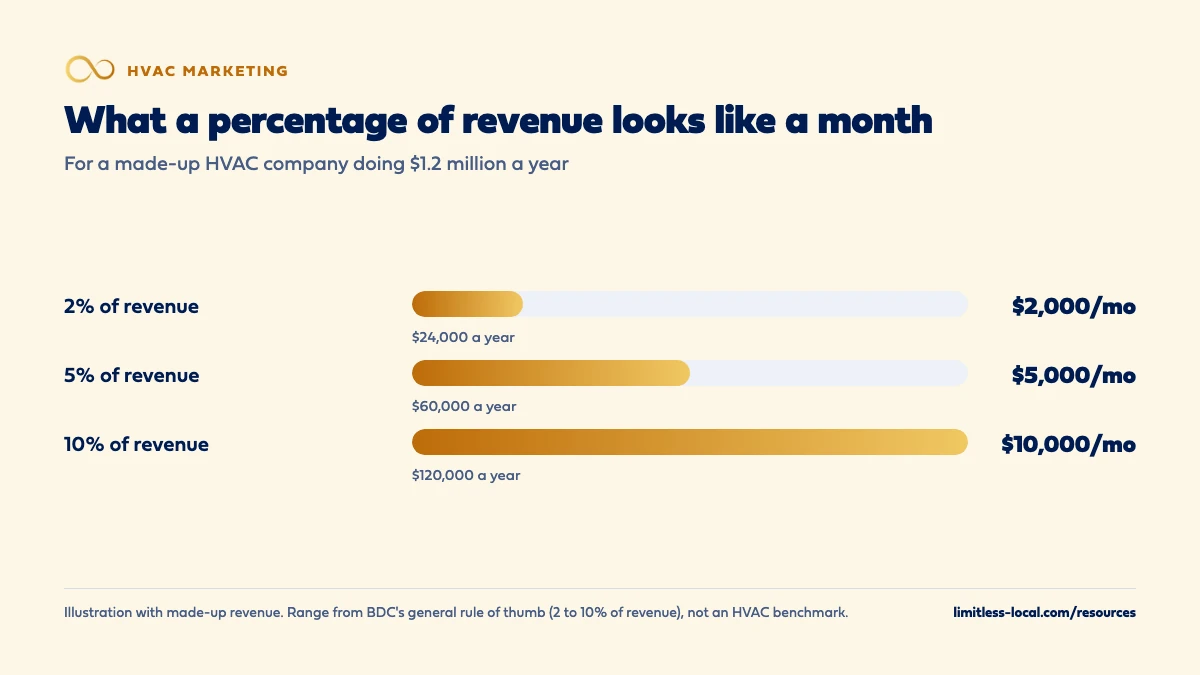
Say your HVAC company does $1.2 million a year in revenue. Here’s what the rule-of-thumb range looks like a month:
- 2% of revenue: $24,000 a year, or $2,000 a month.
- 5% of revenue: $60,000 a year, or $5,000 a month.
- 10% of revenue: $120,000 a year, or $10,000 a month.
Now check one of those against booked jobs. Say a booked job costs you about $250 in marketing across your channels, and leaves about $450 in gross profit on average. At $5,000 a month, you’d be buying about 20 booked jobs, worth about $9,000 in gross profit. That works only if your crews can take 20 more jobs a month. If they can take 12, the extra spend buys calls you can’t run.
For comparison, our Essentials package is $3,500 a month and manages up to $2,500 a month in Google Ads spend, which is paid to Google separately. Fee plus that much ad spend is $6,000 a month, or $72,000 a year, about 6% of this made-up company’s revenue. Whether that’s the right share for yours comes down to the same booked-jobs math.
Frequently asked questions
Does the marketing percentage include my agency's fee?
It should. Count agency fees, ad spend, software and everything else you pay to get calls, or your percentage will look lower than what you really spend.
Is 10% of revenue too much for HVAC marketing?
Not automatically. It sits at the top of the general consumer-business rule of thumb, and it can make sense while you’re growing, hiring or opening a location, as long as the booked jobs it buys earn more than they cost.
Should I set the budget yearly or monthly?
Both, in our judgement: a yearly total as a share of revenue, and monthly spend that follows demand and how full the schedule is.
Where can I find HVAC-specific marketing benchmarks?
The SBA blog post suggests asking your industry trade association or reading trade publications. If you use a figure from one, check who was surveyed and when before relying on it.
Do referrals and repeat customers lower how much I need to spend?
Usually. Work that comes back without new spending lowers the share of revenue marketing has to carry, which is one reason the SBA post says established businesses can often spend less than startups.
Key takeaways
- No single marketing percentage fits every HVAC company; general rules of thumb are a starting point.
- BDC’s rule of thumb: 2 to 5% of revenue for business-to-business companies, often 5 to 10% for consumer businesses.
- Count every marketing cost, and decide on gross profit per booked job, not revenue alone.
- New companies usually need a bigger share; established ones with steady repeat work can often spend less.
- Check any percentage against how many booked jobs it buys and whether your crews can run them.
Want a second set of eyes on your setup?
We'll look at how you show up locally and where calls are leaking, then send you a plain-English breakdown.
More in this section
- How much time should an HVAC owner spend on marketing each week?
- How much should an HVAC company spend on Google Ads?
- What percentage of calls should my HVAC office be booking?
- What are the biggest marketing mistakes HVAC companies make?
- How should a commercial HVAC company market itself?
Sources
- What is an average marketing budget for a small business? — BDC (Business Development Bank of Canada)
- How to Get the Most From Your Marketing Budget — U.S. Small Business Administration
- Break-even point calculator — U.S. Small Business Administration
- Choose your bid and budget — Google Ads Help
- How to Use Lead Sources — Housecall Pro Help Center