
How should a commercial HVAC company market itself?

- What marketing actually wins commercial HVAC contracts?
- How is commercial HVAC marketing different from residential?
- Who actually hires a commercial HVAC company?
- Step 1: What should a commercial HVAC website show?
- Step 2: Does Google still matter for commercial HVAC?
- Step 3: How do I sell commercial service agreements?
- Step 4: How do I get on a property manager's vendor list?
- Step 5: Should a commercial HVAC company do direct outreach?
- Step 6: Is government work worth pursuing for a commercial HVAC company?
- Step 7: Can energy benchmarking help me win commercial customers?
- How do I measure commercial HVAC marketing?
- What can a marketing agency do for a commercial HVAC company?
- What's different for commercial HVAC companies
- A worked example: why cost per lead misleads in commercial HVAC
- Frequently asked questions
- Key takeaways
- More in this section
- Sources
The short version
- Your buyers are property managers, facility managers, building owners and general contractors.
- Most commercial work is won through relationships and service agreements; search catches emergencies and replacements.
- Make it obvious online that you do commercial work, with its own pages and proof.
- Measure revenue per account and agreement renewals, not cost per lead.
For owners of commercial HVAC companies, or residential shops adding commercial work, who need a plan built for property managers and facility teams rather than homeowners.
Get a free visibility audit · Book a growth call
What marketing actually wins commercial HVAC contracts?
A commercial HVAC company should market itself to the people who hire it, property managers, facility managers, building owners and general contractors, mostly through relationships, service agreements and a reputation for showing up, with search as the backstop for emergency and replacement calls. In practice that means a website and Google profile that clearly say you do commercial work, direct outreach to the buyers in your area, an easy first step like a site walkthrough, and service agreements that turn one job into years of work. Expect longer sales cycles than residential, and judge marketing by revenue per account rather than cost per lead.
We’ll be straight about where we fit. We’ve worked with HVAC contractors across the country, residential, commercial and new construction, and the part we handle is getting found: Google, Maps, ads, a website that says what you do, and tracking where every call came from. The relationship selling, bids and vendor lists that win most commercial contracts are work your team owns. Our HVAC marketing page shows the full setup, the HVAC marketing guide covers every channel, and the rest of the HVAC marketing questions library goes question by question.
How is commercial HVAC marketing different from residential?
Almost everything changes except the need to answer the phone. In our judgement the main differences are:
- The buyer isn’t the person with the problem. A tenant reports the hot office; a property or facility manager decides who fixes it.
- Decisions take longer. Replacement projects go through budgets, approvals and often several bids. Service contracts renew on a schedule.
- The prize is the account, not the job. One property manager can control a dozen buildings.
- The offer is different. ServiceTitan’s own documentation separates residential memberships, which are simpler prebuilt plans more often sold in the field, from commercial service agreements, which cover multiple equipment systems, can be tailored to each customer and are typically sold from the office after on-site inspections (ServiceTitan Help).
So the marketing has two jobs: get in front of the people who control buildings, and be easy to find when one of their units fails on a hot afternoon.
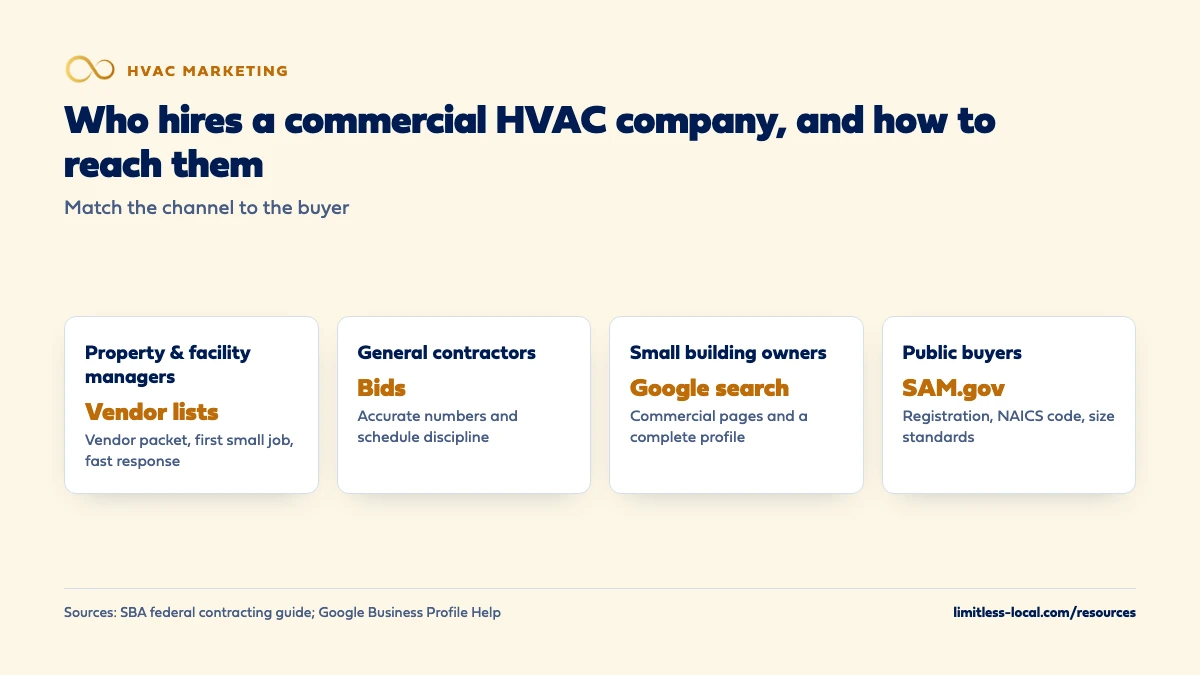
Who actually hires a commercial HVAC company?
Map the buyers in your area before spending anything. The usual list:
- Property managers for office, retail and multifamily buildings.
- Facility managers at schools, clinics, warehouses, plants and campuses.
- Building owners of smaller properties who manage their own.
- General contractors and builders who need a mechanical sub for new construction and tenant build-outs.
- Multi-location businesses, like restaurant groups and retailers, with a regional facilities contact.
- Public buyers: city, county, school district and federal facilities.
Each group buys differently. A general contractor wants accurate bids and schedule discipline; a property manager wants fast response and clean paperwork; a public buyer wants registrations and a bid that follows its rules to the letter. Pick the two or three that fit your crews and equipment, and build the plan around them.
Step 1: What should a commercial HVAC website show?
Enough that a facility manager can shortlist you without a phone call. In our judgement that means:
- Separate commercial pages, not a line on the residential homepage. A page for service and maintenance, one for replacement and installation, and one for emergency service.
- The equipment and building types you handle: rooftop units, split systems, chillers, boilers, controls; offices, retail, restaurants, schools, light industrial. Only list what your crews actually do.
- Your service area and response times in plain words, including after-hours coverage if you offer it.
- Proof: building types you’ve served, short project write-ups with the client’s permission, and the licenses and insurance a vendor packet will ask for.
- An easy first step, like a request for a site walkthrough or a quote on a service agreement, with a form that asks for the building count and equipment.
Commercial buyers often check you out between meetings, on a phone. Put the phone number and the request form where they can find them in one tap.
Step 2: Does Google still matter for commercial HVAC?
Yes, for the calls that don’t come through a contract: a unit down at a restaurant on a Friday night, a new facility manager who doesn’t have a vendor yet, a small building owner searching for “commercial HVAC repair” and a town. Those buyers use the same Google Maps and search results homeowners do.
The same rules apply. Google says local results are mainly based on relevance, distance and popularity, that complete and accurate profiles are more likely to show up, and that there’s no way to pay for a better local ranking (Google Business Profile Help). Make sure your profile’s description, services and photos show commercial work, and ask commercial customers for reviews just as you would homeowners. Optimizing your Google Business Profile covers the profile itself.
Paid search can work for emergency and replacement terms too, but in our judgement keep it narrow: commercial terms in the towns you serve, and a landing page for commercial work, so the budget doesn’t go to homeowners looking for a furnace tune-up.
Step 3: How do I sell commercial service agreements?
Start with a site walkthrough. ServiceTitan describes service agreements as typically sold from the office, using equipment details technicians capture during site walkthroughs, with pricing based on the location, equipment types and quantities (ServiceTitan Help). It also notes agreements can spell out services, locations, equipment and service-level agreements, and can be billed after each visit.
In our judgement the sales sequence that fits most commercial HVAC companies looks like this:
- Offer a no-charge walkthrough and equipment inventory for one building.
- Send a written proposal that lists every unit, the visit schedule, response times and pricing.
- Do the first maintenance visits well, and send a short report after each one: what you checked, what you found, what you’d recommend.
- Use those reports to propose the next building in the manager’s portfolio.
- Put renewal dates in your calendar months ahead, not the week the agreement ends.
The report after each visit is marketing. It’s what the facility manager forwards to the owner when the budget comes up.
Curious what your marketing is actually booking?
Get a free visibility audit — no obligation, no sales pitch.
Step 4: How do I get on a property manager's vendor list?
Make it easy to say yes. Property management companies usually have an approval process for vendors, and the paperwork is the first test. In our judgement, have a vendor packet ready before you reach out:
- Your W-9, certificate of insurance and license numbers.
- The equipment and building types you service, and your service area.
- Response-time commitments for emergency and routine calls, and how after-hours calls are handled.
- Two or three references from commercial customers who’ve agreed to take a call.
- One contact for scheduling and one for billing.
Then ask for a small first job. A single repair or a seasonal maintenance visit done on time, with clean paperwork and a clear invoice, is how most vendor relationships start. Speed on that first job counts as much as it does with homeowners; how fast to respond to new leads covers the response side.
Step 5: Should a commercial HVAC company do direct outreach?
Yes, more than a residential shop would. Commercial buyers are a short, knowable list in most markets, so reaching them directly makes sense: a short email or call to facility and property managers, a visit with your vendor packet, a presence at local property management and building owner association meetings.
If you use email, the rules apply to business buyers too. The FTC says the CAN-SPAM Act covers all commercial messages and makes no exception for business-to-business email (FTC). Every marketing email needs an honest subject line, your physical address and a working way to opt out, and opt-outs have to be honored. Setting up email marketing for HVAC covers the requirements in more detail.
Keep outreach about the buyer’s problems, not your history: response times, preventive maintenance that cuts emergency calls, and reports they can hand to ownership.
Step 6: Is government work worth pursuing for a commercial HVAC company?
It can be, but go in with clear eyes. The SBA’s requirements to compete for federal contracts include registering in the System for Award Management (SAM.gov), which gives you a Unique Entity Identifier, matching your services to a NAICS code, and, for contracts reserved for small businesses, meeting the size standard SBA assigns to that code (SBA). SBA describes your SAM profile as being like a résumé that contracting officials search.
SBA is also candid about the cost. It says it can take a long time and a significant amount of money to win a first government contract, that some businesses spend between $80,000 and $130,000 to earn their first one, and that it could take up to two years to start making a return. It suggests keeping a diverse list of private-sector clients to offset that.
Where to look: SBA says agencies must use SAM.gov to advertise contracts over $25,000, and that, with few exceptions, contracts under $150,000 are automatically set aside for small businesses when at least two small businesses could do the work (SBA). Subcontracting to a larger prime contractor is another way in. State, county and school district work has its own registration and bid process, so check with each buyer.
Step 7: Can energy benchmarking help me win commercial customers?
It gives you a useful conversation to start. ENERGY STAR describes its Portfolio Manager tool as the industry standard for benchmarking commercial buildings, and says nearly 25% of U.S. commercial building space is already benchmarking in it (ENERGY STAR). Many buildings get a 1-100 ENERGY STAR score, where 50 is the median, and buildings scoring 75 or higher may be eligible for certification.
ENERGY STAR also says benchmarking can show when a building uses a lot more energy than similar buildings, which is exactly when a facility manager starts asking about HVAC upgrades. In our judgement, a commercial HVAC company that can talk through a building’s score and what the heating and cooling systems have to do with it sounds like a partner, not a vendor. Some cities also have their own benchmarking rules; check what applies where you work before mentioning them.
How do I measure commercial HVAC marketing?
Not by cost per lead. A single commercial lead can be worth more than a month of residential calls, and the sale can take months. In our judgement the numbers worth tracking are:
- New accounts and where each came from: referral, outreach, search, a general contractor.
- Agreements signed and renewed, and the annual value of each.
- Pull-through work: repairs and replacements from agreement customers.
- Proposals out and their status, so a long sales cycle doesn’t hide a stalled pipeline.
Tag the source on every commercial job in your field software, the same way you would for residential. Tracking whether your marketing is paying off covers the setup.
What can a marketing agency do for a commercial HVAC company?
Less than for a residential shop, and an honest agency will say so. The parts an agency can handle well, in our view: a website with real commercial pages, a Google profile and listings that show commercial work, search ads for emergency and replacement terms, call tracking, and reporting that ties calls to jobs.
The parts that usually stay with your team: walkthroughs, proposals, bids, vendor packets, relationships with property managers, and the quality of the work that earns renewals. If an agency promises to deliver commercial contracts, ask exactly how. Knowing whether your agency is getting results covers what a fair report looks like.
Not sure which of these is costing you jobs?
A free visibility audit checks the Google profile, reviews, site and tracking, and shows what to fix first.
What's different for commercial HVAC companies
Downtime has a dollar cost. A failed rooftop unit at a restaurant or a clinic costs the business money every hour, so response time sells more than price. Say what your response times are, and meet them.
Seasons hit differently. Commercial preventive maintenance can be scheduled through the shoulder seasons, which is one reason service agreements help smooth out a residential company’s slow months.
Residential and commercial need separate messages. A homeowner and a facility manager want different proof, different offers and different pages. If you do both, keep them apart on your site and in your ads so neither audience has to dig.
A worked example: why cost per lead misleads in commercial HVAC
These numbers are made up to show the math, not a benchmark. Say one website request comes in from a property manager with 5 small office buildings. After a walkthrough, you sign a maintenance agreement worth $2,400 a year per building.
- Agreement value: 5 × $2,400 = $12,000 a year.
- If the account renews twice, that’s 3 × $12,000 = $36,000, before any repair or replacement work.
On a lead report, that’s one lead. A month with one lead looks terrible next to a month with forty residential calls, and it may be worth more. That’s why commercial HVAC marketing should be judged by accounts, agreement value and renewals.
For context, our Essentials package is $3,500 a month and covers the getting-found side: Google Business Profile management, a content sprint of up to 10 pages, Google Ads management and call tracking, with ad spend paid to Google separately. Whether that’s worth it for a commercial shop is what a free visibility audit is for.
Frequently asked questions
Should a commercial HVAC company run Local Services Ads?
In our judgement they’re built around home service jobs, so they’re a better fit for the residential side of a mixed company. For commercial work, narrow search ads on commercial repair and replacement terms are usually the closer match.
Can I market residential and commercial HVAC under one name?
Yes, many companies do. Keep separate pages, offers and ad campaigns for each, so a facility manager doesn’t land on a furnace tune-up coupon.
Do commercial customers leave Google reviews?
Some will if you ask, and the same rule applies as with homeowners: ask everyone, and don’t offer anything in exchange. A written reference a facility manager agrees to share is often worth more to the next commercial buyer.
How long does a commercial HVAC sale take?
It varies with the job. A repair can book the same day; a service agreement may take a walkthrough and a proposal; a replacement can wait for a budget cycle. Track proposals by stage so you can see where they stall.
What is a NAICS code and do I need one?
It’s the federal industry classification for what your business does. SBA says you need to match your services to one to compete for federal contracts, and size standards are set by code.
Does CAN-SPAM apply to emails I send facility managers?
Yes. The FTC says the law covers all commercial email and makes no exception for business-to-business messages.
Key takeaways
- Market to the people who control buildings: property and facility managers, owners and general contractors.
- Service agreements, sold after a site walkthrough, turn one job into years of work.
- Google still matters for emergency and replacement calls, so show commercial work clearly online.
- Government work requires SAM.gov registration and patience; SBA says it could take up to two years to start making a return.
- Judge commercial marketing by accounts, agreement value and renewals, not cost per lead.
Want a second set of eyes on your setup?
We'll look at how you show up locally and where calls are leaking, then send you a plain-English breakdown.
More in this section
- How do I market a second HVAC location?
- Which HVAC services should I advertise first?
- How do I market my HVAC company in a new city where nobody knows us?
- What's the simplest marketing setup for a small HVAC company?
- What are the biggest marketing mistakes HVAC companies make?
Sources
- Understand differences between memberships and service agreements — ServiceTitan Help
- Tips to improve your local ranking on Google — Google Business Profile Help
- Get started with contracting — U.S. Small Business Administration
- How to win contracts — U.S. Small Business Administration
- Benchmark Your Building With Portfolio Manager — ENERGY STAR
- CAN-SPAM Act: A Compliance Guide for Business — Federal Trade Commission