
What’s the simplest marketing setup for a small HVAC company?
- Is a website plus a Google Business Profile enough marketing for a small HVAC company to start?
- What does the simplest HVAC marketing setup include?
- Is a Google Business Profile and a website enough to start?
- What does a small HVAC company's website actually need?
- How do I get Google reviews without a fancy review program?
- Do I need call tracking at this stage?
- Who should answer the phone when the marketing starts working?
- What can a small HVAC company skip for now?
- When should a small HVAC company add Google Ads or Local Services Ads?
- How much time does the simple setup take each week?
- How do I know when the simple setup isn't enough anymore?
- What's different for small HVAC companies
- A worked example: what the simple setup has to earn back
- Frequently asked questions
- Key takeaways
- More in this section
- Sources
The short version
- Google Business Profile: verified, complete, with the services and areas you really cover.
- A plain website you own, with one page per main service and a phone number on every page.
- Ask every finished job for a Google review, using Google's own review link.
- Know where calls come from, and make sure a person answers and books them.
For owners of one- to five-truck HVAC shops who want the smallest marketing setup that actually brings in booked jobs, before spending on anything bigger.
Get a free visibility audit · Book a growth call
Is a website plus a Google Business Profile enough marketing for a small HVAC company to start?
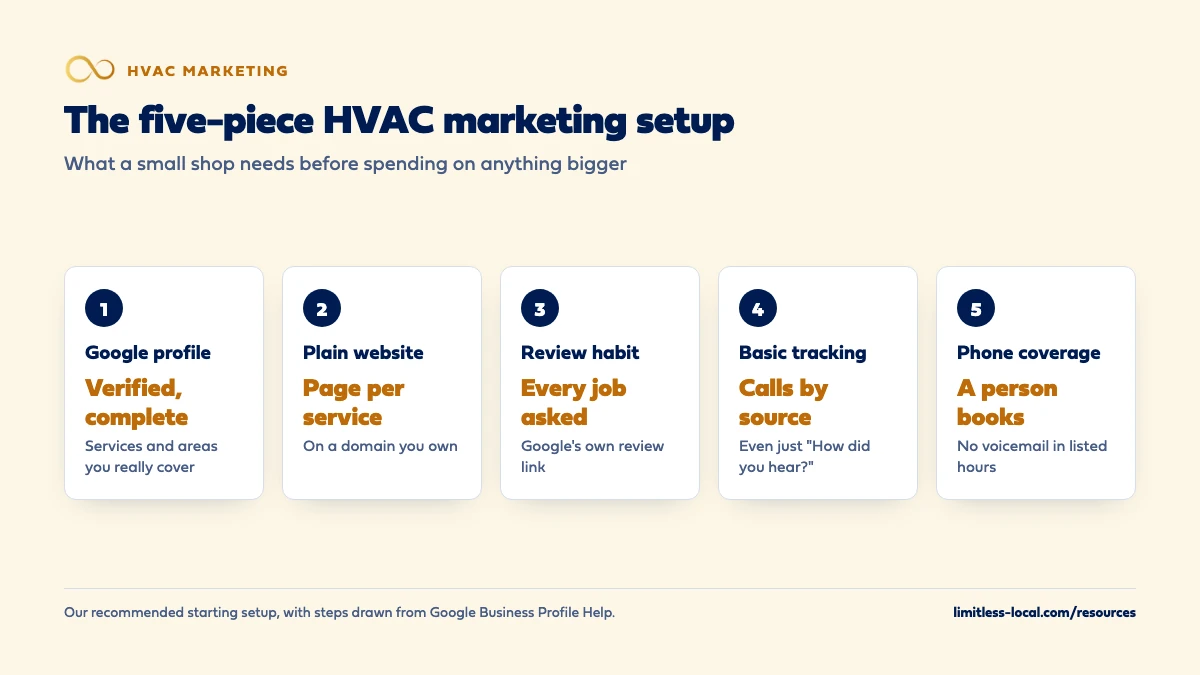
The simplest marketing setup that works for a small HVAC company has five pieces: a verified, complete Google Business Profile, a plain website with a page for each main service, a habit of asking every customer for a Google review, a simple way to see which calls came from where, and someone who answers the phone and books the job. A Google profile plus a website is enough to start, as long as the reviews and the phone coverage come with it. Add paid ads once that base is in place and you need more calls than it brings in.
That base is the first phase of how we work with HVAC companies too: tracking, follow-up and a clean online presence come before turning on more lead flow. If you’d rather have it built and run for you, our packages start with the listing cleanup, Google profile, service pages, reviews and call tracking, and the HVAC marketing page shows how it fits together. The HVAC marketing guide walks through every channel you might add later, and the rest of the HVAC marketing questions library goes question by question.
What does the simplest HVAC marketing setup include?
Five pieces, and nothing else until they’re working:
- A Google Business Profile, verified and filled out completely. It’s what shows up in Google Maps and the map results when someone searches “AC repair near me”.
- A plain website on a domain you own, with a page for each main service and your phone number on every page.
- A review habit: every finished job gets asked for a Google review.
- Basic tracking: enough to know whether a call came from Google, the website, a truck wrap or a referral.
- Phone coverage: a person answers new-customer calls and books them.
The first three are how homeowners find you and decide to call. The last two decide whether those calls turn into booked jobs and whether you can tell what’s working. Skip either half and the setup leaks: a great profile that sends calls to voicemail wastes the profile, and a busy phone you can’t trace gives you nothing to decide with.
Most of this costs time more than money. Google says it costs nothing to appear in its organic search results and that there’s no way to request or pay for a better local ranking (Tips to improve your local ranking), and its own guidance says a small local business can probably do much of its SEO work itself (Do you need an SEO?).
Is a Google Business Profile and a website enough to start?
For a small shop, yes, as long as reviews and phone coverage come with them. Between them they cover the two places most homeowners look before calling: the map results and your site.
The Google profile does the most work. Google says verified businesses are more likely to show up in search results, and businesses with complete and accurate information are more likely to show up in local results (Tips to improve your local ranking on Google). If you don’t have a storefront customers visit, set it up as a service-area business, which Google describes as one that visits customers directly without serving them at its address, like a plumber (Business Profile for service businesses overview).
The website backs it up. People who find your profile tap through to check you out, and the regular results under the map pack rank web pages, not profiles.
Setting up the profile properly takes an afternoon; optimizing your HVAC Google profile goes field by field through categories, services, hours, photos and service areas.
What does a small HVAC company's website actually need?
Less than most website pitches suggest. In our judgement, a small shop needs:
- A home page that says what you do, where you work and how to call, with the number tappable on a phone.
- One page per main service: AC repair, furnace or heating repair, system replacement, maintenance plans. A separate page gives Google something specific to match to each search.
- A service area section listing the towns your trucks actually go to.
- Proof: a few real reviews, photos of your crew and trucks, licensing and insurance.
- A contact page with a short form and your hours.
Own the domain yourself. The SBA notes that once you register a domain name, no one else can use it for as long as you keep renewing it (Marketing and sales), so register it in the business’s name, not your web designer’s.
The details of which pages to build and what goes on them are in what pages an HVAC website should have.
How do I get Google reviews without a fancy review program?
Ask every customer, every time, and make it one tap. Google suggests reminding customers to leave reviews by sending them a Google review link or a QR code from your Business Profile (Tips to get more reviews). For an HVAC shop, that means the invoice, the follow-up text after the job, and a card the tech leaves behind.
Reviews matter beyond looking good. Google says prominence, meaning how well-known a business is, is one of the main factors in local ranking, and that more reviews and positive ratings can help.
Two rules keep it safe:
- Never pay for reviews. Google strictly prohibits offering incentives such as discounts or free service in exchange for posting, changing or removing reviews.
- Reply, briefly. Google’s tips say to keep replies short, professional and specific, and for negative reviews to acknowledge mistakes and offer to sort it out privately.
The person most likely to get a review is the tech standing in the homeowner’s kitchen after the fix. Getting techs to ask for reviews covers how to make that a habit.
Curious what your marketing is actually booking?
Get a free visibility audit — no obligation, no sales pitch.
Do I need call tracking at this stage?
You need to know where calls come from, but it can start simple. Two levels:
- The simple version: ask every new caller “How did you hear about us?” and record the answer in your field software. Your Google profile’s performance report also counts calls, meaning taps on the call button (Understand your Business Profile performance). Google notes that this data includes interactions from both organic search and Google Ads, so if you run ads, those taps are mixed in.
- The better version: a call tracking number on each source. CallRail, for example, can put a tracking number on your Google Business Profile as the primary number while keeping your main business number listed as an additional number (Using CallRail with Google My Business).
Callers misremember where they found you, so the simple version is rough. It’s still far better than nothing, and it’s enough while you’re only working the unpaid channels. Once you spend money on ads, move to tracking numbers; tracking whether marketing pays off covers the full setup.
Who should answer the phone when the marketing starts working?
Someone who can book, during every hour you list on your Google profile. This is the piece small shops most often skip, and it can undo everything above: the profile and the reviews bring the call, and the call goes to voicemail while the owner is under a house.
At a one- or two-truck shop that might be a spouse, a part-time office person, or an answering service with clear instructions. What matters is that a new customer reaches a person who can take the details and offer a time, and that a missed call gets a callback fast.
Give whoever answers a short script with your required questions and a rule for emergencies. How to handle incoming calls lays out the call from greeting to booking.
What can a small HVAC company skip for now?
In our judgement, these can wait until the five pieces are working:
- A posting schedule on every social network. A Facebook page with your hours and number is fine. Daily posting rarely books jobs at this stage.
- A blog. Service pages come first. A blog is a later step for shops trying to rank for more searches.
- Listings on every directory. Get your name, address and phone right on Google and the few big directories first.
- Bought leads. Shared leads sent to several companies at once tend to make you race on price. Build the channels you control first.
- An expensive custom website. A clean, fast site with the right pages beats a showpiece that takes six months to launch.
None of these is wrong forever. They just do less for a small shop than the basics do, and they eat the time the basics need.
When should a small HVAC company add Google Ads or Local Services Ads?
When the base is in place and the schedule has holes the unpaid channels aren’t filling. Paid search can bring calls within days of launch; SEO, which includes the profile and website work above, typically takes 3 to 6 months to show meaningful organic growth. That gap is why many shops run ads while the unpaid channels ramp up.
The base comes first because paid channels lean on it. Local Services Ads rank partly on your rating, number of reviews and responsiveness (About ad rankings), and Google search ads send clicks to your website, so a thin profile or a weak site makes every paid lead cost more.
Which paid channel to start with, and on what budget, is its own question: whether to start with LSAs, Google Ads or SEO walks through the trade-offs.
How much time does the simple setup take each week?
After the first setup, not much. A routine that works for most small shops, in our experience:
- Every job: the tech or the office sends the review link.
- Every week: reply to new reviews, add a few new photos of real jobs, and check the profile’s hours are still right, especially before holidays.
- Every month: look at calls by source, the profile’s performance report, and how many of the calls booked.
- Every season: update the services you’re pushing, such as AC tune-ups in spring and furnace checks in fall.
The setup work at the start is bigger: the profile, the website and the tracking. That’s where a few days of focus, or outside help, pays off.
How do I know when the simple setup isn't enough anymore?
Look for these signs:
- The schedule has holes for weeks at a time, even with reviews coming in and the phone answered.
- Competitors with more reviews sit above you in the map results for the towns you care about most.
- You want specific jobs, such as more system replacements, that the general profile isn’t bringing in.
- You’re opening a second location or moving into a new town.
- You can’t keep up with it, and the reviews and replies have stopped.
Then the next step is usually more of what you have, done better and done consistently: more service and town pages, a steadier review flow, and paid search for the jobs you want most. The five pieces don’t go away; they’re what everything bigger is built on.
Not sure which of these is costing you jobs?
A free visibility audit checks the Google profile, reviews, site and tracking, and shows what to fix first.
What's different for small HVAC companies
Demand follows the weather. The first heat wave and the first cold snap bring a rush of calls. Get the profile, reviews and phone coverage in shape before the season, because none of it can be built in the week the no-cool calls start coming in nonstop.
Emergency calls come at night. If your profile says you offer emergency service, someone has to answer at night. If nobody will, set your hours honestly and let the website say how after-hours calls are handled.
Your trucks are marketing. A wrapped van with your number and website is seen in every driveway you work in. Track those calls too, with a separate number or the “How did you hear about us?” question, so you know what the wrap brings in.
Maintenance plans are the cheapest repeat business. A customer on a maintenance plan books twice a year without new marketing. Make the plan easy to find on the website and mention it on every service call.
A worked example: what the simple setup has to earn back
The job profit number here is made up to show the math, not a benchmark for your market. Say an average booked job leaves you $300 in gross profit after parts and labor.
- Doing it yourself: the profile work, review requests and tracking questions mostly take your time, since Google doesn’t sell better local rankings. A basic website is usually the main cash cost. Our themed website is $3,750, which is 13 jobs at $300 to pay back ($3,750 divided by $300 is twelve and a half).
- Having it run for you: our Essentials package is $3,500 a month and covers listing cleanup, Google profile management, up to 10 content pages, review responses and basic review generation, call and form tracking and Google Ads management. It needs about 12 of those jobs a month to cover the fee ($3,500 divided by $300 is just under twelve), and ad spend is paid to Google separately.
That’s why the honest answer for a lot of one- and two-truck shops is to do the simple setup themselves first. The math changes once replacement jobs are in the mix, or once the owner’s hours are worth more on the trucks than on the laptop.
Frequently asked questions
Can I skip the website and use only a Google Business Profile?
You can start that way, but in our judgement it’s a weak spot. Homeowners tap through to check you out, and the regular search results under the map pack rank web pages, not profiles.
Does a small HVAC company need social media?
A Facebook page with accurate hours, phone number and a few job photos is enough to start. A posting schedule can wait until the five basics are working.
Is it worth buying shared HVAC leads to fill the schedule?
They can fill a gap, but shared leads go to several companies at once, which tends to turn the call into a price race. In our view, build the channels you control first.
Do I need to pay Google to show up in Maps?
No. Google says there’s no way to request or pay for a better local ranking on Google.
Should my Google profile show my home address?
Not if customers don’t come to it. Google treats a business that visits customers but doesn’t serve them at its address as a service-area business, and the profile shows the areas you serve.
How long before the simple setup brings in calls?
Ads can bring calls within days, but organic growth from the profile and website work typically takes 3 to 6 months to become meaningful. Nobody can promise a date.
Key takeaways
- Start with five pieces: Google profile, a plain website, a review habit, basic tracking and phone coverage.
- A Google profile plus a website is enough to start if reviews and phone coverage come with them.
- Own your domain, keep the site plain, and give each main service its own page.
- Ask every job for a review with Google’s own link; never offer anything in exchange.
- Add paid ads once the base works and the schedule still has holes; SEO typically takes 3 to 6 months to show meaningful growth.
Want a second set of eyes on your setup?
We'll look at how you show up locally and where calls are leaking, then send you a plain-English breakdown.
More in this section
- How should a commercial HVAC company market itself?
- How do I set up email marketing for my HVAC company?
- How do I market a second HVAC location?
- What should I do with the marketing after buying an HVAC business?
- Which HVAC services should I advertise first?
Sources
- Tips to improve your local ranking on Google — Google Business Profile Help
- Business Profile for service businesses overview — Google Business Profile Help
- Tips to get more reviews — Google Business Profile Help
- About ad rankings — Google Local Services Help
- Understand your Business Profile performance & insights — Google Business Profile Help
- Do you need an SEO? — Google Search Central
- Using CallRail with Google My Business — CallRail Help Center
- Marketing and sales — U.S. Small Business Administration