
How much control over my brand do I lose hiring an HVAC agency?

- What do I actually hand over when an agency starts running my HVAC marketing?
- What should never leave my hands when I hire an agency?
- Who owns the logo, website design and photos I paid for?
- What does an agency actually control day to day?
- How do I keep my company sounding like my company?
- What should I approve, and what can run without me?
- What access should the agency get in my Google Ads account?
- What role should the agency have on my Google Business Profile?
- Should the agency reply to my Google reviews?
- Can an agency write reviews or testimonials for my company?
- Who should own the domain and website login?
- How do I tell if an agency is taking too much control?
- What's different about brand control for HVAC companies
- A worked example: what a month of approvals actually takes
- Frequently asked questions
- Key takeaways
- More in this section
- Sources
The short version
- Ownership never moves: accounts, domain, logo files and customer list stay in your company's name.
- The agency does the work; you set the rules it works inside.
- Approve anything new that speaks for you: prices, offers, guarantees, new pages.
- Routine work like ad tuning and scheduled posts can run without you.
For HVAC owners who want help with marketing but don’t want to wake up to a logo, an offer or a Google listing they never signed off on.
Get a free visibility audit · Book a growth call
What do I actually hand over when an agency starts running my HVAC marketing?
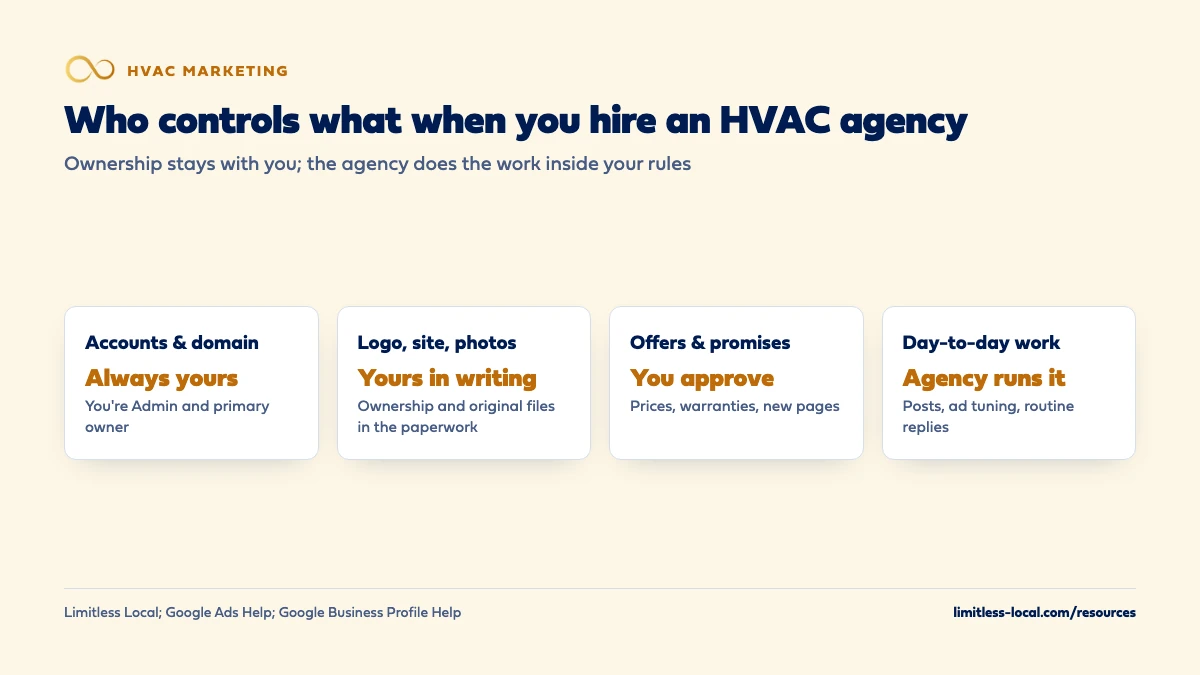
You shouldn’t lose any ownership, and you only lose as much day-to-day control as you choose to hand over. A good agency works inside accounts your company owns (your Google Business Profile, Google Ads, website, domain and call tracking) and follows your rules for the logo, colors, offers and how your company talks. What you hand over is the doing: writing posts, building pages, running and tuning ads. What you keep is the say: admin access to every account, written ownership of the site and creative you paid for, and sign-off on anything new that speaks for your company, like prices, offers and promises.
That split, where you own everything and the agency does the work, is how marketing should feel when it’s done right. What we promise is transparency: you’ll know what we’re doing, why, and what it produced, and if something isn’t working, we’ll tell you and fix it. Our HVAC marketing covers your Google profile, local SEO, Google Ads and tracking, all inside the accounts you own. For the wider picture, the HVAC marketing guide walks through every channel, and the HVAC marketing questions library takes the rest one question at a time.
What should never leave my hands when I hire an agency?
Ownership. Hiring an agency should change who does the work, not who owns the business’s marketing. These stay in your company’s name, with you holding the top level of access, no matter who you hire:
- Your Google Business Profile. You’re the primary owner; the agency gets added as a user.
- Your Google Ads account, with your card on file and your company as the account holder.
- Your domain name and website login.
- Your logo, brand files and job photos, in their original formats.
- Your customer list and the field software it lives in.
- Your call tracking numbers, or at least the right to take them with you.
Get those right and almost nothing an agency does can’t be undone. The contract side of this is covered in what to look for in an HVAC marketing agency contract. Day to day, the questions are who decides what, and how you keep your company sounding like your company.
Who owns the logo, website design and photos I paid for?
Don’t assume paying for it means you own it. Under federal copyright law, work an outside creator makes for you counts as a work made for hire (making your company the author and owner) only in narrow cases. The U.S. Copyright Office’s guide to works made for hire says a commissioned work has to fall into one of nine listed categories, and both sides have to sign a written agreement that expressly calls it a work made for hire. If it misses any of those requirements, it isn’t one.
The practical fix is simple. Put it in the paperwork that your company owns the logo, the website design, the copy and any photos or video made for you, and that you get the original files. For a logo, that means the editable vector file, not just a picture of it. For photos, the full-size originals. For the website, an admin login and a way to export or move the site.
Then keep your own copies. A shared folder your company controls, with the logo files, brand colors, fonts and your best job photos, means no agency ever holds your brand hostage.
What does an agency actually control day to day?
The doing. Once you’ve set the rules, a working agency typically handles:
- Scheduling and writing Google Business Profile posts.
- Building and editing service and town pages on your site.
- Writing ad text, testing new versions and adjusting bids and budgets within the limits you set.
- Replying to routine reviews, if you’ve asked them to.
- Setting up and maintaining call tracking and reports.
What it shouldn’t control, ever: your prices, your warranties, your service area, which jobs you take, your financing terms, and anything you promise homeowners. Those are business decisions. An agency can recommend changes, and a good one will, but the call is yours.
A simple test for any new piece of marketing: does it say something about your company that isn’t already approved? If yes, it waits for you. If it’s the same message in a new place, it can go.
How do I keep my company sounding like my company?
Write it down once. A one-page brand sheet saves more back-and-forth than anything else you can give an agency. Put on it:
- Your exact business name and how it’s written everywhere, plus the one phone number and address you want shown.
- The towns you actually serve and the ones you don’t.
- What you promise: same-day service, upfront pricing, financing, licensed techs, whatever is true and matters to you.
- What you never say: words you hate, claims you won’t make, competitors you don’t mention.
- How you sound: a few lines of how you’d explain a repair to a homeowner on their porch.
- Your logo files, colors and fonts.
Hand that to any agency on day one. It turns “make it sound like us” from a feeling into a checklist they can follow and you can check against. If your trucks are wrapped and your techs wear a uniform, add a few photos of those too, so the online look matches what homeowners see in the driveway.
What should I approve, and what can run without me?
Approve the things that speak for your company in a new way. Let the routine work run. A split that works for most HVAC shops:
- You approve: any new offer or price, any warranty language or promise to homeowners, new pages before they go live, a new ad message or landing page, and changes to your service area or business hours.
- You approve once, then it runs: templates for Google posts, review replies and follow-up emails. After you’ve signed off on the template, the agency fills it in without asking every time.
- Runs without you: bid and budget tuning inside your monthly cap, blocking junk searches, fixing broken links, routine reporting.
Agree on how fast you’ll reply, too. If an approval sits in your inbox for two weeks during peak season, the agency either waits (and the marketing stalls) or goes ahead without you (and you lose the say). A set day each week to clear approvals keeps both sides honest. For more on which marketing work to outsource and which to keep in-house, that page splits it task by task.
Curious what your marketing is actually booking?
Get a free visibility audit — no obligation, no sales pitch.
What access should the agency get in my Google Ads account?
Enough to do the work, while you stay in charge of who has access. Google Ads access levels run from Email-only and Billing up through Read-only and Standard to Admin. Standard users can edit campaigns. Only Admins can give or change account access, accept or unlink manager accounts, and add or remove product links.
For your account, that means:
- You keep Admin, logged in with your own company email, not a shared one.
- The agency gets the level its work needs. Many agencies manage through a manager account link; ask what they need and why.
- Add a second Admin you trust. If an account has only one administrator, you may lose access to your tags if that user becomes unavailable.
- Check the user list a few times a year and remove anyone who’s gone.
What role should the agency have on my Google Business Profile?
Manager, with you as the primary owner. On a Google Business Profile, owners and managers can do almost all of the same things: edit hours, services and photos, publish posts and respond to reviews. The difference is that managers can’t add or remove users or remove the profile. A profile can have several owners but only one primary owner, and the primary owner can’t remove themselves without first handing that role to someone else.
So the setup is simple: your company account is the primary owner, the agency is a manager, and you can remove them any time. When a user is removed, their replies to reviews and their posts stay on the profile, so routine work they did in your name doesn’t vanish when they go.
If an agency asks to be the primary owner “to make things easier,” say no. Getting more calls from your HVAC Google Business Profile covers what the work on it should look like.
Should the agency reply to my Google reviews?
It can handle the routine ones, and you should keep the hard ones. A thank-you on a five-star review for a quick AC repair is easy to hand off with an approved template. A one-star review about a missed appointment or a disputed bill is not. That reply speaks for you in public, and homeowners read it.
A rule that works: the agency replies to positive reviews within your template, and anything three stars or below comes to you (or your office manager) first with a suggested draft. You edit it, approve it, and it goes up.
How an HVAC company should reply to Google reviews has examples.

Can an agency write reviews or testimonials for my company?
No, and this is where handing over control can cost you more than a bad post. The FTC’s rule on consumer reviews and testimonials, in effect since October 2024, says advertising agencies, reputation management companies and review brokers are not immune: they could be liable if they write, create or sell a fake consumer review or testimonial. A business can also be liable if it wrote or created fake reviews, or bought reviews it knew or should have known were false.
So keep a firm line in your brand rules: every review and testimonial comes from a real customer, in their own words. The agency can help you ask for reviews, set up the review link and remind your techs. It shouldn’t write a single one.
If you want more reviews, the fix is in the field, not the office. Getting HVAC techs to ask for Google reviews shows how.
Who should own the domain and website login?
Your company, every time. The domain (your web address) should be registered in your company’s name with an email address you control, at a registrar where you have the login. ICANN, which oversees domain names, says in its FAQ on transferring domain names that moving a domain to another registrar takes an authorization code from your current registrar, and that the registrar must provide it within five calendar days of your request. That’s straightforward when the domain is in your name. It’s a headache when it’s in an agency’s account.
The same goes for the website. You should have your own admin login to the site and to the hosting account, even if you never use them. Ask for both before the site launches, not after something goes wrong.
How do I tell if an agency is taking too much control?
Some warning signs:
- They won’t give you Admin access to your own Google Ads account, or they built it under their name.
- They want to be the primary owner of your Google Business Profile.
- The domain or website is registered to them.
- Offers, prices or guarantees show up in your ads that you never approved.
- Your logo, colors or company name start changing “for consistency” without a conversation.
- Reports show activity but they can’t tell you which calls became booked jobs.
Any one of these is worth a direct question. A good agency will fix access issues the same day and explain anything you didn’t approve. One that pushes back on giving you access to your own accounts is telling you something. If it comes to leaving, switching HVAC marketing agencies without losing anything walks through the handover step by step.
Want to see where your company stands?
A free visibility audit shows where you show up on Google, Maps and AI answers, and what it's costing you in calls.
What's different about brand control for HVAC companies
Offers change with the weather. Tune-up specials, maintenance plan pricing and financing offers come and go by season. Each one is a promise to a homeowner, so each one needs your sign-off, and the agency needs to know when it ends so an expired offer doesn’t keep running in July.
Equipment brands have their own rules. If you’re a dealer for an equipment manufacturer, its program may have its own rules for how you use its name, logo and rebates. Add those to your brand sheet so the agency works inside them too.
Your techs are the brand. Homeowners meet your company in their driveway and their utility closet. Photos of your real trucks, uniforms and crew do more for an HVAC brand than any stock image, and they’re yours. Keep the originals in your own folder.
A worked example: what a month of approvals actually takes
This is a made-up month to show the workload, not a promise of what any plan produces. Say you’re on our Essentials package at $3,500 a month, which includes Google Business Profile management with 1 post a week, 2 blog posts a month and Google Ads management up to $2,500 a month in ad spend (paid to Google separately).
- Google posts: about 4 a month. You approved the post templates and your current offer once, so these run without you.
- Blog posts: 2 a month. You glance at the topics at the start of the month and flag anything that’s off.
- Ads: bid and budget tuning runs inside your cap. A new ad message for a spring tune-up offer comes to you once for sign-off.
- Reviews: routine thank-yous go out on the approved template; you see the few that need your judgment.
In a normal month, that’s a handful of decisions, not a second job. The ownership never moved: the profile, the ads account, the site and the files are still yours.
Frequently asked questions
Can an agency change my business name on Google?
A manager on your Google Business Profile can edit the name, category and website. That’s why your brand sheet should spell out the exact name, and why you should stay the primary owner so you can fix or remove access.
Should the agency use its own Google Ads account for my ads?
No. Have the agency work inside an account your company owns, with your billing and your Admin login, so the history and data stay with your business.
Can I still post on my Google profile myself after hiring an agency?
Yes. Owners and managers can both publish posts. Just let the agency know, so you’re not both posting the same offer the same week.
Who owns the ad copy and landing pages the agency writes?
Whoever the paperwork says. Ask for written ownership of anything made for your company, including ad text and landing pages, so you can keep using them if you leave.
Do I need to approve every Google Ads change?
No. Bid and budget tuning inside your monthly cap is routine. What you should approve is any new message, offer or landing page that speaks for your company.
What if I've already given an agency full control?
Start by checking who’s listed as primary owner on your Google profile and Admin on your Google Ads account, and who holds the domain. Ask for whatever is missing in writing, then add your own access before anything else changes.
Key takeaways
- Hiring an agency should move the work, never the ownership.
- Keep Admin on Google Ads, primary owner on your Google profile, and the domain in your company’s name.
- Get written ownership of the logo, site, copy and photos, plus the original files.
- Approve anything new that speaks for you; let routine tuning and scheduled posts run.
- Every review comes from a real customer. An agency should never write one.
Not sure what's working right now?
Start with a free visibility audit: rankings, Google profile, reviews and tracking, checked against your service area.
More in this section
- How do I switch HVAC marketing agencies without losing anything?
- How do I know if a marketing agency really understands HVAC?
- What should I look for in an HVAC marketing agency contract?
- Should I pay an HVAC agency fee or spend more on ads?
- Which HVAC marketing work should I outsource or keep in-house?
Sources
- About access levels in your Google Ads account — Google Ads Help
- Manage your Business Profile owners & managers — Google Business Profile Help
- Circular 30: Works Made for Hire — U.S. Copyright Office
- FAQs for Registrants: Transferring Your Domain Name — ICANN
- The Consumer Reviews and Testimonials Rule: Questions and Answers — Federal Trade Commission