
How do I know if a marketing agency really understands HVAC?

- How can I tell whether an agency has real HVAC experience before I hire it?
- What does it look like when an agency actually understands HVAC?
- Check 1: Do they plan around the seasons?
- Check 2: Do they know a service call from a replacement?
- Check 3: Do they ask about your phones and call handling?
- Check 4: Do they know your service area and local market?
- Check 5: Do they know what's changing on the HVAC platforms?
- Check 6: Can they show HVAC work you can check?
- Check 7: Do they talk about booked jobs or about clicks?
- What questions should I ask on the first call?
- What are the signs an agency is faking HVAC experience?
- Why HVAC experience matters more than in most trades
- A worked example: why an HVAC-savvy agency splits repair and replacement
- Frequently asked questions
- Key takeaways
- More in this section
- Sources
The short version
- It plans around the seasons, not one flat budget all year.
- It treats repair calls and replacements as different jobs.
- It asks about your phones, your service area and your software.
- It reports booked jobs and cost per job, not clicks.
For HVAC owners talking to marketing agencies who want to sort the ones that know heating and cooling from the ones running a generic home-services script.
Get a free visibility audit · Book a growth call
How can I tell whether an agency has real HVAC experience before I hire it?
A marketing agency really understands HVAC if it talks about your business in your terms before it pitches its own services: the summer and winter rushes and the slow months between them, the difference between a repair call and a system replacement, maintenance agreements, after-hours emergencies, and the towns your trucks actually cover. Ask it to show HVAC work you can check, explain how it would shift budget across the seasons, and report results in booked jobs and cost per job instead of clicks. If it can’t answer those without falling back on a generic contractor script, it doesn’t know the trade well enough yet.
That’s the bar we hold ourselves to. We’ve worked with heating and cooling contractors across residential, commercial and new construction, and our HVAC marketing is built around the realities on this page: seasonal swings, repair versus replacement, and judging everything by booked jobs. For the bigger picture of how HVAC marketing fits together, see the HVAC marketing guide, and the HVAC marketing questions library covers the rest one question at a time.
What does it look like when an agency actually understands HVAC?
You can usually tell within the first call. An agency that knows the trade asks about your business before it shows you a slide deck. It wants to know your split between service, replacement and maintenance work, how many techs and trucks you run, which towns you want more of, what your busy and slow months look like, and who answers the phone.
It also talks in your words. Booked jobs, not conversions. Replacement estimates, not “high-value leads.” Maintenance agreements, not “recurring revenue streams.” It knows names like ServiceTitan, Housecall Pro and Jobber, and asks which one you use because that’s where the booked-job data lives.
An agency that doesn’t know HVAC tends to do the opposite: it leads with its own services, uses the same pitch it gave a dentist last week, and can’t explain what would change in July versus October. The checks below turn that gut feel into questions you can ask. If you want a map of the work itself first, see what digital marketing for an HVAC company actually includes.
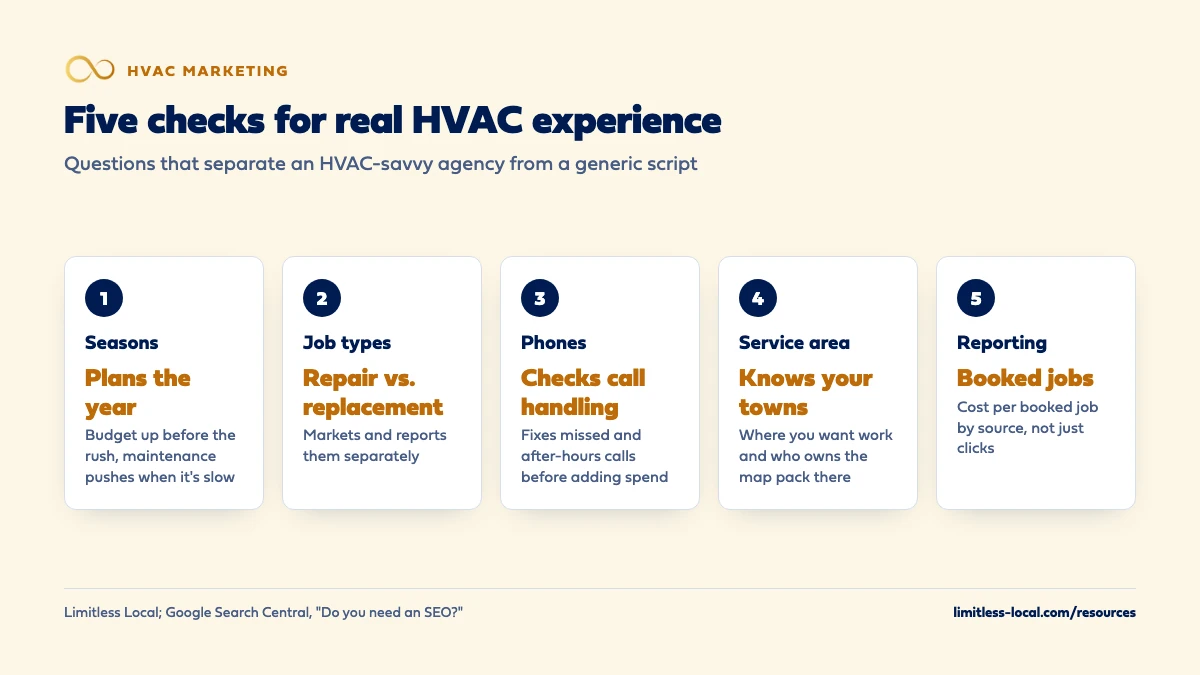
Check 1: Do they plan around the seasons?
Heating and cooling is seasonal in a way most trades aren’t. Ask any agency: “What happens to my budget and my ads before the first heat wave, and what happens in the shoulder months?”
A good answer covers raising budgets before peak demand instead of after the phones are already ringing, pushing tune-ups and maintenance plans when it’s quiet, and knowing that heating and cooling searches come from the same homeowners months apart. It should also know how the platforms handle it. Google says Smart Bidding already manages seasonal events, and that seasonality adjustments are meant for short events of a few days, like a promotion. An agency that wants to fight every weather swing by hand, or doesn’t plan for the seasons at all, is guessing.
A weak answer is one flat monthly plan with the same ads in January as in July.
Check 2: Do they know a service call from a replacement?
A no-cool repair call and a full-system replacement are different jobs with different buyers. One wants a fast answer tonight; the other wants reviews, financing options and an estimate, and might take weeks to decide.
An agency that gets HVAC will want to market and measure them separately: different ads or campaigns, different landing pages, and reports that show booked repair calls apart from sold replacements. If it lumps everything into one “lead” count, you’ll never know whether you’re paying replacement prices for diagnostic calls.
Ask: “How would you report repair calls versus replacement estimates?” How to market HVAC replacements differently from repairs covers what a good split looks like.
Check 3: Do they ask about your phones and call handling?
In HVAC, the marketing is only as good as the person picking up. An agency that understands the trade will ask who answers during the day, what happens after hours, and how fast web forms get a reply, before it spends a dollar on ads.
It matters in hard money, too. With Local Services Ads, Google can charge for a missed call during your business hours if the caller stays on the line more than 20 seconds. An agency that turns on ads without checking your call coverage is setting you up to pay for calls nobody answers.
Ask: “What would you want to fix on our phones before we spend more?” If the answer is “nothing, we just bring the leads,” that’s a sign. How an HVAC office should handle incoming calls shows what good looks like.
Curious what your marketing is actually booking?
Get a free visibility audit — no obligation, no sales pitch.
Check 4: Do they know your service area and local market?
Your market isn’t “HVAC in Texas.” It’s the towns your trucks can reach in a reasonable drive, the neighborhoods with older systems due for replacement, and the competitors who already own the map pack there.
Google’s own guide to hiring an SEO suggests asking about experience in your industry and in your city, and says a good SEO should ask what makes your business unique, who your competitors are and how your customers find you. That applies to any agency.
Listen for specifics. Do they ask where you want more work, not just where you can go? Do they mention checking who shows up in Maps for “AC repair” in your towns? Do they talk about the difference between a service area you’ll drive and one that just looks big on paper? Vague answers about “local SEO” without your towns in them mean they haven’t looked.
Check 5: Do they know what's changing on the HVAC platforms?
A good HVAC agency keeps up with the platforms that send you calls. One easy test right now: ask what’s happening to Local Services Ads.
The right answer is that Google is moving them into the main Google Ads platform, and that HVAC was named in the first phase of the move, which began in August 2026. Budgets become daily instead of weekly, manual bidding goes away, and old Local Services Ads reports don’t carry over, so they should be saved first. They should also know that Google Guaranteed is now the Google Verified badge.
You don’t need to know all of that yourself. You just need to notice whether the agency does, or whether it’s still pitching last year’s setup.
Check 6: Can they show HVAC work you can check?
Ask for examples of HVAC or close home-service work, and for what was done, not just the result. “We grew calls” means little. “We rebuilt the service pages, split repair and replacement ads, and fixed after-hours call routing” tells you they know the work.
Ask for a reference you can call, ideally another heating and cooling owner. Ask that owner two things: did the agency understand the business without a lot of hand-holding, and did the reports show booked jobs?
Watch out for results you can’t check, like a screenshot with no market, no timeframe and no cost attached. And never take a promised ranking as proof. No one can guarantee a spot at the top of Google.
Check 7: Do they talk about booked jobs or about clicks?
An HVAC owner cares about booked calls, sold replacements and what each one cost. An agency that understands that will talk about tracking calls to booked jobs in your field software, and will want to report cost per booked job by source.
An agency that leads with impressions, clicks, click-through rate and rankings is reporting activity. Those numbers can be useful to the people running the ads, but they don’t tell you whether the trucks are busy.
Ask to see a sample report. If it doesn’t show booked jobs or cost per job anywhere, ask how you’d get there. How to know if your HVAC marketing agency is getting results covers what the monthly report should show once you’ve hired someone.
What questions should I ask on the first call?
Keep these handy and take notes on how specific the answers are:
- What would you change about my marketing between July and October?
- How would you report repair calls versus replacement estimates?
- What would you check on our phones before spending more on ads?
- Which towns would you focus on first, and why?
- What’s changing with Local Services Ads for HVAC right now?
- Can I talk to another heating and cooling owner you’ve worked with?
- Will you connect your reporting to my field software to show booked jobs?
- Who owns the Google Ads account, website and Google profile if I leave?
You’re not grading the exact answer. You’re listening for whether they talk about your business or about their packages. For what the contract should say once you’ve picked one, see what to look for in an HVAC marketing agency contract.
What are the signs an agency is faking HVAC experience?
- Swapped-word samples. Their “HVAC” page reads like a roofing page with the trade changed. No mention of seasons, emergencies, tune-ups or replacements.
- No questions. They quote a price before asking about your service mix, towns or phones.
- Ranking promises. A promised top spot in Maps or Google is a red flag in any trade, because nobody controls where Google ranks you.
- Account grabs. They want to own your Google Ads account, website or Google profile. You should own those, and give them access. Google Ads lets you grant and remove a user’s access at any time.
- Lead-count talk only. Everything is about “more leads,” never about which ones booked.
None of these by itself means the agency is bad at marketing. Together they mean it doesn’t know your trade, and you’ll be the one teaching it. How to tell if an SEO offer for your HVAC company is a scam covers the more serious warning signs.
Not sure which of these is costing you jobs?
A free visibility audit checks the Google profile, reviews, site and tracking, and shows what to fix first.
Why HVAC experience matters more than in most trades
The calendar swings hard. Summer AC and winter heating seasons are slammed, and the shoulder months can be slow. An agency that plans the year flat will overspend when you can’t take more work and go quiet when you need calls most.
Emergencies happen at night. No-heat and no-cool calls don’t wait for business hours. An agency that knows HVAC treats after-hours coverage as part of the marketing, not a separate problem.
Residential, commercial and new construction are different markets. Commercial service contracts and new-construction bids aren’t sold the same way as a homeowner’s AC repair. Make sure the agency’s experience matches the work you want more of.
Maintenance agreements keep you alive in the slow months. Building recurring revenue means staying top of mind; without consistent marketing, customers forget to renew. Ask how the agency would keep those renewals coming.
A worked example: why an HVAC-savvy agency splits repair and replacement
These numbers are made up to show why the split matters, not a benchmark for your market. Say your repair leads cost $60 each and about 1 in 2 books, so each booked repair call costs $120. Your replacement leads cost $150 each and about 1 in 3 turns into a sold system, so each sold replacement costs $450.
An agency that lumps both together might report one average and tell you leads cost about $105. That number describes neither job. It hides that repair calls are cheap to book and replacements cost more but are worth far more per job.
An agency that understands HVAC reports them apart, and moves budget based on what each sold job is worth to you. That’s how our reporting is set up: call tracking with recording and transcription, source tagging, and a monthly report with a cost-per-lead breakdown, so you can take it all the way to cost per booked job.
Frequently asked questions
Should I only hire an agency that works with HVAC companies alone?
Not necessarily. An agency that works across home-service trades can know HVAC well. What matters is whether it can answer the HVAC-specific questions on this page, not whether HVAC is its only client type.
How many HVAC clients should an agency have?
There’s no magic number. A few HVAC examples you can actually check, with what was done and a reference you can call, tell you more than a big logo wall.
What access should I give an agency while I'm still deciding?
As little as possible. Read-only access to Search Console is plenty for an agency to look things over; hold back write access and ad-account admin rights until you’ve signed.
Is it a bad sign if the agency also works with plumbers and roofers?
No. Lots of the work overlaps. It’s only a problem if their HVAC pitch is a plumbing or roofing pitch with the trade swapped.
Can an agency that doesn't know HVAC still run good Google Ads?
It can run the mechanics, but without knowing seasons, emergencies and replacement sales it tends to spend money at the wrong times and on the wrong jobs.
Should I ask an agency for its own reviews?
Yes. Read what owners in trades like yours say about communication and reporting, and look at how the agency replies to critical reviews.
Key takeaways
- An agency that understands HVAC asks about your business before it pitches its services.
- Test it on seasons, repair versus replacement, phones, service area and reporting.
- Ask for HVAC work you can check and a reference you can call.
- Red flags: swapped-word samples, ranking promises and wanting to own your accounts.
- The right agency reports booked jobs and cost per job, not just clicks.
Want a second set of eyes on your setup?
We'll look at how you show up locally and where calls are leaking, then send you a plain-English breakdown.
More in this section
- How do I know if my HVAC marketing agency is getting results?
- What should I look for in an HVAC marketing agency contract?
- How do I switch HVAC marketing agencies without losing anything?
- How do I grow my HVAC company with marketing?
- How should a commercial HVAC company market itself?
Sources
- Do You Need an SEO? Tips for Hiring an SEO — Google Search Central
- About seasonality adjustments — Google Ads Help
- How leads work — Google Local Services Help
- Local Services Ads transition to Performance Max campaigns with pay-per-lead goals — Google Ads Help
- Manage access to your Google Ads account — Google Ads Help