
Should an HVAC company use missed call text back for lost calls?
- Is an automatic text after a missed call worth turning on for an HVAC shop?
- What does missed call text back actually do?
- When does an automatic text help an HVAC company most?
- Where does missed call text back fall short?
- What should the text say?
- Do I need to register before my business can send texts?
- How does text-back fit with Local Services Ads calls?
- Who should call back after the text goes out, and how fast?
- Should after-hours missed calls get a different text?
- Is text-back enough, or do I need an answering service too?
- How do I set up text-back without annoying callers?
- How do I know if missed call text back is working?
- What's different about missed calls for HVAC companies
- A worked example: what text-back can save in a busy month
- Frequently asked questions
- Key takeaways
- More in this section
- Sources
The short version
- Text-back sends an automatic text to a caller you missed, from your business number.
- It holds the lead; a fast callback from a real person is what books the job.
- It helps most on heat-wave days, during no-heat nights and when techs are on a roof.
- Register your number for business texting first, and keep the message about their call.
For HVAC owners who miss calls on busy days and after hours, and want to know whether an automatic text actually saves any of those jobs.
Get a free visibility audit · Book a growth call
Is an automatic text after a missed call worth turning on for an HVAC shop?
Yes, most HVAC companies should turn on missed call text back, as a backstop and not a fix. The moment a call goes unanswered, the caller gets a short text that says who you are and when you’ll call, which gives them a reason to wait instead of dialing the next company. It doesn’t book anything by itself, so it only pays off when a person calls back fast, and it does the most good on peak days and after hours.
Text-back buys you a few minutes. What turns those minutes into booked jobs is knowing every call, text and form came in, and following up on all of them. Every one of our HVAC marketing packages includes call tracking with recording and transcription and source tagging, so you can see which missed calls came back and booked. Our automation add-ons (CRM and lead tracking, AI website chat, after-hours answering and automated follow-up) plug into any tier. The HVAC lead generation guide covers where those calls come from, and the HVAC marketing questions library goes question by question.
What does missed call text back actually do?
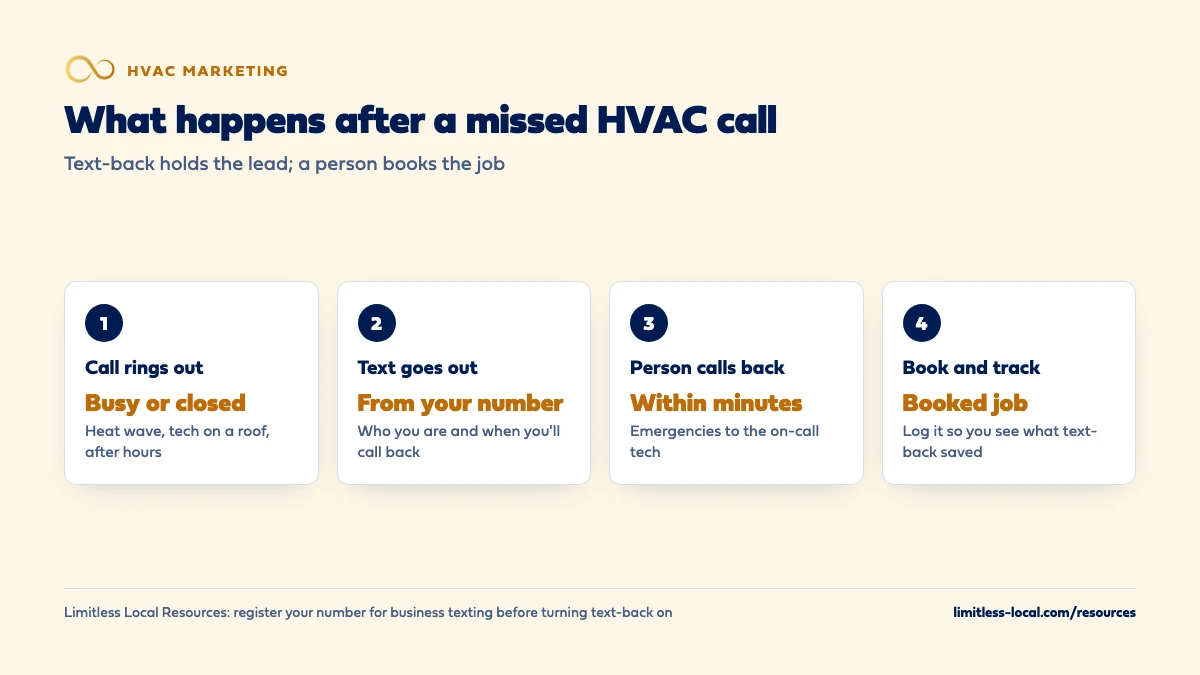
When a call to your business number rings out, the system sends the caller a text from that same number. The text is one you write ahead of time: who you are, that you saw their call, and when someone will call back. The homeowner, who was about to try the next company on the list, now has a reason to wait a few minutes.
It’s usually a setting, not a separate product. Call tracking tools and field-service software often have it built in. In CallRail’s automated response for missed calls, for example, you check a box, write the message, and pick a backup number in case the number someone called can’t send texts. Each auto-reply shows up in that customer’s timeline, so you can see who got one.
Know the gaps before you count on it:
- Landlines don’t get it. A caller on a landline, or any number that can’t receive texts, never sees your message.
- Quick hang-ups may not get it. CallRail classes a call as abandoned if the caller disconnects before 15 seconds, and abandoned calls don’t get the text.
- Toll-free numbers can’t text in CallRail, which is why the backup number matters.
- Some tools only text existing customers. Housecall Pro’s missed call automation, for example, texts your existing customers when you miss their call, which helps maintenance members but not a brand-new caller.
Check what your own tool does with new callers before you assume every missed call gets a text.
When does an automatic text help an HVAC company most?
Text-back earns its keep in the moments when nobody can pick up, which in HVAC are pretty predictable:
- The first heat wave and the first cold snap. Every line is busy, the office is on hold with suppliers, and calls stack up faster than anyone can answer them.
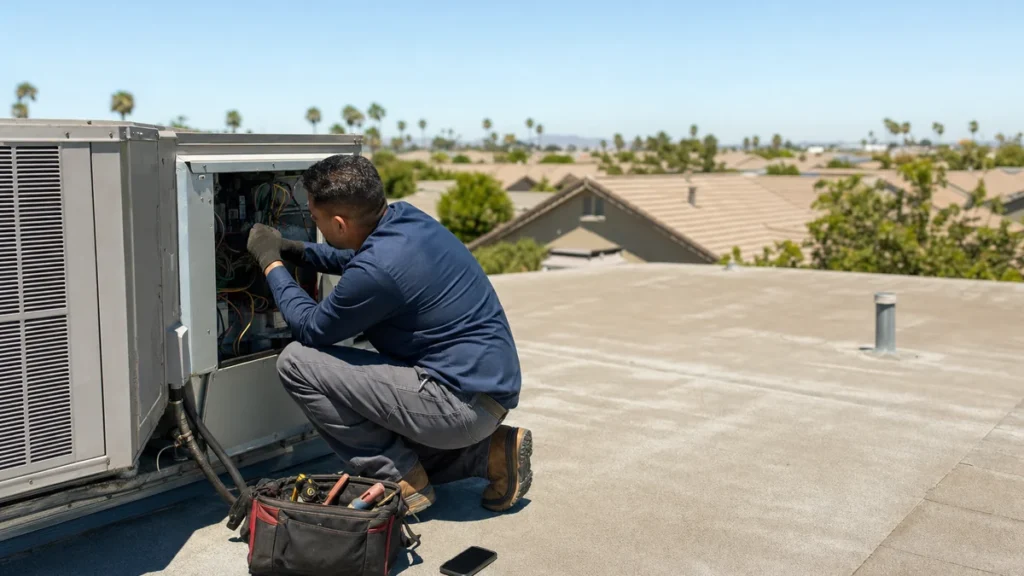
- One-truck and two-truck shops. When the owner is the tech, the phone rings while he’s in an attic or on a rooftop unit. A text tells the caller a human will get back to them.
- Lunch, shift change and the first hour of the morning. The small gaps where the office is empty for a few minutes.
- After hours. A homeowner with no heat at 9 p.m. wants to know whether anyone is coming. A text that says what happens next is far better than silence.
If you rarely miss calls because someone always answers live, text-back is a cheap safety net and not much more. If you miss a lot of calls, it’s a bandage over a staffing or routing problem, and how your office should handle incoming calls is the bigger fix.
Where does missed call text back fall short?
It’s a holding pattern, not a booking. Owners get disappointed when they expect more than that:
- Nobody calls back. A text that promises a callback “in a few minutes” followed by silence for three hours is worse than no text. You’ve told the homeowner you’re not on top of things.
- It can’t triage. A text can’t tell a gas smell from a tune-up request. Emergencies still need a person or an on-call tech.
- It can read like a robot. Generic wording with no company name looks like spam, and some people ignore it or report it.
- It doesn’t fix why you missed the call. If calls ring out because the office line has no rollover, text-back covers the symptom.
So turn it on, but don’t let it become the reason nobody fixes the phones.
What should the text say?
Short, from a real company, and about their call. Three parts do the job: your business name, when you’ll call back, and one easy question they can answer by text.
A daytime version:
“Hi, this is Smith Heating & Air. Sorry we missed your call, we’re with a customer. We’ll call you back shortly. What’s going on with your system? Reply here anytime.”
An after-hours version:
“Hi, this is Smith Heating & Air. Our office is closed, but we got your call. Reply with what’s happening and your address, and our first call in the morning will be to you. No heat or no cooling right now? Reply URGENT.”
Only promise what you’ll actually do. If “shortly” isn’t true on your busiest days, say “within the hour” or “first thing tomorrow” instead. And if you write URGENT into the text, someone has to be watching for it.
Leave out coupons and anything that reads like an ad. It’s a reply to someone who called you.
Do I need to register before my business can send texts?
In the US, yes, and it’s the step owners skip. Business texting from a regular local number runs under carrier rules known as 10DLC, managed by The Campaign Registry. CallRail requires you to register your business for text messaging compliance before you can use missed-call auto-replies, and says that if you don’t register or don’t follow the rules, you won’t be able to send texts at all.
Registration asks for your legal business name, address, tax ID and website, plus examples of the texts you’ll send. A typical registration can take 3 to 5 business days, so do it before peak season, not during it. If your website is thin or out of date, fix the business details on it first, because they’re used to check that you’re a real business.
The rules focus on consent and spam. A few points from CallRail’s 10DLC guidelines matter most here:
- Your first message should say who you are and how to opt out.
- Replies like STOP have to be honored.
- You can reply to someone who reached out to you, but promotional texts to anyone with no documented inquiry need written opt-in, such as a checked box on a form.
- If carriers get complaints, they can block your texts and suspend your texting.
That last point is why the text should stay about the missed call. Don’t quietly add every caller to a promo list.
Curious what your marketing is actually booking?
Get a free visibility audit — no obligation, no sales pitch.
How does text-back fit with Local Services Ads calls?
If you run Local Services Ads, a missed call can still cost you. Google’s rules for valid leads count a call you miss during your business hours as a charged lead once the customer stays on the line for more than 20 seconds. Google also says missed calls may hurt your responsiveness, which is one of the things it uses to rank your ads.
Text-back doesn’t change either of those. What it does is give you a better shot at turning a lead you’ve already paid for into a booked job. Google says follow-up calls or messages with the same customer within 15 days aren’t charged again, so the callback itself doesn’t cost you a second lead.
The bigger lesson for LSAs is to answer live during the hours your ads run. Whether LSAs are worth it for HVAC covers the rest of the math.
Who should call back after the text goes out, and how fast?
Decide this before you turn text-back on, or the texts just pile up. Pick one person per shift who owns missed calls: the CSR at a bigger shop, the office manager at a mid-size one, the owner at a one-truck operation.
- During business hours: call back within minutes, while the homeowner still remembers calling you. Start with anyone who replied to the text, then everyone who didn’t.
- After hours: route emergencies to whoever is on call. Everything else gets called first thing in the morning, before the trucks roll.
- No answer on the callback: reply in the same text thread so they can answer on their own time, then try again later that day.
Speed matters more than polish here. How fast an HVAC company should respond to new leads lays out a full follow-up sequence.
Should after-hours missed calls get a different text?
Yes. A daytime caller needs to hear you’ll call back soon. A night caller needs to know whether anyone is coming, and what to do if it can’t wait. Most tools let you set the message by business hours; Housecall Pro, for example, runs its missed call automation on business hours or a custom date range. Use the after-hours version above, and only offer an urgent option if someone is actually on call.
Holidays and storm days deserve a custom message too. If every tech is booked two days out during a heat wave, say so plainly. Homeowners take “we’re booked until Thursday morning” better than a promise that falls through.
Is text-back enough, or do I need an answering service too?
It depends on what kind of calls you’re missing.
- Text-back alone is usually enough for a small shop that misses a handful of daytime calls a week and doesn’t take night emergencies.
- An answering service or AI answering earns its place when a lot of your missed calls come after hours, or when no-heat and no-cool emergencies are a real part of your revenue. Those callers want a voice, not a text.
- A CRM or field-service system keeps the record of who called, who got texted, who you reached and what happened. Without it, text-back conversations get lost in someone’s phone.
Look at when your missed calls happen before you buy anything. The software an HVAC company needs to handle leads covers the CRM side.
How do I set up text-back without annoying callers?
- Register your number for business texting and wait for approval.
- Text from the number they called. A text from a strange number looks like spam; if that number can’t text, set a local backup that can.
- Write two messages, one for business hours and one for after hours.
- Leave out suppliers and your own techs if your tool lets you exclude numbers.
- Test it yourself. Call from a cell phone, let it ring out, and read the text the way a homeowner would.
- Send replies to a shared inbox the office watches, not a phone in a truck.
Check it again after any phone system change. A new call flow can quietly switch the auto-reply off.
How do I know if missed call text back is working?
Track five numbers each week:
- Missed calls.
- Texts sent.
- Replies to the text.
- Callbacks that reached the homeowner.
- Booked jobs from missed calls.
The last one is the number that matters. If texts go out but few people reply or book, look at the wording and how long callbacks take. If plenty of missed calls never get a text, look for landlines, quick hang-ups or a broken setting.
Keep missed calls in your booking rate, too. A missed call that got a text and never booked is still a lost job. What percentage of calls your HVAC office should be booking covers how to measure that.
Want to see where your company stands?
A free visibility audit shows where you show up on Google, Maps and AI answers, and what it's costing you in calls.
What's different about missed calls for HVAC companies
Missed calls come in waves. A plumber’s emergencies are spread through the year. HVAC calls spike in the first hot week and the first cold week, which is exactly when the office can’t keep up. Turn text-back on and test it before those weeks, not during them.
Emergency calls are heat and cold. A no-heat call from a family with a newborn, or a no-cool call from an elderly homeowner in July, can’t sit until morning. Your after-hours text should give them a way to reach the on-call tech, or tell them plainly that you can’t come tonight.
Replacement shoppers call several companies. Someone pricing a new system often calls three shops in a row. A fast text plus a callback within minutes keeps you in that comparison.
A worked example: what text-back can save in a busy month
These numbers are made up to show the math, not a benchmark for your market. Say your shop misses 50 calls in a hot July month.
- 40 of those callers get the text. The rest were landlines or hung up in a few seconds.
- 18 reply or pick up when you call back.
- 9 book a job.
If your average repair ticket is $400, those 9 jobs are $3,600 of work you’d likely have lost to the next company. That’s 9 of 50 missed calls, or 18%, recovered.
Now flip it. The other 41 missed calls still didn’t book. If the text works but most of those callers never reach a person, the money is in faster callbacks and fewer missed calls in the first place, not in a better text.
Frequently asked questions
Is missed call text back the same as an answering service?
No. Text-back sends one automatic text after a call rings out. An answering service, live or AI, actually picks up the call and can take details or route an emergency.
Can I send the text from my main business number?
Usually, if that number supports texting and is registered for business texting. If it can’t text (toll-free numbers can’t in CallRail), set a local backup number so the text still comes from your company.
Will text-back work for calls from landlines?
No. A landline can’t receive the text, so those callers need a callback like any other missed call.
Can I add people who got a missed-call text to my promotions list?
Not just because they called. Under carrier texting rules, promotional texts to people with no documented inquiry need written opt-in. Ask for permission separately, and keep the missed-call text about their call.
Should the text include a link to book online?
It can, if your online booking actually works on a phone and shows real openings. For most HVAC calls, a callback books more reliably than a link, because the homeowner wants to describe the problem.
Does text-back help with Google reviews or ranking?
Not directly. Its job is saving the call. Reviews come from finished jobs, and the bigger ranking issue for Local Services Ads is answering calls live.
Key takeaways
- Turn on missed call text back as a backstop; it holds the lead but doesn’t book it.
- The payoff comes from a fast callback by a real person, so name who owns missed calls on every shift.
- Run one message for business hours and another for after hours, and only promise what you’ll do.
- Register your number for business texting before peak season, and keep the text about their call.
- Track missed calls, texts sent, replies, callbacks and booked jobs every week.
Not sure what's working right now?
Start with a free visibility audit: rankings, Google profile, reviews and tracking, checked against your service area.
More in this section
- How should my HVAC office handle incoming calls from new customers?
- How should an HVAC company manage leads and customer follow-ups?
- How fast should an HVAC company respond to new leads?
- What should an HVAC website include to turn visitors into calls?
- How do I keep HVAC calls coming in during slow months?
Sources
- Automated responses for missed calls — CallRail Help Center
- Text Message Compliance (10DLC) regulations and guidelines — CallRail Help Center
- Text Messaging Compliance overview — CallRail Help Center
- Voice Settings Overview — Housecall Pro Help Center
- How leads work — Google Local Services Help
- About ad rankings — Google Local Services Help