
How many booked jobs a month before raising a restoration budget?

- When has a restoration company booked enough jobs to justify more marketing spend?
- Is there a set number of booked jobs before I raise my budget?
- How many booked jobs before my cost per job means anything?
- What should my cost per booked job look like before I spend more?
- Should I count booked jobs, finished jobs or paid jobs?
- How do I know budget is what's holding my ads back?
- Do my crews have room for more booked jobs?
- What about cash flow when the jobs are insurance-paid?
- How much should I raise the budget at a time?
- How long should I wait before judging a bigger budget?
- When should I raise even though the jobs aren't there yet?
- What's different about raising budgets for restoration companies
- A worked example: deciding whether to raise
- Frequently asked questions
- Key takeaways
- More in this section
- Sources
The short version
- No magic number: the trigger is trustworthy numbers, healthy margin and room on the crews.
- You need enough booked jobs that one more or one fewer barely moves your cost per job.
- Cost per booked job should sit well under your ceiling, not right at it.
- Check the ads are limited by budget, not by rank or by missed calls.
- Raise in steps, and judge each step by what the extra jobs cost.
For restoration owners whose marketing is starting to book jobs and who want a clear trigger for spending more, rather than a gut feeling.
Get a free visibility audit · Book a growth call
When has a restoration company booked enough jobs to justify more marketing spend?
There’s no fixed number of booked jobs. Raise a restoration marketing budget when you’ve booked enough jobs from a channel that one job more or less no longer swings your cost per booked job much, which for most companies means at least two or three months of tracked results. That cost should sit comfortably under the most you can afford to pay for a job, your crews need room for more work, and the channel has to show it’s held back by budget rather than by bids, ads or phones. When all of that is true, raise spend in steps and check what the extra jobs cost.
Reading those numbers every month is part of the job. Every Limitless Engine package includes monthly reports with a cost-per-lead breakdown, call tracking with recording, and a real-time dashboard, so the decision to raise spend rests on booked jobs, not on a feeling. Essentials manages up to $2,500 a month in Google Ads spend; Growth manages up to $5,000 and adds Local Services Ads; beyond that is a custom Scale plan. Ad spend is paid directly to Google, never bundled into the fee. See how it fits restoration companies, read the restoration marketing guide, or browse more restoration marketing questions.
Is there a set number of booked jobs before I raise my budget?
No, and anyone who gives you one is guessing about your market. A company booking five large water jobs a month off its ads might be ready to spend more, while a company booking thirty might not be, if every one of those thirty costs more than it earns or the crews are already turning work away.
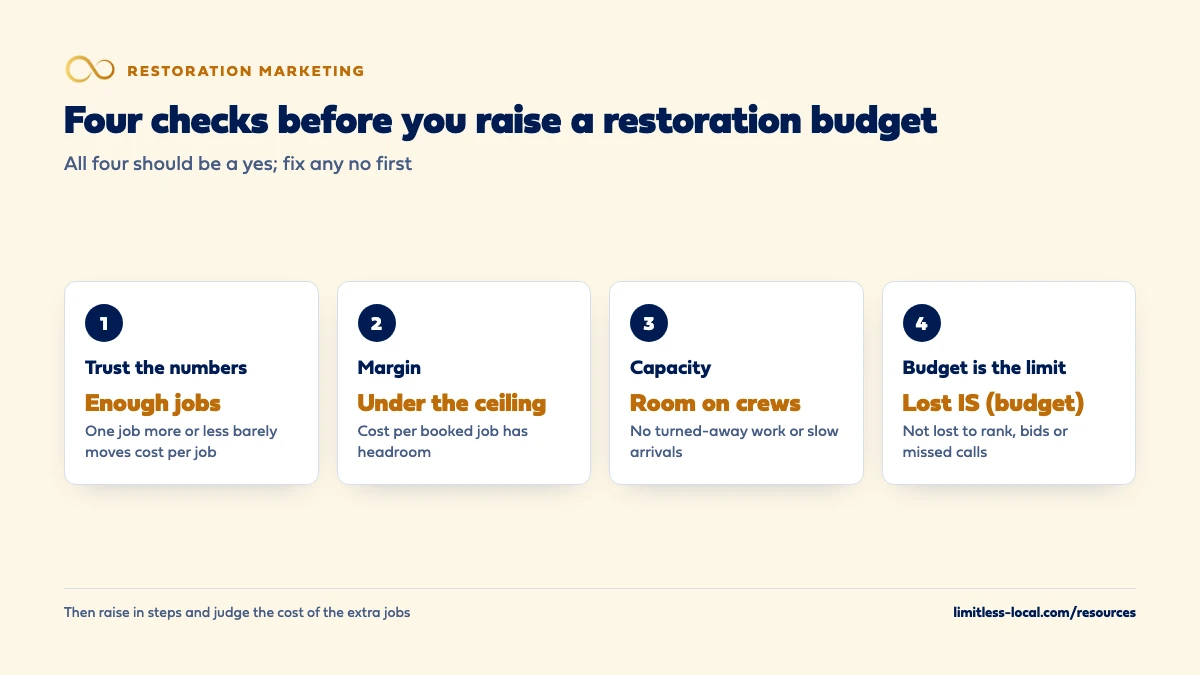
What you’re really asking is four smaller questions:
- Can I trust my numbers? Have enough jobs come through to know what a job really costs?
- Is there margin? Is that cost comfortably under the most I can pay for a job?
- Is there room on the crews? Can we take on more work without letting jobs slip?
- Is budget the limit? Would more money buy more of the same searches, or just pricier ones?
When all four answers are yes, raise. When any one is no, fix that one first. The rest of this page takes them one at a time. If you haven’t set a starting budget yet, what monthly marketing budget a restoration company needs covers the floor.
How many booked jobs before my cost per job means anything?
Enough that one job doesn’t change the answer much. A quick test: divide one by the number of booked jobs you’re averaging over. With 4 jobs, one more or one fewer moves your cost per job by about a quarter. With 20 jobs, it moves it by about a twentieth. A number that can jump a quarter on one job isn’t a number to bet a bigger budget on.
That’s why most restoration companies need two or three months of results before the cost per job settles, and longer for low-volume work like fire or mold. Add the months together instead of judging each one alone.
Watch for months that don’t represent normal business:
- a freeze or storm week that produced a burst of easy jobs;
- a month when the phones went unanswered for a few days;
- a large commercial loss that came from a referral, not from the ads.
Keep them in your records, but don’t let one unusual month be the reason you raise or cut.
What should my cost per booked job look like before I spend more?
Comfortably under your ceiling, the most you’re willing to pay to win a job of that type. Work it out from your own numbers: the gross profit on a typical job, and the share of it you’re willing to spend to get one. What a good cost per booked job is for a restoration company walks through setting it for water, mold, fire and sewage separately.
Headroom matters because extra spend rarely buys jobs at your current average. The first dollars in an account buy the best searches; the next dollars buy higher bids, towns further out and broader searches. So if today’s cost per booked job is already close to your ceiling, more budget will probably push the extra jobs over it.
A sensible rule: the further under your ceiling you are, the bigger the step you can afford to test. If you’re right at the line, spend time improving the booking rate, the landing pages or the negative keyword list before you spend more money.
Should I count booked jobs, finished jobs or paid jobs?
Count booked jobs for the decision, then check them against paid jobs as the money arrives. Booked jobs show up fast enough to steer a monthly budget. Paid jobs are the truth, but in restoration, insurance payments can take weeks or months, and you can’t wait that long to adjust spend.
Be strict about what counts as booked. A sensible definition is that the homeowner has authorized the work and a crew has been scheduled or sent. An inspection that didn’t lead anywhere, a quote that’s still open, or a job that cancelled before you started isn’t a booked job.
Two restoration quirks to decide on up front:
- Mitigation and rebuild. If a water job turns into reconstruction, decide whether you’re judging marketing on the mitigation alone or on both. Pick one and stick with it.
- Where the job came from. A job counts toward a channel only if you can trace it there. Referral and insurance-program work shouldn’t make your ads look better than they are.
Tracking which marketing brings in booked restoration jobs covers how to tag each job to its source.
Curious what your marketing is actually booking?
Get a free visibility audit — no obligation, no sales pitch.
How do I know budget is what's holding my ads back?
Google Ads tells you. Add the impression share columns to your campaigns, which Google’s help page on how to get impression share data describes:
- Search lost IS (budget) is the percentage of time your ads weren’t shown because the budget ran out.
- Search lost IS (rank) is the percentage of time they weren’t shown because of poor Ad Rank in the auction.
A meaningful share lost to budget, with good results on the searches you do get, is the clearest sign that more money can buy more of the same searches. A large share lost to rank and little to budget means the opposite: more money will mostly buy the same searches at higher prices, and the fix is the ads, the landing pages or the bids.
Google also marks campaigns as Limited by budget and may suggest a higher daily budget. Google says applying its recommendation will help increase clicks and impressions. Clicks and impressions aren’t booked jobs, so check the suggestion against your cost per booked job before you accept it.
Do my crews have room for more booked jobs?
More spend only pays if someone can do the work. Before raising, look at the last few busy weeks:
- Did you turn down or refer out work because nobody was free?
- Did jobs wait a day or more for a crew to arrive?
- Was drying equipment all out on jobs?
- Did calls go to voicemail because the person answering was also running jobs?
If the answer to any of those is yes, more leads will mostly become referrals to competitors, slower response, or homeowners who called someone else while they waited. That’s money spent to grow someone else’s business.
Work out how many new jobs your crews can start in a normal week, then compare it with what you’re booking. If there’s real room, raise. If not, hire or add equipment first, or keep the budget where it is and point it at the most profitable job types. How to avoid paying for more leads than your crews can handle shows how to set spend to match capacity.
What about cash flow when the jobs are insurance-paid?
A bigger budget means a bigger ad bill now and more jobs in progress, while insurance payments arrive later. A company can be booking more jobs, each profitable on paper, and still feel squeezed because the money for last month’s jobs hasn’t come in yet.
Before raising, look at how long your jobs actually take to get paid, and how much cash is tied up in jobs that are finished but unpaid. If that number is already uncomfortable, a bigger budget makes it bigger. Raising in small steps gives you time to see the effect on the bank balance before you commit to more.

How much should I raise the budget at a time?
In steps you can measure, not one big jump. A step that’s a modest share of what you spend now, held long enough to see booked jobs come through, tells you what the extra money buys. A doubling tells you much less, because you can’t separate the good extra jobs from the bad.
Keep Google’s budget rules in mind. Its page about average daily budgets says that, for most campaigns, you’ll never pay more than two times your average daily budget on a single day, or more than 30.4 times it in a month. To set a monthly figure, divide it by 30.4. On storm days, that daily flexibility helps you catch more calls.
Before each step, run a forecast. Performance Planner in Google Ads lets you see how changes to budget might affect clicks and conversions, using the last 7 to 10 days adjusted for seasonality. If the forecast barely moves as the budget rises, there isn’t much left to buy at a sensible price.
How long should I wait before judging a bigger budget?
Long enough for the extra spend to turn into booked jobs, and long enough to cover normal swings. For most restoration accounts, that means a few weeks per step at minimum, and longer if a storm, a freeze or a holiday lands in the middle of it.
Judge the step on what the extra money bought, not the overall average. If you spend more and book more, divide the extra spend by the extra jobs. That number, the cost of the extra jobs, is what decides whether to take the next step, hold, or go back.
If the extra jobs cost less than your ceiling, step again. If they cost more, go back to the last good level and put the effort into the booking rate instead. When a restoration company needs to spend $10k a month on ads covers what changes once the steps get big.
When should I raise even though the jobs aren't there yet?
A few situations justify spending ahead of the numbers:
- Before your busy season. If freezes or storm season reliably bring more searches, raise the budget ahead of the first event, not mid-week once calls are already being missed.
- A new town or service. A new channel or market needs enough spend to produce data at all. Treat it as a test with a set budget and end date.
- When the trouble is too little data. If your budget runs out by midday, you’re not seeing enough searches to judge anything, so a modest raise may be what produces the numbers you need.
In each case, write down what you expect the extra spend to produce and when you’ll judge it. That turns a guess into a test you can end.
Not sure which of these is costing you jobs?
A free visibility audit checks the Google profile, reviews, site and tracking, and shows what to fix first.
What's different about raising budgets for restoration companies
Weather swings the numbers. One freeze can double a month’s jobs and make a budget look like a winner. Compare like with like, and judge on several months, not one.
Jobs vary hugely in size. A single large water loss can be worth many small ones, so look at job value as well as job count when you decide whether ads are paying.
Money arrives late. Insurance-paid work means more jobs can mean tighter cash before it means more profit.
Not every job comes from marketing. Plumber referrals, property managers and insurance programs feed restoration companies too. Count only the jobs a channel actually brought in.
A worked example: deciding whether to raise
These numbers are made up to show the math, not a benchmark for your market. Say you’ve spent $4,000 a month on Google Ads for three months, $12,000 in total, and booked 7, 8 and 9 jobs from it: 24 in all. Your cost per booked job is $500, and with 24 jobs, one more or one fewer moves it by only about 4%. You can trust it.
Your ceiling for a water job is $1,200, so there’s plenty of headroom. Search lost IS (budget) is 30%, so the ads are missing searches because the money runs out. Crews have room for a few more jobs a month.
You raise the budget to $5,000 a month, a 25% step, which is an average daily budget of about $164. Over the next two months you spend $10,000 and book 19 jobs, or 9.5 a month instead of 8. The average is about $526 a job, but what matters is the extra: $1,000 more a month bought 1.5 more jobs, or about $667 each. That’s still well under your $1,200 ceiling, so you take another step.
Frequently asked questions
Should I raise my budget because Google says I'm limited by budget?
Not on that alone. Google’s recommendation is aimed at more clicks and impressions. Check your cost per booked job and crew capacity first.
Can I raise the budget for one service and not others?
Yes, and it’s often the smarter move. If water jobs book well and mold doesn’t, give water its own campaign and raise that budget only.
What if my cost per lead looks great but few leads book?
Don’t raise yet. The problem is between the lead and the job, usually call handling, response time or lead quality. More leads would multiply the leak.
Should I raise SEO spend by the same rule?
The idea is the same, but SEO works slower, so judge it over months rather than weeks, and on calls and jobs from organic search and Maps.
Is it a bad sign if the cost per job rises after I raise the budget?
Not by itself. Some rise is normal. The question is whether the extra jobs still cost less than your ceiling.
Should I lower the budget in slow months?
Often, yes. If searches drop and the cost per booked job climbs, scale back, then raise again ahead of the next busy stretch.
Key takeaways
- There’s no fixed number of booked jobs; the trigger is reliable numbers, margin, crew room and a budget-limited channel.
- Use the one-divided-by-jobs test: if one job swings your cost per job by a lot, you need more data.
- Keep cost per booked job well under your ceiling before you spend more.
- Check Search lost IS (budget) before assuming more money will buy more jobs.
- Raise in steps and judge each one by what the extra jobs cost.
- Watch cash flow; insurance-paid work pays late.
Want a second set of eyes on your setup?
We'll look at how you show up locally and where calls are leaking, then send you a plain-English breakdown.
More in this section
- What is a good cost per booked job for a restoration company?
- What lead-to-booked-job rate should a restoration company expect?
- What monthly marketing budget does a restoration company need?
- What is booked job tracking for a restoration company?
- Should a restoration company budget for content and reviews?
Sources
- Get impression share data — Google Ads Help
- Fix “Limited by budget” status — Google Ads Help
- About average daily budgets — Google Ads Help
- About Performance Planner — Google Ads Help