
Does my HVAC company need landing pages for Google Ads?
- Should HVAC Google Ads go to a landing page or the homepage?
- Isn't my homepage already a landing page?
- Can I send my HVAC Google Ads to my homepage?
- Does the landing page change what I pay per click?
- What does Google look at on the page an ad sends people to?
- Is my existing service page good enough, or do I need a separate ad page?
- How many landing pages does an HVAC company need for Google Ads?
- Can my ad landing page live on a separate website or domain?
- Will Google send my ad clicks to pages I didn't choose?
- How do I tell whether my landing page or my homepage is costing me calls?
- Do Local Services Ads need a landing page?
- What's different for HVAC companies
- A worked example: the same ad budget, two different pages
- Frequently asked questions
- Key takeaways
- More in this section
- Sources
The short version
- Every search ad already has a landing page; the question is whether it's the right page for that click.
- Google judges that page on relevance, usefulness, ease of navigation and how well it matches the ad.
- An existing service page counts if it matches the ad; build one page per job you advertise, not per keyword.
- Compare pages on calls and booked jobs per click, not on looks.
For HVAC owners running Google search ads who want to know whether the homepage is good enough or each ad needs a page of its own.
Get a free visibility audit · Book a growth call
Should HVAC Google Ads go to a landing page or the homepage?
Most HVAC companies running Google search ads should send each ad to a page about the exact job in the ad, not the homepage, because Google rates landing page experience on how relevant and useful the page is and whether it matches what people expected when they clicked. That page doesn’t have to be built only for ads: an existing service page works if it matches the ad, loads quickly on a phone and makes calling easy. A homepage is allowed, but it usually matches a specific repair search less well, which can cost you calls and can raise what you pay per click.
That’s how we set up HVAC ad campaigns too: each ad goes to a page about the job it advertises, and each page is judged by the booked jobs it produces. Google Ads management is part of our local ads work in our HVAC marketing packages, starting with Essentials, which includes a landing page. For how ads fit with every other way to get the phone ringing, see the guide to HVAC lead generation, and the rest of the HVAC marketing questions library goes question by question.
Isn't my homepage already a landing page?
Technically, yes. In Google Ads, the landing page is simply the page people reach after they click your ad. Google calls its address the final URL, and you set one for every ad you create (Final URL: Definition). If you typed your homepage address when you set up the campaign, your homepage is your landing page.
So the real question isn’t whether you have a landing page. It’s whether the page each ad sends people to is the best page for that click. A homeowner who searched for help with an AC that’s blowing warm air and tapped your ad wants a company that fixes that, today. Your homepage was built for everyone at once; an AC repair page was built for that one homeowner.
Can I send my HVAC Google Ads to my homepage?
You can, and plenty of HVAC companies do. The cost is in how well the page matches the search. Google’s guide to mobile landing pages makes the point with a retail example: an ad for one specific product should click through to that product’s page, not a general page or the homepage, which forces people to start their search over (Optimizing your mobile landing page).
On an HVAC homepage, starting over usually means scrolling past a photo slider, a menu with a dozen services and a coupon banner to find out whether you fix heat pumps. Some people call anyway. In our judgement, the ones on a phone in a hot house are the least patient, and they’re exactly the clicks repair ads are paying for.
A homepage is a reasonable landing page in two cases: you only offer and advertise one kind of job, or the ad runs on searches for your company name, where the person already knows who you are and may just want your number.
Does the landing page change what I pay per click?
It can. Google’s ad quality is an estimate of the experience people have when they see your ad and once they reach your landing page. Google says higher-quality ads typically cost less per click, and that with low-quality ads your actual cost per click may sit close to your maximum bid even when few others are bidding. Ad quality also affects whether your ad can show at all and where it appears on the page (About ad quality).
The page is one part of three. Google’s Quality Score, a one-to-ten diagnostic, combines expected clickthrough rate, ad relevance and landing page experience, each rated Above average, Average or Below average against other advertisers whose ads showed for the same search (About Quality Score). The full list of what sets your price is in what decides what you pay per click.
What does Google look at on the page an ad sends people to?
Google’s help article on landing page experience, which Google marks as applying to Google Ads, describes it as four things and names it one of the factors behind a keyword’s Quality Score (Landing page experience):
- Useful, relevant information. Does the page talk about the job in the ad, in the area the homeowner is in?
- Ease of navigation. Can someone find the phone number and the next step without hunting for it?
- The number of links on the page.
- What people expect from the ad they clicked. An ad that says same-day furnace repair sets up a promise the page has to keep.
Google doesn’t say how many links is too many. In our judgement, link count is one of the clearest differences between a homepage and an ad page: a homepage exists to send people everywhere on your site, while an ad page exists to get one call about one job.
Google also says information gathered by its crawlers may be used to assess ad quality (About Quality Score). The page has to be one Google can read, not only one a homeowner can.
Curious what your marketing is actually booking?
Get a free visibility audit — no obligation, no sales pitch.
Is my existing service page good enough, or do I need a separate ad page?
Often it’s good enough. An AC repair page that matches the ad, loads fast on a phone and puts the call button where a thumb can find it already does the job of a landing page. In our judgement, a page built only for ads earns its keep in four situations:
- You’re running an offer that isn’t on the site, like a tune-up special. The page has to show the offer the ad promised.
- The service page is written mainly to rank in search, with long sections, lots of internal links and the full menu. That helps SEO and slows down someone who wants a truck today.
- You want a separate tracking number for ad calls, so paid calls don’t blend in with calls from your Google Business Profile and organic results.
- You’re advertising a job you don’t have a page for yet, such as ductless mini-splits or commercial rooftop units.
If none of those apply, improve the service page you have instead of building a near-copy of it. The must-haves for any HVAC ad page, like a tap-to-call number at the top, your service area in plain words and real proof, are listed in what to fix before paying for ads.
How many landing pages does an HVAC company need for Google Ads?
One for each kind of job you advertise, not one per keyword. In our judgement, most HVAC companies start with two to five: AC repair, heating repair and system replacement, plus maintenance plans or heat pumps if you advertise them. Searches for AC repair near me, an air conditioner not cooling and AC repair in a named town all want the same thing, so they belong on the same AC repair page.
Let the pages follow how the campaign is built. If replacement keywords sit in their own ad group with their own ads, they get their own page, with options and financing instead of an arrival window. If you haven’t settled which jobs to advertise, start with which HVAC services to advertise first; the page list falls out of that. Why a replacement page has a different job from a repair page is covered in marketing replacements differently from repairs.
Can my ad landing page live on a separate website or domain?
Not on a different domain. Google’s policy is that your landing page and the web address shown in your ad must share the same domain, and you can’t use cross-domain redirects in your final URL (Final URL: Definition). A page made in a landing page builder needs to be published on your own domain, not on the builder’s address.
The page doesn’t have to appear in your site’s menu, though. In our judgement, keeping ad pages out of the main navigation is fine, as long as they are real pages on your site with your real business name, phone number and reviews.
Will Google send my ad clicks to pages I didn't choose?
In some campaign types, yes. In Performance Max campaigns, a setting called Final URL expansion is on by default. It lets Google replace your chosen final URL with a page from your site that it thinks fits the search better. Google warns this can sometimes send ads to unintended pages, and gives two controls: exclude URLs you don’t want used, or turn Final URL expansion off. For a campaign where one page is the only path to a conversion, Google’s own answer is to turn expansion off and set that page as the final URL (About Final URL expansion in Performance Max).
For an HVAC company, the pages worth excluding are the ones that can’t book a job: careers, the blog, a financing application, or a page about a service you’ve stopped offering.
How do I tell whether my landing page or my homepage is costing me calls?
Compare them on calls and booked jobs per click. Google gives you two places to start:
- The Landing pages report lists each page your ads send traffic to with its clicks. A Mobile-friendly click rate below 100% means the page didn’t pass Google’s mobile-friendly test every time (Evaluate the performance of your landing pages).
- The Landing Page Exp. column in the keywords view shows Above average, Average or Below average for each keyword, and Google says Average or Below average may point to room to improve. A dash means there aren’t enough exact searches yet to score it (About Quality Score).
Then use your own numbers. Plenty of clicks with few calls or forms points at the page. Plenty of calls with few booked jobs points at the phones or the follow-up, and no landing page will fix that; telling whether ads, website or follow-up is the problem walks through the check. If you test a new page against the old one, change only the page and give both enough clicks that one busy afternoon doesn’t decide it.
Do Local Services Ads need a landing page?
No. With Local Services Ads, the homeowner calls you, sends a message or requests a booking from the ad itself, and you pay for valid leads, not clicks (How leads work). What does the work there is your profile: reviews, job types, service area and how fast you answer. Whether Local Services Ads are worth it covers how those leads are ranked and charged.
Plenty of HVAC companies run both: Local Services Ads at the top of the page, and search ads with landing pages for the jobs they want more of, like system replacements.
Not sure which of these is costing you jobs?
A free visibility audit checks the Google profile, reviews, site and tracking, and shows what to fix first.
What's different for HVAC companies
Same page, new season. Keep your AC repair and heating repair pages live all year and change which campaigns run, rather than building a fresh page every season. In our judgement, a stable page address is easier to track month over month, and you update what’s on it, like the seasonal offer, instead of the ads that point to it.
Repair and replacement buyers want different pages. A no-cool caller wants a phone number, your service area and how soon you can come. A replacement buyer is comparing systems, financing and installers, and often fills in a form instead of calling. Sending both to one page shortchanges both.
Commercial work needs its own page. If you advertise commercial service, a property manager is looking for service agreements, response times and the kind of equipment you handle. Landing them on a page written for homeowners tells them you’re a residential shop.
A worked example: the same ad budget, two different pages
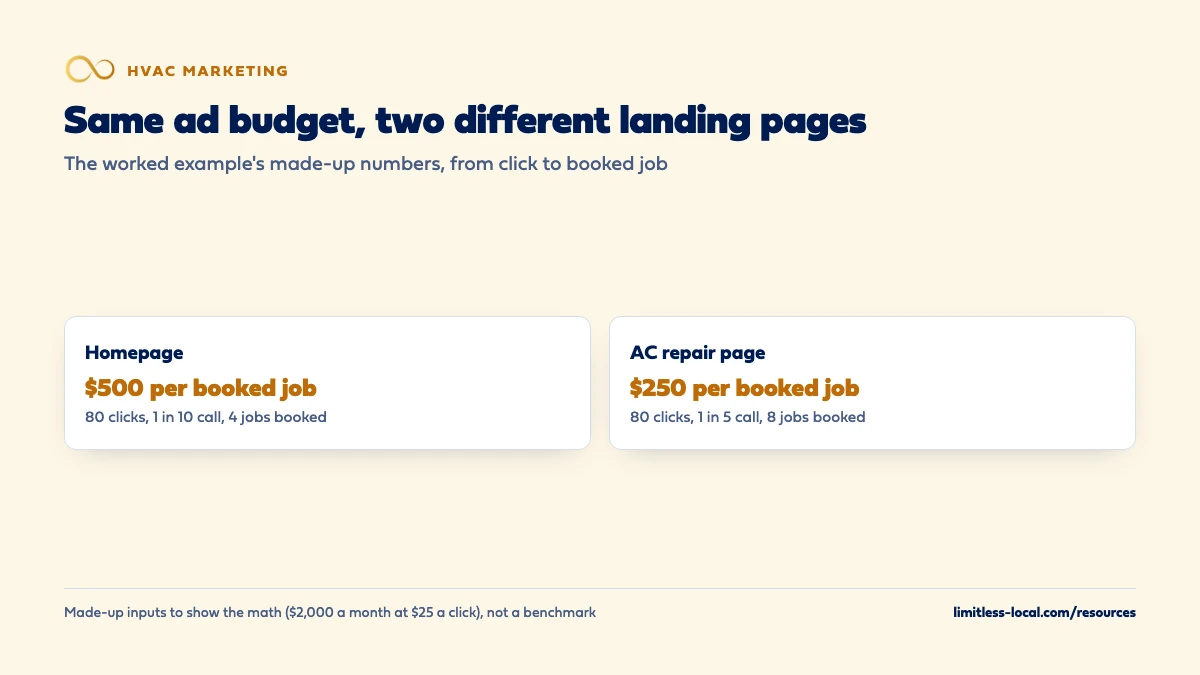
These numbers are made up to show the math, not a benchmark for your market. Say you spend $2,000 a month on AC repair ads and clicks cost $25, so the month buys 80 clicks. Sent to the homepage, 1 in 10 of those people calls: 8 calls. Your office books half of them, so you get 4 booked jobs, or $500 in ad spend per booked job.
Send the same 80 clicks to an AC repair page where 1 in 5 people calls, and you get 16 calls and 8 booked jobs: $250 per booked job from the same budget. If the better page also lifts your ad quality, clicks may get cheaper too, but that’s a bonus to measure afterward, not something to count on in the plan.
The page is the one part of that math that costs nothing extra at Google. For comparison, our Essentials package is $3,500 a month and includes Google Ads management for up to $2,500 a month in ad spend plus one landing page, with ad spend paid to Google separately. Running your own click, call and booking numbers through the same math is what a free visibility audit is for.
Frequently asked questions
Can the same page work for Google Ads and for SEO?
Usually, yes. A service page that matches the ad, loads fast and makes calling easy can serve both. In our judgement, you only need a separate ad page when the SEO version is long enough or busy enough to slow down someone who wants to call now.
Should my landing page still have a menu?
A simple one is fine. Google’s mobile landing page guide recommends easy, intuitive navigation and a way back to the main site (Google Ads). Put the job and the call button first, and keep the menu out of their way.
Should the landing page have a form or only a phone number?
Both. Google’s mobile guide notes that forms are inconvenient on a phone and can make visitors leave, so keep the form short. In our judgement, the form is for the homeowner who can’t talk right now, not a replacement for the call button.
How fast does an ad landing page need to load?
Fast enough that nobody waits. Google says prospects will wait only seconds for mobile pages to load before going elsewhere, and points to its free PageSpeed Insights tool for checking (Google Ads).
Do I need a separate landing page for every ad?
No. Ads in the same ad group about the same job can share one page. The page needs to match the job and the promise in each ad, not the exact wording of every headline.
Do sitelinks count as landing pages?
Yes. For Search campaigns, Google’s Landing pages report shows sitelink URLs alongside the main ad URLs (Google Ads Help). Point sitelinks at real pages that can book a job, such as maintenance plans or financing.
Key takeaways
- Every Google search ad has a landing page; what matters is whether it’s the right page for that click.
- Google rates landing page experience on relevance, usefulness, ease of navigation, link count and how well it matches the ad, and it feeds into ad quality.
- An existing service page can be your landing page if it matches the ad and works on a phone.
- Build one page per job type you advertise, and keep ad pages on your own domain.
- In Performance Max, check Final URL expansion so clicks don’t land on pages that can’t book a job.
- Judge pages by calls and booked jobs per click, not by design.
Want a second set of eyes on your setup?
We'll look at how you show up locally and where calls are leaking, then send you a plain-English breakdown.
More in this section
- Are Google Local Services Ads worth it for an HVAC company?
- Do Google Ads work for a brand-new HVAC company?
- Should my HVAC company start with LSAs, Google Ads or SEO?
- How much should an HVAC company spend on Google Ads?
- What pages should an HVAC company website have?
Sources
- Final URL: Definition — Google Ads Help
- Landing page experience — Search Ads 360 Help (applies to Google Ads)
- About Quality Score for Search campaigns — Google Ads Help
- About ad quality — Google Ads Help
- 5 things to consider when optimizing your mobile landing page — Google Ads (business.google.com)
- About Final URL expansion in Performance Max — Google Ads Help
- Evaluate the performance of your landing pages — Google Ads Help
- How leads work — Google Local Services Help