
How can an HVAC company get more leads?
- What's the best order to build HVAC lead sources?
- Where do HVAC leads actually come from?
- Step 1: Stop losing the leads you already get
- Step 2: Build your Google Business Profile and reviews
- Step 3: Give each main service its own page on your website
- Step 4: Add paid search when you need calls sooner
- Step 5: Get more repeat jobs and referrals from past customers
- Step 6: Add the extra channels last
- Which lead sources give me leads nobody else gets?
- How do I know which lead source to grow next?
- How fast will each lead source start bringing in calls?
- What's different about getting leads for an HVAC company
- A worked example: picking which lead source to grow
- Frequently asked questions
- Key takeaways
- More in this section
- Sources
The short version
- Fix missed calls and start tracking lead sources before you add anything.
- Build your Google profile and reviews, then a page for each main service.
- Use Local Services Ads or search ads for calls while SEO builds.
- Grow the source with the lowest cost per booked job, not the most leads.
For HVAC owners who want more calls and aren’t sure which lead source to build first, or what each one actually does.
Get a free visibility audit · Book a growth call
What's the best order to build HVAC lead sources?
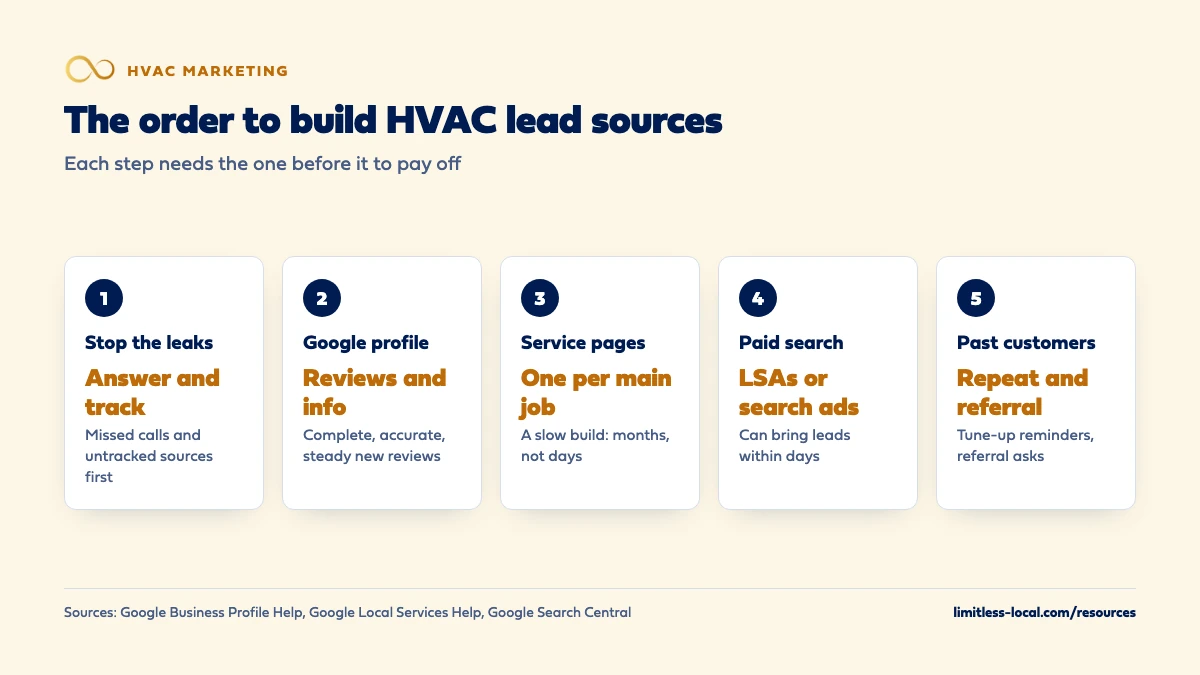
An HVAC company gets more leads by building the sources homeowners use when their system breaks, in order: first stop losing the calls you already get, then build a complete Google Business Profile with a steady flow of reviews, then give each main service its own page on your website. Paid search and Local Services Ads bring in calls sooner while that base grows, and past customers, maintenance plans and referrals add leads no competitor is bidding on. Add one source at a time and keep the ones that book jobs at a cost you can live with.
That order is how we build lead flow too: tracking, follow-up and a clean Google presence first, then local SEO and ads around the towns and jobs you want, then monthly tuning based on calls, leads and revenue. Google Ads management is part of every one of our HVAC marketing packages, and Local Services Ads management is added from the Growth package up; both sit in our local ads work. For the wider plan, see how to grow an HVAC company with marketing, the HVAC marketing guide and the HVAC lead generation guide, or browse the rest of the HVAC marketing questions library.
Where do HVAC leads actually come from?
Almost every HVAC lead starts in one of two places. The first is a homeowner who needs help now: the AC quit, the furnace won’t light, or a quote is due before summer. That person searches Google, looks at the map results and the ads at the top of the page, and calls someone within a few minutes. The second is a homeowner who isn’t searching yet: a past customer due for a tune-up, a neighbor who hears your name, or someone who sees your truck, a postcard or a Facebook ad.
The first group is where most urgent repair work comes from, and you compete for it on Google: the map pack, the regular results, Local Services Ads and search ads. The second group is smaller on any given day, but you’re often the only company in the conversation. A lead plan that works covers both, built in an order where each new source has something under it.
Step 1: Stop losing the leads you already get
Before you pay for one more lead, find out what happens to the ones you have. Call your own number at lunch and on a Saturday, and count how many calls rang out last month. A missed call from someone with no heat is usually a booked job for whoever answered next.
Then start recording where each customer came from. Job software can do most of this for you; Housecall Pro, for example, has a Lead Source field that tracks where customers found your business on customers, jobs and estimates, so you can see which sources bring good jobs. If you run Google Ads, call conversion tracking can show which ads and keywords lead to phone calls, and it can import calls you track in another system so only the calls that turned into sales count. How quickly your office gets back to people matters as much as where the lead came from, which is why how fast an HVAC company should respond to new leads is worth reading before you add anything new.
Step 2: Build your Google Business Profile and reviews
Your Google Business Profile is the listing that shows in Google Maps and the map pack, and in our judgement, for many HVAC companies it’s the biggest free source of calls. Google says local results are mainly based on relevance, distance, and popularity. You can’t change distance, but you can work on the other two. Google says businesses with complete and accurate information are more likely to show up in local search results, and that more reviews and positive ratings can help your local ranking.
In practice that means a verified profile, the right primary category, accurate hours, real photos of your trucks and crews, and a steady flow of new reviews. Google lets you create a review link or QR code to send customers, and it’s strict about one thing: offering incentives, like free or discounted services, in exchange for a review counts as fake and misleading content and is strictly prohibited. Have techs ask in person at the end of a good visit, then send the link the same day. Getting HVAC calls without paying for ads covers the profile, reviews and free listings step by step.
Step 3: Give each main service its own page on your website
The regular Google results below the map pack send leads to websites, not profiles. To show up there for “AC repair” or “heat pump installation” in your town, your site needs a page about each of those jobs, written for the homeowner who’s about to call. A single home page that lists every service in one paragraph gives Google and the homeowner very little to go on.
This is work you can start yourself. Google says that if you run a small local business, you can probably do much of the SEO work yourself, and it costs nothing to appear in Google’s organic results. Google also says advertising with Google won’t have any effect on your site’s presence in its search results, so paying for ads doesn’t help your organic rankings, and skipping them doesn’t hurt.
The page only produces a lead if the visitor can call easily once they land. What a service page needs for that, from the tap-to-call button to the trust signals, is covered in what an HVAC website should include to turn visitors into calls.
Curious what your marketing is actually booking?
Get a free visibility audit — no obligation, no sales pitch.
Step 4: Add paid search when you need calls sooner
Steps 2 and 3 take months to build. Paid search fills the gap, because ads can bring in leads within days of launch while SEO typically takes 3-6 months to show meaningful organic growth. For HVAC there are two main options on Google.
- Local Services Ads. You pay for valid leads instead of clicks: a call you answer, a missed call during business hours where the caller stays on the line more than 20 seconds, a message, a voicemail or a booking request. Google screens out spam and duplicate contacts before charging.
- Google search ads. You choose the searches, usually pay per click, and send people to a page on your site. They give you more control over which jobs you show up for, such as system replacements.
Both work best once your profile has reviews and your phones are answered, which is why they’re step 4 and not step 1. Which one to start with depends on your budget and your market; whether to start with LSAs, Google Ads or SEO walks through the trade-offs.
Step 5: Get more repeat jobs and referrals from past customers
The cheapest lead is a customer who already trusts you. HVAC has a built-in reason to stay in touch: systems need seasonal maintenance, and the tune-up visit is often where a tech spots the repair or the aging system that becomes the next job. A reminder before each season, a maintenance plan, and a simple way to book again all turn one service call into several.
Referrals work the same way when you make them easy. Some job software includes a referral program; Jobber’s, for example, lets clients earn a credit when a friend they refer books with you, and tracks how many jobs and how much revenue those referrals brought in. Ask at the moment the customer is happiest, usually when the system is running again, and track referrals as their own lead source so you can see what they’re worth.
Step 6: Add the extra channels last
Once the base is working, other channels can add leads at the edges:
- Facebook and Instagram remarketing to people who visited your site, mostly for planned work like tune-ups and replacements.
- Direct mail to past customers and the neighborhoods you already serve, with a tracked phone number on every piece.
- Shared lead services, where you pay for a homeowner request that other contractors may also receive.
None of these is wrong, but each depends on the earlier steps. Remarketing needs site visitors to remarket to. Mail needs a way to tell which calls it produced. Shared leads reward whoever calls back first, so they only pay off if your office already answers fast. If you’re paying for shared leads now, how to avoid wasting money on shared HVAC leads shows how to cap the spend and judge them fairly.

Which lead sources give me leads nobody else gets?
A lead you own is one where the homeowner chose to contact your business: a call from your Google profile, a form on your website, a past customer, a referral. A lead you share is one where a platform sends the same request to more than one company, and the job often goes to whoever reaches the homeowner first or quotes lowest.
Even on Google, competition shows up in the price. For Local Services Ads message leads, Google says the price is based on how likely the customer is to book your business, and one of the factors it lists is whether the customer has contacted other Local Services advertisers. In our judgement, the more of your leads come from your own name, your own reviews and your own customers, the less each booked job costs over time and the less you depend on any single platform.
How do I know which lead source to grow next?
Grow the source that books jobs at the lowest cost, not the one that produces the most leads. That means tracking each lead all the way to a booked, paid job, then dividing what the source cost (ad spend, fees, postage, staff time) by the number of jobs it booked. A source with half the leads and twice the close rate can be the better buy.
The tracking doesn’t have to be fancy. The U.S. Small Business Administration notes that tracking can be as simple as asking new customers where they learned about your business, and that print, direct mail, TV and radio ads can each carry a different code. It also suggests that if you’ve been in business a while, you focus on the efforts that have gotten the best results and phase out the ones that haven’t. If the words lead, call and booked job get blurred in your reports, the difference between a click, a lead and a booked HVAC job sorts them out.
How fast will each lead source start bringing in calls?
Each source runs on its own clock:
- Fixing missed calls: immediately. These are leads you already have.
- Paid search and Local Services Ads: ads can generate leads within days of launch.
- Google profile and reviews: builds week by week as reviews come in. Google gives no timeline for local ranking.
- Website service pages: SEO typically takes 3-6 months to show meaningful organic growth.
- Past customers and referrals: grows with every job you finish, and shows up most around each season’s first tune-up push.
That’s why the order matters. The fast sources keep the phone ringing this month, and the slow ones lower what a booked job costs next year. Nobody can honestly promise a number of leads from any of them, because results depend on your market, your competition and how your office handles the calls.
Not sure which of these is costing you jobs?
A free visibility audit checks the Google profile, reviews, site and tracking, and shows what to fix first.
What's different about getting leads for an HVAC company
Demand comes in waves. The first heat wave and the first cold snap can bring more calls in a week than a slow month. In our judgement, the sources that can be turned up quickly, like Local Services Ads and search ads, are the ones to have ready before those weeks, while the slow-building ones carry the shoulder seasons.
Emergency and planned work need different sources. A no-cool call is won on Google in minutes by whoever shows up and answers. A system replacement is often researched over days, and the homeowner may read reviews, compare quotes and come back. Remarketing, follow-up and your reviews do more for that second kind of job.
Maintenance is a lead source. Every tune-up customer is a chance at the next repair or replacement, and a referral. HVAC companies that treat their customer list as a lead source have one channel that no competitor can buy.
A worked example: picking which lead source to grow
These numbers are made up to show the math, not a benchmark for your market. Say last month your Local Services Ads cost $1,800 and produced 30 charged leads, and 9 of them booked a job. Your Google search ads cost $2,000, brought in 25 calls, and 8 booked.
- Local Services Ads: $1,800 ÷ 9 booked jobs = $200 per booked job.
- Search ads: $2,000 ÷ 8 booked jobs = $250 per booked job.
On these numbers, the next dollar goes to Local Services Ads first, as long as your schedule can take the jobs. Before you move it, check what kind of jobs each one booked: if the search ads booked replacements and the LSAs booked small service calls, the higher cost per job may still be the better deal. This is the same cost-per-booked-job math a free visibility audit runs across every source you use.
Frequently asked questions
What's the cheapest way for an HVAC company to get more leads?
Answer the calls you already get, then work your Google Business Profile, reviews and past customers. Those cost time rather than ad money, though they build over months, not days.
Can I pay Google to rank higher in the map pack?
No. Google says there’s no way to request or pay for a better local ranking. Local Services Ads and search ads are paid placements; they don’t buy you a higher spot in the unpaid local results.
Should I buy HVAC leads from lead services?
They can fill a schedule, but you may be competing with other contractors for the same homeowner. Track the cost per booked job and compare it with leads that come straight to you.
Do Google reviews really bring in more HVAC leads?
Google says more reviews and positive ratings can help your local ranking, and reviews show next to your profile in Maps and Search, where homeowners compare companies before calling.
How many lead sources should a small HVAC company have?
In our judgement, a few that you can track and answer well beat many that you can’t. A Google profile, a website with service pages and one paid source is a workable start for most small shops.
Does running Google Ads help my SEO?
No. Google says advertising with Google won’t have any effect on your site’s presence in its search results. Ads and SEO are separate, and both can run at the same time.
Key takeaways
- Fix missed calls and start tracking lead sources before buying more leads.
- Google local results are mainly based on relevance, distance and popularity, so a complete profile and steady reviews come early.
- A page for each main service is what earns leads from the regular search results.
- Ads can bring leads within days; SEO typically takes 3-6 months, so most shops run both.
- Grow whichever source books jobs at the lowest cost, checked against the kind of jobs it books.
Want a second set of eyes on your setup?
We'll look at how you show up locally and where calls are leaking, then send you a plain-English breakdown.
More in this section
- How do I get more repeat customers and referrals for my HVAC company?
- How do I grow my HVAC company with marketing?
- How should a commercial HVAC company market itself?
- How fast should an HVAC company respond to new leads?
- What should an HVAC website include to turn visitors into calls?
Sources
- Tips to improve your local ranking on Google — Google Business Profile Help
- Tips to get more reviews — Google Business Profile Help
- How leads work — Google Local Services Help
- Do you need an SEO? — Google Search Central
- About phone call conversion tracking — Google Ads Help
- How to Get the Most From Your Marketing Budget — U.S. Small Business Administration
- Referrals | Marketing Tools — Jobber Help Center
- How to Use Lead Sources — Housecall Pro Help Center