
Is SEO worth it for a small HVAC company?
- Is SEO worth paying for as a small HVAC contractor when money is tight?
- What does SEO actually mean for a small HVAC company?
- When is SEO worth it for a small HVAC company?
- When is SEO not worth paying for yet?
- Can I do HVAC SEO myself?
- What am I paying for when I pay for SEO?
- How long before SEO pays for itself?
- Is SEO worth it in a small town as well as a big city?
- Does SEO still matter now that people use AI search?
- How do I know if the SEO I'm paying for is worth it?
- What are the red flags that an SEO offer isn't worth it?
- What's different about SEO for HVAC companies
- A worked example: cost per booked job, ads versus SEO, over a year
- Frequently asked questions
- Key takeaways
- More in this section
- Sources
The short version
- Usually yes, if you'll serve the same towns for years and can wait for a ramp.
- SEO typically takes 3 to 6 months to show meaningful organic growth; ads can bring calls within days.
- Much of the basic work you can do yourself; pay for help when time or skill runs out.
- Judge it on cost per booked job over a year, not on rankings in month two.
For owners of small HVAC shops deciding whether SEO deserves part of a tight budget, and whether to do it themselves or pay for it.
Get a free visibility audit · Book a growth call
Is SEO worth paying for as a small HVAC contractor when money is tight?
SEO is usually worth it for a small HVAC company that plans to serve the same towns for years, because calls from Google Maps and the regular search results don’t cost per click and can keep coming in as long as the work is maintained. It’s a slow return: SEO typically takes 3 to 6 months to show meaningful organic growth, so it isn’t the answer if you need calls this month and can’t also fund ads. The cheapest version, a complete Google Business Profile, steady reviews and a page for each main service, is work Google says a small local business can largely do itself.
We put it the same way to HVAC owners: SEO is the slower channel that keeps paying, and it’s judged on booked jobs, not rankings. Local SEO is part of every one of our HVAC marketing packages, and we don’t guarantee rankings, lead counts or revenue, because nobody honestly can. The HVAC marketing guide shows where SEO sits next to ads and follow-up, and the rest of the HVAC marketing questions library goes question by question.
What does SEO actually mean for a small HVAC company?
Two things, and you need both:
- Your Google Business Profile, which decides whether you show up in Google Maps and the map results at the top of a search like “furnace repair near me”.
- Your website, which decides whether you show up in the regular results under the map: a page for AC repair, a page for replacements, pages for the towns you serve.
Neither is something you buy from Google. Google says it never accepts money to include or rank sites in its search results, that it costs nothing to appear in its organic results, and that advertising with Google has no effect on your site’s presence in them (Do you need an SEO?). For the map results, Google says there’s no way to request or pay for a better local ranking (Tips to improve your local ranking on Google).
So when you “pay for SEO”, you’re paying for someone’s time and skill to do that work, not for a spot. That’s the whole worth-it question: is the work worth more to you than it costs, in money or in your own hours?
When is SEO worth it for a small HVAC company?
In our judgement, SEO tends to pay off for a small shop when most of these are true:
- You’ll be in the same towns for years. SEO builds up over time, so the longer you stay, the more you get from work already done.
- Homeowners in your area search for what you sell. AC repair, furnace repair and replacements are searched in almost every market; the question is how many companies are competing for them.
- Your jobs are worth enough. A few booked replacements a year from organic search can cover a lot of SEO work.
- Someone answers the phone. SEO brings calls; it can’t book them.
- You can wait. Either you have work coming in from elsewhere, or you’re running ads while SEO ramps up.
The appeal for a small shop is that organic calls don’t cost per click. With Google search ads, you pay for each click on your ad (Cost-per-click definition), and the calls stop when the budget does. Organic visibility, once earned, keeps working while you maintain it.
When is SEO not worth paying for yet?
There are real cases where paying for SEO is the wrong move for now:
- You need calls this month and can’t fund both. SEO won’t fill next week’s schedule. Ads can, which is why the cash usually goes there first.
- The do-it-yourself basics aren’t done. An unverified Google profile, a handful of reviews and no service pages are things you can fix yourself before paying anyone. The simplest marketing setup lists them.
- You can’t track where calls come from. If you can’t tell an organic call from a referral, you’ll never know whether SEO was worth it.
- You’re about to move, rebrand or rebuild the site. Start SEO with the new site, not before it. Google itself says a great time to hire an SEO is when you’re planning a redesign or a new site.
None of these means never. Each is something to fix or wait out, and the order of channels is its own decision: whether to start with LSAs, Google Ads or SEO covers it.
Can I do HVAC SEO myself?
Much of it, yes. Google’s own guidance says that if you run a small local business, you can probably do much of the work yourself, and it points to its SEO Starter Guide as the place to begin. It adds that even if you hire someone later, knowing the basics helps you spot a technique that isn’t recommended.
What an owner can usually handle, in our view:
- Verifying and completing the Google Business Profile, with the right categories, services, hours and photos.
- Asking every customer for a review and replying to them.
- Writing a clear page for each main service and the towns you cover.
- Getting links from people who already know you: suppliers, equipment brands you sell, local sponsorships.
Where it gets harder is the website’s technical side, producing pages consistently month after month, and competing in a crowded market. The real cost of doing it yourself is time: hours at a laptop after a day on the trucks. If those hours aren’t happening, the DIY plan is costing you more than it looks.
Curious what your marketing is actually booking?
Get a free visibility audit — no obligation, no sales pitch.
What am I paying for when I pay for SEO?
Google lists the kinds of services SEOs and agencies provide, which makes a useful checklist for what a proposal should include:
- Review of your site’s content and structure.
- Technical advice on how the site is built, such as hosting, redirects and error pages.
- Content development.
- Keyword research.
- Expertise in specific markets and areas.
- Optimizing for generative AI.
For a small HVAC shop, that usually translates into: fixing the Google profile and your listings on other sites, building or rewriting service and town pages, getting reviews flowing, earning local links, and reporting on what changed. If a proposal is mostly vague “optimization” with no list of pages, fixes and reports, you can’t tell what you’re paying for.
How long before SEO pays for itself?
Longer than ads, and that’s the trade-off you’re making. Ads can generate leads within days of launch; SEO typically takes 3 to 6 months to show meaningful organic growth. Google’s own Starter Guide says some changes take effect in a few hours and others take several months, and suggests waiting a few weeks before judging whether a change made a difference.
So the honest way to judge whether SEO is worth it is over a year, not a month. In the first months you’re paying for work the phone hasn’t felt yet. After that, each month of organic calls is lowering what each of those booked jobs cost you.
What happens month by month, and what to watch before the calls show up, is covered in how long HVAC SEO takes to bring in calls. Nobody can honestly give you a date.
Is SEO worth it in a small town as well as a big city?
Often more so in a small town. Google says local results are mainly based on three things: relevance, distance and popularity. Prominence includes how many websites link to you and how many reviews you have, and more reviews and positive ratings can help.
In a small town with a handful of HVAC companies, the bar for prominence is lower, so in our judgement the map results are often within reach sooner. In a big metro, you’re climbing past competitors with years of reviews and links, which takes longer and usually costs more.
Distance is the part nobody controls. You’ll tend to show up most in the map results close to your shop and less at the edges of your area. A small shop in a big market usually does better focusing SEO on the towns nearest its base, and covering the farther ones with ads if they’re worth it. How a small HVAC company can compete with big ones goes deeper on that.

Does SEO still matter now that people use AI search?
In our view, yes, and it’s part of the same work. Google now lists optimizing for generative AI among the services SEOs provide, and it tells business owners to check that any AI advice they’re given lines up with Google’s own guidance on generative AI features.
The basics that help a small HVAC company in Maps and regular results, such as accurate business details, real reviews and clear pages about each service, are the same things that give AI answers something accurate to say about you. What’s still changing is how often AI tools send a homeowner to call a contractor, and how to measure it. Getting recommended by ChatGPT and AI search covers what’s known so far.
How do I know if the SEO I'm paying for is worth it?
Watch the early signs, then the calls, then the booked jobs:
- Search Console’s Performance report shows clicks, impressions, click-through rate and average position, and which searches bring people to your site (Performance report). Rising impressions and better positions for searches like “AC repair” plus your town come first.
- Your Business Profile’s performance counts calls from the call button, website clicks and the searches people used to find you. Google notes this includes interactions from Google Ads as well as organic search, so separate the two if you run ads (Business Profile performance).
- Booked jobs from organic calls, which is the number that answers the worth-it question. That needs call tracking and a lead source on every job.
Google also suggests asking anyone you hire what results they expect, in what timeframe, and how they’ll measure success. If you can’t get straight answers, knowing if your agency is getting results lists more questions to ask.
What are the red flags that an SEO offer isn't worth it?
Google’s guide to hiring an SEO names several, and they all apply to HVAC:
- A promised top spot. Google says no one can guarantee a #1 ranking on Google, and that if an SEO says their changes will put you in first place, you should find someone else.
- Secrecy. If they won’t explain what they’re doing, be careful. Google warns that deceptive content created on your behalf can get your site removed from its index entirely, and you’re responsible for what the people you hire do.
- Link schemes and mass submissions. Google says to avoid SEOs that talk about link popularity schemes or submitting your site to thousands of search engines.
- Cold emails. Google advises skepticism about unsolicited emails offering search engine services.
One more from us: if you don’t own your website, your domain and your Google Business Profile, the work doesn’t stay with you if you leave. Check that before you sign anything.
Not sure which of these is costing you jobs?
A free visibility audit checks the Google profile, reviews, site and tracking, and shows what to fix first.
What's different about SEO for HVAC companies
Searches follow the weather. AC repair searches jump in the first heat wave and furnace searches in the first cold snap. SEO can’t be switched on the week it gets hot, which is the strongest argument for starting it before you need it, and for comparing results month against the same month last year.
Replacements change the math. A system replacement is worth many repair calls. If organic search brings in even a few replacement estimates that close, SEO can be worth it at a level of calls that wouldn’t justify it for repairs alone. Give replacements their own page so Google has something to match those searches to.
Emergency searches are local and urgent. A homeowner with no heat at night calls one of the first companies they see. Showing up in the map results close to your shop matters more for those calls than ranking for broad terms.
A worked example: cost per booked job, ads versus SEO, over a year
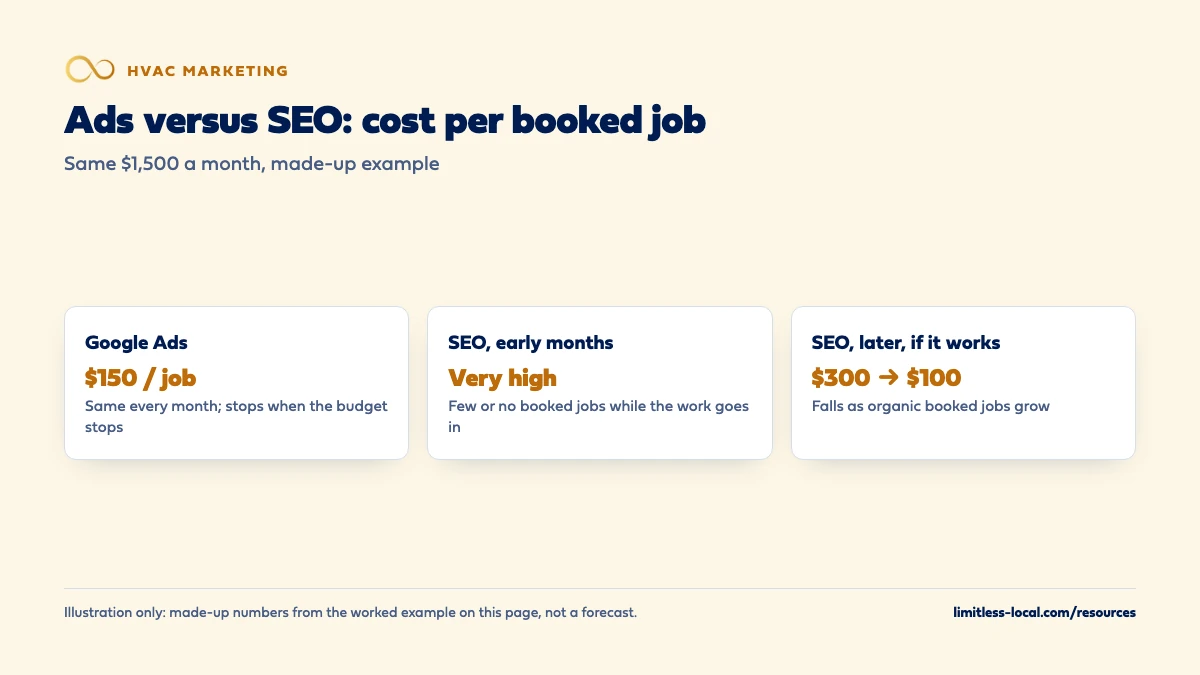
These numbers are made up to show the math, not a benchmark or a forecast for your market. Say you spend $1,500 a month on either Google Ads or SEO.
- Ads: at a made-up $150 per booked job, $1,500 brings 10 booked jobs a month, from the first month to the last, and stops when you stop paying.
- SEO, early months: almost no booked jobs while the foundation goes in. Cost per booked job is very high, or can’t be calculated at all.
- SEO, if it works, later in the year: say it reaches 5 booked jobs a month, which is $300 each. If it later reaches 15, it’s $100 each, below the ads.
That’s the shape of the trade: ads cost the same per job every month; SEO costs more per job early and less later, if it works in your market. If you can’t carry the early months, or if you don’t expect to be in the same towns long enough to reach the later ones, the ads-only math wins. If you can, running both, ads for now and SEO for later, is often the most practical setup.
Frequently asked questions
Is SEO a waste of money for a one-truck HVAC company?
Not usually, but paying someone may be. The basics (Google profile, reviews, a page per service) are work a one-truck owner can do; pay for help when the time isn’t there or the market is crowded.
Will running Google Ads help my SEO?
No. Google says advertising with Google has no effect on your site’s presence in its organic search results. The two have to be worked on separately.
Can I stop SEO once I'm ranking?
You can, but in our judgement rankings tend to slip as competitors keep working and reviews age. Most shops scale the work down rather than stopping it.
What's a fair monthly price for HVAC SEO?
It depends on what’s included and how crowded your market is. Ask for a list of the work, the reports and how results will be measured, and judge it on cost per booked job, not the monthly number alone.
Can an SEO company guarantee I'll be in the map pack?
No. Google says no one can guarantee a #1 ranking, and there’s no way to pay for a better local ranking. Treat a promised ranking as a red flag.
Is SEO worth it if I already get most work from referrals?
It can be, as a way to grow beyond your current customers’ networks. If referrals keep the schedule full, the do-it-yourself basics may be all you need for now.
Key takeaways
- SEO is usually worth it for a small HVAC shop that will serve the same towns for years.
- It’s a ramp: SEO typically takes 3 to 6 months to show meaningful organic growth.
- Google says a small local business can do much of its SEO itself; pay for help when time or skill runs out.
- Judge SEO on cost per booked job over a year, using Search Console, your profile’s performance and tracked calls.
- Walk away from promised rankings, secrecy and link schemes.
Want a second set of eyes on your setup?
We'll look at how you show up locally and where calls are leaking, then send you a plain-English breakdown.
More in this section
- Are Google Local Services Ads worth it for an HVAC company?
- How long does HVAC SEO take to bring in calls?
- How do I tell if an SEO offer for my HVAC company is a scam?
- Should my HVAC company start with LSAs, Google Ads or SEO?
- Do Google Ads work for a brand-new HVAC company?
Sources
- Do you need an SEO? — Google Search Central
- SEO Starter Guide: The Basics — Google Search Central
- Tips to improve your local ranking on Google — Google Business Profile Help
- Understand your Business Profile performance & insights — Google Business Profile Help
- Cost-per-click (CPC): Definition — Google Ads Help
- Performance report (Search results): Overview and basic setup — Search Console Help