
What should a plumber avoid when using AI in marketing?

- What AI marketing mistakes can hurt a plumbing company's rankings or make it look fake?
- What's the biggest AI mistake plumbers make in marketing?
- Avoid copy that could belong to any plumber
- Avoid churning out pages at scale
- Avoid AI-written or fake reviews, in any form
- Avoid AI photos of work you didn't do
- Avoid claims nobody checked
- Avoid letting AI talk to customers unsupervised
- Avoid AI voice calls to people who didn't ask
- Avoid feeding AI what it shouldn't have
- How do I keep a person in charge without slowing down?
- What's different about AI marketing for plumbing companies
- A worked example: red-penning one AI ad draft
- Frequently asked questions
- Key takeaways
- More in this section
- Sources
The short version
- Never publish an AI draft nobody at the company has read.
- Never let AI make up reviews, photos, prices or credentials.
- Don't mass-produce near-identical pages for every town.
- Keep a person between AI and your customers.
For plumbing owners already using AI for ads, pages, posts or replies, who want to know where it can hurt rankings or trust.
Get a free visibility audit · Book a growth call
What AI marketing mistakes can hurt a plumbing company's rankings or make it look fake?
Avoid publishing anything AI writes without a person reading it, and never let AI invent the things customers rely on: reviews, job photos, prices, warranties, licenses or arrival times. Also avoid using AI to churn out lots of near-identical pages, such as city pages with only the town name changed, which Google’s spam policies treat as scaled content abuse. AI is useful for drafts; the risk comes from generic copy, fake-looking proof and unchecked claims going live under your company’s name.
Local SEO in every Limitless Engine package, from $3,500 a month, covers the pages, Google profile posts and review responses this page is about, with a monthly report that shows what the work produced. See how our local SEO works for plumbing companies, or browse more plumbing marketing questions.
What's the biggest AI mistake plumbers make in marketing?
Publishing without reading. AI drafts come back fast and sound confident, so it’s tempting to paste them straight onto the website, the Google profile or an ad. That’s where most other AI marketing problems start.
AI tools predict likely words; they don’t know your company. A draft can say you offer 24-hour service when you don’t, name a town you don’t serve, or describe a warranty you’ve never offered. Google’s guidance on generative AI content says AI outputs may contain inaccuracies, and that it’s critical to manually fact-check and review all AI-generated content before publishing, including titles, meta descriptions and image alt text.
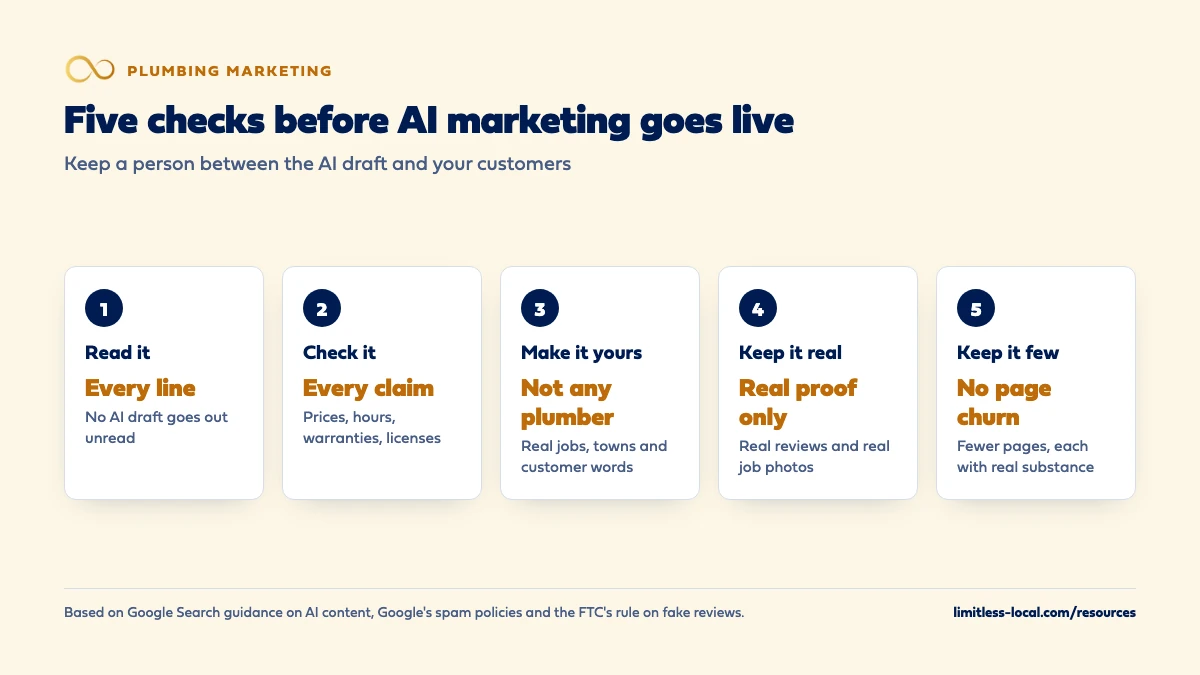
Someone at the company reads every line before it goes out.
Avoid copy that could belong to any plumber
Ask AI for a plumbing service page with no details and you’ll get the same page every other plumber gets: “fast, reliable, affordable”, “no job too big or small”, “your satisfaction is our priority”. It isn’t wrong. It’s just empty, and it gives nobody a reason to call you.
Generic copy also hurts you twice. Customers skim past it, and it doesn’t give search engines or AI assistants anything specific to match you with.
The test: cover your company name and read the page. If it could be any plumber in the country, rewrite it with what’s true only of you: the jobs you do most, the towns you cover, how your techs work, real customer words. Whether AI-written content will hurt your plumbing website’s rankings explains why helpfulness, not who wrote it, is what Google looks at.
Avoid churning out pages at scale
The fastest way AI can hurt a plumbing website is volume: fifty city pages in an afternoon, or a page for every service in every town, each one the same text with names swapped.
Google’s spam policies describe scaled content abuse as many pages generated for the primary purpose of manipulating search rankings and not helping users, and give using generative AI tools to generate many pages without adding value as an example. Doorway abuse, in the same policies, includes pages targeted at specific regions or cities that funnel users to one page.
Build fewer pages, each with something real in it. If you want local pages, start with the towns where you have jobs, photos and reviews to show. Whether AI can help a plumber write local content for the towns served walks through doing it the right way.
Avoid AI-written or fake reviews, in any form
This one isn’t a gray area. Don’t use AI to write reviews, don’t post reviews as customers, and don’t buy them.
The FTC’s final rule on fake reviews and testimonials, announced in August 2024, prohibits businesses from creating or selling reviews that misrepresent that they’re by someone who doesn’t exist, such as AI-generated fake reviews, or by someone who didn’t have actual experience with the business. It also prohibits buying such reviews when the business knew or should have known they were fake or false, and offering compensation or incentives conditioned on reviews expressing a particular sentiment. The rule lets the FTC seek civil penalties against knowing violators.
Also avoid the softer version: handing customers an AI-written review to paste in. If the words aren’t theirs, the review isn’t either. Real reviews come from asking every customer, every time. How to get more Google reviews for a plumbing company covers how.
Curious what your marketing is actually booking?
Get a free visibility audit — no obligation, no sales pitch.
Avoid AI photos of work you didn't do
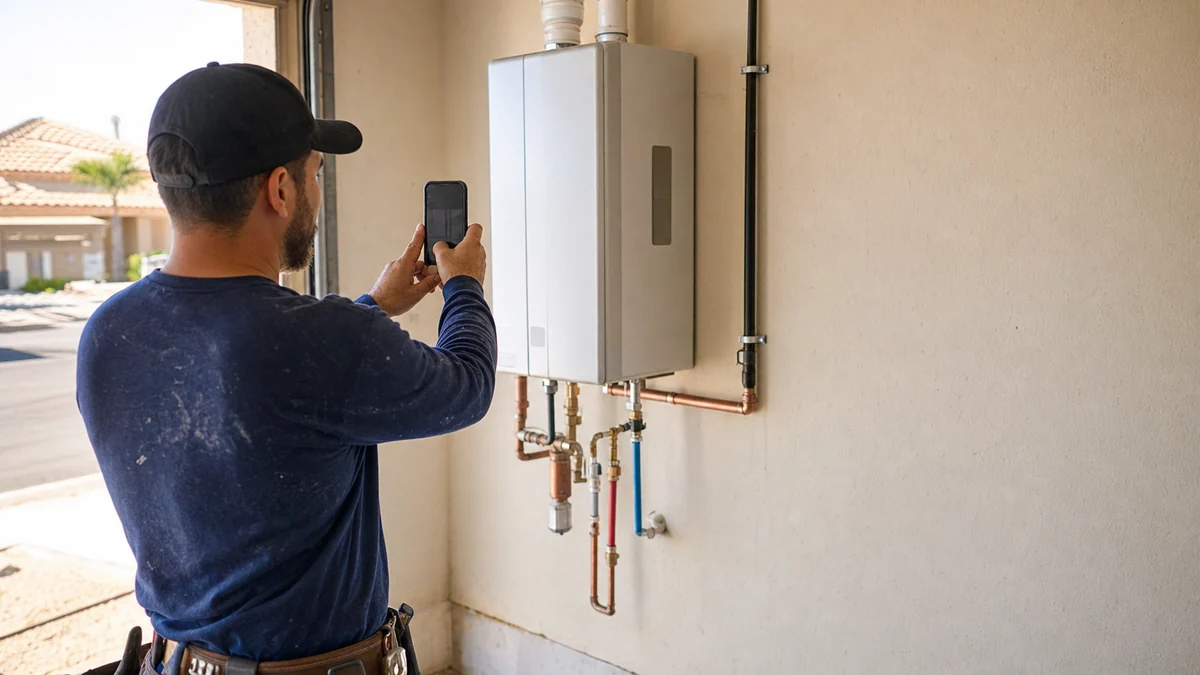
A generated picture of a spotless tech in front of a gleaming water heater might look better than your crew’s phone photo. It also tells customers something that isn’t true, and people are getting better at spotting it.
On your Google profile it’s also against the spirit of the rules. Google’s tips for business photos say photos should have no significant alterations or excessive use of filters or AI; the image should represent reality.
Use real photos of your trucks, your team and your jobs, with the customer’s permission. A slightly crooked photo of an actual repipe does more for trust than a perfect image of nothing. AI can still help here: writing captions and photo descriptions, as long as they match what’s in the picture.
Avoid claims nobody checked
AI fills gaps with things that sound good. In plumbing marketing, the dangerous ones are:
- Prices and specials you don’t offer, or that expired.
- Arrival promises like “there in 30 minutes” that your schedule can’t keep.
- Warranty terms that aren’t in your paperwork.
- Licenses, certifications and awards you don’t hold.
- Years in business or job counts nobody looked up.
- Hours that don’t match your Google profile.
In ads, these can also break the rules. Google Ads’ misrepresentation policy doesn’t allow ads that deceive users by excluding relevant information or giving misleading information about products, services and businesses, and it lists unreliable claims among its examples. Keep a one-page fact sheet of your real prices, hours, service area, warranties and credentials, and check every AI draft against it. How to use AI to improve your plumbing ads and messages shows how to build that fact sheet into the drafting.
Avoid letting AI talk to customers unsupervised
AI review replies, AI website chat and AI answering can all be useful. They go wrong when nobody checks what they say.
- Review replies: a canned, cheerful AI reply to an angry one-star review about a flooded basement reads badly to everyone else who sees it. Have a person approve replies to anything negative, and personalize the good ones.
- Chat and answering tools: set what they’re allowed to say. They shouldn’t quote prices you haven’t given them, promise arrival times or diagnose a problem.
- Follow-up texts and emails: read the templates before they’re turned on, and check them again after any price or policy change.
Read a sample of conversations every week, at least at first. That’s how you catch the tool saying something you’d never say.
Avoid AI voice calls to people who didn't ask
Using an AI voice to answer calls people make to you is one thing. Using one to call leads, past customers or a purchased list is another.
In February 2024 the FCC confirmed that “artificial or prerecorded voice” in the Telephone Consumer Protection Act covers AI technologies that resemble human voices, so calls using them fall under that law and the FCC’s rules for it.
The safe habit: keep AI voice tools on the receiving end, answering and taking details, and have a person make outbound calls. If a vendor pitches you an AI that calls leads for you, ask them in writing how their calls comply with that ruling before you sign up.
Avoid feeding AI what it shouldn't have
Be careful what you paste into an AI tool. Customer names, addresses, phone numbers, gate codes and photos of the inside of someone’s home don’t belong in a general-purpose chatbot.
Before you use a tool for anything with customer details, check its settings and terms for how it stores and uses what you enter, and use a business account where you can control that. For drafting marketing copy, you rarely need customer details at all. “A homeowner in the north end with a 40-year-old cast-iron drain line” gives AI everything it needs.
How do I keep a person in charge without slowing down?
A short routine covers most of it:
- One fact sheet. Prices, hours, service area, warranties, credentials. AI drafts from it; reviewers check against it.
- One reviewer. The owner or a trusted manager signs off on anything public. A plumber reads anything technical.
- Three questions before publishing. Is every fact true? Could this be any plumber? Would I be fine with a customer reading this out loud to me?
- Real proof only. Real reviews, real photos, real job stories.
- A monthly look back. Which AI-assisted pages, posts and ads brought calls and booked jobs, and which didn’t.
For where AI does help, from call summaries to draft replies, which AI tools are actually useful for plumbing marketing lays out the options.
Not sure which of these is costing you jobs?
A free visibility audit checks the Google profile, reviews, site and tracking, and shows what to fix first.
What's different about AI marketing for plumbing companies
Customers are letting you into their homes. Trust decides who gets the call. Fake-looking photos, generic copy or a review that sounds like a robot all cost more in plumbing than in businesses where the customer never meets you.
Emergencies punish wrong promises. If an AI-written ad says “24/7” and a customer with a burst pipe at midnight gets voicemail, you’ve lost that customer and probably earned a bad review.
Licensing claims matter. Never let AI describe your licenses or what you’re allowed to do; write that part yourself, from your actual paperwork.
A worked example: red-penning one AI ad draft
This is a made-up example to show the check. An owner asks an AI tool for a Google ad about drain cleaning and gets back:
- “$49 drain cleaning, any drain”
- “Licensed master plumbers on every call”
- “At your door in 30 minutes, 24/7”
- “Family-owned since 1985”
Against the company fact sheet: drain cleaning starts at $129 for one accessible drain, not $49 for any drain. Most calls are run by journeyman plumbers, so “master plumbers on every call” is false. The shop answers after hours for emergencies only and can’t promise 30 minutes. The company was founded in 2009.
Every one of those lines would have gone live as a claim customers rely on. The corrected ad says what’s true: drain cleaning from $129, licensed plumbers, emergency service after hours and the real founding year. It took five minutes to check, and it’s the ad the shop can actually deliver on.
Frequently asked questions
Is it okay to use AI to reply to my Google reviews?
As a drafting tool, yes. Have a person read and adjust each reply, and write replies to negative reviews yourself or approve them carefully.
Can I use AI to improve a real customer's review before posting it?
No. A review should be the customer’s own words about their own experience. You can ask for reviews; you shouldn’t write or rewrite them.
Will Google penalize my site just for using AI?
Not for using AI on its own. Problems come from what the content is: thin, copied, mass-produced or inaccurate.
Should I use AI-generated images in my plumbing ads?
Avoid images that look like your team or your work if they aren’t. For a simple background or a graphic, it’s less of an issue, but real photos of your crew build more trust.
Can AI help me spot problems in my marketing instead of creating it?
Yes. It’s good at summarizing call recordings, grouping review themes and finding inconsistent hours or phone numbers across your listings, all of which a person then acts on.
Who on my team should check AI content?
The owner or a trusted manager for anything public, and a plumber for anything technical. One clear reviewer works better than everyone glancing at it.
Key takeaways
- The biggest AI mistake is publishing without reading; someone at the company checks every line.
- Never let AI invent reviews, photos, prices, warranties, licenses or arrival times.
- Don’t mass-produce near-identical pages; that’s what scaled content abuse looks like.
- Keep a person between AI and customers in review replies, chat, follow-up and calls.
- Use one fact sheet and one reviewer, and judge AI-assisted work by the booked jobs it brings.
Want a second set of eyes on your setup?
We'll look at how you show up locally and where calls are leaking, then send you a plain-English breakdown.
More in this section
- Which AI tools are actually useful for plumbing marketing?
- How can I use AI to improve my plumbing ads and messages?
- Can AI help a plumber write local content for the towns served?
- Can AI help a plumbing company answer leads faster?
- Can AI help my plumbing company get more 5-star reviews?
Sources
- Google Search's guidance on using generative AI content on your website — Google Search Central
- Spam policies for Google web search — Google Search Central
- Federal Trade Commission Announces Final Rule Banning Fake Reviews and Testimonials — Federal Trade Commission
- Tips for business-specific photos on your Business Profile — Google Business Profile Help
- Misrepresentation — Advertising Policies Help
- FCC 24-84: Implications of Artificial Intelligence Technologies on Protecting Consumers from Unwanted Robocalls and Robotexts — Federal Communications Commission