
Can I use AI to find plumbing services and towns customers search?

- How can a plumber use ChatGPT or another AI tool to find the services and towns worth targeting?
- What can AI actually do to help me pick services and towns?
- What can't AI tell me about what customers search?
- Step 1: What should I feed AI from my own jobs?
- Step 2: How do I get AI to list the words homeowners use?
- Step 3: How do I check AI's list against Google's own data?
- Step 4: How do I use AI to map the towns, then check the map?
- Step 5: Can Google Trends show which towns search most?
- Step 6: How do I turn all this into a short list?
- What does AI get wrong most often for plumbers?
- How often should I redo this?
- What's different about this for plumbing companies
- A worked example: from a job export to a short list
- Frequently asked questions
- Key takeaways
- More in this section
- Sources
The short version
- AI is good at sorting your own job data and listing the ways homeowners describe a problem.
- It can't see real search counts in your towns, and it can make things up.
- Check every service and phrase against Keyword Planner, autocomplete and your Google profile's search terms.
- End with a short grid of services and towns to build pages and ads around.
For plumbing owners who want a faster way to decide which services and towns to build pages and ads around, without trusting a chatbot’s guesses.
Get a free visibility audit · Book a growth call
How can a plumber use ChatGPT or another AI tool to find the services and towns worth targeting?
Yes, as long as AI does the sorting and brainstorming and Google’s own tools do the checking. Feed an AI tool your job history to rank services and towns by jobs and revenue, and ask it for the plain words homeowners use for each problem. Then check every suggestion against Keyword Planner, Google’s autocomplete and the search terms in your Google Business Profile, because AI can’t see real search counts and can state made-up numbers with confidence.
Finding the services and towns worth targeting is the first step of local SEO, and it’s where our work starts. Our packages include business listing cleanup, Google Business Profile management and a content sprint of up to 10 pages, built around the jobs and towns you want more of. Our local SEO page shows how that work fits together, our plumbing marketing page covers plumbing companies specifically, and the plumbing marketing questions library takes it one question at a time.
What can AI actually do to help me pick services and towns?
Three jobs it does well:
- Sorting your own data. Paste in a year of jobs with the service, town and invoice total, and it’ll rank towns by jobs and revenue and services by count and average ticket in seconds.
- Listing how homeowners talk. Ask how people describe a slab leak, a running toilet or no hot water, and you’ll get a long list of plain phrases to check.
- Organizing. It can group phrases into emergency and planned work, match them to the services you actually sell, and build a simple grid of services by towns.
That’s real time saved. What it can’t do is tell you how many people in your towns search for any of it. That part still comes from Google.
What can't AI tell me about what customers search?
AI chat tools don’t have Google’s search data, so any search count they give you is a guess dressed up as a number. OpenAI’s help page Does ChatGPT tell the truth? says it can produce incorrect or misleading answers, including fabricated studies and citations, and that it may sound confident even when it’s wrong. It encourages checking important information against reliable sources.
For a plumber, that shows up as:
- Monthly search numbers for “water heater repair” in your town that came from nowhere.
- Towns or neighborhoods that are misspelled, outside your area, or don’t exist.
- Services you don’t offer, like well pumps or septic work, presented as big opportunities.
- Trade words homeowners rarely type, like PRV or backflow, listed as top searches.
Treat AI output as a list of things to check, never as the answer.
Step 1: What should I feed AI from my own jobs?
Start with what you already know, because it’s the most reliable data you have. Export the last 12 months of jobs from ServiceTitan, Housecall Pro or Jobber with four columns: service type, town or ZIP code, invoice total and lead source.
Before you paste anything in, delete customer names, street addresses, phone numbers and emails. The tool doesn’t need them to count jobs by town.
Then ask something like:
“Here are 12 months of plumbing jobs. Rank the towns by number of jobs and by total revenue. Then rank the services by number of jobs and average ticket. Flag any town where we do lots of small jobs but few big ones.”
Check a couple of totals against your field software to make sure it added correctly. What you get is the starting map: the towns and services already paying the bills, and the gaps where you’d like more.
Step 2: How do I get AI to list the words homeowners use?
Ask about one problem at a time, in the homeowner’s shoes, and tell it where you work:
“I’m a plumber in [your metro]. List 25 ways a homeowner might search Google when their water heater stops making hot water. Use plain words, include phrases with ‘near me’ and town names, and don’t make up search volumes.”
Repeat for each service you want more of: drain cleaning, sewer line repair, slab leaks, repipes, water softeners, gas lines. Then ask it to sort the full list into emergency searches, like “burst pipe” or “plumber open now,” and planned ones, like “tankless water heater cost.” That split matters, because the two kinds of search usually need different pages and different ads.
You’ll get plenty of phrases nobody types. That’s fine. The next step throws them out.
Curious what your marketing is actually booking?
Get a free visibility audit — no obligation, no sales pitch.
Step 3: How do I check AI's list against Google's own data?
Run the list through three free checks:
- Keyword Planner. Google’s Keyword Planner shows estimates of how many searches a keyword gets each month and what it costs to target. You can start with words or with a website, and keywords with very low search volume won’t show estimates at all. You’ll need a Google Ads account with billing set up to use it.
- Autocomplete. Start typing a phrase into Google. Google says its predictions reflect real searches and take into account the location a search comes from, though they aren’t simply the most common searches on a topic.
- Your Google profile. The Performance report shows the search terms people used to find your business (Understand your Business Profile performance). Those are real searches from your own area.
Keep phrases that show up in at least one of these. Drop the rest. The full keyword method, including your call recordings and ad search terms, is in how plumbers find the keywords homeowners really search.
Step 4: How do I use AI to map the towns, then check the map?
Ask AI to list the towns, suburbs and neighborhoods within a set drive time of your shop, and have it group them by direction. It’s quicker than tracing a map by hand, but it gets distances and boundaries wrong often enough that you have to check.
- Give it your location. OpenAI’s help page on searching the web with ChatGPT says it may use an approximate location from your IP address, and suggests including your city or postal code if local results show the wrong area. It also warns that search results and citations can be incomplete, outdated or incorrect.
- Check drive times yourself. Look up each town in Google Maps at a busy time of day. An emergency call 40 minutes away at rush hour isn’t really in your area.
- Add what AI can’t know. Where your trucks already go every day, where your reviews come from, and which towns your plumbers won’t drive to.
Then join this list to the Step 1 ranking. Which towns a plumber should target first walks through scoring them.
Step 5: Can Google Trends show which towns search most?
Sometimes, and it’s better for timing than for small towns. Google Trends shows interest in a topic down to city level, scaled from 0 to 100 relative to all searches in that place and time, so it compares popularity rather than giving search counts. Searches made by very few people show as zero, which rules out most small towns.
Where it helps a plumber:
- Seasonality. Compare “frozen pipes” or “water heater repair” across a few years to see when demand rises in your metro, so pages and ads are ready before the spike.
- Comparing phrases. See whether people in your area say “tankless water heater” or “on demand water heater” more.
- Bigger cities. In a large metro, it can show which cities have more interest in a service.
It isn’t a perfect mirror of search activity, so use it as one data point, not the decider.
Step 6: How do I turn all this into a short list?
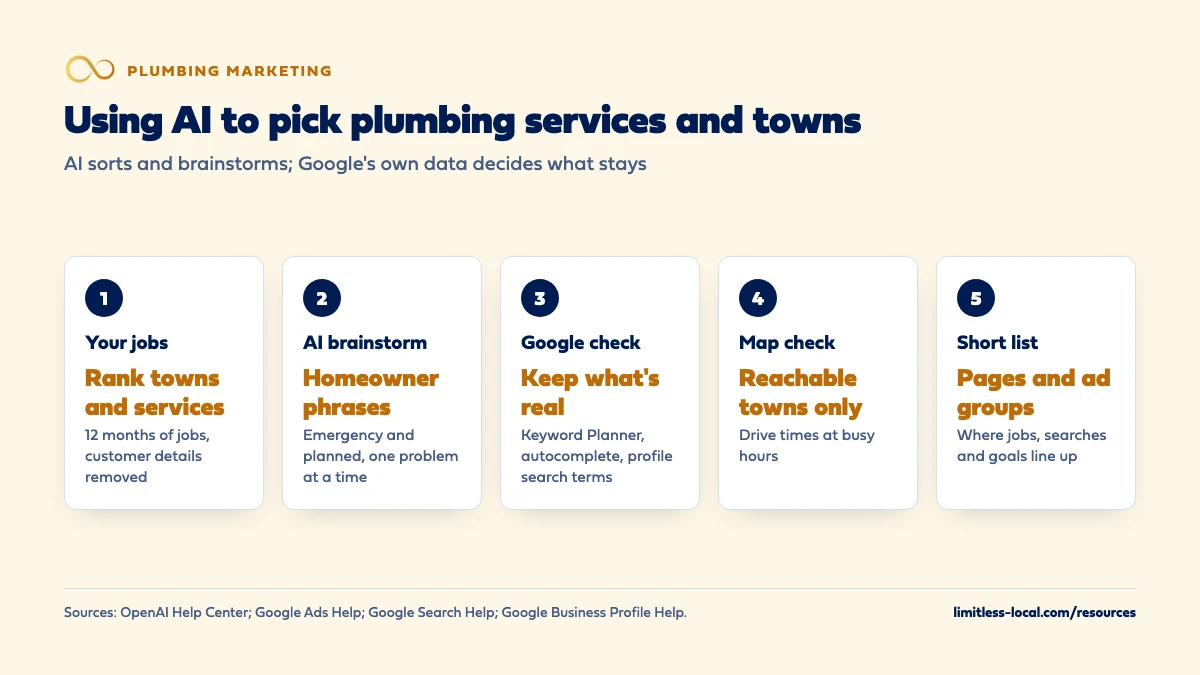
Ask AI to build a grid from what survived the checks: services down the side, towns across the top. In each box, note three things: how many jobs you already do there, whether Google showed real searches for that service, and whether you want more of that work.
Then pick the few boxes where all three line up. Those become:
- Service pages for the services with real searches and good tickets.
- Town pages for the towns where you do real work and can reach quickly.
- Ad groups for the emergency phrases that book fastest.
Keep the list short. Five strong combinations you’ll actually build beat dozens you won’t. When it’s time to write the pages, how AI can help write local content for your towns covers doing that without thin, copied pages.
What does AI get wrong most often for plumbers?
- National wording. It suggests what people say on average, not what people say where you work. Regional words for the same problem vary.
- Confident numbers. Search volumes, cost per click and “opportunity scores” with nothing behind them.
- Too many towns. It lists every suburb in the metro, including ones your trucks can’t reach on an emergency call.
- Services you don’t do. It fills the list with work outside your license or your crew’s skills.
- Out-of-date facts. Without web search turned on, it works from training data that stops at a cutoff date, so new subdivisions and recent town changes may be missing.
Every one of these gets caught by the Google checks in Steps 3 and 4. Skipping them is how owners end up with pages nobody searches for.
How often should I redo this?
Once a year is enough for most shops, plus any time you add a service, hire a plumber who opens up a new area, or open a second location. Your Google profile’s search terms update monthly, so glance at them more often. They’re the quickest way to spot a new phrase or a town that’s starting to find you.
Save the prompts you used and the grid you ended with. Next year, paste in the new job export and compare. If you’re deciding which service to put ad money behind first, which plumbing services to advertise first covers that choice.
Not sure which of these is costing you jobs?
A free visibility audit checks the Google profile, reviews, site and tracking, and shows what to fix first.
What's different about this for plumbing companies
Two kinds of search, two kinds of page. Emergency searches are short and urgent: “burst pipe,” “plumber near me,” “plumber open now.” Planned searches are longer and about cost or options: “tankless water heater cost,” “repipe a house.” Sort AI’s list into the two before you check it.
Distance matters more than for most trades. An emergency call has to be reachable fast, so the town list should follow drive times, not county lines.
Housing age shapes demand. Older neighborhoods bring repipes and sewer lines; newer ones bring water heaters and fixtures. Your own job data shows this better than any AI guess.
Weather spikes. Freeze and storm searches jump for days at a time. Trends helps you plan for them; AI can’t predict them.
A worked example: from a job export to a short list
These numbers are made up to show the method, not a benchmark for your market. A plumbing shop exports 12 months of jobs, removes the customer details and asks an AI tool to rank its nine towns.
- Your data: three towns account for most of the jobs, but one of them brings almost no water heater or repipe work.
- AI brainstorm: asked about water heaters, drains and sewer lines, the tool suggests 75 phrases.
- Google check: 31 of the 75 show search estimates in Keyword Planner or appear in autocomplete or the profile’s search terms. The other 44 are dropped.
- Map check: two of the towns AI listed are more than a 45-minute drive at rush hour and come off the list.
The short list: water heater replacement and sewer line repair pages, town pages for the three busiest towns, and an emergency ad group for burst pipes and no-hot-water searches. AI saved hours of sorting. Google decided what stayed.
Frequently asked questions
Which AI tool is best for this?
Any of the main chat tools can sort a spreadsheet and brainstorm phrases. The tool matters less than the checks afterward; none of them has Google’s search counts.
Is it safe to paste my job list into an AI tool?
Remove customer names, addresses, phone numbers and emails first. Service type, town, invoice total and lead source are all the tool needs.
Can AI tell me which towns my competitors rank in?
Not reliably. Search from those towns yourself, or look at the map results with your location set there. Using AI to analyze your top local competitors covers what AI can help with there.
What if Keyword Planner shows no searches for a small town?
Small towns often don’t have enough volume to show. Use the search terms in your Google profile and your own job data instead, and treat the town as part of the nearest bigger area.
Should I build a page for every phrase AI finds?
No. Group phrases that mean the same thing onto one page. One strong water heater page covers dozens of ways to say “no hot water.”
Key takeaways
- Let AI sort your own job data and brainstorm homeowner phrases; don’t let it supply search counts.
- Check every phrase against Keyword Planner, autocomplete and your Google profile’s search terms.
- Check AI’s town list against real drive times and where your trucks already go.
- Use Google Trends for timing and phrase comparisons, not for small towns.
- End with a short grid of services and towns you’ll actually build pages and ads for.
Want a second set of eyes on your setup?
We'll look at how you show up locally and where calls are leaking, then send you a plain-English breakdown.
More in this section
- Can AI help a plumber write local content for the towns served?
- Can AI help improve my plumbing Google Business Profile?
- Can I use AI to analyze what top local plumbing competitors do?
- Can AI help write plumbing service pages and Google Posts?
- Can AI help track my plumbing rankings, calls and leads?
Sources
- Does ChatGPT tell the truth? — OpenAI Help Center
- Searching the web with ChatGPT — OpenAI Help Center
- Use Keyword Planner — Google Ads Help
- How Google autocomplete predictions work — Google Search Help
- FAQ about Google Trends data — Trends Help
- Understand your Business Profile performance & insights — Google Business Profile Help