
When should a restoration company split SEO, ads and reviews budgets?

- Should a restoration company run separate budget lines for SEO, ads and reviews?
- Why not just run one marketing budget?
- When should I start splitting into separate lines?
- What belongs on each budget line?
- Why do the lines need different time frames?
- How do I measure each line separately?
- Where do reviews fit when they help both SEO and ads?
- How should I divide the money between the lines?
- How often should I move money between lines?
- What if my agency bills one fee for everything?
- When should the split go further than three lines?
- What's different about splitting budgets for restoration companies
- A worked example: what one blended number hides
- Frequently asked questions
- Key takeaways
- More in this section
- Sources
The short version
- Split as soon as you pay for more than one kind of marketing.
- Ads, SEO and reviews pay back on different clocks, so judge each on its own.
- A single blended number hides the line that isn't working.
- Review ads monthly, SEO quarterly, and keep reviews running all the time.
- Track booked jobs by source, or the split is just a guess.
For restoration owners paying for more than one kind of marketing who can’t tell which part is actually booking the jobs.
Get a free visibility audit · Book a growth call
Should a restoration company run separate budget lines for SEO, ads and reviews?
Split them as soon as you’re paying for more than one, which for most restoration companies is the moment ads join SEO or Google profile work. Each line pays back on a different clock: ads can bring calls within days, SEO typically takes months, and reviews build slowly while helping both. One blended budget hides which line books jobs, and makes it easy to cut the slow one just before it pays off. Keep one total, but give ads, SEO and reviews their own spend, goal and review schedule, and track the booked jobs each one brings.
Our packages keep the lines visible: one monthly fee covers local SEO and Google Business Profile management, Google Ads management and review response with review generation, and every package includes call tracking with source tagging and a monthly report with a cost-per-lead breakdown. Essentials is $3,500 a month and Growth is $4,500, which adds Local Services Ads; ad spend is always paid directly to Google, so it never blurs into the fee. See how it fits restoration companies, read the restoration marketing guide, or browse more restoration marketing questions.
Why not just run one marketing budget?
Because one number can’t tell you what to do next. If you spend a set amount a month on “marketing” and book a set number of jobs, you know your overall cost per job. You don’t know whether the ads are carrying a weak SEO effort, whether the SEO is quietly producing most of the jobs while the ads lose money, or whether reviews are what’s making both work.
That matters most when money gets tight. A restoration owner looking at one blended budget in a slow month will usually cut whatever feels least productive, and that’s usually SEO, because it’s slow and hard to see. If SEO was three months from paying off, that cut throws away everything already spent on it.
The general advice from the U.S. Small Business Administration’s guide on how to get the most from your marketing budget points the same way: once you’ve been in business a while, focus on the methods that have gotten the best results, and track results so you can phase out what isn’t working. You can only do that if each method has its own line.
When should I start splitting into separate lines?
As soon as any of these is true:
- You pay for more than one channel. Ads plus SEO, or ads plus a review tool, is already two lines.
- You pay one fee that covers several kinds of work. Ask what it covers, then track each part’s results separately.
- You can’t say what each channel costs per booked job. That’s the sign the split is overdue.
- You’re about to add a channel. Set up its line before the first dollar goes in, so you can judge it from day one.
- You’re about to raise the budget. You need to know which line deserves the extra money.
The only time one budget is fine is when you genuinely do one thing, for example a Google profile and review requests with no ads and no paid SEO. Even then, keep a note of what that work costs in time.
What belongs on each budget line?
A simple split that fits most restoration companies:
- Ads: ad spend paid to Google (search ads and Local Services Ads), plus whatever you pay someone to manage it. Split further by service once you spend real money: water, sewage, mold and fire book differently.
- SEO and Google profile: profile management, service and town pages, content, local links and listings cleanup.
- Reviews: the review request system, any software, and the staff time spent asking and replying.
- Foundations: call tracking, the website’s hosting and upkeep, and reporting. These serve every line, so keep them separate rather than loading them onto one.
Some costs straddle lines. A landing page built for ads also helps SEO; a review program helps both. Put each cost where its main job is, and don’t overthink it. The point is to see what each line produces, not to build a perfect accounting system. How to split ad spend and agency fees covers the fee side of the ads line.
Why do the lines need different time frames?
Because they pay back at very different speeds:
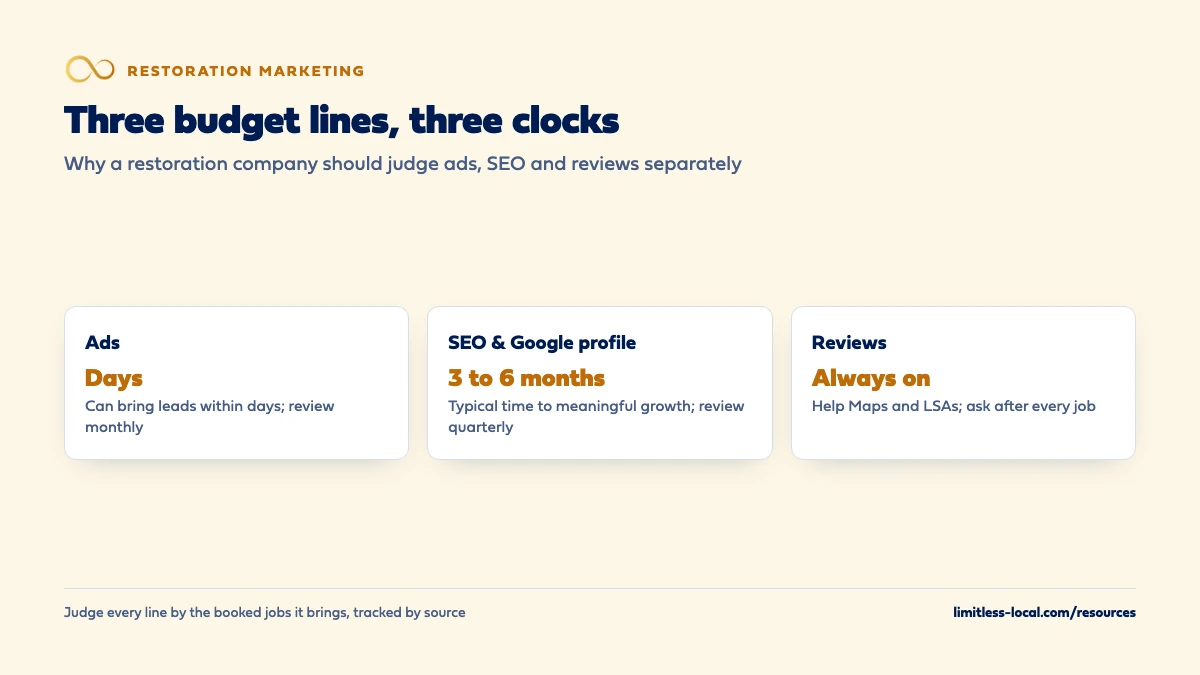
- Ads can produce leads within days of launch. You can judge them, and move money, month to month.
- SEO typically takes 3 to 6 months to show meaningful organic growth. Judging it monthly in the first half-year is how good SEO gets cancelled.
- Reviews build steadily. Each review helps a little, and the effect shows over months, not weeks.
So give each line its own goal and schedule. Ads: cost per booked job, checked monthly. SEO: rising calls and jobs from organic search and Maps, checked quarterly, with early signs like more impressions and better positions in between. Reviews: a steady number of new reviews each month, checked monthly, with the payoff judged over the year.
A realistic restoration SEO timeline at three, six and twelve months sets out what to expect from the SEO line at each stage.
Curious what your marketing is actually booking?
Get a free visibility audit — no obligation, no sales pitch.
How do I measure each line separately?
Each line needs its own way of tagging the jobs it brings in:
- Ads: conversion tracking in Google Ads, plus a tracking number on the ads, so you can tie calls to campaigns.
- Google profile: a tracking number on the profile, and the Business Profile performance numbers, which show calls, website clicks and the searches people used to find you.
- Website SEO: a separate tracking number on the site for organic visitors, and Search Console’s Performance report for the searches your pages show up for.
- Reviews: new reviews per month and your average rating. They rarely bring jobs directly, so judge them on whether profile calls and ad results improve as they grow.
Then, in your job software, mark the source on every booked job. Have whoever answers the phone ask how the caller found you, and check it against the tracking number. Tracking which marketing brings in booked restoration jobs shows how to set it up.
Where do reviews fit when they help both SEO and ads?
Reviews deserve their own line precisely because they help everything else. Google’s local ranking help says more reviews and positive ratings can help your local ranking. For Local Services Ads, Google’s page about ad rankings lists your rating and number of reviews as part of profile quality, and says higher-quality profiles may rank higher and may pay lower costs per lead.
So a review line can make your SEO line and your ads line cheaper at the same time. If you buried review work inside one of them, you’d never see that.
The review line is usually small: a simple way to ask every customer at the end of the job, someone responsible for asking, and time to reply. What it should never include is paying for reviews. The Federal Trade Commission’s final rule on fake reviews, announced in August 2024, prohibits businesses from buying fake reviews and from offering compensation or incentives conditioned on a review expressing a particular sentiment. How to get more five-star Google reviews covers doing it the right way.
How should I divide the money between the lines?
There’s no standard percentage, because it depends on where your company is:
- New company, no rankings: ads carry most of the jobs at first, while SEO and the profile are built. The SEO line is an investment that won’t show much for months.
- Established company, solid rankings in the home market: SEO and the profile may already bring a big share of calls for free, so ads can focus on edge towns, services you don’t rank for yet, and storm weeks.
- Growing into new towns or services: both lines rise for the new area, ads first.
Fund the foundations first, then keep the SEO and review lines steady, and use the ads line as the flexible one that rises and falls with demand and capacity. That way the slow lines keep building and the fast line does the adjusting.
For the full budget picture, whether to budget for content and reviews covers those two lines in more depth.

How often should I move money between lines?
Match the review schedule to each line’s clock:
- Ads: monthly, and within the month during freezes and storms. Move money between services and towns toward the lowest cost per booked job.
- SEO: quarterly. Change the plan if a quarter shows no progress in impressions, positions or calls, not because one month was quiet.
- Reviews: don’t move this money at all. Keep asking after every job.
The rule that saves the most money: don’t raid the slow lines to feed the fast one. When ads are working well in a busy month, it’s tempting to move the SEO money into ads too. Do that every busy month and SEO never gets the steady months it needs, which leaves you paying for every call forever.
What if my agency bills one fee for everything?
That’s common, and it’s fine, as long as you can still see the lines. Ask for three things:
- What the fee covers, in plain words: SEO and profile work, ad management, review work, reporting.
- Ad spend kept separate. You should pay Google directly, or see exactly what was spent, so the fee and the media don’t blur together.
- Results by source. Calls, leads and booked jobs from ads, from the profile and from the website, every month, plus review counts.
With those, you can judge each line even if you only write one check. Without them, you’re back to one blended number and a guess.
When should the split go further than three lines?
Once the three lines are running, split further where the money and the results differ a lot:
- By service on the ads line, so water, sewage, mold and fire each show their own cost per booked job.
- By market once you cover a second city or open a second location, so each area’s SEO and ads stand on their own.
- By ad type once you run Local Services Ads alongside search ads.
Stop splitting when a line gets too small to judge. A campaign or area that books one job a month can’t tell you much, so group it with a similar one until it grows. How a restoration budget changes for one city versus several covers the market split.
Not sure which of these is costing you jobs?
A free visibility audit checks the Google profile, reviews, site and tracking, and shows what to fix first.
What's different about splitting budgets for restoration companies
Storms tempt you to move money. A freeze makes ads look like the only thing that matters. Let the ads line rise for the week, and leave the SEO and review lines alone.
Emergency work leans on the profile. Many water damage calls come straight from the Google profile, so the SEO and profile line often does more for restoration than owners expect.
Reviews come at a hard moment. You’re asking homeowners who just had a bad week. A clear, simple ask at the end of a well-run job is what makes the review line work.
Not every job comes from marketing. Plumber referrals, property managers and insurance programs feed restoration companies too. Keep those out of the marketing lines so they don’t make any channel look better than it is.
A worked example: what one blended number hides
These numbers are made up to show the math, not a benchmark for your market. Say you spend $6,000 a month on marketing and book 12 jobs from it. Blended, that’s $500 a job, and it looks fine.
Now split it. Ads take $3,200 a month and bring 8 booked jobs, $400 each. SEO and profile work takes $2,200 and brings 4 jobs, $550 each. Reviews and tracking take the other $600.
Looked at alone, SEO seems like the weak line, and in a slow month it’s the obvious one to cut. But the split also shows its trend: one job from organic search in its first month, 4 now, with impressions still climbing. Ads, meanwhile, cost the same per job every month and will keep costing that for every call. Cut SEO now and you lose the line that’s getting cheaper. Keep it, and the ads line can shrink later.
Frequently asked questions
Is call tracking part of the ads budget or the SEO budget?
Neither. It serves every line, so keep it in a small foundations line of its own.
Should a new restoration company split budgets from the start?
Yes, even if the amounts are small. The earlier each line has its own numbers, the sooner you’ll know which one to grow.
Can I skip SEO and just run ads?
You can, and some companies do for a while. You’ll pay for every call, though, and you’ll feel it whenever storms or new competitors push click prices up.
How much time do reviews really take?
A few minutes per job if asking is built into how jobs close out: a link or QR code at the final walkthrough, and someone replying to new reviews each week.
Do Local Services Ads belong on the ads line?
Yes, but track them as their own part of it. They charge per lead rather than per click and rank partly on reviews, so their numbers behave differently from search ads.
Key takeaways
- Split SEO, ads and reviews into their own lines as soon as you pay for more than one.
- Each line pays back on its own clock: ads in days, SEO over months, reviews steadily.
- Give each line its own goal and review schedule, and track booked jobs by source.
- Keep the slow lines steady and let the ads line flex with demand.
- Never pay for reviews; build asking into how every job closes out.
Want a second set of eyes on your setup?
We'll look at how you show up locally and where calls are leaking, then send you a plain-English breakdown.
More in this section
- Should a restoration company fix SEO, ads or its website first?
- Should a restoration company budget for content and reviews?
- How should a restoration company split ad spend and agency fees?
- How should a restoration company use SEO and ads in a slow season?
- How much does SEO cost for a restoration company?
Sources
- How to Get the Most From Your Marketing Budget — U.S. Small Business Administration
- Tips to improve your local ranking on Google — Google Business Profile Help
- About ad rankings — Google Local Services Help
- Understand your Business Profile performance & insights — Google Business Profile Help
- Federal Trade Commission Announces Final Rule Banning Fake Reviews and Testimonials — Federal Trade Commission