
What should pool customers mention in their Google reviews?

- Can a pool builder tell customers what to write in a Google review?
- Can I tell pool customers what to write in a Google review?
- What makes a pool review useful to the next homeowner?
- If I can't ask for details, how do I get more detailed reviews?
- What can I say when I ask, and what crosses the line?
- How does my services list shape what reviews say?
- Should customers mention my city or keywords to help my ranking?
- Is it okay if customers mention my staff by name?
- Is it bad if a review mentions a delay or a problem?
- What should I do with the details customers write?
- What if a customer asks me what they should write?
- What's different about review content for pool builders
- A worked example: reading your last 20 reviews
- Frequently asked questions
- Key takeaways
- More in this section
- Sources
The short version
- Google doesn't allow businesses to ask for specific content in a review, including staff names.
- Ask for an honest review of the experience, with no list, no template and no rating hint.
- Keep your services list complete; Google may ask reviewers which job you did.
- Read what customers mention on their own and fix the build experience, not the wording.
For pool builders who want reviews that help the next homeowner decide, without breaking Google’s rules on asking for them.
Get a free visibility audit · Book a growth call
Can a pool builder tell customers what to write in a Google review?
Whatever was true for them, in their own words. Google’s review policy doesn’t allow a business to ask for specific content, so a pool builder can’t hand customers a list of things to mention, a staff name to praise or a keyword to use. What you can do is ask every customer openly at handover, while the build is fresh, and keep the services on your Business Profile complete, since Google may ask a reviewer which job you did. The details the next homeowner looks for, such as the type of pool, how the build went and how problems were handled, tend to come through on their own when the ask is open.
Reviews only help when they’re real, so the part we can help with is the system around them: the ask at every handover, the link, the replies and a profile whose services list matches the work you do. Review response and basic review generation are included in our Essentials package ($3,500 a month) as part of our local SEO work, and Growth ($4,500 a month) adds advanced review generation. See how it fits our pool builder marketing, or browse the rest of the pool builder marketing questions library.
Can I tell pool customers what to write in a Google review?
No. Google’s Maps content policy says that when a business asks for reviews, it should not require or pressure customers to leave them on the premises, “nor should they request that specific content be included.” It also lists, as not allowed, a business asking its staff to collect reviews that include specific content, “including content that identifies a staff member.” What Google does allow is encouraging reviews of a genuine experience, “without offering incentives to do so or attempting to influence the rating or the contents of the review.”
So the honest answer to the question in the title is that pool customers should mention whatever mattered to them. Your job is the ask, not the script. Source: Prohibited & restricted content.
What makes a pool review useful to the next homeowner?
Detail. A five-star rating with “Great job!” tells a homeowner very little about a build that takes months and costs more than most cars. In our judgement, the reviews that help a pool buyer decide are the ones that describe the experience: what kind of job it was, whether the schedule and the price held up, how the builder communicated through permits and inspections, how the yard was left, and what happened when something went wrong.
Research points the same way, with a caveat. The Medill Spiegel Research Center, in a 2021 report analyzing retail review data supplied by PowerReviews, found that star ratings had a stronger influence on expensive items than on cheaper ones, and that when reviews are longer, the number of reviews matters less. That’s online retail, not pool contracts, so treat it as a direction rather than a number for your business. Source: Star Ratings and Review Content.
If I can't ask for details, how do I get more detailed reviews?
Ask at the right moment and keep the request open. A few things are fully in your control:
- Timing. Ask at the startup or handover walkthrough, when the customer has just seen the pool running and walked through the build with you. The details are fresh then; a year later they’re a blur. When to ask is covered in more depth in when to ask during the build.
- An open request. “Would you write an honest review about building with us?” invites a story. “Could you leave us five stars?” invites a rating and nothing else, and hints at the rating, which Google’s policy rules out.
- Context, not content. In our reading of the policy, telling customers why reviews matter to you (“most of our new customers read reviews from people like you before they call”) is not asking for specific content. It explains the ask without telling them what to say.
- An easy link. A review link by text gives them time to write something longer at home than they would on the spot.
The rest of the routine, who asks and how to reach past customers, is in getting more Google reviews.
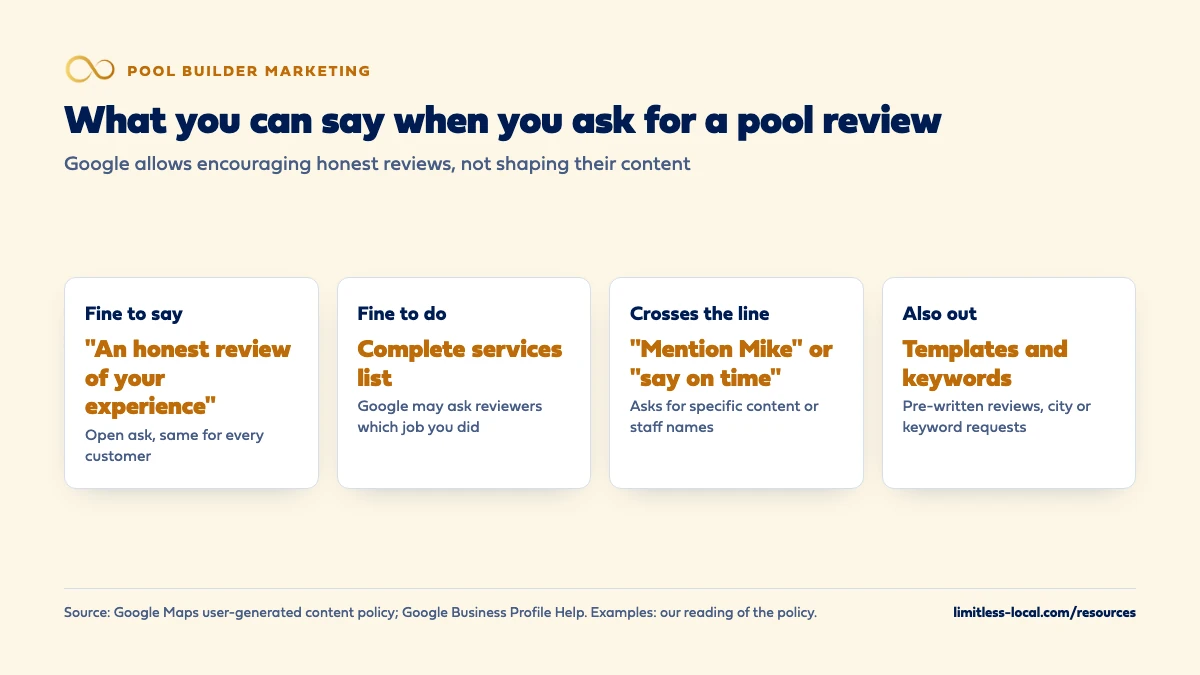
What can I say when I ask, and what crosses the line?
The line in Google’s policy is between encouraging a review and influencing what it says. In our reading, these fall on either side of it:
- Fine: “We’d be grateful for an honest review of your experience.” “Here’s the link; take your time.” “Other homeowners read these before they hire a builder.”
- Crosses the line: “Mention that we finished on time.” “Say something about Mike, our project manager.” “If you could use the words custom pool builder and your city, that helps us.” “Five stars would mean a lot.”
- Also out: a card in the owner’s binder listing “things to mention”, a pre-written review the customer only has to paste, or a draft you write for them with an AI tool. A pre-written review isn’t the customer’s evaluation in their own words.
Federal rules point the same way. The FTC’s rule on consumer reviews makes it a violation for a business to write or create a consumer review that misrepresents the reviewer’s experience, and the FTC’s guide for marketers tells businesses to know the platform’s rules before asking for reviews. That’s a summary, not legal advice. Sources: 16 CFR Part 465 and Soliciting and Paying for Online Reviews.
Curious what your marketing is actually booking?
Get a free visibility audit — no obligation, no sales pitch.
How does my services list shape what reviews say?
More than most owners realize. Google says customers reviewing a service business may be asked to identify what tasks the business performed, and that information is used in the review. The tasks come from your service list, your website or a standard list for your business type, and if a job type is missing, you can add it to your service list. Google’s help page on managing reviews adds that if the customer writes a review, their selection shows in it.
For a pool builder, that’s the one legitimate way to shape what a review says: make sure new pool construction, renovations, resurfacing, tile and coping, decking, or whatever you really do, are on the list. A homeowner looking for a renovation builder can then see reviews tagged with renovation work. What to put on that list is covered in optimizing your pool Google Business Profile. Sources: About reviews for service businesses and Manage customer reviews.
Should customers mention my city or keywords to help my ranking?
Don’t ask them to. Asking for a keyword or a city name is asking for specific content, which is the thing Google’s policy says not to do. Google says prominence draws on information such as how many reviews you have, and that more reviews and positive ratings can help local ranking. None of the Google help pages we cite say the words inside a review help a business rank, so we don’t make that claim, and we’d advise against chasing it.
In our judgement, it wouldn’t be worth it even if words did count: a review that reads like a keyword list looks planted to the homeowner reading it. Customers do often mention their town or neighborhood on their own, and that’s fine. If ranking in Maps is the real goal, ranking your pool company in Maps covers the levers that are yours to pull.
Is it okay if customers mention my staff by name?
Yes, when they do it on their own. Customers often name the project manager who ran their build or the crew lead who walked them through the equipment, and that’s a genuine detail other homeowners find useful. What Google’s policy rules out is the business asking for it, including asking staff to collect reviews that name a staff member. In our reading, that means no “please mention Mike”, and no review targets or bonuses for staff tied to being named.
In our judgement, the healthy way to use those mentions is internal. When a project manager keeps getting named, that’s a signal about how they run a job, and it’s worth recognizing in a way that has nothing to do with the review count.

Is it bad if a review mentions a delay or a problem?
Not necessarily. Google’s own advice says honest and balanced reviews can help potential customers decide, and that a mix of positive and negative feedback often feels more trustworthy. The same 2021 Spiegel report found that purchase likelihood across more than 40 retail categories peaked when the average rating was between 4.2 and 4.5 stars and dropped as it approached a perfect 5, and cited earlier research that 82 percent of shoppers specifically seek out negative reviews. Again, that’s retail data, not pool buyers.
Pool builds have delays nobody controls, such as permits, inspections and weather. A review that says “the permit took six weeks longer than expected, but they kept us posted every week” can do more for the next homeowner than a vague five stars. How to reply when a review is critical is covered in responding to negative pool reviews. Sources: Tips to get more reviews and Star Ratings and Review Content.
What should I do with the details customers write?
Three things, all allowed:
- Reply with substance. Google’s reply tips say to focus on reviews where you can share a helpful update or answer a question, to keep replies short, and to be conversational, not promotional. Adding a detail about the job, such as the finish or the startup, reinforces what the customer said.
- Share the review. Google lets you get a direct link to a customer’s review to share as a testimonial with new customers. Sending a few reviews of similar builds to a homeowner who’s comparing bids is a natural use.
- Feature it carefully. If you put reviews on your website or in ads, the FTC’s endorsement guidance says that if customers were told in advance their comments might be used in advertising, that fact should be disclosed, because the chance to be featured can be seen as having value.
Sources: Tips to get more reviews, Manage customer reviews and FTC’s Endorsement Guides: What People Are Asking.
What if a customer asks me what they should write?
It happens, especially with customers who like you and want to help. In our judgement, the safe answer turns the question back to their experience without supplying content: “Whatever stood out to you, good or bad. Other homeowners just want to know what it was really like.” If they push, “what you’d tell a neighbor who asked about us” keeps it in their words.
What we’d avoid is answering with a list, however casual. “Maybe mention the timeline and the design process” is exactly the specific content the policy describes. Train the person who asks at handover on this one question.
Want to see where your company stands?
A free visibility audit shows where you show up on Google, Maps and AI answers, and what it's costing you in calls.
What's different about review content for pool builders
One review covers months of work. A service call is one visit; a pool build is design, permits, excavation, steel, shell, tile, decking, startup and the first season. Customers have a lot to say.
New builds and renovations read differently. A homeowner planning a remodel wants to see renovation reviews. Google’s job selection, fed by your services list, is how a review shows what kind of job it was, so keep both kinds of work on the list.
Problems are visible and expected. A delayed inspection or a rain week is part of most builds. Reviews that mention them along with how you handled them are, in our judgement, among the most persuasive a pool builder can have.
Photos sell pools. Google lets customers post photo updates to your profile, which don’t affect your review score but are visible to other customers. Your own project photos matter more, and using project photos and videos covers how to post them. Source: Manage customer reviews.
A worked example: reading your last 20 reviews
These numbers are made up to show the method, not a benchmark. Since you can’t steer what customers write, the useful move is to read what they already say and treat it as feedback on the build. Pull your last 20 Google reviews and tally which topics come up on their own:
- 14 mention the project manager or crew by name or role.
- 11 mention communication, good or bad.
- 6 mention the schedule, and 4 of those mention a delay.
- 3 mention a renovation; the rest are new builds or don’t say.
- 2 mention the yard or cleanup after the build.
What that tells this builder: communication is what customers notice most, so the weekly update text during permits is worth protecting. Delays come up in 4 of 20 reviews, so the startup walkthrough is a good place to acknowledge them before the ask. Few reviews show renovation work, so check that renovations and resurfacing are on the services list, since that’s where Google’s job selection comes from. None of those fixes touches what the customer writes; all of them change what they have to write about.
Frequently asked questions
Can I give customers a sample review to show what a good one looks like?
We wouldn’t. A sample is a template, and customers tend to copy it, which turns it into a request for specific content. Showing them real reviews from other customers on your profile is a gentler way to show what’s useful, but don’t point at the parts you’d like repeated.
Can I ask a customer to add more detail to a short review?
In our reading of Google’s policy, no. Asking for more detail after the fact is still trying to influence the contents of the review. Thank them and move on; a short genuine review still counts toward your total.
Can I ask customers to mention a pool feature, like the spa or the lighting?
No. Naming a feature to mention is asking for specific content. If the spa was the highlight of their build, they’ll likely mention it on their own.
Can I ask for a photo with the review?
Google lets customers add photos, and photo updates don’t affect your review score. In our judgement, keep the ask itself about an honest review and let the customer decide whether to add photos; your own project photos are the bigger lever.
Do the aspects Google shows, like price, come from what customers write?
Google says customers of certain service businesses can rate specific aspects of their experience, and that you can’t change which aspects customers are asked about. Source: About reviews for service businesses.
Should customers mention reviews on other sites too?
In our judgement, one ask for one review is plenty. The FTC’s guide says to know each platform’s rules before asking, so check the rules of any other site before you send customers there.
Key takeaways
- Google doesn’t allow businesses to ask for specific content in reviews, including staff names.
- Ask every customer for an honest review at handover, with no list, template, keyword or rating hint.
- Keep your services list complete; it feeds the job selection Google may show in reviews.
- Reviews that mention delays and how you handled them can help more than a vague five stars.
- Read what customers mention on their own and fix the build experience, not the wording.
Not sure what's working right now?
Start with a free visibility audit: rankings, Google profile, reviews and tracking, checked against your service area.
More in this section
- How do I get more Google reviews for my pool company?
- How should a pool builder respond to negative Google reviews?
- How do I get my pool company to rank in Google Maps?
- How do I optimize a pool builder Google Business Profile?
- How should a pool builder set up its Google service area?
Sources
- Prohibited & restricted content — Maps User Generated Content Policy Help
- About reviews for service businesses — Google Business Profile Help
- Manage customer reviews — Google Business Profile Help
- Tips to get more reviews — Google Business Profile Help
- 16 CFR Part 465: Rule on the Use of Consumer Reviews and Testimonials — Electronic Code of Federal Regulations (FTC rule)
- Soliciting and Paying for Online Reviews: A Guide for Marketers — Federal Trade Commission
- FTC's Endorsement Guides: What People Are Asking — Federal Trade Commission
- Star Ratings and Review Content — Medill Spiegel Research Center, Northwestern University