
How do I position my pool company as a premium builder?
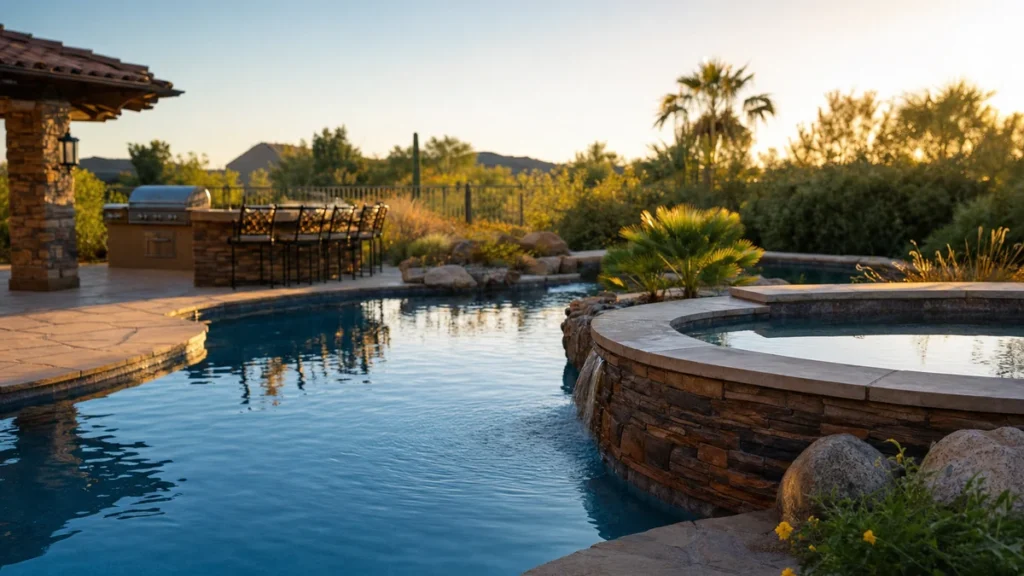
- How does a pool builder attract high-budget clients instead of competing on price?
- What does it mean to be a premium pool builder?
- Step 1: Who is my ideal high-budget pool client?
- Step 2: What makes my pool company worth more, and can I prove it?
- Step 3: How do I show my work like a premium builder?
- Step 4: How do I make my design and build process part of the pitch?
- Step 5: What kind of reviews help a premium pool builder?
- Step 6: How do I keep bargain shoppers out?
- Step 7: How should the consultation and proposal feel?
- Should a premium pool builder show prices on the website?
- What should a premium pool builder avoid?
- How do I know if premium positioning is working?
- What's different about premium positioning for pool builders
- A worked example: fewer pools, bigger contracts
- Frequently asked questions
- Key takeaways
- More in this section
- Sources
The short version
- Define the client and project you want before changing any marketing.
- Prove the difference with your own builds, your process and detailed reviews.
- Only claim what you can back up; "best" and "luxury" need evidence behind them.
- Filter bargain shoppers out and make the sales process match the price.
For pool construction owners who want bigger, better-fit projects and fewer bids decided on price alone.
Get a free visibility audit · Book a growth call
How does a pool builder attract high-budget clients instead of competing on price?
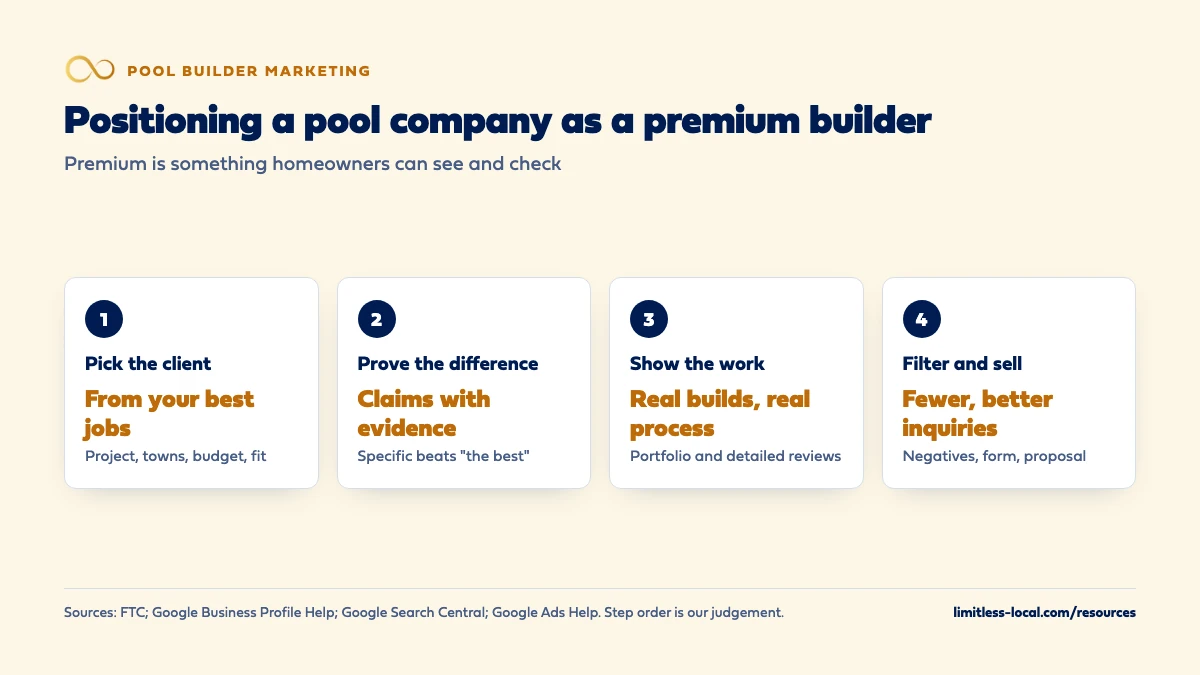
Position your pool company as a premium builder by choosing the high-budget client and project you want, then making every place a homeowner checks you prove why you’re worth more: a portfolio of your own finished pools with the story behind each, a design and build process explained step by step, and detailed reviews from past clients. Back every claim with evidence, filter out bargain shoppers in your ads and on your request form, and make the consultation and proposal feel like the premium experience you’re selling. Premium is something homeowners see, not a word on your website.
Most of premium positioning lives on your website and in your sales process, which is why we build pool sites as portfolios first. The agency was an equity partner in a pool construction company, where it streamlined back-office operations, built the lead-generation engine and ran sales and marketing. That business did $2M+ revenue in year one. Our website design work and the pool builder marketing page show how we approach it, and the rest of the pool builder marketing questions library goes question by question.
What does it mean to be a premium pool builder?
It means homeowners choose you for something other than the lowest number, and expect to pay more for it. That something is usually design, build quality, the way the project is run, or the kind of project you take on, such as custom gunite builds, difficult lots, or a full backyard with a spa, kitchen and hardscape.
In our judgement, premium positioning fails most often in one of two ways. Either the builder calls itself premium but its website, photos and sales process look like everyone else’s, or the builder really is better but never shows the proof, so homeowners line its bid up against cheaper ones and pick on price. The steps below are about closing both gaps.
Step 1: Who is my ideal high-budget pool client?
Start with your own signed contracts, not a guess. Pull the last two or three seasons and sort them by contract value and by how the job went. Then look at the projects you’d happily build again:
- The project: new build or renovation, pool type, size, and what came with it (spa, water features, outdoor kitchen, hardscape).
- The place: which towns and neighborhoods, and what kind of lots.
- The homeowner: how they found you, how long they took to decide, who made the decision, and how they paid.
- The fit: which clients were easy to work with, paid on time and referred others.
Write the result down in a paragraph your office manager, salesperson and marketing help can all repeat. A clear picture of the client is what keeps every later step pointed the same way. If your best clients cluster in a handful of towns, that also tells you where to focus ads and city pages.
Step 2: What makes my pool company worth more, and can I prove it?
Pick two or three real differences, not ten generic ones. Good candidates are things a homeowner can see or check: an in-house designer, a named project manager on every build, the materials you use, how you handle drainage on a sloped lot, or how you communicate during the build.
Then make sure you can back each one up. The FTC’s advertising guide for small businesses says advertising must be truthful and not deceptive, that advertisers must have evidence to back up their claims, and that the law requires that proof before the ad runs. The same guide notes that subjective claims customers can judge for themselves get less attention than claims they can’t easily check. “Beautiful custom pools” is opinion; “the most experienced builder in the county” or a specific warranty or performance claim needs evidence. This is general information, not legal advice.
In our view, the most convincing premium claims are specific and checkable: a process you can show, photos of your own builds, and reviews that describe what the homeowner got.
Step 3: How do I show my work like a premium builder?
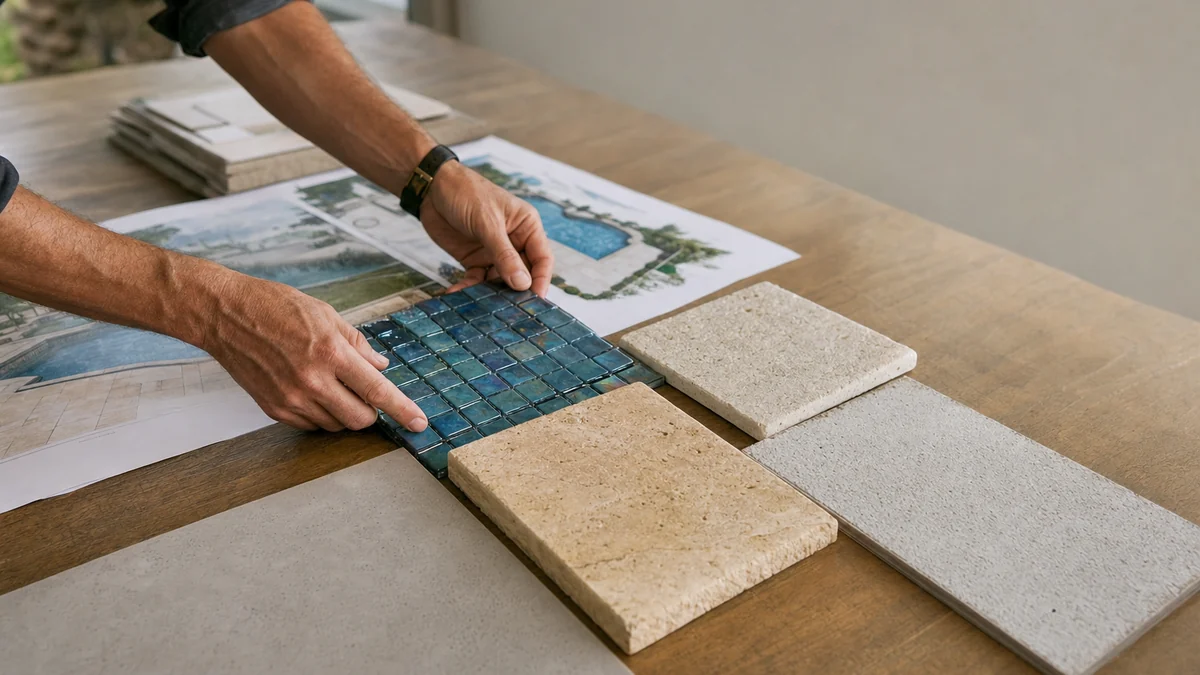
Your finished pools are the strongest evidence you have, so give them room. A premium portfolio, in our judgement, shows fewer projects in more depth: the backyard before, the build in progress, the finished pool in good light, and a short story about what the homeowner wanted and how you solved it. Using project photos and videos covers what to shoot at each stage.
Keep the photos real. Google’s Business Profile photo tips ask for photos that are in focus and well lit, with no significant alterations or excessive filters or AI, so the image represents reality, and suggest photos at work that show the type of work you do. A homeowner who sees an edited render in your gallery and a different pool at the walkthrough remembers the gap.
Step 4: How do I make my design and build process part of the pitch?
A premium price buys certainty as much as concrete. Homeowners spending this much want to know what happens, in what order, and who they’ll deal with. Write your process down and put it on the website:
- First conversation and site visit
- Design consultation and design
- Proposal, with what’s included and what isn’t
- Permits and scheduling
- The build, stage by stage, and how you’ll keep them updated
- Startup, walkthrough and what happens after
This is also the kind of page Google says it wants to rank. Its guide to helpful, reliable content asks whether content clearly demonstrates first-hand expertise and depth of knowledge, and whether it presents information in a way that makes you want to trust it. A process page written by someone who actually builds pools does that; a page of slogans doesn’t. What a pool builder website should include covers the rest of the site.
Curious what your marketing is actually booking?
Get a free visibility audit — no obligation, no sales pitch.
Step 5: What kind of reviews help a premium pool builder?
Detailed ones. A review that says “great job” helps a little; one that mentions the designer by name, how the crew handled a tricky yard and how the pool looks a year later helps a premium buyer decide. You can’t script that, though: Google’s review content policy says a business asking for reviews shouldn’t request that specific content be included. What you control is when and how you ask, covered in what pool customers mention in Google reviews.
Reviews matter more as the price goes up. In research on online retail shopping first published in 2017, Northwestern’s Spiegel Research Center found that displaying reviews raised the conversion rate 380% for a higher-priced product, against 190% for a lower-priced one. It also found purchase likelihood typically peaks at ratings between 4.0 and 4.7 and dips as ratings approach a perfect 5.0. That’s retail data, not pool data, but in our view the lesson carries: a few honest, detailed reviews with the occasional imperfect one can read as more believable than a wall of identical five-star ratings.
Keep it clean. The FTC’s Consumer Reviews and Testimonials Rule covers fake reviews and testimonials, and treats reviews a business pays for or incentivizes as testimonials. Getting more Google reviews for your pool company covers how to ask.
Step 6: How do I keep bargain shoppers out?
Premium positioning works partly by repelling the wrong inquiries. In our judgement, three places do most of the filtering:
- Your words. Drop “cheap”, “affordable” and “lowest price” from your site and ads. Talk about design, process and what’s included.
- Your ads. Google’s negative keyword help says negative keywords let you exclude search terms so you focus on the keywords that matter to your customers. In our judgement, a premium builder will often exclude searches like cheap, kit, DIY or above-ground. Google also notes that negative keywords don’t match close variants, so add plurals and other forms yourself.
- Your request form. Ask about the project type, timeline and investment range before the consultation. Qualifying leads before the design consultation covers how to ask without scaring good clients off.
If you have a real minimum project size, saying so on the site is one of the clearest premium signals there is, as long as it’s true.
Step 7: How should the consultation and proposal feel?
Like the rest of the brand promised. In our view, this is where most of the premium price is won or lost, because the homeowner has finally met you. That means a fast, personal reply to the first inquiry, a design consultation that’s prepared (you’ve looked at the property and their inspiration photos), and a proposal that explains what’s included, what isn’t, and why your number is what it is.
Follow-up should match too: a scheduled next step after the proposal, not a “just checking in” text two weeks later. Turning design consultations into signed contracts goes deeper on the sales side.
Should a premium pool builder show prices on the website?
Not a price list, in our judgement, because every custom pool is different and a single number invites comparison on the wrong thing. But some price signal usually helps a premium builder: a typical project range or a minimum, stated honestly, lets the right homeowners self-select and saves your designer from consultations that were never going to sign.
If you mention financing, be careful with the wording. Under the federal Truth in Lending rules (Regulation Z’s advertising section), a credit ad that states certain terms, such as a payment amount or a down payment, must also state other terms, including the annual percentage rate. This is general information, not legal advice; get financing language from your lender or an attorney.
What should a premium pool builder avoid?
- Claims you can’t back up. “Best”, “number one” and “most trusted” invite a question you need evidence to answer.
- Stock photos and renders presented as your builds. Label any 3D design as a design.
- Discounting to win a bid. A premium builder that matches the cheapest number teaches homeowners its price was never real.
- A brand that changes from channel to channel. Your truck, yard signs, website, Google profile and proposal should look and sound like the same company.
- Waiting for premium clients to find you. Premium positioning still needs marketing; it just aims it at fewer, better-fit homeowners.
How do I know if premium positioning is working?
Watch the mix, not just the count. In our judgement the signs are: a higher average contract value, more inquiries in your target project range, fewer consultations lost on price alone, and a close rate that holds or improves on the projects you want. Lead volume may drop; that’s fine if signed revenue goes up.
None of that is visible unless each inquiry carries its source and each contract its value, so tag them from the first call. Give it a full selling season before you judge, because a pool homeowner can take months from first look to signature.
Not sure which of these is costing you jobs?
A free visibility audit checks the Google profile, reviews, site and tracking, and shows what to fix first.
What's different about premium positioning for pool builders
The product is visual and permanent. A homeowner is buying something they’ll look at every day for years, so photos, design and finish carry more weight than in a trade that fixes something behind a wall.
Bids get compared line by line. Pool buyers often collect several proposals for the same backyard. If your proposal reads like the others, the comparison comes down to the total. In our view, a premium builder’s proposal should make the differences visible: what’s included, the materials, who manages the build.
The decision is long and shared. Two decision-makers, financing, an HOA or a permit often stand between the first call and the signature. Premium positioning has to hold up over months of browsing your site, your profile and your reviews, not just one meeting.
Renovations can be premium too. A full remodel with new tile, coping and automation can be as much of a design project as a new build. If that’s work you want, show it with the same care.
A worked example: fewer pools, bigger contracts
These numbers are made up to show the math, not a benchmark. Say last year you signed 20 pools averaging $65,000, or $1,300,000 in contracts. This year you aim at larger custom builds and sign 15 averaging $95,000, or $1,425,000.
Now add marketing. If you spend $6,000 a month (our Essentials package at $3,500 plus $2,500 in Google Ads spend paid to Google), that’s $72,000 a year. Spread over 20 pools, marketing costs $3,600 per signed pool, about 5.5% of contract value. Over 15 pools it’s $4,800 per pool, but about 5.1% of contract value, with five fewer builds for your crews to staff.
So cost per signed contract went up while the share of revenue spent on marketing went down. That’s why, in our judgement, a premium builder should judge marketing by cost per contract against the value of the contract, not by cost per lead. For reference, our themed websites start at $3,750 and custom sites from $5,000, and our web work has won 9 web design awards. A free visibility audit is the place to run this math with your own contract mix.
Frequently asked questions
Can I call my pool company "the best" in my area?
Only with care. The FTC says advertisers need evidence for their claims before an ad runs, and treats subjective opinion differently from claims customers can’t easily check. Specific, provable differences are safer and more convincing.
Do I need a perfect five-star rating to look premium?
No. Spiegel Research Center’s retail research, first published in 2017, found purchase likelihood typically peaks at ratings between 4.0 and 4.7. Detailed, genuine reviews matter more than a perfect score.
Can I use 3D renderings in my pool portfolio?
Yes, if they’re labeled as designs. Google asks that Business Profile photos represent reality, so keep renders out of your profile’s photos of finished work.
Will premium positioning lower my lead count?
Often, yes, and in our judgement that’s expected. Judge it by average contract value and signed revenue, not inquiry volume.
Should I stop doing small pool jobs to look premium?
Not necessarily. Keep work that’s profitable and fits your crews, but lead your marketing with the projects you want more of.
How long does it take to reposition a pool company?
There’s no fixed timeline. Website and portfolio changes can go live quickly, but reviews and a body of premium projects build over seasons, and SEO typically takes 3 to 6 months to show meaningful growth.
Key takeaways
- Define your ideal high-budget client from your own best contracts.
- Pick two or three provable differences and back every claim with evidence.
- Show real builds, a written process and detailed reviews; label renders as designs.
- Filter bargain shoppers with your wording, negative keywords and request form.
- Judge success by average contract value and cost per signed contract, not lead count.
Want a second set of eyes on your setup?
We'll look at how you show up locally and where calls are leaking, then send you a plain-English breakdown.
More in this section
- How should pool builders nurture leads who plan to build next year?
- How do pool builders stop attracting price shoppers?
- How do I advertise a pool construction company?
- How do pool builders qualify leads before the design consultation?
- What keywords should a pool builder target?
Sources
- Advertising FAQ's: A Guide for Small Business — Federal Trade Commission
- The Consumer Reviews and Testimonials Rule: Questions and Answers — Federal Trade Commission
- Tips for business-specific photos on your Business Profile — Google Business Profile Help
- Creating helpful, reliable, people-first content — Google Search Central
- How Online Reviews Influence Sales — Spiegel Research Center, Northwestern University
- § 1026.24 Advertising — Consumer Financial Protection Bureau
- About negative keywords — Google Ads Help
- Prohibited & restricted content — Maps User Contributed Content Policy Help