
How do I know if my pool marketing agency is working?

- How can a pool builder tell if a marketing agency is getting real results?
- What does "working" mean for a pool marketing agency?
- What should I look at in the first three months, before contracts sign?
- How do I check the Google Ads work myself?
- How do I check the SEO and Google profile work myself?
- How do I check lead quality without trusting the agency's report?
- How do I match the agency's leads to signed contracts?
- Why compare this season with last season instead of last month?
- How do I keep home shows, referrals and past customers out of the agency's numbers?
- Is it the agency, or is it my sales process?
- What are the signs a pool agency isn't delivering?
- What should I do if the numbers aren't there?
- What's different about judging an agency for a pool company
- A worked example: the winter that looked like a failure
- Frequently asked questions
- Key takeaways
- More in this section
- Sources
The short version
- Working means signed contracts traced to the agency's channels at a cost per contract you can afford.
- In the first months, judge tracking, lead quality and booked consultations, not contracts.
- Check the search terms, Search Console and call recordings yourself with your own logins.
- Compare like seasons, and keep shows, referrals and past customers in their own columns.
For pool builders already paying an agency and trying to tell results from activity.
Get a free visibility audit · Book a growth call
How can a pool builder tell if a marketing agency is getting real results?
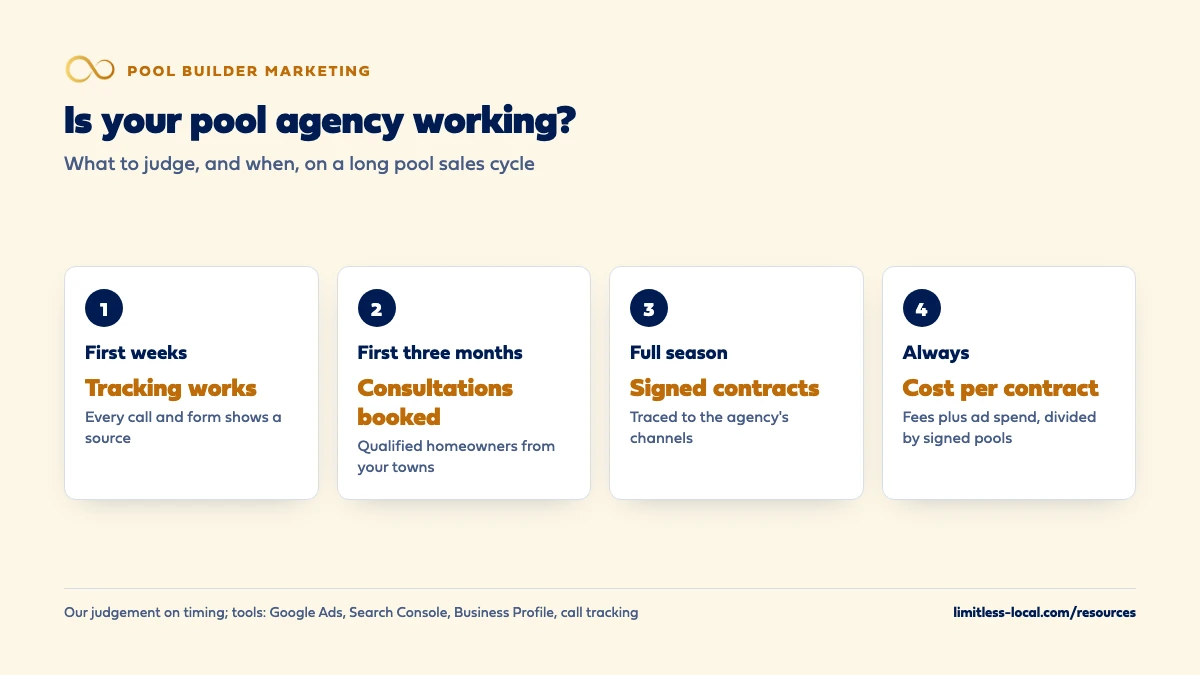
Your pool marketing agency is working if you can trace signed contracts back to its channels at a cost per contract your profit on a pool can carry. Because pool contracts often sign months after the first inquiry, judge the early months on qualified inquiries and booked design consultations from your towns, and judge contracts over a full season. Check the numbers in your own Google Ads, Search Console, Business Profile and call tracking logins, and keep shows and referrals out of the agency’s column.
At Limitless Local, every package includes call tracking with recording, source tagging, a real-time dashboard and monthly performance reports with a cost-per-lead breakdown, so the numbers on this page are ones you can see for yourself. If you’d like a second opinion on what your current agency is reporting, the pool builder marketing page shows what we run for pool companies, and package details are on the packages page. More questions like this one are in the pool builder marketing questions library.
What does "working" mean for a pool marketing agency?
It means signed pool contracts you can trace back to the agency’s work, at a marketing cost per contract that your profit on a pool can carry. Everything else in the report is a step on the way there.
For a pool builder, those steps usually look like this:
- Inquiries: calls, forms and messages from the agency’s channels.
- Qualified leads: homeowners in your towns who want the kind of pool you build.
- Design consultations booked and held.
- Proposals sent.
- Signed contracts, with the contract value.
An agency that reports only the first step is asking you to take the rest on faith. One that reports all five, by source, is giving you something you can check. In our judgement, the agency is mainly responsible for the first three steps, and you and your sales team carry most of the last two.
What should I look at in the first three months, before contracts sign?
Pool contracts often sign months after the first inquiry, so the early months have to be judged on setup and the top of the ladder. In our judgement, these are the questions to ask in that window:
- Is tracking working? Every call and form should show a source. Place a test call and send a test form yourself and check that they show up.
- Are inquiries coming from the towns you build in? A pile of leads from outside your service area is a setup problem, not a result.
- Are consultations being booked? If inquiries rise but consultations don’t, look at lead quality and at how fast your office calls back.
- Can the agency explain what it changed? Google says a good SEO should be willing to explain all the changes they make to your site. Source: Do you need an SEO?.
Ads can start bringing in inquiries within days of launch, so an ads account with nothing to show after the first weeks deserves a hard look. SEO typically takes 3 to 6 months to show meaningful organic growth, so early SEO judgement is about the work being done and the direction of the numbers. The longer view is in how long pool builder SEO takes.
How do I check the Google Ads work myself?
Open the search terms report in your Google Ads account. Google describes it as the list of actual searches that triggered your ads and how those searches performed, and the Keyword column shows which of your keywords matched each search. Google’s own example is a flower seller whose broad keyword showed ads for flowers they don’t sell. Source: About the search terms report.
For a pool builder, scan it for searches that can’t become a pool contract: pool supplies, chemicals, cleaning or opening services, above-ground pool kits, public pools, jobs. A few are normal. A report where those make up a big share of the clicks means money is going to the wrong searches, and the agency should be adding negative keywords and tightening match types.
You need your own login to do this. If you don’t have admin access to your Google Ads account, that’s the first thing to fix; the questions to ask about access are in what to ask before hiring.
How do I check the SEO and Google profile work myself?
- Search Console Performance report. It shows clicks, impressions, average position and the queries that bring people to your site, and its default view covers the past three months. Group by query and look for pool construction searches with your town names rising over time, not just your company name. Weekly and monthly views smooth out short swings. Source: Performance report (Search results).
- Google Business Profile performance. Owners and managers can see views, the searches people used to find the profile, calls, website clicks, direction requests and messages, for a date range you pick. Two cautions from Google: the data includes interactions from both organic results and Google Ads, and the searches metric updates at the start of each month and can take up to 5 days to appear. Source: Understand your Business Profile performance & insights.
Because profile numbers mix organic and ad activity, in our judgement an agency shouldn’t credit a jump in profile calls to SEO alone if it also turned on ads that month. Ask it to show the two separately where the tools allow.
How do I check lead quality without trusting the agency's report?
Listen to the calls. If your agency uses call tracking, you should be able to log in and see each call, its source and, where recording is on, hear it. CallRail’s Call Log, for example, lets you filter by date, source and tags, filter to first-time callers only, and compare two time periods. It also notes that its attribution columns typically show the contact’s first touch, meaning how they first engaged with your company. Source: Call Log.
Pick ten calls a month at random and sort them into three piles: homeowners asking about a new pool or renovation you’d take, existing customers and service calls, and junk. In our judgement, that ten-minute exercise tells you more about lead quality than any chart in the monthly report. If the junk pile keeps growing, ask the agency what it’s changing. If good leads are coming in but not booking, the fix may be on your side; screening before the consultation is covered in qualifying pool leads.
Curious what your marketing is actually booking?
Get a free visibility audit — no obligation, no sales pitch.
How do I match the agency's leads to signed contracts?
Record the source on every lead in your own system the day it comes in, then let your software tie it to what happened next. Jobber’s Lead Source Report, for example, shows leads by source along with how many of them got a quote, a job and an invoice, plus the value of the first invoice tied to each lead. Source: Lead Source Report. Most field service and CRM tools have something similar.
For Google Ads, the account itself can learn about contracts if you send them back. Google’s example of an offline conversion is a person signing a contract after clicking an ad: you keep the click ID with the lead and return it when the contract signs. For accounts that haven’t set this up, Google recommends starting with enhanced conversions for leads. Source: About offline conversion imports.
The full setup, from tracking numbers to the monthly review, is in tracking which marketing signs contracts.
Why compare this season with last season instead of last month?
Pool demand moves with the calendar, so one month against the month before often measures the weather more than the agency. In our judgement, the fairer comparisons are the same months last year, and a rolling view that’s long enough for consultations to turn into contracts.
Watch the reporting windows too. Google Ads only counts a conversion inside the conversion window set for it; the default is 30 days, and Search campaigns can be set to 30, 60 or 90 days depending on the conversion source. A conversion after the window isn’t recorded, and changing the window doesn’t count past conversions retroactively. Source: About conversion windows. If a pool contract signs after the window closes, the Google Ads report will never show it, so your own lead log has to.
How do I keep home shows, referrals and past customers out of the agency's numbers?
Give each one its own lead source and keep it out of the agency’s column. Home and garden shows, referrals from landscapers or home builders, repeat customers and neighbors who watched you build next door all produce contracts the agency didn’t create.
The reverse matters too. A homeowner who first saw you at a show and later searched your name and clicked an ad can show up as an ad lead. In our judgement, asking “how did you first hear about us?” at the consultation, and writing the answer next to the tracked source, is the cheapest way to keep both sides honest.

Is it the agency, or is it my sales process?
Look at where the drop happens. If good-fit inquiries are coming in and consultations are booked, but few turn into signed pools, the weak step is usually after the agency hands over the lead: response time, the consultation itself, the proposal, financing or follow-up. If inquiries are thin, from the wrong towns or mostly junk, the problem sits closer to the agency.
This split is our judgement, not a rule; a good agency should help you see it, not hide behind it. If the drop is after the consultation, turning consultations into contracts is the place to start.
What are the signs a pool agency isn't delivering?
In our judgement, these are the ones to watch:
- The report is the same every month and never mentions consultations or contracts.
- They can’t say where last month’s best leads came from.
- You can’t log in to your own Google Ads account, profile or call tracking.
- Nobody can tell you what was changed this month or why.
- Every bad month is blamed on the season, and every good month is credited to the agency.
Google’s hiring advice covers the last word on secrecy: be careful if a company is secretive or won’t clearly explain what it intends to do, and remember you’re responsible for the actions of any company you hire. Source: Do you need an SEO?.
What should I do if the numbers aren't there?
Put the numbers in front of the agency and ask for a written plan: what they’ll change, by when, and which number should move. Give it a fair window that fits the channel, shorter for ads than for SEO. If the plan doesn’t come, or the numbers don’t move, make sure you have admin access to every account before you give notice, then leave. If you’re weighing a new agency against taking some of the work in-house, hiring an agency or doing it yourself covers that decision.
For what it’s worth, that’s how we’d want to be judged too. We ask for three months in our contract, but if you want to leave, we won’t make you stay.
Not sure which of these is costing you jobs?
A free visibility audit checks the Google profile, reviews, site and tracking, and shows what to fix first.
What's different about judging an agency for a pool company
The lag is long. A roofer or plumber can often see a job within days of the call. A pool builder may wait months between the first inquiry and a signed contract, so the early evidence has to come from consultations and lead quality.
The calendar distorts month-to-month numbers. Inquiries, consultations and signings don’t peak at the same time. Comparing like seasons is fairer than comparing neighboring months.
A few contracts decide the year. Because each pool is a large sale, one or two contracts more or less can swing the cost per contract a long way. In our judgement, judge on a season of data, not a single month.
Lots of contracts come from outside marketing. Shows, referrals and neighbors matter more in pools than in most trades, which makes clean lead sources essential before you credit or blame an agency.
A worked example: the winter that looked like a failure
These numbers are made up to show the math, not a benchmark. Say you pay $7,000 a month in fees and ad spend through January, February and March, $21,000 in all. The agency’s channels bring 45 inquiries and 14 design consultations in those three months, and no contracts sign before March ends.
Judged in March, that’s $21,000 for nothing signed. Then 4 of those consultations sign in April, May and June. Counted against the winter spend, that’s $5,250 per signed pool.
Whether $5,250 is good depends on what a pool earns you, which only you know. But the March view and the June view describe the same agency doing the same work. The difference is whether you waited long enough for consultations to close, and whether your lead log tied those April signings back to the January inquiries.
Frequently asked questions
How long should I give a pool marketing agency?
Judge setup and lead quality in the first few months, and contracts over a full season. Ads can bring inquiries within days, while SEO typically takes 3 to 6 months to show meaningful growth.
Should my agency report cost per lead or cost per contract?
Both, if it can. Cost per lead shows whether the channels are efficient; cost per signed contract shows whether the marketing paid for itself.
My agency says rankings are up but the phone isn't ringing. Who's right?
Rankings for searches homeowners don’t use, or outside your towns, don’t book consultations. Ask which queries moved in Search Console and whether consultations from those pages went up.
Can I see what my agency changed in Google Ads?
With your own login you can review the account, including the search terms report. A good agency will also tell you what it changed and why without being asked.
What if my agency won't give me access to my accounts?
Treat it as the first problem to fix. In our judgement, the Google Ads account, Business Profile, website and call tracking should all be accessible to you as the owner.
Is it normal for a pool agency to have a slow first winter?
Winter inquiries may sign in spring, so a slow-looking winter can still pay off. What isn’t normal is a winter with no consultations and no clear plan.
Key takeaways
- An agency is working when signed contracts trace back to its channels at a cost per contract your margin can carry.
- Judge the first months on tracking, lead quality and booked consultations; judge contracts over a season.
- Check search terms, Search Console, profile performance and call recordings in your own logins.
- Keep shows, referrals and past customers in their own lead sources.
- If good leads aren’t signing, look at your consultation and follow-up before blaming the agency.
Want a second set of eyes on your setup?
We'll look at how you show up locally and where calls are leaking, then send you a plain-English breakdown.
More in this section
- What should a pool builder ask before hiring a marketing agency?
- Should I hire a pool marketing agency or do it myself?
- How do I track which marketing produces signed pool contracts?
- How much should a pool builder spend on marketing?
- Does my pool company website need a redesign before marketing?
Sources
- About the search terms report — Google Ads Help
- Performance report (Search results): Overview and basic setup — Search Console Help
- Understand your Business Profile performance & insights — Google Business Profile Help
- Call Log — CallRail Help Center
- Lead Source Report — Jobber Help Center
- About offline conversion imports — Google Ads Help
- About conversion windows — Google Ads Help
- Do you need an SEO? — Google Search Central