
How much should a pool builder spend on marketing?

- What's a realistic monthly marketing budget for a pool construction company?
- How should a pool builder set a marketing budget?
- What do the percent-of-revenue rules of thumb say?
- What should a pool builder's marketing budget cover?
- How much of the budget should go to Google Ads?
- Why does a long sales cycle change how I judge the budget?
- Should a pool builder spend the same amount every month?
- Is $5,000 a month too much for pool construction marketing?
- When should I raise my pool marketing budget?
- How do I know if I'm spending too little?
- What does it cost to hire an agency compared with doing it yourself?
- What's different about marketing budgets for pool builders
- A worked example: working a pool builder's budget backward
- Frequently asked questions
- Key takeaways
- More in this section
- Sources
The short version
- Start from signed contracts wanted, then work back through close rate and consultation rate.
- Set a ceiling on marketing cost per signed pool that your profit per pool can carry.
- Use percent-of-revenue rules only as a rough check; big tickets can make the percentage look low.
- Judge over a full season, because contracts sign months after the marketing that found them.
For pool builders deciding how much to put into marketing, and how to tell whether the number they’re spending now is too little or too much.
Get a free visibility audit · Book a growth call
What's a realistic monthly marketing budget for a pool construction company?
A pool builder should spend what it takes to sign the number of pools it wants, at a marketing cost per signed contract its profit per pool can carry, so work the budget backward from contracts, not forward from a percentage. Percent-of-revenue rules of thumb are a rough check at best: a Canadian development bank suggests 5 to 10% of revenue for consumer-facing businesses, while a 2019 SBA blog post says there’s no hard and fast answer. Because pool buyers take months to decide and demand is seasonal, judge the spend over a full season and by signed contracts, not by a single month of leads.
The number that matters is cost per signed contract, not cost per lead, and we recommend an ad budget after a quick audit rather than from a percentage. Our packages are public: Essentials is $3,500 a month and Growth is $4,500 a month, with ad spend paid directly to Google or Meta on top. The packages page lists what each includes, our pool builder marketing page covers how we approach the trade, and the rest of the pool builder marketing questions library goes question by question.
How should a pool builder set a marketing budget?
Backward from the contracts you want, in four steps:
- Signed pools wanted from marketing this year, beyond what referrals and repeat customers already bring.
- Your close rate from design consultation to signed contract, from your own records.
- Your consultation rate: how many new leads book a consultation.
- Your ceiling: the most you’ll pay in marketing per signed pool, set from your profit per pool, not your contract price.
Multiply the contracts you want by that ceiling and you have the most the year’s marketing can cost. The steps in between tell you how many consultations and leads that money has to produce. In our judgement, this is the only way to set a budget you can defend, because it ties every dollar to a contract. If you don’t know your close rate or consultation rate yet, tracking which marketing produces signed contracts is the first job, and it’s worth doing before you raise any budget.
What do the percent-of-revenue rules of thumb say?
They give a range, not an answer. A 2019 SBA blog post on marketing budgets says there’s no hard and fast answer to how much a small business should spend, that many businesses use a percentage of revenue as a guide, and that the range is wide. It cites a Web Strategies figure of 11.8% of revenue for business-to-consumer services companies in 2018, an average across all such companies, not pool builders, and says new businesses usually need to budget more than established ones while they build awareness. Canada’s Business Development Bank (BDC), writing for Canadian small businesses, gives a common rule of thumb of 5 to 10% of revenue for business-to-consumer companies.
For a pool builder, treat those as a sanity check, not a target. A single pool is a large contract, so in our judgement a builder with a healthy cost per signed pool can land below those ranges, while a new builder trying to get known may need to spend above them for a while. The SBA post suggests asking your industry trade association or reading trade publications for benchmarks, and BDC suggests researching what’s common in your industry. Sources: How to Get the Most From Your Marketing Budget (SBA) and What is the average marketing budget for a small business? (BDC).
What should a pool builder's marketing budget cover?
More than ad spend. BDC suggests splitting a marketing budget across categories such as the website, social media, online advertising, video and training. For a pool builder, our list looks like this:
- Ad spend, paid to Google or Meta.
- Management: an agency’s fee, or the hours you or a staff member spend running it.
- Website: a portfolio-style site with real project pages, plus hosting and upkeep.
- Photos and video of your builds.
- Software for tracking calls, forms and follow-up.
- Your Google Business Profile and reviews, which cost time more than money.
Count all of it when you work out cost per signed contract. In our judgement, owners who count only ad spend tend to think marketing is cheaper than it is, and then can’t explain why the profit didn’t show up.
How much of the budget should go to Google Ads?
Enough to reach the homeowners who are actively searching for a pool builder in your area, and no more than your cost-per-contract ceiling allows. Google’s Keyword Planner shows suggested bids based on what other advertisers pay for the same keywords and location, which is the input you need to estimate what a month of clicks costs in your market. BDC’s advisor, writing for Canadian small businesses, suggests planning for at least $1,000 a month in search advertising for it to be effective; that’s one advisor’s starting point, not a rule.
Google asks for an average daily budget rather than a monthly one, and says to divide the monthly figure by 30.4, the average number of days in a month. It also says a campaign can spend more than the daily average on busy days and less on quiet ones, with the month capped at 30.4 times the daily average for most campaigns. Whether search ads pay off for your business is its own question, covered in whether Google Ads are worth it for pool builders. Sources: How to use the Keyword Planner tool effectively and About average daily budgets.
Curious what your marketing is actually booking?
Get a free visibility audit — no obligation, no sales pitch.
Why does a long sales cycle change how I judge the budget?
Because the contract shows up long after the money is spent. A homeowner who first clicks your ad in winter might book a design consultation in early spring and sign in late spring. If you judge a month’s marketing by that month’s contracts, you’ll cut spend that was working and credit the wrong month.
In our judgement, judge in two layers. Month to month, watch the leading numbers: new leads, consultations booked and your cost per consultation. Over a full season, judge on signed contracts and cost per signed contract. Channels ramp differently too: ads can generate leads within days of launch, while SEO typically takes three to six months to show meaningful organic growth, and for a pool builder the contracts come after that. How long pool builder SEO takes to bring in leads covers that ramp.
Should a pool builder spend the same amount every month?
Not usually. Spring and summer are busy and leads slow down in winter, so in our judgement the paid side of the budget should rise ahead of the season, when homeowners are researching and booking consultations, rather than once your build calendar is already full. What keeps running year-round is the slow-building work: your Google Business Profile, reviews, the website and any SEO, because cutting them in the off-season means starting the ramp over in spring.
The other reason to keep some spend going in winter is the sales cycle. Homeowners who start planning in the cold months are the ones signing for spring builds. Keeping leads coming in the off-season covers what to run when demand is low. Google Ads makes the up-and-down easy: you can change your average daily budget at any time.
Is $5,000 a month too much for pool construction marketing?
It depends on what it signs. $5,000 a month is $60,000 a year. If each signed pool leaves you, say, $20,000 in profit (a made-up figure for illustration), that budget pays for itself once it brings in three extra signed pools a year, and anything beyond that is profit after marketing. For a builder with a full calendar and a good close rate, that can be a modest number; for a builder who can’t answer the phone during the day or doesn’t follow up after consultations, it can be money wasted.
So the honest answer is to run your own figures through the backward math above. If your profit per pool, close rate and capacity say three or four extra contracts a year are realistic, the spend is in range. If they don’t, the fix may be in your follow-up or your consultation process, not the budget; qualifying leads before the design consultation is often where that starts.

When should I raise my pool marketing budget?
When three things are true. In our judgement:
- The tracking says it’s working. You can see your cost per signed contract by channel, and it’s below your ceiling.
- You have room. Your build calendar, crews and permits can handle more contracts in the season you’re selling into.
- The leads are being worked. Calls are answered, consultations are booked quickly and every quote gets followed up.
If any one of those is missing, more budget mostly buys more of the same problem. When they’re all true, raise one channel at a time and give it long enough to show up in consultations before judging it. The SBA post adds a warning worth keeping in mind: cutting marketing because sales are slowing can push sales down further.
How do I know if I'm spending too little?
The signs, in our judgement, are on your calendar more than in your ad account. Your consultation calendar has gaps in peak season; you’re signing fewer pools than your crews can build; and when you search for your own services in the towns you want, you rarely see your business in the ads, the map results or the regular results. Google Ads can also mark a campaign “Limited by budget” when it judges the campaign is underperforming because of its budget, and it will suggest a recommended budget. That recommendation is aimed at more clicks and impressions, so in our judgement treat it as one input and check it against your cost per signed contract before applying it. Source: Fix “Limited by budget” status.
Before raising the budget, check the cheaper fixes: is your Google Business Profile complete, do you have recent reviews, and are leads answered quickly? If those are already in order and the calendar still has gaps, the budget is a likely culprit.
What does it cost to hire an agency compared with doing it yourself?
Doing it yourself costs the ad spend plus your time, and the time is real during building season. Hiring an agency adds a monthly fee on top of ad spend. Ours are public: Essentials is $3,500 a month for one location and includes Google Ads management for up to $2,500 a month in ad spend; Growth is $4,500 a month and adds a second location, a larger ad spend allowance and Meta remarketing; Scale is custom. Ad spend isn’t included in any package and is paid directly to Google or Meta. We ask for three months in the contract, but if you want to leave, we won’t make you stay.
Put any agency’s fee into the same cost-per-contract math as your ad spend. Hiring a pool marketing agency or doing it yourself covers the rest of that decision.
Not sure which of these is costing you jobs?
A free visibility audit checks the Google profile, reviews, site and tracking, and shows what to fix first.
What's different about marketing budgets for pool builders
Big tickets, few contracts. A pool builder can carry a much higher marketing cost per signed contract than a service company can per job, because each contract is worth so much more. That’s also why percent-of-revenue rules can mislead in both directions.
Lag between spend and contract. The money goes out months before the contract comes in, so you need the cash to fund a season of marketing before it pays back. Plan the budget for the year, not the month.
Seasonality. Most homeowners want to be swimming by summer, so the marketing that fills your calendar has to run before and during the research months, not only when you’re already busy.
New builds and renovations. A renovation or resurfacing contract is smaller than a new build and often decided faster. If you sell both, in our judgement it’s worth tracking cost per signed contract for each separately, because a blended number can hide that one is profitable and the other isn’t.
A worked example: working a pool builder's budget backward
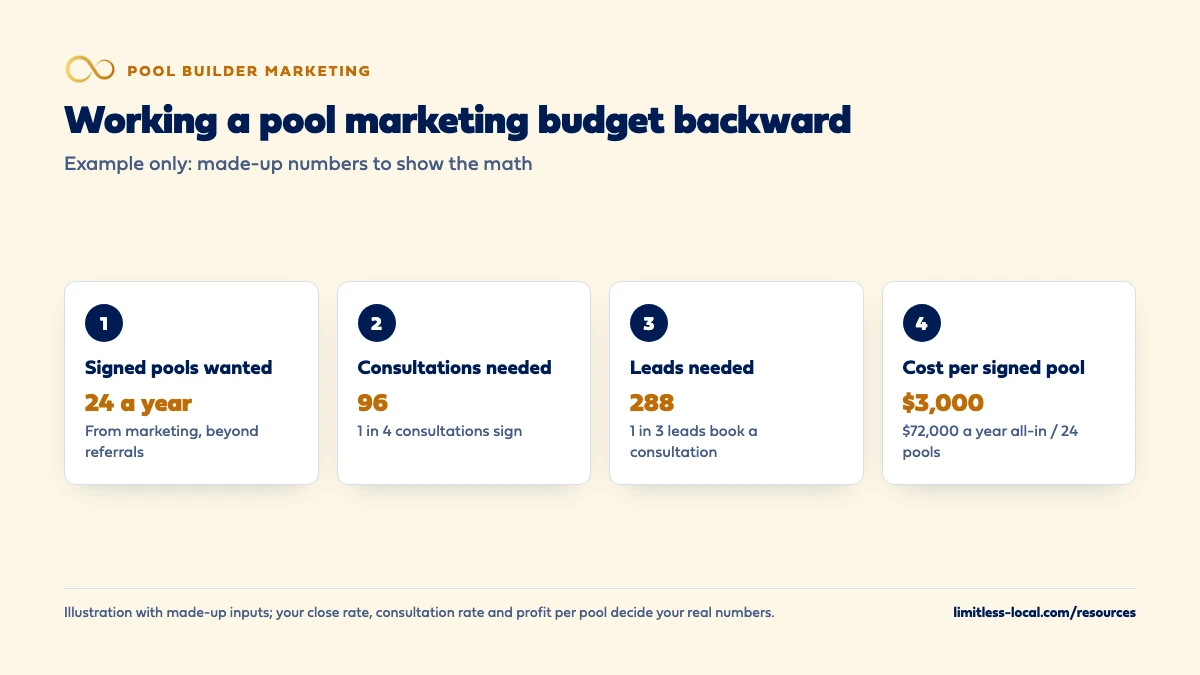
These numbers are made up to show the math, not a benchmark for your market. Say you want 24 signed pools a year from marketing. About 1 in 4 of your design consultations sign, so you need 96 consultations. About 1 in 3 leads book a consultation, so you need 288 leads over the year.
Now the budget. Say you spend $6,000 a month all-in: our Essentials package at $3,500 plus $2,500 a month in Google Ads spend paid to Google. That’s $72,000 a year. If it produces those 24 contracts, each signed pool cost $3,000 in marketing, and each consultation cost $750. In Google Ads terms, the $2,500 monthly spend is an average daily budget of about $82.
Is that a good deal? If each pool leaves $20,000 in profit, marketing takes 15% of the profit on each one. And if the average contract is $80,000, those 24 pools are $1,920,000 in revenue, so marketing ran at about 3.75% of the revenue it brought in, below the 5 to 10% rule of thumb even though the cost per contract is healthy. That’s why the contract math, not the percentage, should set your budget.
Frequently asked questions
Should referrals and repeat customers count toward my marketing budget?
Leave them out of the backward math. In our judgement, budget for the contracts you need beyond what referrals already bring, and track referrals separately so marketing doesn’t get credit for them.
Is ad spend included in an agency's monthly fee?
Not with us. Ad spend isn’t included in any of our packages; it’s paid directly to Google or Meta. Ask any agency you talk to the same question, in writing.
Can I pause marketing in winter to save money?
You can pause or lower ads; Google lets you change your average daily budget at any time. In our judgement, keep the slower-building work going, because restarting SEO and reviews in spring means starting the ramp over.
How long before I can tell if my marketing budget is working?
Watch leads and consultations monthly, and judge signed contracts over a full season. Ads can bring leads within days, while SEO typically takes three to six months to show meaningful organic growth.
Do Local Services Ads belong in a pool builder's budget?
Check first whether Google offers Local Services Ads for your pool services in your area before budgeting for them. If it doesn’t, plan around search ads, your Google Business Profile, your website and remarketing.
What if a competitor is outspending me?
In our judgement, you don’t have to match it. A smaller budget with fast follow-up, strong reviews and real project photos can sign more pools per dollar than a bigger budget without them; the cost-per-contract math tells you which you have.
Key takeaways
- Work the budget backward from signed pools, close rate and consultation rate.
- Set a ceiling on marketing cost per signed pool from your profit per pool.
- Percent-of-revenue rules are a rough check; a big-ticket builder can land below them and still be healthy.
- Raise paid spend ahead of the season; keep profile, reviews, website and SEO running year-round.
- Judge over a full season by signed contracts, not one month of leads.
Want a second set of eyes on your setup?
We'll look at how you show up locally and where calls are leaking, then send you a plain-English breakdown.
More in this section
- Should I hire a pool marketing agency or do it myself?
- How long does pool builder SEO take to bring in leads?
- Are Google Ads worth it for pool builders?
- What keywords should a pool builder target?
- How do I advertise a pool construction company?
Sources
- How to Get the Most From Your Marketing Budget — U.S. Small Business Administration
- What is the average marketing budget for a small business? — BDC (Business Development Bank of Canada)
- About average daily budgets — Google Ads Help
- How to use the Keyword Planner tool effectively — Google for Business
- Fix "Limited by budget" status — Google Ads Help