
What keywords should a pool builder target?
- Which searches should a pool construction company try to rank and advertise for?
- What makes a keyword worth targeting for a pool builder?
- Which searches mean a homeowner is ready to hire a pool builder?
- Should I target searches for gunite, fiberglass and vinyl pools?
- Should a pool builder target renovation and remodel keywords?
- Are research keywords like pool cost worth targeting?
- Which pool keywords should I avoid?
- Should I put my city names in my keywords?
- How do I find the keywords homeowners actually use in my area?
- How many pages do I need for all these keywords?
- Do keywords matter for my Google Business Profile too?
- How long until these keywords bring consultations?
- What's different about keywords for pool builders
- A worked example: turning keyword groups into pages
- Frequently asked questions
- Key takeaways
- More in this section
- Sources
The short version
- Start with ready-to-hire searches: pool builder or inground pool plus your towns.
- Add the pool types and renovation work you actually sell, each with its own page.
- Answer research questions too; pool buyers read for a long time before they call.
- Find your real keywords in Search Console and your ads search terms report, not in guesswork.
For pool construction owners deciding which searches their website, Google Business Profile and ads should be built around.
Get a free visibility audit · Book a growth call
Which searches should a pool construction company try to rank and advertise for?
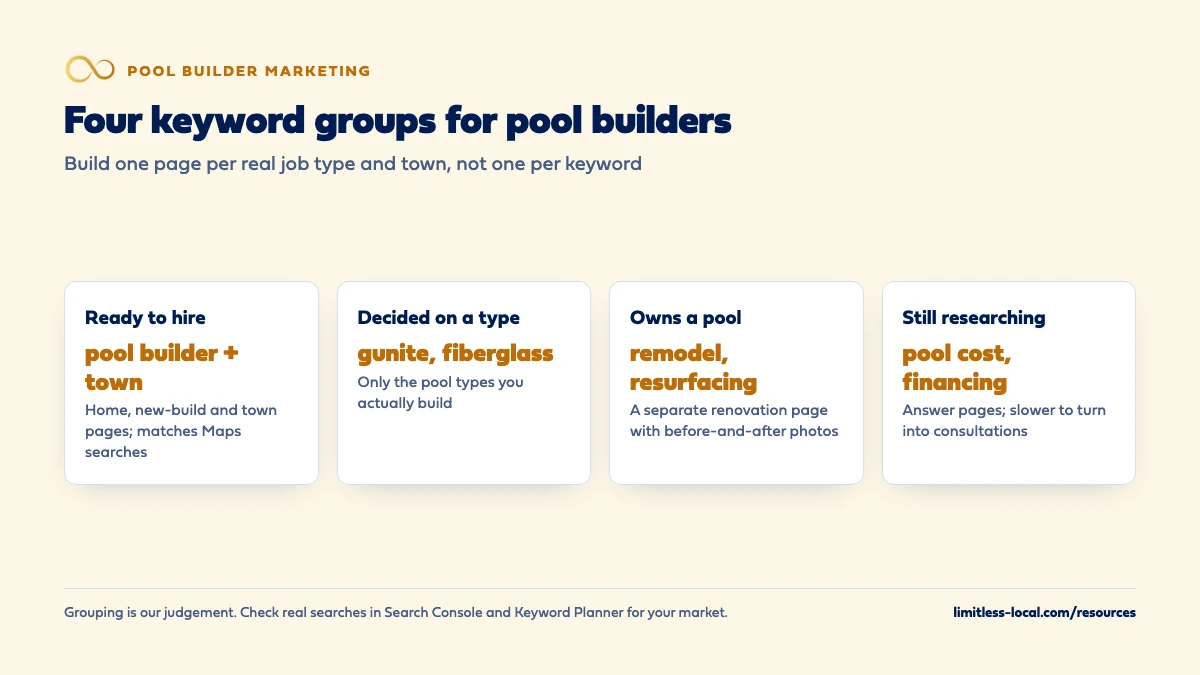
A pool builder should target the searches homeowners use when they’re ready to hire, such as “pool builder” or “inground pool” plus a town, then the type-specific searches for the pools you build, like gunite or fiberglass, and the renovation searches like pool resurfacing or remodeling if you do that work. Research searches, such as what an inground pool costs, are worth a page too, because pool buyers research for a long time before they call. Leave out searches that belong to a different business, like pool cleaning or above-ground pools, unless you actually sell that work.
Picking the right searches is the first step of the local SEO work we do for pool builders: the searches become pages, the pages show your projects, and the result is measured in consultations booked. Local SEO is part of every one of our packages, and the pool builder marketing page shows how it fits with ads and your website. The rest of the pool builder marketing questions library goes question by question.
What makes a keyword worth targeting for a pool builder?
Three things, in our judgement. The person searching is a homeowner who could hire you; the search is for work you actually do and want more of; and the search is tied to a place you actually build. A keyword that misses any one of those brings visits that never turn into consultations.
Google’s SEO Starter Guide puts the starting point plainly: think about the words someone might search for to find your content, and expect people who know a lot about a topic to use different words from someone who is new to it. For pool builders that gap is wide. A homeowner on their second pool may search “gunite pool builder”; a first-time buyer may search “backyard pool cost”. Both can become customers, at different points in a long decision.
Which searches mean a homeowner is ready to hire a pool builder?
The ones that name the service and a place, or say “near me”. Most ready-to-hire searches follow the same pattern:
- pool builder / pool contractor + town
- inground pool + town, or inground pool installation
- custom pool builder, pool construction company
- pool builders near me
These deserve your strongest pages: your home page, a new-construction page, and a page for each town you want work from. In our experience, they’re also the searches where the Google Maps results tend to show up, so your Business Profile has to match them. Optimizing a pool builder Google Business Profile covers that side.
Should I target searches for gunite, fiberglass and vinyl pools?
Only the types you build. A homeowner who searches “fiberglass pool installation” has usually already made one decision, and a gunite-only builder ranking for it wastes their time and yours. If you build more than one type, give each its own page with photos of that type, what it suits, and how your process differs.
Google’s Starter Guide also says you don’t need to anticipate every variation, because its language matching can understand how a page relates to many searches even without the exact words. So write each page the way you explain that pool type at a consultation, and the variations largely take care of themselves.
Should a pool builder target renovation and remodel keywords?
If you do the work, yes, and as a separate group. Searches like pool remodel, pool resurfacing, pool replastering, pool tile replacement and pool deck resurfacing come from homeowners who already own a pool, which is a different buyer with a different budget and, often, a shorter decision.
In our view, a builder who does both new construction and renovations should never let one page try to rank for both. A remodel page with before-and-after photos and a new-build page with finished backyards each match their search far better than one blended “pool services” page. Using project photos and videos covers how to make those pages show the work.
Are research keywords like pool cost worth targeting?
Yes, with the right expectations. Searches like “how much does an inground pool cost”, “gunite vs fiberglass pool”, “how long does it take to build a pool” and “pool financing” come from homeowners early in the decision. They rarely call the same day, but a builder who gives them a straight answer is the one they remember when they’re ready.
Two cautions, in our judgement. Answer these on your own site in your own words, with your process and your real ranges if you’re willing to publish them; a vague page helps nobody. And don’t expect them to fill the calendar quickly, because research-stage searches turn into consultations slowly. Pages like these also attract price shoppers, which is why qualifying leads before the design consultation matters.
Curious what your marketing is actually booking?
Get a free visibility audit — no obligation, no sales pitch.
Which pool keywords should I avoid?
Searches that sound close but belong to another business. Common ones for a pool builder:
- Pool cleaning, pool service, weekly pool maintenance, unless you run a service division.
- Above-ground pools and pool supplies, if you only build in-ground.
- Public pools, pool hours, pool jobs, and anything about billiards.
In ads, these become negative keywords. Google says negative keywords let you exclude search terms and focus on the keywords that matter to your customers, and suggests looking for search terms similar to yours that cater to someone searching for something different. That’s exactly what “pool cleaning” is to a gunite builder.
Should I put my city names in my keywords?
On your website, yes, in the right places: a page for each town you build in, with projects from that town and what’s different about building there. What doesn’t work is a block of town names at the bottom of every page. Google’s spam policies list “blocks of text that list cities and regions that a web page is trying to rank for” as an example of keyword stuffing.
In Google Ads it works differently. Google’s keyword research best practices say to include a location in your keywords if your customers aren’t in the same location as your service, and not to include a location if you plan to use location targeting for your ads. For most pool builders, location targeting on your service area does that job, and the keywords can stay plain.
How do I find the keywords homeowners actually use in my area?
- Search Console. The Queries tab in the Performance report shows which searches your site already appears for, with clicks, impressions and average position. Searches with impressions but few clicks are often the quickest pages to improve.
- Keyword Planner. Google’s Keyword Planner suggests keywords related to your business and shows estimates of how many searches they get each month and what they cost to target. You need to finish your Google Ads account setup, including billing, to use it. Its best-practice guide suggests describing your service the way customers think of it (“pool builder”, not “best pool builder”) and adding your website for more relevant ideas.
- Your ads’ search terms report. If you run Google Ads, the search terms report shows how your ads performed for actual searches. Google notes some low-volume searches are left out for privacy.
- Your consultations. Write down the words homeowners use when they describe what they want. They’re usually closer to real searches than industry terms.
How many pages do I need for all these keywords?
One page per real job type and one per town you want work from, in our judgement, rather than one page per keyword. A page about fiberglass pool installation can rank for many fiberglass searches at once. A page per keyword variation produces thin, repetitive pages that help nobody.
A practical map for most builders: a home page for the main ready-to-hire search; one page each for new construction, renovations and any pool types you specialize in; one page per core town; and a handful of answer pages for the research questions homeowners ask at every consultation. What a pool builder website should include covers what goes on those pages so visitors actually ask for a consultation.
Do keywords matter for my Google Business Profile too?
Yes, but through the right fields, not by stuffing your business name. Google’s category help says the categories you select affect your local ranking, asks you to pick a primary category that best describes your business and to be specific, and says not to select a category for every product or service, but to use a few from the list. Choose the most specific pool construction category Google offers as your primary, and add others only for work you really do.
Your project photos, your description and the words in your reviews all support the same searches, in our view. Stuffing extra keywords into your business name is not the fix.
How long until these keywords bring consultations?
For organic search, SEO typically takes 3 to 6 months to show meaningful growth, and contracts come after that, at the pace of your sales cycle. Ads on the same keywords can start bringing leads within days. How long pool builder SEO takes lays out the ramp, and whether Google Ads are worth it for pool builders covers the paid side.
Want to see where your company stands?
A free visibility audit shows where you show up on Google, Maps and AI answers, and what it's costing you in calls.
What's different about keywords for pool builders
Long research, few buyers. Pool buyers search for months and compare several builders, so research keywords matter more than they do for an emergency trade. Few of those searches turn into calls quickly, which is why we’d put ready-to-hire pages first and research pages second.
Construction versus service. The word “pool” pulls in a lot of service and maintenance searches. Most pool builders need to separate the two on their site and in their ads, or pay for clicks from people who want a weekly cleaning.
The work sells itself, if Google can see it. Photos and project pages tied to a pool type and a town give a search engine and a homeowner the same evidence: you build this kind of pool, here.
A worked example: turning keyword groups into pages
This builder is made up to show the method. Say you build gunite and fiberglass pools, do renovations, and want work from four towns. A page map might look like this: the home page for “pool builder” plus your main town; a new-construction page; a gunite page and a fiberglass page; a renovation and resurfacing page; and four town pages. That’s nine pages, before any research answers like pool cost or financing.
That map fits inside the content sprint in our Essentials package, which is $3,500 a month and includes up to 10 pages, along with 2 blog posts a month that can cover the research questions over time. The point of the example is the method, not the count: start from the work you want and the towns you’ll drive to, and let the pages follow. A free visibility audit is where we’d build that map with your actual searches.
Frequently asked questions
Does Google still use the meta keywords tag?
No. Google’s SEO Starter Guide says Google Search doesn’t use the keywords meta tag, so there’s no need to fill it in.
Should my domain name include "pools" and my city?
It won’t do much for rankings. Google’s Starter Guide says keywords in the domain name alone have hardly any effect beyond appearing in breadcrumbs, so pick a name that works for your business.
Is Keyword Planner free?
It sits inside Google Ads, and Google says you must complete your account setup by entering billing information to use basic features like getting new keyword ideas.
Should I target "best pool builder" searches?
Google’s keyword research advice is to describe your service the way customers think of it and not to start your research with an adjective: begin with “pool builder” and use words like “best” sparingly. In our judgement, “best” is earned with reviews and projects more than with the word itself.
How often should I revisit my keyword list?
In our judgement, every few months, by checking which searches Search Console and your search terms report show, and adding pages for real work you’ve started to see demand for.
Key takeaways
- Target ready-to-hire searches first: pool builder or inground pool plus the towns you build in.
- Give each pool type and your renovation work its own page, only for work you actually do.
- Research searches like cost and financing deserve answer pages, but they turn into consultations slowly.
- Exclude look-alike searches such as pool cleaning or above-ground pools with negative keywords.
- Never stuff town lists into pages; Google’s spam policies name it as keyword stuffing.
Not sure what's working right now?
Start with a free visibility audit: rankings, Google profile, reviews and tracking, checked against your service area.
More in this section
- What should a pool builder website include to get more consultations?
- How long does pool builder SEO take to bring in leads?
- How do I advertise a pool construction company?
- How much should a pool builder spend on marketing?
- How do pool builders qualify leads before the design consultation?
Sources
- SEO Starter Guide: The Basics — Google Search Central
- Spam Policies for Google Web Search — Google Search Central
- Use Keyword Planner — Google Ads Help
- Best practices for finding new keywords — Google Ads Help
- About the search terms report — Google Ads Help
- About negative keywords — Google Ads Help
- Manage your business category — Google Business Profile Help
- Performance report (Search results): Overview and basic setup — Search Console Help