
How should a pool builder respond to negative Google reviews?
- What should a pool construction company say when it gets a bad Google review?
- Should a pool builder reply to every negative review?
- Do negative reviews hurt my pool company's Maps ranking?
- How quickly should I reply to a bad review?
- What should my reply actually say?
- How do I reply to a complaint about delays?
- How do I reply when the review is about price or change orders?
- What if the review is wrong or unfair?
- Can I ask a customer to change or remove the review?
- When will Google remove a negative review?
- What if a wave of one-star reviews comes with a demand for money?
- How do I keep one bad review from defining my profile?
- What's different about negative reviews for pool builders
- A worked example: what one bad review does to a small review count
- Frequently asked questions
- Key takeaways
- More in this section
- Sources
The short version
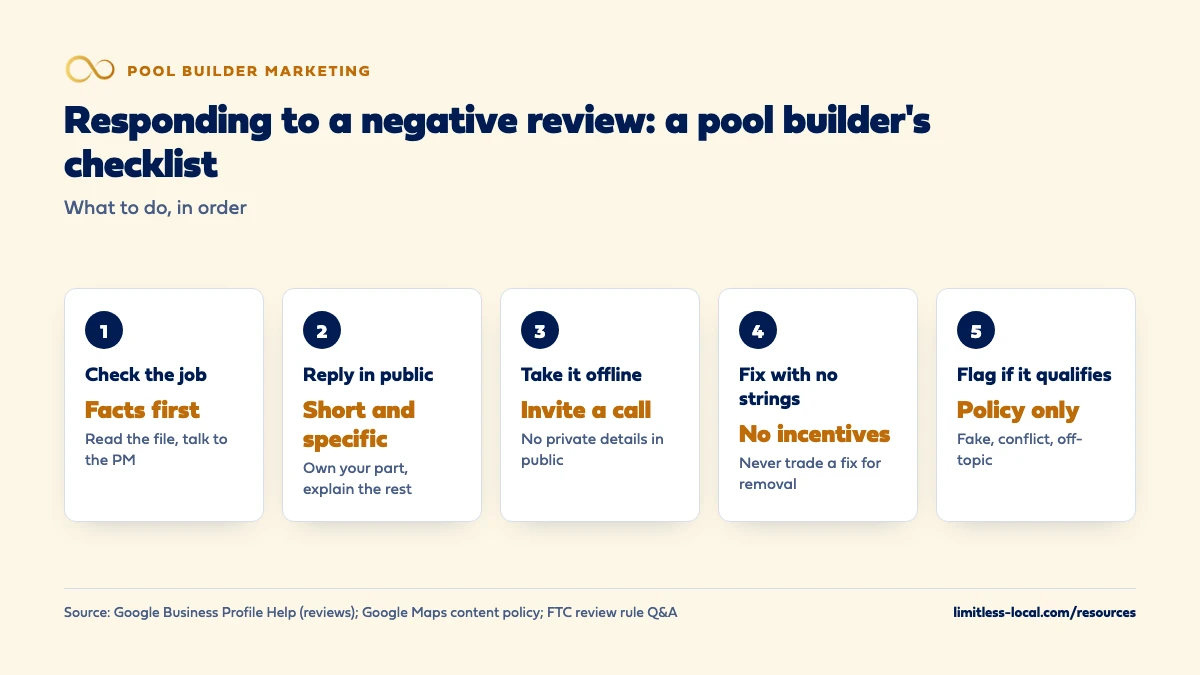
- Reply to every negative review: short, specific, polite, with an invitation to call you.
- Never trade a fix, refund or discount for removing or changing a review.
- Flag a review only for a real policy violation, such as a competitor or fake account.
- If a wave of one-star reviews comes with a demand for money, don't pay; report it.
For pool builders facing a one-star review about a delay, a cost overrun or a crew: what to say in public, what never to say, when Google will remove a review and when it won’t.
Get a free visibility audit · Book a growth call
What should a pool construction company say when it gets a bad Google review?
Reply to every negative review, promptly and calmly: thank the customer, acknowledge the specific problem, explain honestly what was and wasn’t in your control, apologize where it’s earned, and invite them to call you to sort it out, without sharing any private details about their project. Never offer a discount, a free repair or anything else in exchange for removing or changing the review, and never threaten or accuse the reviewer. Report a review to Google only if it breaks Google’s content policies, because a review you simply disagree with won’t be removed.
Review responses are part of the Google Business Profile management in every package of our local SEO work, alongside review generation, and they’re part of the approach on our pool builder marketing page. For the rest of the profile and review questions, browse the pool builder marketing questions library.
Should a pool builder reply to every negative review?
Yes. Google says replying shows customers you value their feedback, that honest and balanced reviews help potential customers decide, and that a mix of positive and negative feedback often feels more trustworthy. Its advice is to reply to reviews and share your perspective. Source: Tips to get more reviews. Your reply is posted publicly under the review, shown as coming from the business, and the person who wrote the review is notified. Customers can still change their review after reading your reply. Source: Manage customer reviews.
For a pool builder, the reply matters more than the review itself, in our judgement. A homeowner about to spend a large sum reads the bad reviews on purpose, to see what happens when something goes wrong. A calm, specific reply tells them how you’ll act on their job. Silence, or an angry reply, tells them too.
Do negative reviews hurt my pool company's Maps ranking?
Google says prominence is partly based on how many reviews you have, and that more reviews and positive ratings can help your local ranking. Source: Tips to improve your local ranking on Google. Your review score is the average of all ratings published on Google, and after a new review it can take up to two weeks for the score to update. Source: Understand review scores for local places & businesses.
Google doesn’t say how much one bad review moves your position, and nobody outside Google can tell you. What the math does show is that a pool builder with few reviews feels each one more: one bad rating among a dozen moves the average far more than one among two hundred. That’s why, in our view, the long-term fix for negative reviews is more reviews, from every customer, covered in getting more Google reviews. If a competitor’s review count is part of why they rank above you, see why a competitor outranks you.
How quickly should I reply to a bad review?
Google lists responding in a timely manner among its tips for negative reviews, saying a prompt response shows you value feedback. Source: Tips to get more reviews. Replies are reviewed against Google’s content policies before they post; Google says that usually takes up to 10 minutes but can take up to 30 days, and if a reply isn’t approved you’ll be asked to edit it. Source: Manage customer reviews.
Our rule of thumb: reply within a business day or two, but never in the first hour after you read it. Pool reviews are personal; they’re about a project you and your crew spent weeks on. Read it, check the job file, talk to the project manager, and write the reply when you can do it without heat. If the review raises a real problem on an open job, call the customer before you post anything.
What should my reply actually say?
Google’s tips for negative reviews are specific: be professional and polite, keep it short, personalize it with the reviewer’s name and their specific feedback, acknowledge mistakes without taking responsibility for things outside your control, explain what you can and can’t do, apologize when appropriate, never share private information or make personal attacks, and ask the reviewer to contact you by phone or email when the situation is complex. Google also says to be conversational, not promotional. Source: Tips to get more reviews.
A structure that follows those tips:
- Thank them by name for taking the time.
- Name the specific issue, so the next reader knows you read it.
- Own what was yours and explain plainly what wasn’t.
- Say what you’ve done or will do.
- Invite a call and sign with your name.
Keep it to a few sentences. The reply isn’t the place to win the argument; it’s where the next homeowner decides whether you’re reasonable.
How do I reply to a complaint about delays?
Delays are among the most common complaints in pool construction, in our judgement, and Google’s own example fits them closely: if bad weather forces a cancellation, explain that you monitor the weather and give advance notice when you can. Source: Tips to get more reviews. A pool start depends on permits, inspections, weather and subcontractor schedules, and some of that is outside your control. Some of it isn’t, such as how often you told the customer about the delay.
An example of a reply that follows Google’s tips, in our wording:
“Dana, thank you for telling us about this. You’re right that your start date moved twice, and we should have called you sooner each time instead of waiting for the new permit date. The inspection backlog that spring was outside our control; keeping you informed wasn’t. We’ve since changed how we update customers during permitting. I’d like to talk this through; please call me directly. Mike”
It’s short, names the problem, owns the part that was yours, explains the part that wasn’t, and doesn’t argue.
Curious what your marketing is actually booking?
Get a free visibility audit — no obligation, no sales pitch.
How do I reply when the review is about price or change orders?
Carefully, because the details are private. Google says never to share a reviewer’s private information. Source: Tips to get more reviews. A pool contract, its change orders, the customer’s financing and the final balance are exactly the kind of detail that doesn’t belong in a public reply, in our judgement, even when they’d prove your point.
Instead, describe how you work in general terms and take the specifics offline: “We put every change in writing and get a signature before the work is done, and we’d like to walk through the final invoice with you line by line.” The next homeowner learns that you document changes; the reviewer gets an invitation; nobody’s contract ends up on Google. If cost surprises keep showing up in reviews, in our judgement that’s worth fixing earlier in the sale, when you set expectations at the design consultation.
What if the review is wrong or unfair?
You can respond publicly, but watch what you say. The FTC’s Consumer Reviews and Testimonials Rule prohibits a business from making a false accusation about a reviewer when it knows the accusation is false, or makes it with reckless disregard for the truth. A reply also shouldn’t use physical threats or intimidation to get a review removed or changed, and the FTC says intimidation can include abusive communications and character assassination. You can threaten legal action only if you have a legitimate basis; the rule bars unfounded or groundless legal threats used to get a review removed. Source: The Consumer Reviews and Testimonials Rule: Questions and Answers.
In practice, state the facts once, calmly, without calling the customer a liar: “Our records show the plaster was applied on the date in your contract; we’d welcome the chance to go over the timeline with you.” If you think a review is defamatory, talk to a lawyer before you reply, not after. This page is general guidance, not legal advice.
Can I ask a customer to change or remove the review?
You can contact them to fix the problem. The FTC says its rule doesn’t prohibit contacting customers who post negative reviews to resolve the issues, or simply asking satisfied customers to update their reviews. Source: The Consumer Reviews and Testimonials Rule: Questions and Answers.
What you can’t do is pay for the change. Google’s content policy says merchants may not offer incentives, such as payment, discounts or free goods or services, in exchange for posting a review or for revising or removing a negative one. Source: Prohibited & restricted content. For a pool builder, in our reading, that rules out “we’ll redo the coping for free if you take the review down”, a credit on the final payment, or waiving the last draw. Fix the problem because it’s your warranty and your reputation, with no condition attached. If the customer is happy afterward, you can tell them they’re welcome to update their review if they feel differently now, and leave it there.

When will Google remove a negative review?
Only when it breaks Google’s policies. Google says you can report any review, but only those that violate its policies are eligible for removal, and you shouldn’t report a review just because you disagree with it; Google doesn’t get involved in disputes between businesses and customers. Evaluation typically takes several days, and if a flagged review isn’t removed you can submit a one-time appeal through the Reviews Management Tool, covering up to ten reviews at once. Source: Report inappropriate reviews on your Business Profile.
Reasons that do qualify under Google’s content policy include content that isn’t based on a real experience, content posted from multiple accounts by one person, content based on a conflict of interest such as current or former employment or a competitor, content posted on a competitor’s business to undermine it, and off-topic rants. Source: Prohibited & restricted content. A review from a former crew member, or from another pool company, is worth flagging. A harsh but genuine review from a real customer isn’t.
What if a wave of one-star reviews comes with a demand for money?
That’s an extortion scam, and Google has a separate process for it. Google describes these scams as a sudden increase in 1-star and 2-star reviews followed by someone demanding money, goods or services to remove them. Its instructions: don’t engage with or pay the people involved, don’t try to resolve it yourself by offering money or services, gather evidence immediately, and report it through Google’s merchant extortion report form. Source: Report negative review extortion scams on your Business Profile.
Google asks for screenshots of every demand showing the date, time and sender, links to each suspicious review, any names, numbers or accounts used by the people making the demands, and when you first noticed the reviews and the demand. Don’t reply to the fake reviews in anger while you wait; in our judgement, a short, neutral reply such as “We have no record of this project and have reported this review to Google” is enough.
How do I keep one bad review from defining my profile?
Reply to it well, then bury it in honest volume. Google says a mix of positive and negative feedback often feels more trustworthy, and that replies to reviews, positive and negative, show you’re responsive. Sources: Tips to get more reviews and Manage customer reviews. A profile with one thoughtful reply to a complaint among many recent five-star stories reads, in our judgement, as a builder who’s real and accountable.
That takes a steady stream of reviews, which for a pool builder means asking at the right moment in the build; the timing is covered in when to ask for a review. More on replying to all reviews is in optimizing a pool builder profile.
Not sure which of these is costing you jobs?
A free visibility audit checks the Google profile, reviews, site and tracking, and shows what to fix first.
What's different about negative reviews for pool builders
Every review is a big share. A builder finishes far fewer jobs than a service trade, so one bad review moves the average more and stays near the top longer.
Long projects, many failure points. Permits, weather, excavation surprises, subcontractors and change orders all give a customer something to write about. In our judgement, most complaints are about communication during those moments, not the finished pool.
Subcontractors carry your name. The tile setter or plaster crew may have caused the problem, but the review is on your profile. Own it in public; sort it out with the sub in private.
Problems surface later. Some issues show up after the first winter or season. A reply that explains your warranty process helps the next buyer as much as the reviewer.
A worked example: what one bad review does to a small review count
These numbers are made up to show the math, not a benchmark. Say your pool company has 38 Google reviews averaging 4.8 stars, and a customer whose start was delayed leaves a one-star review. Because the score is the average of all ratings, your new average is about 4.7 across 39 reviews.
Now compare a service company with 250 reviews at the same 4.8 average. The same one-star review barely moves it; the average still rounds to the same figure. The pool builder feels the hit more because it has fewer reviews, not because the complaint is worse.
Here’s the recovery. If you then ask every customer for a review and 11 new customers leave five stars over the next season, your average climbs back to within a few hundredths of where it started, across 50 reviews. Nothing about that requires removing the bad review. It requires a good reply now and steady asking afterward.
Frequently asked questions
Can I delete a negative review from my profile myself?
No. You can reply, and you can flag a review that breaks Google’s policies, but only Google removes reviews. Source: Report inappropriate reviews on your Business Profile.
Should I reply to a one-star rating with no text?
In our judgement, yes, briefly: thank them and invite them to call. If you can’t match the rating to any customer, say you have no record of the project and ask them to get in touch.
Will my name show on my reply?
Google says replies appear as coming from your business and your personal name isn’t shown. Signing with your first name in the text is your choice.
Can I offer a refund to an unhappy customer?
Yes, as a way to resolve the problem. What Google’s policy forbids is offering anything in exchange for removing or changing a review. Don’t link the two.
A former employee left a fake review. What do I do?
Flag it. Google’s content policy lists conflicts of interest, including current or former employment, among the reasons content isn’t allowed. Reply briefly and neutrally while you wait.
Key takeaways
- Reply to every negative review: short, specific, polite, signed, with an invitation to call.
- Keep contract, financing and change-order details out of public replies.
- Never offer a fix, refund or discount in exchange for removing or changing a review.
- No false accusations, intimidation or groundless legal threats; the FTC’s rule covers replies.
- Flag only real policy violations, and report extortion scams instead of paying.
Want a second set of eyes on your setup?
We'll look at how you show up locally and where calls are leaking, then send you a plain-English breakdown.
More in this section
- What should pool customers mention in their Google reviews?
- How do I get more Google reviews for my pool company?
- How should a pool builder set up its Google service area?
- How do I optimize a pool builder Google Business Profile?
- What negative keywords should pool builders add in Google Ads?
Sources
- Tips to get more reviews — Google Business Profile Help
- Manage customer reviews — Google Business Profile Help
- Report inappropriate reviews on your Business Profile — Google Business Profile Help
- Report negative review extortion scams on your Business Profile — Google Business Profile Help
- Prohibited & restricted content — Google Maps User Contributed Content Policy Help
- The Consumer Reviews and Testimonials Rule: Questions and Answers — Federal Trade Commission
- Understand review scores for local places & businesses — Google Business Profile Help
- Tips to improve your local ranking on Google — Google Business Profile Help