
How fast should my office answer electrical calls before I lose them?
- What answer and callback time should an electrical company aim for on new calls?
- What answer time should an electrical company aim for?
- Is a five-minute callback fast enough? Is fifteen minutes too slow?
- Does it matter whether calls are answered in under a minute?
- How many calls does a typical electrical company actually book?
- Which electrical calls can't wait at all?
- How fast do web forms, Google messages and LSA leads need a reply?
- Can my techs answer calls from the job site?
- What about calls that come in after hours?
- Who should answer the phone at a small electrical shop?
- How do I measure how fast my office answers?
- What's different about answering electrical calls
- A worked example: what slow callbacks cost
- Frequently asked questions
- Key takeaways
- More in this section
- Sources
The short version
- Live answer within a few rings for every new-customer call.
- Missed call: automatic text right away, a person calls back within five minutes.
- Web forms and texts: a reply from a person within five minutes during business hours.
- Warning-sign calls, like burning smells or warm outlets, go straight to a person.
For electrical contractors who suspect new callers are hanging up and calling the next electrician before anyone picks up.
Get a free visibility audit · Book a growth call
What answer and callback time should an electrical company aim for on new calls?
Answer new-customer calls live within a few rings, and when a call is missed during business hours, have a person call back within five minutes, not fifteen or an hour later. Reply to web forms and text leads within the same five minutes, and send an automatic text the moment a call goes unanswered so the caller knows who you are and when you’ll call. Calls about warning signs like burning smells, warm outlets or breakers that keep tripping should reach a person right away. The five-minute line is a judgement based on research showing the odds of reaching a web lead fall sharply within minutes, and on Google charging Local Services Ads for missed calls that ring past 20 seconds.
Answering fast is mostly a staffing and phone-routing problem, and it’s the one we look at first, because there’s no point buying more calls that ring out. Our automation work covers after-hours answering and automated follow-up, and every package includes call tracking with recordings, so you can see how fast calls are really answered. It’s one part of how we approach electrical contractor marketing, and the rest of the electrical marketing questions library covers how to bring those calls in.
What answer time should an electrical company aim for?
Here’s the standard we’d hold an electrical office to, by type of contact:
- New-customer phone calls during business hours: answered live by someone who can book, within a few rings. In our judgement, if a caller hears more than four or five rings, a good share of them will hang up and call the next listing.
- Missed calls: an automatic text right away, then a person calls back within five minutes.
- Web forms, Google messages and texts: a reply from a person within five minutes during business hours, ideally a phone call.
- After hours: an automatic text the moment the call or form comes in, saying when you’ll call, then a callback first thing in the morning. Urgent safety calls go to whoever is on call.
None of these numbers is a law. They’re our standard, set where they are because of how quickly the odds of reaching someone fall off and how Google treats missed calls, which the next sections explain.
Is a five-minute callback fast enough? Is fifteen minutes too slow?
Five minutes is a good target; fifteen is too slow if you can avoid it. The best-known research on this is a 2007 lead response study by InsideSales.com and MIT researcher James Oldroyd, which looked at three years of web-form leads across six companies. It found the odds of contacting a lead dropped 100 times when the first call came at 30 minutes instead of 5, and the odds of qualifying the lead dropped 21 times. It also reported that the odds of contacting a lead fell by 5 times between the 5-minute and the 10-minute mark.
Treat that as a direction, not a benchmark. It’s old, it studied web leads rather than phone calls, it wasn’t about electricians, and it measured whether a lead was reached and qualified, not whether a job was sold. In our judgement the lesson holds for a homeowner with a dead circuit: they’re still holding the phone right after the call fails, and fifteen minutes later they may have booked someone else.
Does it matter whether calls are answered in under a minute?
For phone calls, yes, because the real goal is a live answer, not a fast callback. Every callback starts with the homeowner deciding whether to pick up an unknown number, and many won’t.
Google puts a number on it if you run Local Services Ads. Its help page on how leads work says you can be charged when you miss a call during your business hours and the customer stays on the line for more than 20 seconds. A call that goes to voicemail or an automated greeting during business hours is treated as connected and charged if the caller stays on more than 20 seconds, whether or not they leave a message. If you or someone at your business answers, even after 20 seconds of ringing, the ring time doesn’t decide the charge; the call is judged on the conversation. Business hours are the hours set in your Google Business Profile.
So on those calls, letting the phone ring out is the most expensive outcome: you may pay for the lead and still lose the job. Our page on whether Local Services Ads are worth it covers the rest of that math.
How many calls does a typical electrical company actually book?
Fewer than most owners think. ServiceTitan reported in a 2022 analysis of call booking rates across more than 3,000 trade businesses using its software that the typical shop booked 42% of calls in June 2022, and electrical businesses averaged 41. Shops with 25 or more techs booked 59% of calls; shops with fewer than five techs booked 24%. Booking rates also dropped later in the day: for small shops, from a 26% peak to 9% after 6 p.m.
That data measures booking, not answer speed, and it only covers ServiceTitan users. But ServiceTitan’s advisors tied the gap partly to having a dedicated, trained call taker rather than whoever is free, and said growing shops should get to that role as early as they can. In our judgement a big share of the difference for small electrical shops is simply calls nobody answered in time.
Curious what your marketing is actually booking?
Get a free visibility audit — no obligation, no sales pitch.
Which electrical calls can't wait at all?
Some callers are worried about safety, and they won’t sit through voicemail. The NFPA’s guide to electrical safety in the home tells people to call a qualified electrician if they have frequent problems with blowing fuses or tripping breakers, discolored or warm wall outlets, a burning or rubbery smell coming from an appliance, or flickering or dimming lights. Those are exactly the calls an electrical office gets.
Set a rule for them. In our judgement, a caller describing any of those signs, a partial power loss or anything sparking should reach a person immediately, day or night, and whoever answers should be trained on what to tell them while they wait, including calling 911 first if there’s smoke or fire. Planned work, like a quote for an EV charger or a lighting upgrade, can follow the five-minute callback standard.
How fast do web forms, Google messages and LSA leads need a reply?
Treat a web form or text like a missed call: a person reaches out within five minutes during business hours, by phone if you have a number, with a text right after if nobody answers.
Google rewards speed on Local Services Ads too. Its guide to managing leads recommends responding to leads as soon as they come in and says a consistently fast response time could improve your ad’s ranking. If you have 2 or more message leads in the last 90 days, your ad may show an estimated message response time, from “a few minutes” to “one day”. Homeowners comparing electricians can see it.
If quotes come out of those conversations, the follow-up has its own clock; our page on following up on quotes automatically covers that.
Can my techs answer calls from the job site?
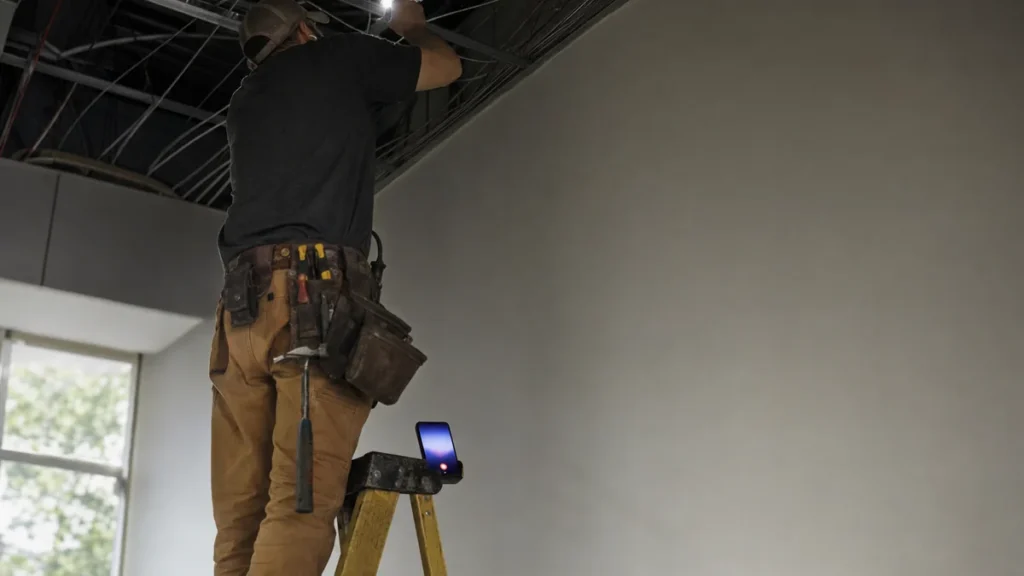
Not reliably, and in our judgement they shouldn’t try. An electrician with hands in a live panel or up a ladder can’t safely grab the phone, and a tech who answers mid-task gives a rushed answer that doesn’t book the job. In most small shops the owner is also working in the field, which is exactly when calls go unanswered.
The fix is routing, not willpower: calls ring to someone whose job is to answer, roll to a second person or an answering service if they don’t, and send a text-back if nobody picks up. Our page on how to stop missing calls walks through each option, from ring groups to answering services.

What about calls that come in after hours?
Decide which after-hours calls you’ll take live and which can wait until morning, then make the phone match that decision. Urgent safety calls should reach whoever is on call. Everything else should get an immediate text or a live answer that sets a callback time, and a person should call first thing the next morning, before the trucks roll.
Keep your Google Business Profile hours honest, since on Local Services Ads they decide which missed calls can be charged. If you’re weighing an answering service against software, our page on whether an electrician should use an AI receptionist after hours looks at that choice.
Who should answer the phone at a small electrical shop?
In our judgement, one named person during business hours, with a named backup, and never “whoever’s free.” At a one- or two-truck shop that might be a part-time office person or a remote answering service that can book into your calendar. At a larger shop it’s a dedicated call taker with a schedule in front of them.
Whoever it is needs three things: the ability to book on the call, a short list of questions to ask, and a clear rule for urgent calls. A fast answer from someone who can only take a message is better than voicemail, but much worse than a booking.
How do I measure how fast my office answers?
Start with the calls nobody answered. ServiceTitan’s CSR dashboard classifies missed calls as abandoned and lets a manager open each one to call back or book it. CallRail marks a call as abandoned if the caller hangs up less than 15 seconds after placing it, and shows answered and unanswered calls separately, so you can see how many callers gave up and when.
Then check four numbers each week: missed calls during business hours, time from a missed call to the first callback, time from a form or text to the first reply, and booking rate. The ServiceTitan article also suggests something simpler: call your own business now and then and listen to what a customer hears. If call tracking isn’t set up, our page on whether you need call tracking numbers explains what it shows.
Not sure which of these is costing you jobs?
A free visibility audit checks the Google profile, reviews, site and tracking, and shows what to fix first.
What's different about answering electrical calls
The person who could answer is usually holding a tool. Electrical work doesn’t pause safely mid-task, so the owner-tech model leaves the phone unanswered at exactly the busiest times. Routing has to account for that.
Urgency is all over the map. One call is a burning smell from an outlet; the next is someone pricing a charger for a car that arrives in two months. The office needs a fast way to tell them apart, and a rule for which ones go straight to a person.
Outages and storms bring surges. After a storm, calls about generators, damaged service masts and partial power can arrive all at once. Plan an overflow route, like a second line or an answering service, before the surge, not during it.
A worked example: what slow callbacks cost
These numbers are made up to show the math, not a benchmark. Say an electrical shop gets 120 new-customer calls a month and misses 35 of them during business hours because everyone is on a job. Today, those missed calls get a callback a couple of hours later, and 5 of the 35 turn into booked jobs.
The shop adds a missed-call text and a rule that someone calls back within five minutes, and 12 of the next 35 missed calls book. That’s 7 more jobs a month. At an average of $450 a job, that’s $3,150 a month in work from calls the shop was already getting. If any of those missed calls came from Local Services Ads and rang past 20 seconds, the shop was paying for them either way.
Your own numbers will differ; your call log and booking rate will show them. On our side, after-hours answering and automated follow-up are automation add-ons that plug into any of our packages, with pricing shared on the discovery call, and every package includes call tracking with recording so you can see answer times. A free visibility audit is a good place to start.

Frequently asked questions
Is a fifteen-minute callback too slow for electrical leads?
Usually, yes. A study of web leads found the odds of contacting a lead fell by 5 times between 5 and 10 minutes, so in our judgement a fifteen-minute callback gives the homeowner plenty of time to call someone else.
What does speed to lead mean for an electrical business?
It’s the time from when a new customer reaches out, by call, form or text, to when a person from your company actually talks to them. The shorter it is, the more of those customers you reach before they call another electrician.
Does a missed-call text replace calling back?
No. It tells the caller who you are and buys a few minutes, but a person still needs to call. CallRail, for example, notes that a caller on a landline won’t receive the text, and it requires text messaging compliance registration before automated texts go out.
Do I get charged for missed Local Services Ads calls?
You can be. Google says a call missed during your business hours can be charged if the customer stays on the line for more than 20 seconds, and calls that reach voicemail are treated the same way.
Should the owner answer every call personally?
Not if it means calls ring out while you’re on a job. In our judgement a named office person or answering service with a booking calendar does better than an owner who answers some calls and misses others.
What's a normal call booking rate for an electrical company?
ServiceTitan’s 2022 data put electrical businesses at an average of 41% in June 2022, with smaller shops booking far less than larger ones. Track your own rate before comparing it to anyone’s.
Key takeaways
- Aim for a live answer within a few rings on every new-customer call during business hours.
- When a call is missed, send an automatic text and have a person call back within five minutes.
- Answer web forms, Google messages and texts within five minutes too.
- Route warning-sign calls, like burning smells or warm outlets, straight to a person.
- Measure missed calls, callback time and booking rate every week, and call your own line now and then.
Want a second set of eyes on your setup?
We'll look at how you show up locally and where calls are leaking, then send you a plain-English breakdown.
More in this section
- Should an electrician use an AI receptionist for after-hours calls?
- How do I stop my electrical company from missing calls?
- How do I follow up on electrical quotes automatically?
- What should an electrician's website have to get more calls?
- Do I need call tracking numbers for my electrical business?
Sources
- Lead Response Management Study — InsideSales.com and MIT (James Oldroyd)
- Automated responses for missed calls — CallRail Help Center
- Typical call-booking rate for ServiceTitan users? The number might shock you into action — ServiceTitan
- Dashboard CSR metrics — ServiceTitan Help
- How leads work — Local Services Help
- Manage leads and jobs — Local Services Help
- Troubleshoot call routing — CallRail Help Center
- Electrical Home Fire Safety — National Fire Protection Association