
What red flags mean an electrical marketing agency will waste money?

- What are the warning signs before an electrician hires a marketing agency?
- What's the biggest red flag in an agency's sales pitch?
- Red flag: the offer came out of the blue
- Red flag: they won't say what they'll actually do each month
- Red flag: they'd own your Google Ads account or Google profile
- Red flag: they'd keep your tracking phone numbers
- Red flag: the fee and the ad spend are one number
- Red flag: hundreds of city pages, cheap links or bulk AI content
- Red flag: they offer to "handle" your reviews
- Red flag: they don't ask about the electrical work you want
- Red flag: they measure clicks and leads, not booked jobs
- Which red flags show up after I've signed?
- What should I ask an agency before I sign?
- What's different when electricians hire an agency
- A worked example: what a bundled price can hide
- Frequently asked questions
- Key takeaways
- More in this section
- Sources
The short version
- Promised rankings, map pack spots or lead counts: no one can honestly promise them.
- You should own the ad account, Google profile, domain and tracking numbers from day one.
- The agency fee and your ad spend should be two separate numbers you can check.
- Mass city pages, bought links, review shortcuts and click-only reports all waste money.
For electrical contractor owners talking to marketing agencies, or a few months into a contract with one, who want to spot the money-wasters early.
Get a free visibility audit · Book a growth call
What are the warning signs before an electrician hires a marketing agency?
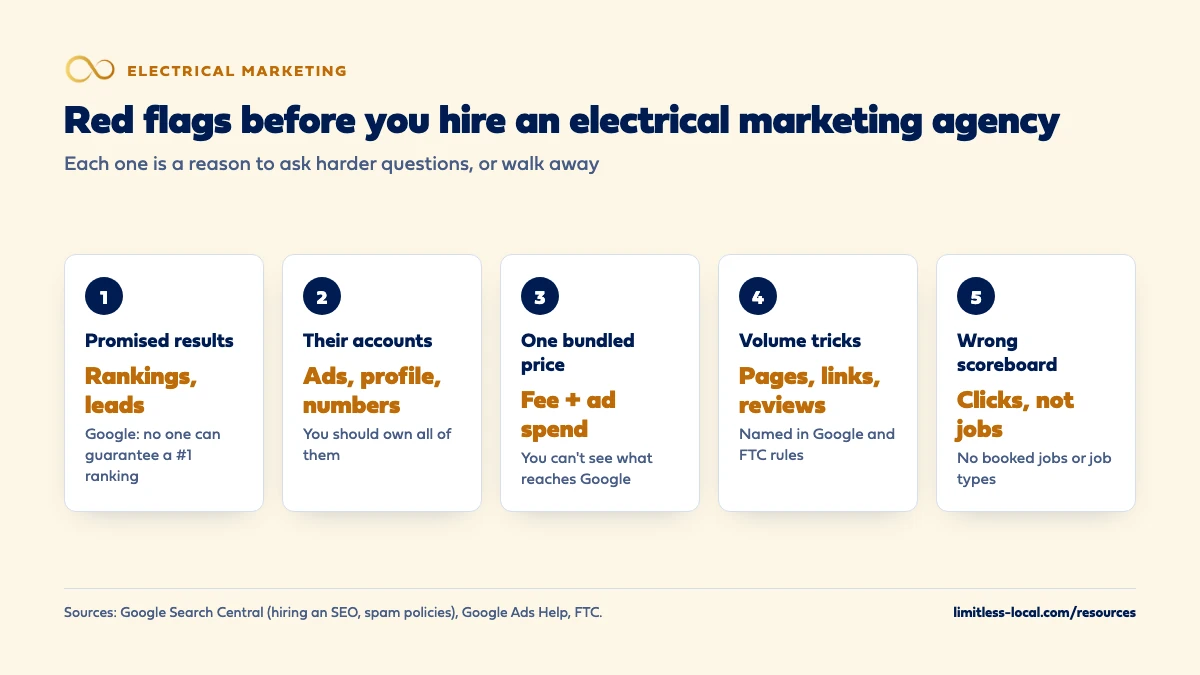
The biggest red flags are promised rankings or lead counts, a refusal to say exactly what the agency will do each month, and accounts that would belong to the agency instead of you: the Google Ads account, Google Business Profile, website domain and tracking phone numbers. Watch too for a single price that hides how much of your money reaches Google, offers of mass city pages, bought links or review shortcuts, and reports built on clicks instead of booked jobs. An agency that doesn’t ask which electrical jobs you want more of is unlikely to bring them.
We’re an agency too, so this is the list we expect owners to hold us to. Our packages page lays out what each tier includes and what it costs, with ad spend paid directly to Google, and our electrical contractor marketing page shows how that work applies to service calls and bigger projects. The rest of the electrical marketing questions library goes question by question.
What's the biggest red flag in an agency's sales pitch?
A promise about results nobody controls: a top ranking, a guaranteed spot in the map pack, or a set number of leads or jobs a month. Google’s own advice on hiring an SEO says no one can guarantee a #1 ranking on Google. It also says to beware of anyone who promises rankings, claims a “special relationship” with Google, or advertises a “priority submit” to Google, and that if an SEO audit promises first place in search results, you should find someone else (Google Search Central).
A good agency will tell you what it plans to do, what it expects to happen and how it will measure it, and that it can’t promise the outcome. In our judgement, the pitch that sounds most certain is usually the one most likely to waste your money.
Red flag: the offer came out of the blue
Most electricians get these weekly: an email saying your site isn’t showing up, a call claiming to be from Google about your listing, a text offering page-one rankings. Google tells site owners to be wary of SEO firms and consultants that email out of the blue, and says it never accepts money to include or rank sites in its search results, and that advertising with Google has no effect on your site’s presence in organic results (Google Search Central).
So “we spend so much with Google that we can get you ranked” is false on its face. Not every cold pitch is a scam, but it deserves extra checking.
Red flag: they won't say what they'll actually do each month
“Our proprietary system” is not a plan. Google says to be careful if a company is secretive or won’t clearly explain what it intends to do, warns that deceptive or misleading content created on your behalf could get your site removed from Google’s index entirely, and notes that you are ultimately responsible for the actions of any company you hire (Google Search Central).
Before you sign, ask for the first three months in writing: which pages get built or fixed, what happens to your Google Business Profile, which ad campaigns launch and for which kinds of jobs, and what the monthly report will show. If the answer is still vague after you’ve asked twice, that’s your answer. What a realistic early stretch looks like is laid out in what to expect in the first 90 days.
Red flag: they'd own your Google Ads account or Google profile
Ask who owns what before you sign, not when you leave. Google Ads has five access levels, Email-only, Billing, Read-only, Standard and Admin, and you want at least one Admin login that belongs to you (Google Ads Help). An agency’s manager account can be linked to your account as an owner without taking away your ownership, and the client account keeps its data and can remove the agency’s access by unlinking (Google Ads Help). That only protects you if the ad account is yours in the first place, not one the agency created and kept.
Your Google Business Profile works the same way: a profile can have several owners but only one primary owner, and only owners can add or remove other users (Google Business Profile Help). You should be the primary owner; the agency can be a manager. In our judgement, the website domain should also be registered in your company’s name, with your own logins to the hosting. An agency that resists any of this is telling you how leaving will go.
Red flag: they'd keep your tracking phone numbers
Call tracking numbers end up on your Google profile, your ads and sometimes your trucks, so losing them hurts. Ask in writing whether the numbers can go with you. Numbers in CallRail, for example, can be ported to another provider, with the receiving provider starting the port; CallRail says it typically takes 4-6 weeks and that you shouldn’t deactivate the numbers or close the account until the port is confirmed (CallRail Help). If the account is in the agency’s name, you need its cooperation to do any of that.
In our judgement, the cleanest setup is a tracking account in your company’s name that the agency is given access to.
Curious what your marketing is actually booking?
Get a free visibility audit — no obligation, no sales pitch.
Red flag: the fee and the ad spend are one number
“Two thousand a month, ads included” sounds simple, but it hides the one split you need: how much goes to Google and how much the agency keeps. In our judgement, ad spend should be billed straight to your card inside your own Google Ads account, where you can see it, and the agency’s fee should be a separate line. Google Ads even has a Billing access level for people who only need to see and manage payments (Google Ads Help).
If an agency won’t show you the account or the actual spend, you can’t work out what a booked job costs, and that’s the number that tells you whether marketing pays. How much to spend on marketing covers how to set the budget once the split is clear.
Red flag: hundreds of city pages, cheap links or bulk AI content
Some offers sound like volume: a page for every town in three counties, hundreds of backlinks for a flat fee, dozens of AI-written posts a month. Google’s spam policies name these practices. Doorway abuse includes pages targeted at specific regions or cities that funnel users to one page, and creating substantially similar pages. Scaled content abuse is generating many pages mainly to manipulate rankings rather than help users, including using AI tools to generate many pages without adding value. Buying or selling links for ranking purposes is link spam (Google Search Central).
Google’s hiring advice adds that you should never have to link to an SEO, and to avoid anyone talking about link popularity schemes or submitting your site to thousands of search engines (Google Search Central). A city page that’s real, with work you’ve done there and the service area you cover, is fine. Fifty copies with the town name swapped is the kind of work that can set a site back.
Red flag: they offer to "handle" your reviews
Reviews matter a lot for electricians, which is why some agencies sell shortcuts. The FTC’s rule on consumer reviews and testimonials took effect on October 21, 2024, and lets courts impose civil penalties for knowing violations. The FTC’s Q&A says businesses and individuals can be liable for writing, creating or selling fake reviews, that brokers of fake reviews generally fall under the prohibition, and that offering compensation or incentives conditioned on reviews expressing a particular sentiment can also violate it (FTC).
So any offer to post reviews, buy them, or reward only the five-star ones is a reason to walk away, and it puts your business at risk too, not just the agency. Honest ways to get more of them are in getting more Google reviews.

Red flag: they don't ask about the electrical work you want
Google’s advice says your SEO should be interested in your business: what makes it unique, who your competitors are and how your customers find you (Google Search Central). For an electrician, in our judgement, a serious agency asks before it quotes:
- Which work you want more of: service calls, panel and service upgrades, EV chargers, generators, rewires or commercial.
- Which work you’d rather not get, and which towns you don’t want to drive to.
- Your licensing, insurance and any certifications, so ads and pages only claim what’s true.
- How your office answers calls and follows up on quotes, because leads die there too.
A proposal that could be handed to a plumber with the logo swapped wasn’t written for you.
Red flag: they measure clicks and leads, not booked jobs
Ask to see a sample monthly report before you sign. If it’s built from impressions, clicks, rankings and a lead count, with no line for booked jobs, job type and revenue, that’s what you’ll get every month. For an electrician the gap is wide: thirty small service calls and eight jobs that include panel upgrades can cost the same and land very differently in the bank.
In our judgement, a report you can check against the jobs and invoices in your own field software is the minimum. Knowing if your agency is getting results covers what that report should contain once you’re working together.
Which red flags show up after I've signed?
Some only appear once the work starts. In our judgement, these are worth raising the first time you see them:
- Weeks go by and you still don’t have Admin access to the ad account or owner access to your Google profile.
- You can’t hear or read the calls the agency counts as leads.
- Nobody can tell you what changed this month and why.
- Every question about results gets “give it more time,” even for ads, which can bring calls within days.
One is a conversation. Several together usually mean it’s time to plan a change, starting with getting your accounts back in your own name.
What should I ask an agency before I sign?
Start with Google’s own interview list: ask for examples of past work and success stories, whether they follow Google Search Essentials, what results they expect and in what timeframe, how they measure success, what experience they have in your industry and your area, and whether they’ll share every change they make with the reasoning behind it. Google also suggests checking references by asking past clients whether the work was useful and produced positive results (Google Search Central).
Then add the electrical questions: Who will own the ad account, profile, domain and tracking numbers? What will a booked job cost me, fee and ad spend included, and how will we both check it? What happens to my accounts and numbers if I leave, and how much notice do you need?
Not sure which of these is costing you jobs?
A free visibility audit checks the Google profile, reviews, site and tracking, and shows what to fix first.
What's different when electricians hire an agency
Your ads make claims you’re responsible for. Electrical marketing leans on trust: licensed, insured, permits pulled, available after hours. The FTC says advertising must be truthful, that advertisers need evidence for their claims before the ad runs, and that an advertising agency can also be held responsible for misleading claims (FTC). An agency that writes “24/7 emergency service” or “master electrician” without asking whether it’s true is creating risk for you, not just bad copy.
Job mix hides waste. A string of small service calls can make a campaign look busy while the panel upgrades, EV chargers and generators you wanted go elsewhere. An agency that can’t split results by job type can’t tell you which of its work is paying.
Storms and outages flatter bad agencies. A week of outage and generator calls can make any agency’s month look good. Ask how it will separate weather-driven calls from what its own work produced, and compare against the same period last year.
A worked example: what a bundled price can hide
These numbers are made up to show the math, not a benchmark. Say one agency quotes $3,000 a month “with ads included” and won’t give you access to the ad account. After you insist, you find that $1,200 a month is reaching Google. That means you’re paying $3,000 minus $1,200, or $1,800 a month, in management on $1,200 of ad spend, and you couldn’t have known from the quote.
Now say that account books 8 jobs a month. Your real cost per booked job is $3,000 divided by 8, or $375, whatever the report calls a “lead”. You can only do that math when the fee and the spend are separate and the jobs are counted in your own software. Tracking which marketing brings in real jobs shows how to set up the counting.
For comparison, our Essentials package is $3,500 a month and includes Google Ads management for up to $2,500 a month in ad spend, which you pay directly to Google, plus call, web and form tracking and a monthly report. We don’t guarantee rankings or lead counts. We ask for three months in the contract, but if you want to leave, we won’t make you stay.
Frequently asked questions
Is it a bad sign if an agency won't guarantee results?
No, it’s the honest answer. Google says no one can guarantee a #1 ranking, and lead counts depend on your market, budget and how your office handles calls. Be more wary of the agency that promises them.
Is a long contract always a red flag?
Not always, but the exit terms matter more than the length. Read what happens to your accounts, website, domain and tracking numbers if you leave, and what notice you have to give.
Should I give an agency my Google password?
No. Add the agency as a user with its own login instead: a manager on your Google Business Profile and the right access level in Google Ads, while you keep owner and Admin access.
Is a cheap agency always a waste of money?
Not always, but check what the price leaves out. A low monthly fee that bundles ad spend, uses accounts you don’t own or skips call tracking can cost more per booked job than a higher fee that doesn’t.
What if I already signed with an agency that shows these red flags?
Start by getting Admin access to your Google Ads account and primary ownership of your Google Business Profile, and find out who owns the domain and tracking numbers. That keeps your options open whatever you decide next.
Key takeaways
- Walk away from promised rankings, map pack spots or lead counts; no one can honestly promise them.
- You should own the Google Ads account, Google Business Profile, domain and tracking numbers before any work starts.
- Ad spend and the agency’s fee should be separate, so you can work out what each booked job costs.
- Mass city pages, bought links and review shortcuts are named in Google’s spam policies and the FTC’s reviews rule.
- A good agency asks which electrical jobs you want and reports booked jobs, not just clicks.
Want a second set of eyes on your setup?
We'll look at how you show up locally and where calls are leaking, then send you a plain-English breakdown.
More in this section
- How do I know if my electrical marketing agency is getting results?
- How much should an electrical contractor spend on marketing?
- What is a good cost per booked job for electrical marketing?
- What should I expect from electrical marketing in the first 90 days?
- How do I track which electrical marketing brings in real jobs?
Sources
- Do You Need an SEO? Tips for Hiring an SEO — Google Search Central
- Spam policies for Google web search — Google Search Central
- About access levels in your Google Ads account — Google Ads Help
- Manager Accounts (MCC): About ownership of client accounts — Google Ads Help
- Manage your Business Profile owners & managers — Google Business Profile Help
- Port a phone number away from CallRail — CallRail Help Center
- The Consumer Reviews and Testimonials Rule: Questions and Answers — Federal Trade Commission
- Advertising FAQ's: A Guide for Small Business — Federal Trade Commission