
How do I sell maintenance agreements to past electrical customers?

- How can an electrician turn past customers into maintenance agreement members?
- Do maintenance agreements make sense for an electrical company?
- Step 1: Pull your past customers out of your software
- Step 2: Decide what the agreement actually includes
- Step 3: Sort past customers by the reason they'd say yes
- Step 4: Write the offer around a reason, not a discount
- Step 5: Email the offer the right way
- Step 6: Text only the customers who agreed to it
- Step 7: Call your best past customers yourself
- Step 8: Make the offer part of every job from now on
- How should commercial maintenance agreements be different?
- How do I know if maintenance agreements are worth it?
- What's different about maintenance agreements for electricians
- A worked example: what a past-customer list can turn into
- Frequently asked questions
- Key takeaways
- More in this section
- Sources
The short version
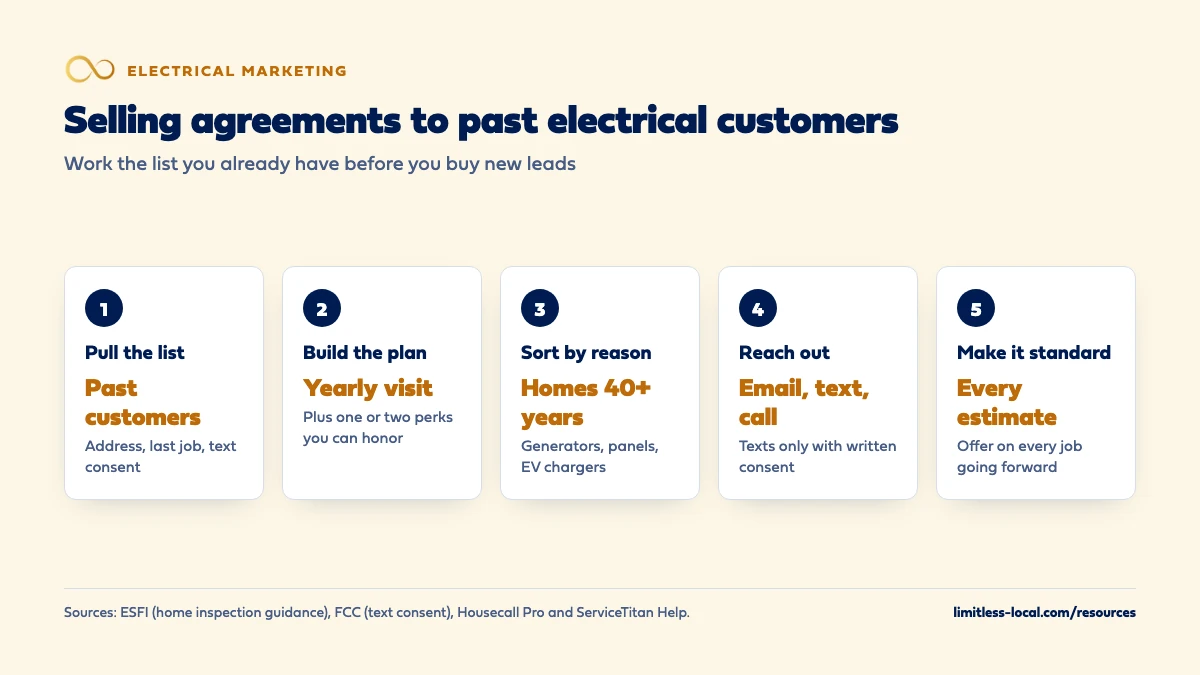
- Pull past customers from your software and sort them: older homes, generator owners, panel and EV charger customers.
- Build one simple plan around a yearly visit with a written safety check and one or two perks.
- Email with an ad disclosure, address and opt-out; text only customers who gave written consent.
- Add the offer to every estimate and job from now on; treat commercial agreements as a separate product.
For electrical contractor owners who want steady, repeat work from the customers already in their software, not just the next new lead.
Get a free visibility audit · Book a growth call
How can an electrician turn past customers into maintenance agreement members?
Start with the past customers in your field software and sort them by the reason they’d want an agreement: older homes, standby generator owners, and recent panel upgrade or EV charger customers. Build a simple plan around one yearly visit with a written safety check, plus one or two perks you can honor during a storm week, and offer it by email, by text only to customers who gave written consent, and by phone for your best accounts. Then put the offer on every estimate and job going forward, and sell commercial customers a separate, equipment-based service agreement.
Most of this is follow-up work, and follow-up is where repeat business usually leaks: the reminder that never went out, the “let me think about it” nobody called back. Our automation work handles that side, with reminders, scheduling and messaging add-ons that plug into any tier, and our electrical contractor marketing page shows how it fits with search, ads and reviews. The rest of the electrical marketing questions library goes question by question.
Do maintenance agreements make sense for an electrical company?
They can, but they’re a harder sell than in HVAC, and it helps to know why before you start. A furnace or AC unit has an obvious yearly service routine; most homeowners don’t think their wiring needs anything until something trips, flickers or quits. So an electrical agreement has to be built around something the customer can picture: a yearly safety check of an older house, service on the standby generator you installed, or priority help when the power goes out.
The payoff is the same one the field-software companies describe. ServiceTitan says memberships and service agreements are designed to give a business a steady flow of income and to get technicians back on site, where they can spot upsell and replacement opportunities. Housecall Pro says service plans help generate dependable revenue, smooth out seasonal swings and keep you connected to your best customers. For an electrician, in our judgement, the visit itself matters as much as the fee: every one is a chance to find the undersized panel, the missing surge protection or the outlet that’s been warm for a year.
Step 1: Pull your past customers out of your software
Your best prospects are already in your field service software: everyone you’ve done good work for in the last few years. Pull a list with the name, service address, last job date, what the job was, and whether they agreed to get texts. If you use Jobber, its Campaigns tool is built for this kind of list, with client segments for re-engaging past customers and an automated Re-engage past clients campaign that emails clients who haven’t booked with you in a while (Jobber Help). Housecall Pro and ServiceTitan have their own customer lists and campaign tools that work the same way.
Before you send anything, remove duplicates, anyone who asked not to be contacted, and anyone with an unresolved complaint.
Step 2: Decide what the agreement actually includes
Keep the first version simple enough that a tech can explain it in a minute. The software already frames the decisions. In Housecall Pro, for example, a service plan template sets the number of included visits per year (up to 12), whether the plan continues until the customer cancels or ends after a set duration, how often the customer pays (every month, quarter, six months or year), and an optional discount applied to every job for members (Housecall Pro Help).
For a residential electrical agreement, in our judgement, a workable first plan looks something like this:
- One yearly visit, covering a safety check of the panel, breakers, outlets, GFCI and AFCI protection, and smoke alarm power, with a written list of what you found.
- Generator service as an add-on for customers who have a standby generator.
- One or two member perks you can honor even during a storm week: priority scheduling, a waived trip fee, or a discount on repairs.
Price it so the yearly visit pays for its own truck roll even if the customer never buys another thing. Anything that depends on upsells to make money is a plan you’ll quietly stop honoring when the schedule fills.
Step 3: Sort past customers by the reason they'd say yes
One generic email to everyone is the weakest version of this. Sort the list into groups, each with its own reason:
- Older homes. The Electrical Safety Foundation recommends a home electrical inspection if the home is 40 years old or older, if it was bought previously owned, if it has had a major renovation, or if major new appliances were added in the last 10 years (ESFI). Your job history and the service address often tell you which customers fit.
- Generator owners. Anyone you installed a standby generator for is the most natural member you have, because the equipment obviously needs looking after.
- Panel upgrade and EV charger customers. They’ve just added load and spent real money; a yearly check protects that investment.
- Commercial accounts. A different product altogether, covered further down.
If your list is thin, getting more referrals from past customers covers the other half of working the customers you already have.
Step 4: Write the offer around a reason, not a discount
Lead with what the customer gets and why it matters for their house, then the price, then the perks. For an older-home group that might read: your house was built before most of what you plug into it existed; once a year we’ll check the panel, breakers and protection devices and give you a written list of anything that needs attention. For generator owners: we’ll service the unit before storm season so it starts when you need it.
In our judgement, a big discount up front attracts customers who cancel after the first visit, while a clear yearly visit plus one perk they’ll actually use keeps members. Put the cancellation terms and the renewal billing in the offer in plain words, so nobody is surprised by a charge a year later.
Curious what your marketing is actually booking?
Get a free visibility audit — no obligation, no sales pitch.
Step 5: Email the offer the right way
An email whose main purpose is selling an agreement is a commercial message under the CAN-SPAM Act, and the FTC’s compliance guide lists what it needs: accurate header information, a subject line that matches the content, a clear disclosure that it’s an advertisement, your valid physical postal address, and a clear way to opt out of future marketing email. You have to honor an opt-out within ten business days, and if you hire someone to send the email for you, you’re still responsible for it (FTC).
Two details matter once customers sign up. The FTC says subscribers and members keep the right to opt out of marketing emails, so members who opt out still get their visit reminders but not your promotions. And messages that only confirm an agreed transaction or notify someone about their existing membership count as transactional or relationship content, which is exempt from most of CAN-SPAM’s requirements, as long as the routing information isn’t false or misleading. That’s a summary of the FTC’s guide, not legal advice.
Step 6: Text only the customers who agreed to it
Texting gets read faster than email, but the rules are stricter. The FCC says autodialed texts to a mobile number need the owner’s prior consent, that commercial texts require written consent, and that people can opt out at any time and in any reasonable manner (FCC). A text selling a maintenance agreement is commercial.
In practice, text only the past customers who gave written consent to marketing texts, usually through a checkbox when they booked, and honor a STOP reply right away. This is general information, not legal advice; if you’re unsure, check with someone qualified. Everyone else gets the email and, for your best customers, a phone call. Going forward, ask for that consent when you take each new request, which is also covered in following up on quotes automatically.
Step 7: Call your best past customers yourself
For the top of the list, such as generator customers, large panel or rewire jobs and anyone who has called you back more than once, a short phone call from the owner or office manager usually does more than any email, in our judgement. Keep it to three things: thank them for the work, say what the agreement includes and what it costs, and offer to put the first visit on the calendar.
Log every call in your software with the outcome, so nobody gets called twice and the ones who said “not now” get one more email in a few months instead of being forgotten.
Step 8: Make the offer part of every job from now on
Once the past-customer push is done, the steady source of members is the work you do every week. Housecall Pro lets you add a service plan offer to a saved estimate or to a job; on an estimate, the customer can tick a box to include the plan when they approve, and declining the plan doesn’t block the estimate approval (Housecall Pro Help). ServiceTitan notes that residential memberships are most often sold in the field by technicians or by call-center staff, and that the sale is quick because no proposal is needed (ServiceTitan Help).
So put the offer on every residential estimate and every completed job, have techs mention it at the end of good calls, and set your software’s automated campaigns to remind past customers who haven’t booked in a year.
How should commercial maintenance agreements be different?
Commercial customers buy a different product. ServiceTitan describes commercial service agreements as more detailed, covering multiple equipment systems, tailored to each customer, priced from the site’s equipment types and quantities, and usually sold from the office after on-site inspections, with options for not-to-exceed limits and service-level agreements (ServiceTitan Help).
For electrical work there’s also a recognized standard behind the conversation. The NFPA describes NFPA 70B, Standard for Electrical Equipment Maintenance, as providing requirements and guidance for the preventive maintenance of electrical, electronic and communications equipment, including developing an electrical maintenance program, maintenance intervals, testing methods and documentation, and says facility managers and electrical service providers use it across a variety of facilities. Its 2026 edition adds a new chapter on transfer switches (NFPA). In our judgement, a facility manager is far more likely to sign an agreement framed as help building and keeping that maintenance program than one framed as a discount. Whether a given facility is required to follow it depends on who adopts and enforces it locally, so don’t tell a customer they’re out of compliance unless you know. Marketing to commercial customers covers how to reach those accounts in the first place.
How do I know if maintenance agreements are worth it?
Track a few numbers each month in your software: new members, cancellations, renewals, the share of member visits that turn up additional work, and the revenue from that work.
If members cancel after the first year, the visit probably isn’t showing them enough value; send the written findings after every visit and fix the plan before you sell harder. If renewals hold but visits rarely find work, the plan still pays as long as the fee covers the truck roll. Tie member jobs back to their source the same way you track any other channel, as covered in tracking which marketing brings in real jobs.
Not sure which of these is costing you jobs?
A free visibility audit checks the Google profile, reviews, site and tracking, and shows what to fix first.
What's different about maintenance agreements for electricians
Nobody wakes up wanting electrical maintenance. Unlike a furnace tune-up, there’s no season that reminds homeowners. The agreement has to supply the reason: house age, a generator, new load from an EV charger or panel upgrade, or an outage plan.
Generators and outages are the natural hook. Customers with standby generators already understand that equipment needs servicing, and priority service during an outage is a perk people remember. If you sell that perk, make sure you can honor it in the worst week of the year. Bringing in more generator work to begin with is covered in getting more generator installation leads.
Inspections find real work, so write it down. A yearly check that produces a written list of findings, with photos, gives the customer a reason to renew and gives you a documented, non-pushy way to quote repairs. Keep the findings factual; don’t use scare language to sell the follow-up work.
A worked example: what a past-customer list can turn into
These numbers are made up to show the math, not a benchmark. Say your software shows 400 residential customers from the last three years after you clean the list. You sort them into older homes, generator owners and recent panel and EV charger customers, email each group its own offer, text the ones who agreed to texts, and call the generator owners.
If 1 in 25 of those customers signs up, that’s 16 members. With one yearly visit each, that’s 16 visits already on next year’s calendar before you spend anything on ads, plus generator service for the ones who have them. If 1 in 4 of those visits turns up work the customer approves, that’s 4 more booked jobs from the visits alone, and members who call you first the next time something goes wrong.
The follow-up that makes this work, such as reminders, scheduling and texting from one inbox, is what our automation add-ons handle; they plug into any of our packages, and pricing is shared on the discovery call. A free visibility audit is the place to see how your follow-up and the rest of your marketing are working today.
Frequently asked questions
What should an electrical maintenance agreement cost?
There’s no published benchmark for electricians that we’d stand behind. Price it from your own numbers: the yearly visit should cover its own truck roll and time even if the customer never buys another repair, and the perks should be ones you can afford to honor in your busiest week.
Can members opt out of my marketing emails?
Yes. The FTC says subscribers and members keep the right to opt out of marketing emails. Messages that only remind them about their existing plan or confirm a visit are relationship messages and are exempt from most CAN-SPAM requirements.
Should the agreement renew automatically?
It can. Housecall Pro, for example, lets a plan continue until the customer cancels or end after a set duration. If it renews automatically, say so plainly when they sign up and remind them before the renewal charge.
Is an electrical safety inspection a good agreement for every customer?
Not every one. It fits best for the groups the Electrical Safety Foundation names, such as homes 40 years old or older, homes bought previously owned or recently renovated, and homes that added major appliances. A newer house with no generator may not see enough value.
Should commercial customers get the same plan as homeowners?
No. Commercial agreements are usually priced from the site’s equipment, sold from the office after a walkthrough, and often framed around the facility’s maintenance program under NFPA 70B.
Key takeaways
- Electrical agreements need a concrete reason: an older home, a generator, new load or an outage plan.
- Start with your field software’s past-customer list and sort it by the reason each group would say yes.
- Marketing emails need an ad disclosure, your address and an opt-out; marketing texts need written consent.
- Put the agreement offer on every residential estimate and job from now on, not just in one campaign.
- Commercial maintenance agreements are a separate product, often framed around an NFPA 70B maintenance program.
Want a second set of eyes on your setup?
We'll look at how you show up locally and where calls are leaking, then send you a plain-English breakdown.
More in this section
- How do I get more referrals from past electrical customers?
- How should an electrical contractor market to commercial customers?
- Should my electrical company market smart home installs?
- How should a new electrical contractor get its first customers?
- How should an electrician market lighting upgrades and LED retrofits?
Sources
- Understand differences between memberships and service agreements — ServiceTitan Help
- Create Service Plan Templates — Housecall Pro Help Center
- How to Sell A Service Plan — Housecall Pro Help Center
- Home Electrical Safety Challenge — Electrical Safety Foundation International
- NFPA 70B, Standard for Electrical Equipment Maintenance — National Fire Protection Association
- CAN-SPAM Act: A Compliance Guide for Business — Federal Trade Commission
- Stop Unwanted Robocalls and Texts — Federal Communications Commission
- Campaigns | Marketing Tools — Jobber Help Center