
How should an electrician market lighting upgrades and LED retrofits?

- What's the best way for an electrical contractor to sell lighting and LED retrofit work?
- Is lighting work worth marketing for an electrician?
- Who buys LED retrofits from an electrician?
- How do I sell an LED retrofit to a business owner?
- How should I use utility rebates in my marketing?
- What can I claim about energy savings?
- Should lighting get its own pages and ads?
- How do I reach commercial building owners and property managers?
- How do I market residential lighting upgrades?
- How do I list lighting work on my Google Business Profile?
- Can lighting work turn into repeat business?
- How do I know if lighting work is paying off?
- What's different about marketing lighting work
- A worked example: the savings math for one retrofit
- Frequently asked questions
- Key takeaways
- More in this section
- Sources
The short version
- Treat commercial LED retrofits and residential lighting as two separate offers.
- Sell retrofits on the building's own savings math, rebate help and after-hours installs.
- Sell residential lighting with real photos, its own page and past customers.
- Never promise a savings figure you can't back up for that building.
For electrical contractors who want more lighting work, from residential fixture and outdoor upgrades to commercial LED retrofits.
Get a free visibility audit · Book a growth call
What's the best way for an electrical contractor to sell lighting and LED retrofit work?
Market lighting as two different jobs. Commercial LED retrofits sell on numbers, so reach business owners and property managers with an estimate of their energy and maintenance savings, help with utility rebates, and installs scheduled around their hours. Residential lighting upgrades sell on how the home looks and works, so lead with real photos of your installs, a page for each kind of lighting work, and offers to customers you already serve. In both cases, back any energy-savings claim with that building’s own numbers, not a generic percentage.
That’s how we’d build lighting into an electrician’s marketing: separate pages for commercial retrofits and residential lighting, the services listed on your Google profile, and search work aimed at the buyers you actually want. Our local SEO page shows how that work is done, and our electrical contractor marketing page shows how lighting fits with your other services. More questions like this are in the electrical marketing questions library.
Is lighting work worth marketing for an electrician?
It can be, but only once you decide which lighting work you mean. A homeowner who wants recessed lights in the kitchen and a property manager who wants a warehouse converted to LED are different buyers, with different budgets, different questions and different reasons to say yes. In our view, an electrician who markets “lighting” as one thing usually reaches neither of them well.
The commercial side has a clear case behind it. ENERGY STAR’s page on upgrading commercial lighting says lighting makes up 17% of all electricity consumed in U.S. commercial buildings, and that buildings with high electricity costs and long operating hours get the greatest return from upgrading. That tells you who to go after first. The residential side is usually smaller jobs, but it fills the schedule, pairs well with panel and smart-home work, and comes from customers who already trust you.
Who buys LED retrofits from an electrician?
Start with buildings where the lights are on for long hours and the owner pays the bill. In our judgement, the most likely buyers are:
- Warehouses, shops and light industrial buildings with old high-bay fixtures.
- Retail stores, restaurants and auto shops where the lights run all day.
- Office buildings and medical offices, often through a property manager.
- Parking lots and garages, where lighting runs all night.
- Churches, schools and community buildings with tight budgets and a board to convince.
Your existing commercial customers are the shortest path. If you already do service work for a building, you’ve seen its lighting. Marketing to commercial customers covers how to reach property managers and general contractors more broadly.
How do I sell an LED retrofit to a business owner?
With numbers they can check. A business owner doesn’t buy LEDs because they’re modern; they buy them because the lighting bill and the maintenance calls go down. ENERGY STAR’s lighting page says LEDs give the same brightness as traditional bulbs while using 90% less energy, and last 15 times longer, which it says means big savings on operations and maintenance.
The same page lists what a lighting vendor can do for a business: provide a lighting audit for the building, research and provide rebate information, manage the rebate process, oversee the installation and track the energy savings. That’s a ready-made offer. In our view, the electricians who win retrofit work show up with a walkthrough, a fixture count, a savings estimate built from that building’s hours and electric rate, and a plan to handle the rebate paperwork, rather than a price per fixture.
How should I use utility rebates in my marketing?
As help you offer, not a number you promise. ENERGY STAR notes that utilities and other energy efficiency program sponsors offer incentives such as mail-in rebates, buy-downs and instant rebates, and that many programs specifically target commercial buildings. What’s offered, and the rules for getting it, depend on the utility.
Know the programs where you work before you mention them. DSIRE, the Database of State Incentives for Renewables & Efficiency, lets you search policies and incentives by ZIP code or by state. Then read each program’s own rules, including whether it needs approval before work starts. In your marketing, say that you check the available rebates and handle the paperwork; on the quote, show the rebate only once you’ve confirmed the building qualifies.
What can I claim about energy savings?
Only what you can back up. The FTC’s advertising guide for small businesses says advertisers must have evidence to back up their claims before the ad runs, and lists claims consumers would have trouble checking for themselves, such as a product reducing energy costs by a set percentage, among the kinds the FTC pays closest attention to.
So keep general claims general and source them. The Department of Energy’s consumer guide to energy-efficient lighting says LEDs use up to 90% less energy and last up to 25 times longer than incandescent bulbs. That’s fair to quote with the source. “Cut your electric bill by half” isn’t, unless you’ve done the math for that customer’s building. For a specific quote, show the inputs (fixture count, wattage before and after, hours, electric rate) so the owner can check your work.
Product claims have their own rule. The same FTC guide notes that its Appliance Labeling Rule addresses energy savings claims for lighting products, and that under these rules, energy efficiency claims in ads must be based on specific standardized tests. In our view, that means quoting the manufacturer’s tested ratings for a fixture rather than your own figures. This is a summary of the FTC’s guidance, not legal advice.
Curious what your marketing is actually booking?
Get a free visibility audit — no obligation, no sales pitch.
Should lighting get its own pages and ads?
Yes, and usually two pages, not one. A commercial LED retrofit page should talk about audits, savings estimates, rebates, after-hours installs and the kinds of buildings you’ve done. A residential lighting page should cover recessed lighting, fixture replacements, outdoor and security lighting, and dimmers, with photos of finished rooms and yards.
For ads, keep lighting in its own campaign or ad group so you can see what it costs. In our view, residential lighting searches suit Google Ads aimed at a residential lighting page, while commercial retrofit buyers more often come from direct outreach, referrals and organic search, so the commercial page matters more than the ad budget. Which Google Ads campaigns work best for electricians covers how to split campaigns by job type.
How do I reach commercial building owners and property managers?
Mostly directly. Commercial buyers don’t usually search “LED retrofit near me” on a whim. In our judgement, the steady sources are your existing commercial customers, property management companies, general contractors doing tenant improvements, and owners you can reach with a short, specific offer: a free lighting walkthrough and a savings estimate.
Some owners already track energy closely. ENERGY STAR describes Portfolio Manager as a tool for benchmarking a building’s energy use against a yearly baseline, national medians or similar buildings. A property manager who benchmarks is already measuring the bill your retrofit lowers, which makes them a good first conversation. Ask them what they track, and show your estimate in the same terms.
How do I market residential lighting upgrades?
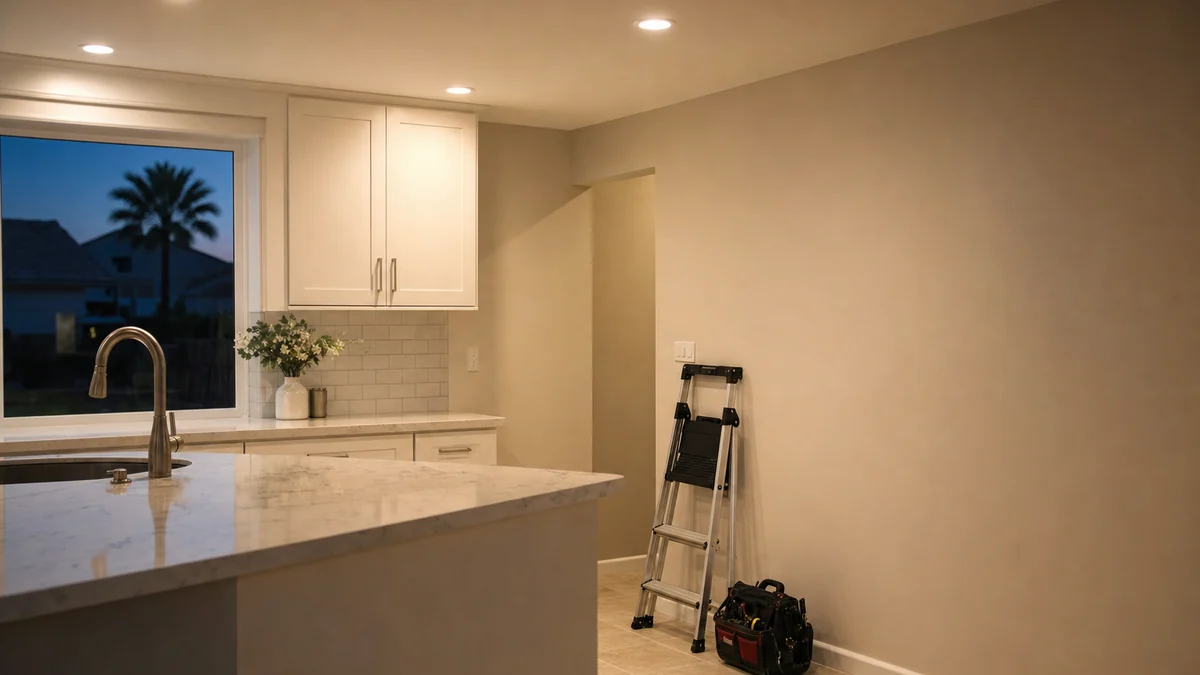
Show the result. Residential lighting is one of the few electrical jobs where the finished work is something the homeowner shows off, so photos do a lot of selling: a kitchen with new recessed lights, a lit front walk, a back patio after dark. Take them on every job, before and after, from the same spot.
Google’s image SEO best practices recommend descriptive filenames, titles and alt text, so name and describe the photos for what they show (“recessed lighting in a remodeled kitchen”) rather than leaving camera file names. Then use them on your lighting page, your Google profile and in follow-ups.
The other residential source is your own customer list. A homeowner whose panel you upgraded or whose outlets you fixed already trusts you; a short note about lighting upgrades costs nothing. If you also sell dimmers, smart switches and other connected controls, marketing smart home installs covers that overlap.
How do I list lighting work on my Google Business Profile?
Add it to your services. Google’s help page on managing services on your Business Profile says you can choose suggested services or add custom ones, group them into categories and add descriptions, and that when local customers search for something you offer, that service may be highlighted on your profile.
So list lighting work in the words customers use: LED lighting retrofits, recessed lighting installation, outdoor and landscape lighting, lighting repair. The same page warns that custom services are automatically rejected if they break policy, including service names that contain prices or phone numbers, so keep the names plain and put details in the description. Add your best lighting photos to the profile too.
Can lighting work turn into repeat business?
It can, on the commercial side especially. A building you retrofitted still needs repairs, controls adjustments and service on parking lot and exterior lights, and a customer who saw the savings is likely to call you for the next building or the next upgrade. A service agreement that covers lighting checks and repairs keeps you on the property. Selling maintenance agreements to past customers covers how to set one up.
On the residential side, lighting customers tend to come back for the next room, the outdoor lighting or a smart-home upgrade. Ask for a review once the work is done; a review that says “the kitchen lights look great” sells the next lighting job better than a star rating alone.
How do I know if lighting work is paying off?
Track it as its own job type. In your field software, tag lighting jobs and quotes separately, and split commercial retrofits from residential lighting, so you can see how many of each you quote, how many you win, and what they’re worth. Give the lighting pages and any lighting ads their own tracked phone number or form source.
Watch the commercial side over a longer window. A retrofit can take months from walkthrough to signed job, so judge it on quotes and walkthroughs booked first, then signed jobs. Tracking which marketing brings in real jobs walks through the setup.
Want to see where your company stands?
A free visibility audit shows where you show up on Google, Maps and AI answers, and what it's costing you in calls.
What's different about marketing lighting work
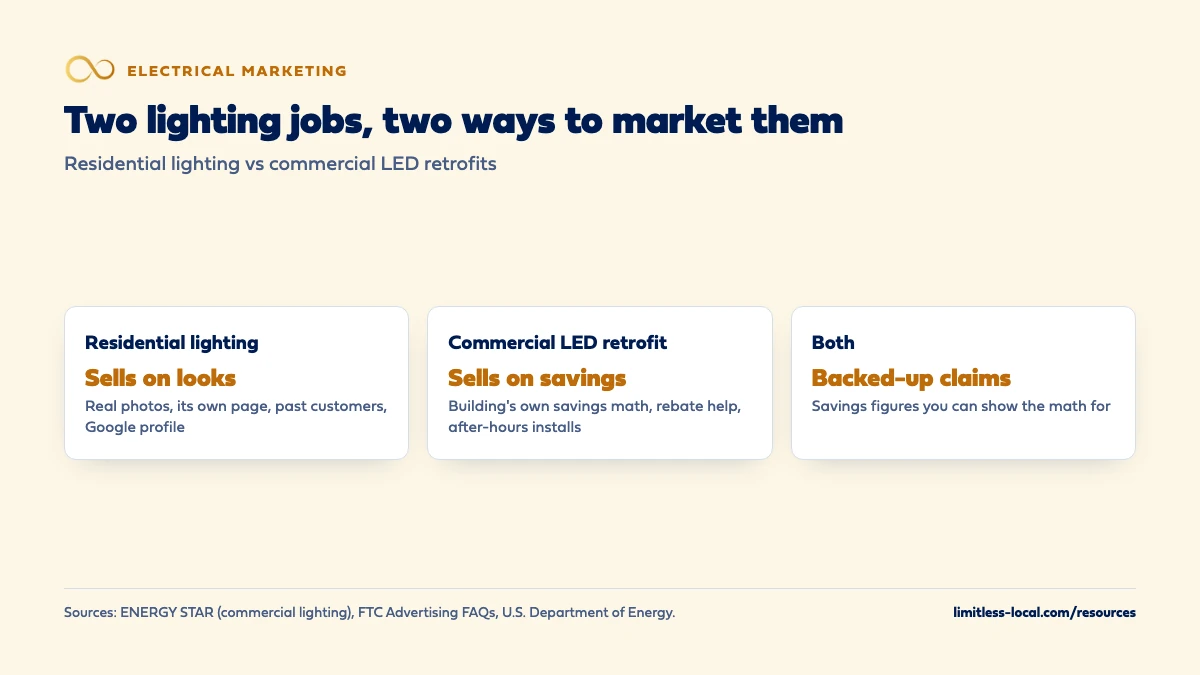
Two buyers, two reasons to buy. A business owner buys an LED retrofit for lower bills and fewer maintenance calls; a homeowner buys lighting for how the house looks and feels. One message rarely reaches both, which is why lighting usually needs two pages and two kinds of outreach.
Paperwork is part of the sale. Rebate forms, savings estimates and fixture counts can feel like overhead, but for a commercial buyer, an electrician who handles them is easier to say yes to than one who leaves them to the owner.
The schedule has to fit the business. A store or office can’t go dark for a day. Saying you’ll do the work after hours or in phases, if you can, answers an objection before it’s raised.
The work photographs well. Unlike most electrical jobs, finished lighting is visible and attractive. Night photos of lit buildings, parking lots and homes are some of the strongest marketing an electrician can have.
A worked example: the savings math for one retrofit
These numbers are made up to show the math a business owner wants to see; they’re not a benchmark. Say a warehouse has 120 high-bay fixtures drawing 400 watts each, and you propose LED fixtures drawing 150 watts each.
- That’s 250 watts saved per fixture, or 30 kilowatts across the building.
- At 4,000 hours of lighting a year, that’s 120,000 kilowatt-hours saved.
- At a made-up electric rate of $0.12 per kilowatt-hour, that’s about $14,400 a year in energy savings, before maintenance savings or any rebate.
If the job is quoted at a made-up $36,000, it pays for itself in about two and a half years on energy alone. Every input here should come from the actual building: its fixture count, wattages, hours and electric rate. That’s what makes the estimate something the owner can trust and the FTC’s evidence rule easy to meet.
Lighting is one of the services we can build pages, profile listings and campaigns around for an electrical company. A free visibility audit is a quick way to see whether people in your area are finding you for lighting work today.
Frequently asked questions
Should I quote LED retrofits per fixture?
You can show a per-fixture breakdown, but lead with the total, the estimated yearly savings and the rebate you’ve confirmed. Owners compare the payback, not the fixture price.
Can I say LEDs cut energy use by 90%?
As a general statement with a source, yes: ENERGY STAR and the Department of Energy say LEDs use 90% less energy than traditional bulbs and up to 90% less than incandescent bulbs, respectively. For a specific building, show that building’s own numbers instead.
Do I need special credentials to do LED retrofits?
Licensing rules vary by state and locality, so check with yours. If you hold a lighting certification, mention it; ENERGY STAR’s lighting page links to a locator for certified lighting professionals.
Should I run Meta ads for lighting work?
Residential lighting is visual, so photo-led remarketing to people who visited your lighting page can make sense. Commercial retrofits are usually better reached directly.
What should a commercial lighting page include?
The kinds of buildings you’ve retrofitted, what a walkthrough involves, how you estimate savings, whether you handle rebate paperwork and after-hours installs, and photos of finished work.
Are lighting jobs worth it for a small electrical shop?
Residential lighting often is, because it fills gaps in the schedule and comes from existing customers. Large commercial retrofits need the crew and cash flow to handle them, so start with buildings you can finish well.
Key takeaways
- Market commercial LED retrofits and residential lighting as two separate offers with separate pages.
- Target commercial buildings with long operating hours and high electric bills, starting with customers you already serve.
- Sell retrofits with a walkthrough, the building’s own savings math and help with utility rebates.
- Back every energy-savings claim with evidence; quote general LED figures only with their source.
- List lighting services on your Google profile, use real photos, and track lighting jobs as their own type.
Not sure what's working right now?
Start with a free visibility audit: rankings, Google profile, reviews and tracking, checked against your service area.
More in this section
- How should an electrical contractor market to commercial customers?
- Should my electrical company market smart home installs?
- How should a new electrical contractor get its first customers?
- Should an electrician market battery backup and solar tie-in work?
- How do I get more referrals from past electrical customers?
Sources
- Upgrade Your Lighting — ENERGY STAR
- Consumer Guide to Energy-Efficient Lighting — U.S. Department of Energy
- Database of State Incentives for Renewables & Efficiency (DSIRE) — NC Clean Energy Technology Center
- Advertising FAQ's: A Guide for Small Business — Federal Trade Commission
- Benchmark Your Building With Portfolio Manager — ENERGY STAR
- Manage your services on your Business Profile — Google Business Profile Help
- Image SEO Best Practices — Google Search Central