
What Google Ads campaigns work best for electricians?
- Which Google Ads campaign types book the most jobs for an electrical contractor?
- What Google Ads campaign types can an electrician choose from?
- Why do Search campaigns usually come first for an electrical company?
- How should an electrician split Search campaigns by job type?
- Where do Local Services Ads fit for an electrician?
- Should an electrician run Performance Max?
- Do Display or YouTube campaigns make sense for electricians?
- How do call assets help an electrician get phone calls?
- Which searches should an electrician keep out of their ads?
- How should an electrician set where the ads show?
- How do I know which Google Ads campaign is booking electrical jobs?
- What's different about Google Ads for electricians
- A worked example: comparing two electrical campaigns by cost per booked job
- Frequently asked questions
- Key takeaways
- More in this section
- Sources
The short version
- Start with Search campaigns split by job type, because they reach people searching for an electrician right now.
- Add call assets so a phone search can turn into a call without visiting your site.
- Local Services Ads charge per lead and are moving into Google Ads, with electrical among the first categories for select advertisers.
- Add Performance Max, Display or YouTube once calls are tracked and Search is booking jobs at a cost you can carry.
For electrical contractors deciding which Google Ads campaigns to run, in what order, and which ones to leave off until the basics are booking jobs.
Get a free visibility audit · Book a growth call
Which Google Ads campaign types book the most jobs for an electrical contractor?
For most electricians, the campaigns that book jobs first are Search campaigns split by job type, such as service and repair calls, panel upgrades, EV charger installs and generators, with call assets so people can phone you straight from the ad. Local Services Ads are the pay-per-lead option alongside them, and Google is moving them into Google Ads as Performance Max campaigns with pay-per-lead goals, with electrical among the categories in the first phase, which began in August 2026 for select advertisers. Standard Performance Max, Display and YouTube campaigns reach people across many Google channels, which usually makes them a better second step for remarketing and planned work than a first campaign for urgent calls.
That order is how we set up Google Ads for local service businesses: Search first, built around the jobs and towns you want, then other campaign types once the tracking shows which jobs are booking. It’s part of our electrical contractor marketing, and the rest of the electrical marketing questions library goes question by question.
What Google Ads campaign types can an electrician choose from?
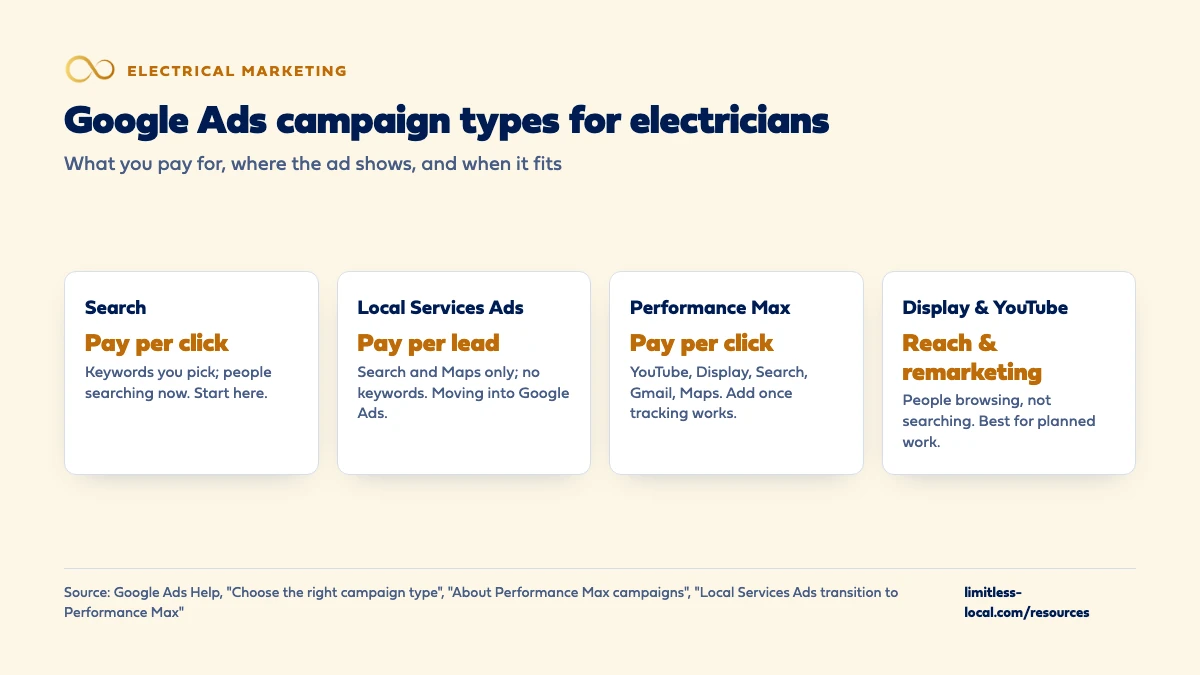
Google’s own guide to choosing a campaign type lists Performance Max, Search, Display, Video, App and Shopping campaigns. App and Shopping campaigns are built for app installs and retail product listings, so for an electrical contractor the real choice is between four, plus Local Services Ads:
- Search: text ads on Google search results, triggered by keywords you pick.
- Local Services Ads: pay-per-lead ads on Google Search and Maps, targeted by service category and area instead of keywords.
- Performance Max: one campaign that can show across YouTube, Display, Search, Discover, Gmail and Maps, with Google’s automation choosing where.
- Display: image ads on websites and apps, including ads shown to people who already visited your site.
- Video: ads on YouTube and other sites.
They aren’t interchangeable. They differ in who sees the ad (someone searching for an electrician today, or someone browsing), what you pay for (a click or a lead) and how much control you keep.
Why do Search campaigns usually come first for an electrical company?
Google describes Search campaigns as a way to reach people while they’re searching for the services you offer, with targeting you control: you write the ads and pick the keywords. For an electrician, that’s the homeowner typing “electrician near me” after a breaker keeps tripping, or a property manager searching for commercial electrical service.
In our judgement that’s why Search is the usual first campaign. The person already needs an electrician, you decide which jobs you show up for, and every click can be tied to a keyword, so you learn quickly which searches turn into booked jobs. Before you build it, make sure the page each ad points to matches the job in the ad; what an electrician’s website needs covers that side.
How should an electrician split Search campaigns by job type?
Google’s advice on organizing an account is to create a separate campaign whenever you need different settings, such as a different budget or location targeting, and inside each campaign to build ad groups around a narrow theme with keywords and ads that match it. Google recommends at least three ads in each ad group, and points out that reorganizing later wipes out the data you’ve built up, so it pays to set the structure up properly from the start.
For an electrical contractor, a sensible split looks something like this:
- Service and repair: outlets, breakers, lighting, troubleshooting, and urgent calls if you take them.
- Panel upgrades and service changes: planned, higher-ticket work that usually needs an estimate.
- EV charger installs: a different searcher with a different question, often tied to a panel or capacity check.
- Generators: installs and service, if you do them.
- Commercial: its own campaign, because the buyer, the towns and the budget are usually different.
Splitting this way lets you put more budget behind the jobs you want and see cost per booked job for each one. How to grow the panel and EV side specifically is covered in getting more panel upgrade and EV charger jobs.
Where do Local Services Ads fit for an electrician?
Local Services Ads charge for valid leads, such as calls and messages, instead of clicks. They show only on Google Search and Google Maps, and they’re keywordless: targeting comes from the service categories and areas you choose. Google is moving Local Services Ads into Google Ads as Performance Max campaigns with pay-per-lead goals, and electrical is named in the first phase, which began in August 2026 for select home and storefront service advertisers. Service-area businesses without a physical storefront follow in late 2026.
A few details matter for electricians after the move. Budgets become daily, with the month capped at your daily average budget times 30.4. Manual bidding, such as setting a maximum cost per lead, is no longer supported. And if you want separate bidding for different business categories, Google says to set up separate campaigns for each one. Whether LSAs pay off for your shop is its own question, covered in whether Local Services Ads are worth it for electricians.
Curious what your marketing is actually booking?
Get a free visibility audit — no obligation, no sales pitch.
Should an electrician run Performance Max?
Standard Performance Max is a different thing from the pay-per-lead version that replaces LSAs. It charges per click, and it can show your ads across YouTube, Display, Search, Discover, Gmail and Maps from one campaign, with Google’s automation deciding where your budget goes based on the conversion goals you set. Google says you can use it to complement keyword-based Search campaigns, and that when a search matches an exact match keyword in a Search campaign, the Search campaign gets priority.
Our view: Performance Max is a poor first campaign for most electricians, because it learns from the conversions you feed it. If your account can’t yet tell a booked panel upgrade from a wrong number, it has nothing good to learn from. Once calls and form leads are tracked and Search is booking jobs, it can be worth testing, with negative keywords and brand exclusions set. Watch Final URL expansion too: when it’s on, Google may send people to a different page on your site than the one you chose, and Google notes that you remain responsible for what that page and any generated text say.
Do Display or YouTube campaigns make sense for electricians?
Display campaigns put image ads on websites and apps, and Google notes you can build one around your data segments to show ads to people who’ve already visited your site. Video campaigns run on YouTube, and Google lists some types as built for awareness and others for driving conversions.
For an electrician, these tend to fit planned work better than urgent calls: a homeowner who looked at your EV charger page last week, or someone thinking about a standby generator before the next storm season. Someone with sparking outlets is searching, not watching YouTube. One setting to check on any Search campaign: Display Expansion can show your Search campaign’s ads on the Display Network using the same budget. Google says cost per conversion on Display may vary, so if you want your service budget spent on searchers only, review that setting before launch.
How do call assets help an electrician get phone calls?
A call asset adds your phone number to your search ad, so on a phone people can tap to call you directly instead of visiting your site first. Google says a tap on the call button costs the same as a headline click. You can schedule the number to show only during the days and hours you’re answering, which matters if you don’t take after-hours calls.
Two more points from Google’s help page. Don’t put your phone number in the ad text itself, because that can get the ad disapproved; use the call asset. And turn on call reporting, which uses Google forwarding numbers so calls from your ads can be counted as conversions. Without that, you can’t tell which campaign made the phone ring.

Which searches should an electrician keep out of their ads?
Negative keywords stop your ads from showing on searches you don’t want to pay for. Electrical searches attract a lot of people who will never hire you: do-it-yourselfers looking up how to wire a switch, people searching for electrician jobs or apprenticeships, and shoppers looking for parts and supplies. Common negatives for an electrical contractor include words like “how to”, “DIY”, “jobs”, “salary”, “apprenticeship” and “school”, plus any services you don’t do.
One catch from Google’s documentation: negative keywords don’t match close variants, so you’ll need to add singular and plural versions and synonyms yourself. Your search terms report, which shows what people actually typed, is where new negatives come from. Check it every week in the first months.
How should an electrician set where the ads show?
By default, Google’s location targeting reaches people who are in your target area and people who have shown interest in it. Google’s page on advanced location options says to consider the “Presence” setting when you only want to reach people located in, or regularly in, your chosen locations. For a service business whose trucks only drive so far, that is often the better fit. Someone in another state reading about your town isn’t going to book an outlet repair.
Draw the target around the towns you actually want to work in, and consider tighter areas for small service calls than for panel upgrades or commercial jobs that justify a longer drive. That’s another reason to split campaigns by job type: each campaign can have its own map.
How do I know which Google Ads campaign is booking electrical jobs?
Google Ads will report clicks, calls and form fills for each campaign, but it doesn’t know which of those became a booked job unless you tell it. The number to compare across campaigns is cost per booked job: what the campaign cost divided by the jobs it put on the schedule. A campaign with cheap leads that rarely book can be worse than one with expensive leads that usually do.
That means tagging each call and form by source, marking which ones booked, and ideally which job type and ticket size they turned into. Tracking which electrical marketing brings in real jobs walks through the setup, and how much an electrical contractor should spend covers the budget side.
Want to see where your company stands?
A free visibility audit shows where you show up on Google, Maps and AI answers, and what it's costing you in calls.
What's different about Google Ads for electricians
A wide job mix. One electrical company can do small service calls, panel upgrades, EV charger installs, generators and commercial work, and each has a different ticket size and a different searcher. One catch-all campaign blends them together and hides which ones pay. Separate campaigns are how you see the difference.
Licensed versus handyman. Homeowners don’t always know the difference between a licensed electrician and a handyman, and some searches will be price-led. If you’re licensed and insured, say so in the ad and on the page it points to. Licensing rules vary by state, so describe your own credentials and leave other people’s out of it.
Planned versus urgent work. A dead circuit is an urgent search; an EV charger or a generator is usually researched over days or weeks. Urgent work suits Search and call assets. Planned work is where remarketing through Display, YouTube or Performance Max can earn its place, once tracking is in.
A worked example: comparing two electrical campaigns by cost per booked job
These numbers are made up to show the math, not a benchmark for your market. Say an electrician runs two Search campaigns for a month, each spending $1,200. The service-call campaign brings in 24 calls, and 12 of them book, so each booked job cost $1,200 divided by 12, or $100. The panel upgrade campaign brings in 8 estimate requests and 2 signed jobs, so each booked panel job cost $600.
On cost per lead alone the panel campaign looks far worse. But if a panel upgrade leaves several times the profit of a service call, it may be the better use of the next dollar. That comparison is only possible because the campaigns are separate and the bookings are tracked.
For reference on what management costs: our Essentials package is $3,500 a month and includes Google Ads management up to $2,500 a month in ad spend for one location, but not Local Services Ads. Growth is $4,500 a month and adds Local Services Ads management, Meta remarketing and Google Ads up to $5,000 a month in spend. Ad spend is paid to Google separately in every package. A free visibility audit runs this same math on your own market.
Frequently asked questions
Can I run Search ads and Local Services Ads at the same time?
Yes. They’re separate campaigns with different pricing: Search charges per click on keywords you choose, and Local Services Ads charge per valid lead from your service categories and areas. Running both lets you compare cost per booked job side by side.
Can I create a new Local Services Ads campaign inside Google Ads?
Not yet. Google says new campaigns with pay-per-lead goals can’t be created directly in Google Ads at this time, so new setups still go through Local Services. Campaign creation in Google Ads is coming later.
Do calls from my ad cost more than clicks?
No. Google charges a tap on the call button in a call asset the same as a click on the ad’s headline, at a standard cost per click.
Can I put my phone number in my ad's headline?
Google warns that a phone number placed elsewhere in the ad text may get the ad disapproved. Use a call asset, which also lets you schedule when the number shows.
Will Performance Max take over the searches in my Search campaign?
Not for exact matches. Google says a Search campaign gets priority over Performance Max when a search matches one of its exact match keywords; Performance Max search themes carry the same priority as phrase and broad match keywords.
Do Local Services Ads show on YouTube or other websites?
No. Google says campaigns with pay-per-lead goals show only on Google Search and Google Maps, while standard Performance Max campaigns can run across YouTube, Gmail and the Display Network.
Key takeaways
- Search campaigns split by job type are the usual first campaign, because they reach people searching for an electrician now.
- Give commercial work, panel upgrades, EV chargers and service calls their own campaigns so each has its own budget and map.
- Local Services Ads are pay per lead and are moving into Google Ads, with electrical among the first categories; businesses without a storefront follow in late 2026.
- Add Performance Max, Display or YouTube after calls and bookings are tracked, mainly for planned work and remarketing.
- Compare campaigns on cost per booked job, not cost per click or per lead.
Not sure what's working right now?
Start with a free visibility audit: rankings, Google profile, reviews and tracking, checked against your service area.
More in this section
- Are Google Local Services Ads worth it for electricians?
- Should my electrical company start with LSAs, Google Ads or SEO?
- How do I optimize my electrician Google Business Profile?
- How should an electrical contractor market to commercial customers?
- How do I track which electrical marketing brings in real jobs?
Sources
- Choose the right campaign type — Google Ads Help
- About Performance Max campaigns — Google Ads Help
- Local Services Ads transition to Performance Max campaigns with pay-per-lead goals — Google Ads Help
- About call assets — Google Ads Help
- Organize your account with ad groups — Google Ads Help
- About negative keywords — Google Ads Help
- About Display Expansion on Search campaigns — Google Ads Help
- About advanced location options — Google Ads Help