
How should an electrical contractor market to commercial customers?
- What's the best way for an electrical contractor to win commercial work in 2026?
- How is marketing commercial electrical work different from residential?
- Who actually hires a commercial electrician?
- How do I get on general contractors' bid lists?
- Can maintenance contracts become steady commercial work?
- How do I win commercial EV charging work?
- What should the commercial side of my website show?
- Does Google search still matter for commercial electrical work?
- Should I reach out to commercial buyers directly?
- Is government electrical work worth chasing?
- How do I measure commercial electrical marketing?
- What's different for commercial electrical contractors
- A worked example: why bid invitations matter more than leads
- Frequently asked questions
- Key takeaways
- More in this section
- Sources
The short version
- Your commercial buyers are general contractors, property and facility managers, business owners, EV charging site hosts and public agencies.
- Most commercial electrical work is won through bid lists, relationships and maintenance agreements; search catches emergencies and small jobs.
- Maintenance programs and workplace EV charging both give you a reason to start a conversation with a facility.
- Track bids out, bids won and account value, not cost per lead.
For electrical contractor owners who want more tenant build-outs, maintenance contracts and commercial service work, not just more homeowner calls.
Get a free visibility audit · Book a growth call
What's the best way for an electrical contractor to win commercial work in 2026?
An electrical contractor should market to commercial customers by going after the people who award the work (general contractors, property and facility managers, business owners and EV charging site hosts), mostly through bid lists, relationships and maintenance agreements, with Google search catching the emergency and small-project calls. In practice that means getting prequalified with the general contractors in your area, offering facility managers preventive maintenance and inspection work, showing commercial jobs clearly on your website and Google profile, and following up on every bid. Judge it by bids won and account value, not cost per lead.
Our part of commercial marketing is getting found and getting credit for it: a website with real commercial pages, a Google profile and listings that show commercial work, search ads for emergency and project terms, and call tracking that shows where every call came from. Most of that sits in our local SEO work, and our electrical marketing page shows the full setup. The bids, walkthroughs and GC relationships that win most commercial contracts are work your team owns. The rest of the electrical marketing questions library goes question by question.
How is marketing commercial electrical work different from residential?
Nearly everything changes except the need to answer the phone. In our judgement these are the differences that matter most:
- The buyer usually isn’t the person who uses the building. A tenant reports the dead circuit; a property manager, facility manager or general contractor decides who gets the work.
- A lot of the work is bid. Tenant build-outs and new construction usually go to whoever is on the general contractor’s bid list and comes in with a clean, accurate number. You can’t win a job you were never invited to price.
- The prize is the relationship, not the job. One general contractor or property manager can send you work for years.
- Service work and project work need different marketing. A restaurant with half its kitchen down wants someone today. A developer planning a build-out wants a bid in three weeks. Those are different pages, different offers and different follow-up.
So the marketing has two jobs: reach the people who award commercial work before they need you, and be easy to find when something fails.
Who actually hires a commercial electrician?
List the buyers in your area before you spend anything. The usual groups:
- General contractors and builders who need an electrical sub for tenant improvements, remodels and new construction.
- Property managers for office, retail and multifamily buildings, who need service calls, lighting work and a reliable vendor.
- Facility managers at plants, warehouses, schools, clinics and campuses, who own maintenance on switchgear, panels and backup power.
- Business owners of restaurants, shops and small offices who manage their own building.
- EV charging site hosts: employers, apartment owners and parking operators adding chargers.
- Public buyers: city, county, school district and federal facilities.
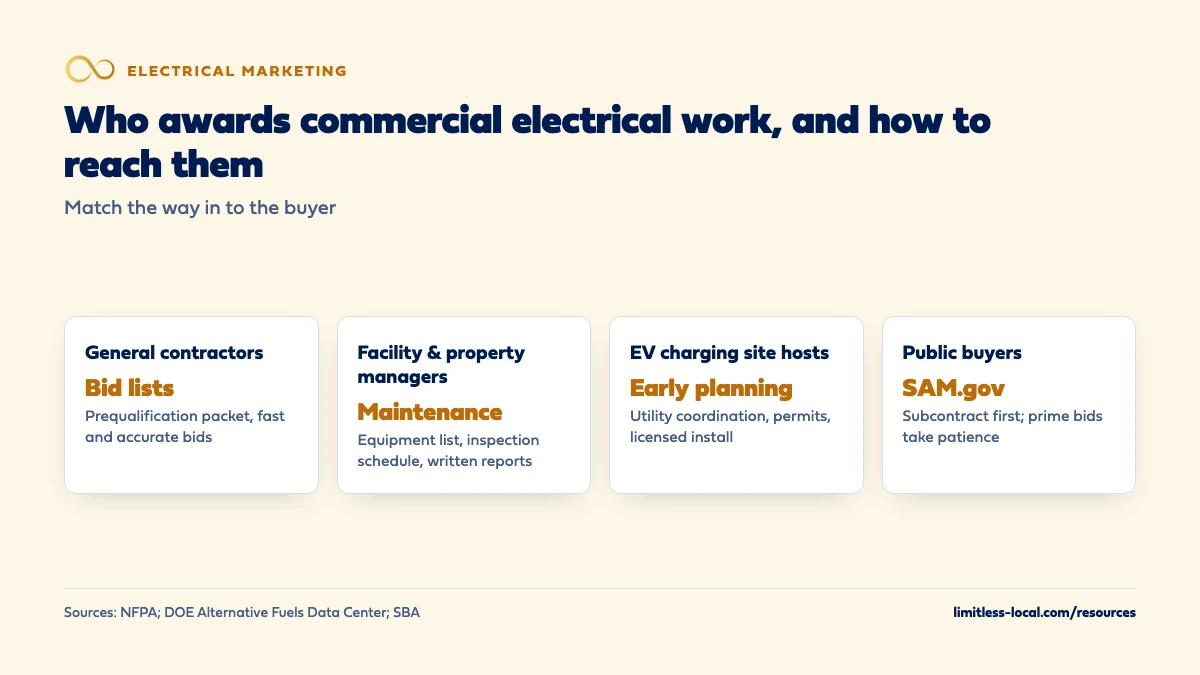
Each one buys differently. A general contractor wants accurate bids and a crew that keeps the schedule. A property manager wants fast response and clean paperwork. A facility manager wants documentation. Pick the two or three groups that fit your license, crews and equipment, and build the plan around them.
How do I get on general contractors' bid lists?
Treat each general contractor as a customer with its own approval process. In our judgement, have a prequalification packet ready before you ask anyone for a bid invitation:
- Your license numbers, certificate of insurance, bonding capacity if you have it, and safety record.
- The kinds of commercial work you do well: tenant improvements, service upgrades, lighting retrofits, EV charging, generators, low voltage. Only list what your crews actually do.
- Three or four recent commercial jobs with the building type, scope and size, and a contact who has agreed to take a reference call.
- Your crew size and how many jobs you can run at once, so the estimator knows what to send you.
- One contact for bids and one for the field.
Then ask the estimator to add you to the bid list for the job types you want, and bid what they send even if you lose the first few. Turnaround and accuracy on those first bids decide whether the invitations keep coming. Track every bid you send and chase each one with a short follow-up after the bid date; following up on electrical quotes automatically covers the mechanics.
Can maintenance contracts become steady commercial work?
They can, and electrical maintenance has become an easier conversation to start. NFPA 70B, the Standard for Electrical Equipment Maintenance, gives organizations a framework for setting up an electrical maintenance program, and NFPA says facility managers, maintenance supervisors, safety directors, engineers and electrical service providers rely on it to guide maintenance in commercial, industrial and similar facilities (NFPA). The Electrical Safety Foundation notes that the 2023 edition turned 70B from a recommended practice into a standard, and that it starts by having owners categorize their equipment and its criticality, then sets how often each piece must be maintained (ESFI).
For your marketing, that gives you something specific to offer a facility manager: help building the equipment list, a schedule of inspections and testing, and a written record after every visit. Whether a particular building is required to follow 70B depends on what its owner, insurer or local authority has adopted, so ask rather than assume, and don’t sell it as a legal requirement unless you’ve confirmed it for that site.
In our judgement the maintenance report is the best marketing a commercial electrician has: it’s what gets forwarded to the owner when the budget for panel replacements or a generator comes up.
Curious what your marketing is actually booking?
Get a free visibility audit — no obligation, no sales pitch.
How do I win commercial EV charging work?
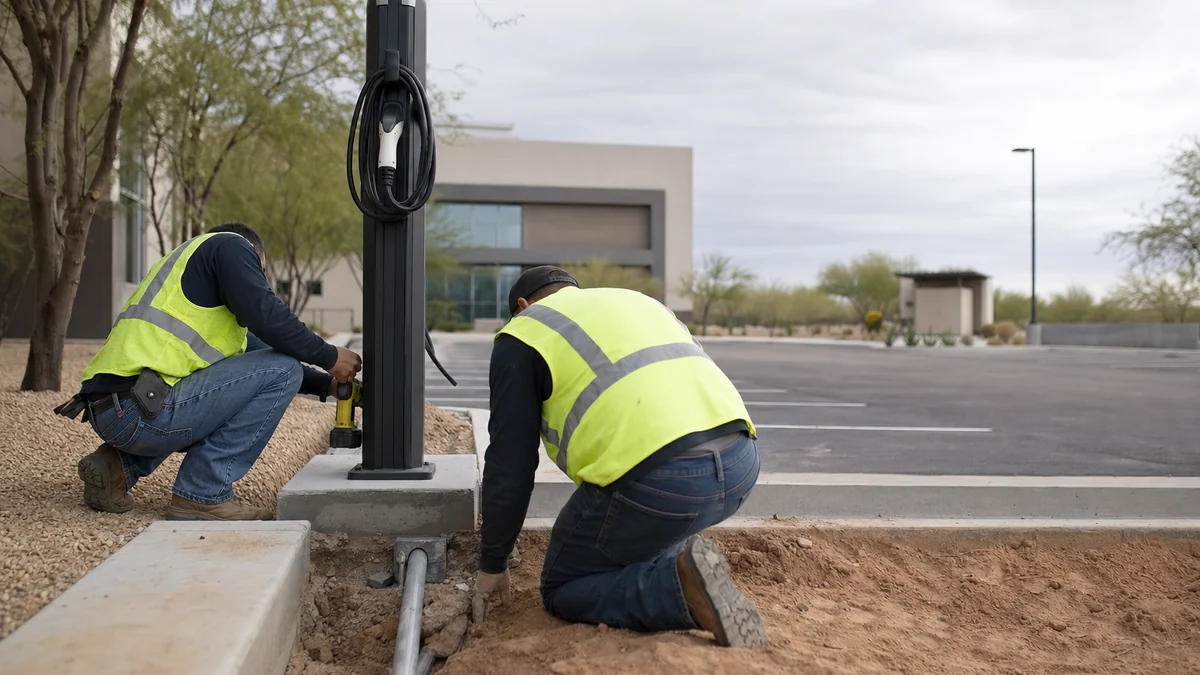
Get in early, before the equipment is chosen. The Department of Energy’s Alternative Fuels Data Center tells employers to consult their utility, an electrical contractor, a charging equipment provider and other stakeholders early in the process (AFDC). Its planning checklist has site hosts engage the utility on electrical service upgrades, assess codes and permits, and decide whether a formal request for proposals is needed (AFDC).
The same page says charging station installations must comply with local and state codes and be completed by a licensed electrical contractor, and it points site hosts to the Electric Vehicle Infrastructure Training Program’s list of contractors trained and certified in charger installation. If you hold that certification, make sure you’re on the list. For workplaces, AFDC’s workplace charging page says Level 2 stations are the most commonly used, and it suggests workplaces and multifamily housing consider Level 1 and Level 2 charging.
In our judgement that points to a commercial EV charging page explaining how you handle load calculations, utility coordination, permits and inspections, plus relationships with charger vendors and utility programs that refer contractors. The residential side of the same work is covered in getting more panel upgrade and EV charger jobs.
What should the commercial side of my website show?
Enough that an estimator can shortlist you without a phone call. In our judgement that means:
- Separate commercial pages, not one line on a residential homepage: commercial service and emergency calls, tenant improvements and build-outs, maintenance and inspections, EV charging, and generators or backup power if you do them.
- Building types you’ve worked in: offices, retail, restaurants, warehouses, multifamily, medical. Only list real ones.
- Short project write-ups with the scope, building type and a photo, shared with the customer’s permission.
- License, insurance and service area stated plainly, including after-hours coverage if you offer it.
- A commercial request form that asks for the building type, the scope and the timeline, so a bid request doesn’t land in the same pile as a homeowner’s outlet question.
The basics that make any electrician’s site produce calls still apply; what an electrician’s website needs covers those.
Does Google search still matter for commercial electrical work?
Yes, for the work that doesn’t come through a bid list: a store that lost power to half its lights, a new property manager without a vendor yet, an owner searching for “commercial electrician” and a town. Those buyers use the same Google results and Maps homeowners do.
The same rules apply, too. Google says local results are mainly based on relevance, distance and popularity, that complete and detailed business information helps it match your profile to searches, and that there’s no way to request or pay for a better local ranking (Google Business Profile Help). Make sure your profile’s description, services and photos show commercial work, and ask commercial customers for reviews the same way you ask homeowners. Getting into the Google map pack covers the profile side.
Paid search can work for commercial emergency and project terms as well. In our judgement keep it narrow, commercial terms in the towns you serve with a commercial landing page, so the budget doesn’t go to homeowners asking about a ceiling fan.
Should I reach out to commercial buyers directly?
Yes, more than a residential shop would. In most markets the general contractors, property management firms and large facilities are a short list you can actually name. A short email or call, a visit with your prequalification packet, and showing up where those buyers meet, such as local builder and property management associations, reach people search never will.
If you use email, the rules apply to business buyers too. The FTC says the CAN-SPAM Act covers all commercial messages and makes no exception for business-to-business email (FTC). Every marketing email needs honest header and subject lines, your physical postal address and a working way to opt out, and opt-outs have to be honored. That’s a summary of the FTC’s guide, not legal advice; read the guide or ask a lawyer before you start a campaign.
Keep the message about the buyer’s problems: how fast you respond and how you document work.
Is government electrical work worth chasing?
It can be, but subcontracting is often the easier way in. SBA points small businesses to SUBNet, a database of subcontracting opportunities posted by large contractors looking for small subs, and to directories of prime contractors that are required to set subcontracting goals (SBA). SBA also says agencies must use SAM.gov to advertise all contracts over $25,000, and that, with few exceptions, contracts under $150,000 are automatically set aside for small businesses when at least two small businesses could do the work.
Bidding as a prime takes patience. SBA’s requirements include registering in SAM.gov and matching your services to a NAICS code, and it’s candid that some businesses spend between $80,000 and $130,000 to earn their first contract and that it could take up to two years to start making a return (SBA). It suggests keeping a diverse list of private-sector clients to offset that.
How do I measure commercial electrical marketing?
Not by cost per lead. One bid invitation from a general contractor can be worth more than a month of residential calls, and the sale can take months. In our judgement the numbers worth tracking are:
- Bid invitations and where each came from: a GC relationship, outreach, search, a referral.
- Bids sent and bids won, so you know your win rate by job type and by general contractor.
- Maintenance agreements signed and renewed, and their annual value.
- Pull-through work: repairs, upgrades and projects that came from maintenance customers.
Tag the source on every commercial job in your field software, the same as residential work. Tracking which marketing brings in real jobs covers the setup.
Want to see where your company stands?
A free visibility audit shows where you show up on Google, Maps and AI answers, and what it's costing you in calls.
What's different for commercial electrical contractors
Your license and paperwork are part of the pitch. Commercial buyers check licensing, insurance and safety records before they check price. Licensing and permit rules vary by state and city, so state exactly what you hold and where, and keep the documents current in your packet.
Power loss stops everything. When a building loses power, nothing else in it works, so response time sells harder than price on service calls. Say what your commercial response times are, and meet them.
New work keeps arriving with new equipment. EV charging, generators and building upgrades all put an electrician in the conversation early, often before any other trade. Being the contractor who explains the load, the utility side and the permits is how you get the call before the bid goes out.
A worked example: why bid invitations matter more than leads
These numbers are made up to show the math, not a benchmark. Say you bid 20 commercial jobs a quarter, averaging $35,000 each, and you win 4. That’s a win rate of 4 out of 20, or 20%, and $140,000 of work.
- If outreach and a stronger prequalification packet get you on two more general contractors’ bid lists, and they send you ten more invitations a quarter at the same win rate, that’s 2 more jobs.
- At the same average size, that’s 2 × $35,000 = $70,000 more work a quarter, from what a lead report would show as zero new leads.
That’s why commercial marketing should be judged by invitations, win rate and account value. For context, our Essentials package is $3,500 a month and covers the getting-found side: Google Business Profile management, a content sprint of up to 10 pages, Google Ads management and call tracking, with ad spend paid to Google separately. Whether that’s worth it for a commercial shop is what a free visibility audit is for.
Frequently asked questions
What is NFPA 70B?
It’s the NFPA’s Standard for Electrical Equipment Maintenance. It covers setting up an electrical maintenance program, maintenance intervals, testing methods and documentation for electrical equipment in commercial, industrial and similar facilities.
Do I need EVITP certification to install commercial EV chargers?
The Alternative Fuels Data Center says installations must be completed by a licensed electrical contractor and points site hosts to EVITP’s list of trained and certified contractors. Whether a specific utility or incentive program requires EVITP is set by that program, so check its rules.
Can I market residential and commercial electrical work under one name?
Yes, many contractors do. Keep separate pages, offers and ad campaigns for each, so an estimator doesn’t land on a residential coupon and a homeowner doesn’t land on a bid form.
Do commercial customers leave Google reviews?
Some will if you ask, so ask every one. A written reference a property manager or general contractor agrees to share is often worth more to the next commercial buyer.
Does CAN-SPAM apply to emails I send general contractors?
Yes. The FTC says the law covers all commercial email and makes no exception for business-to-business messages. This is a summary of the FTC’s guidance, not legal advice.
What is a NAICS code and do I need one?
It’s the North American Industry Classification System code for what your business does. SBA says you need to match your services to one to compete for federal contracts, and it sets small-business size standards by code.
Key takeaways
- Market to the people who award commercial work: general contractors, property and facility managers, business owners and EV charging site hosts.
- Get on bid lists with a prequalification packet, then win them over with fast, accurate bids and steady follow-up.
- NFPA 70B maintenance programs and early-stage EV charging planning both give you a reason to start a conversation.
- Google still matters for commercial emergencies and small jobs, so show commercial work clearly online.
- Judge commercial marketing by bid invitations, win rate and account value, not cost per lead.
Not sure what's working right now?
Start with a free visibility audit: rankings, Google profile, reviews and tracking, checked against your service area.
More in this section
- How should a new electrical contractor get its first customers?
- How much should an electrical contractor spend on marketing?
- What should an electrician's website have to get more calls?
- What Google Ads campaigns work best for electricians?
- What should I expect from electrical marketing in the first 90 days?
Sources
- NFPA 70B, Standard for Electrical Equipment Maintenance — National Fire Protection Association
- NFPA 70B: What the Change Means for Maintenance, Operations and Safety — Electrical Safety Foundation
- Workplace Charging for Electric Vehicles — U.S. Department of Energy, Alternative Fuels Data Center
- Procurement and Installation for Electric Vehicle Charging Infrastructure — U.S. Department of Energy, Alternative Fuels Data Center
- Tips to improve your local ranking on Google — Google Business Profile Help
- CAN-SPAM Act: A Compliance Guide for Business — Federal Trade Commission
- How to win contracts — U.S. Small Business Administration
- Get started with contracting — U.S. Small Business Administration