
What marketing should I pause while I’m hiring electricians?

- Which electrical marketing should I scale back while I'm short on electricians?
- Should I pause my marketing at all while I'm hiring?
- Mistake 1: Pausing SEO, reviews and your Google profile
- Mistake 2: Leaving ads on for work you can't staff
- Mistake 3: Removing campaigns instead of pausing them
- Mistake 4: Pausing when lowering the budget would do
- Mistake 5: Running ads during hours nobody can answer
- Mistake 6: Stopping follow-up on estimates and past customers
- Mistake 7: Mixing recruiting ads with customer marketing
- How do I decide how much to pull back?
- When should I turn everything back on?
- What's different for electrical contractors
- A worked example: trimming ads after losing one of three electricians
- Frequently asked questions
- Key takeaways
- More in this section
- Sources
The short version
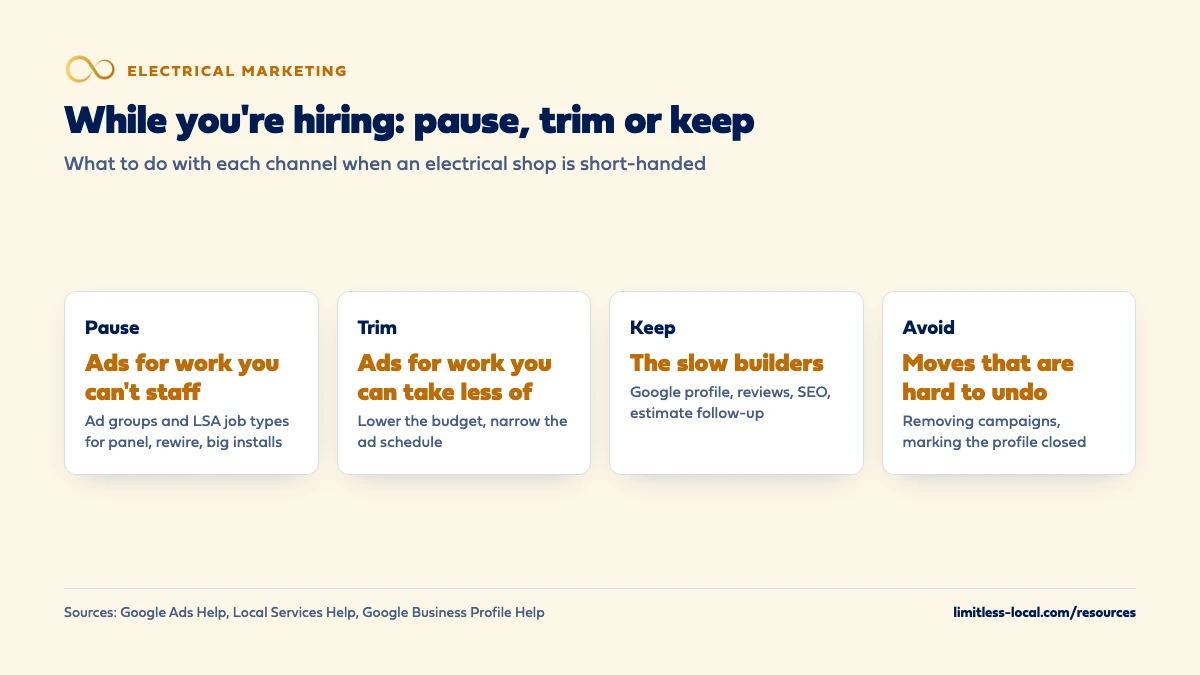
- Pause or trim paid ads only for job types you can't staff right now.
- Keep your Google profile, reviews, SEO and estimate follow-up running.
- Never mark the profile closed because you're busy, and pause instead of removing campaigns.
- Turn ads back up when the new electrician can take calls, not on hire day.
For electrical contractors who are short a licensed electrician or hiring one: what to pause, what to trim, what to keep running, and the mistakes that make the restart harder.
Get a free visibility audit · Book a growth call
Which electrical marketing should I scale back while I'm short on electricians?
Pause or trim only the paid channels that create calls for work you can’t staff right now, usually the Google Ads and Local Services Ads job types for panel upgrades, rewires and other jobs that need a licensed electrician on site. Keep your Google Business Profile, review requests, SEO and estimate follow-up running, because they take months to build and are what fills the schedule once the new hire starts. In Google Ads, pause or lower the budget instead of removing campaigns, since removal is permanent and pausing keeps settings and history.
Matching marketing to crew capacity is part of how we set and adjust budgets in our marketing packages: ads are planned around the jobs you can actually run, while the slower SEO and review work keeps building. See how it fits our electrical contractor marketing, or browse more electrical marketing questions.
Should I pause my marketing at all while I'm hiring?
Pause less than you think. The marketing that hurts you while you’re short-handed is the kind that creates calls today that nobody can run: paid ads and Local Services Ads for jobs your crew can’t take this month. Everything that builds slowly, such as your Google profile, reviews, SEO, and follow-up on estimates you’ve already given, should keep going, because it takes months to build and is what fills the schedule once the new electrician starts.
In our judgement, the common mistakes when an electrical shop loses a person or starts hiring are pausing the wrong channel, pausing it the wrong way, or pausing everything and paying for it later.
Mistake 1: Pausing SEO, reviews and your Google profile
These are the channels you can least afford to stop. Ads can bring calls within days of launch, but SEO typically takes 3-6 months to show meaningful organic growth, and a review habit that stops for a quarter leaves a gap homeowners can see. Turning them off saves a little now and costs you the head start you’ll want when the new hire is ready.
The worst version is marking your Google Business Profile as closed because you’re busy. Google says “Temporarily closed” is for businesses closed more than 7 days, for the off-season or indefinitely; for 7 days or less it says to set special hours instead. It also warns that for broad searches, temporarily closed businesses can rank after open ones. If you’re open but booked out, you’re open. Say so on the phone and quote honest lead times. Source: Mark your business as closed.
Mistake 2: Leaving ads on for work you can't staff
This is the most expensive one. If you’re down a licensed electrician, the ads still promising panel upgrades, rewires and EV charger installs are buying calls for jobs you’ll either turn down or book weeks out. The Bureau of Labor Statistics notes that most states require electricians to be licensed, that requirements vary by state, and that after an apprenticeship, electricians are considered journey workers who may work on their own, subject to local or state licensing. A new apprentice adds hands, not a second crew lead.
So pause by job type, not by channel. In Google Ads, that usually means pausing the ad groups or campaigns for the work you can’t staff and keeping the ones for work you can. Local Services Ads are moving into Google Ads: Google began migrating select home-service advertisers, electrical included, in August 2026. Once your account has moved, the old Local Services Ads dashboard redirects to Google Ads, and service types are managed under Settings in the Campaigns menu, which is where you’d trim the job types you can’t staff. Sources: BLS: Electricians and Local Services Ads transition to Performance Max.
If you run both, running Google Ads and LSAs together covers how they overlap.
Mistake 3: Removing campaigns instead of pausing them
In Google Ads, pause and remove are not the same button. Google says pausing is temporary: ads stop, charges stop, and all settings and history are kept so you can resume any time. Removing is permanent; you can view the old data but can’t restore the campaign, and you’d have to rebuild or copy it.
One catch when you come back: resuming a campaign only turns the campaign back on. If you also paused ad groups or keywords inside it, Google says you have to resume each of those by hand before ads show again. Write down what you paused, at which level, the day you pause it. Source: Enable, pause, or remove a campaign.
Curious what your marketing is actually booking?
Get a free visibility audit — no obligation, no sales pitch.
Mistake 4: Pausing when lowering the budget would do
If you’ll want the calls back in a few weeks, a lower budget is often the gentler move. Google says changes to budgets take effect immediately and never trigger a “Learning” status for Smart Bidding. A recently created or reactivated bid strategy, on the other hand, is one of the causes Google lists for “Learning” status, which can show for up to 7 days while your ads keep running.
A lower budget also changes your bill right away: Google says that after a budget change, spend for the rest of the month won’t exceed the new daily budget times the remaining days. In our judgement, a fully paused campaign is for work you truly can’t take for a month or more; a trimmed budget is for work you can take less of. Sources: About Smart Bidding learning and How budget changes take effect. Setting a monthly Google Ads budget goes deeper on the number itself.
Mistake 5: Running ads during hours nobody can answer
When the office is short too, after-hours and weekend calls go to voicemail, and an emergency caller with no power won’t wait. Google Ads campaigns show ads “All day” by default, and Google’s ad schedule lets you limit ads to certain days and hours, such as the business hours when you can actually handle inquiries.
Narrowing the schedule while you hire keeps the ads you’re paying for pointed at hours when someone picks up. Widen it again when the new electrician can take on-call shifts. Source: About Ad Scheduling.
Mistake 6: Stopping follow-up on estimates and past customers
Estimate follow-up doesn’t create new calls; it turns quotes you’ve already given into booked jobs, often for later dates that the new hire will be around for. Past-customer reminders work the same way. Both cost little, and stopping them while you’re busy throws away work you’ve already paid to win. Following up on quotes automatically covers setting it up so it doesn’t need office time.
If the problem is that the schedule is full for the next three weeks, say that in the follow-up and offer the first open date. That’s our judgement: a homeowner planning an EV charger or a generator often has more time than someone with a tripped main.

Mistake 7: Mixing recruiting ads with customer marketing
If you advertise the job opening on Facebook or Instagram, Meta treats it as an employment ad. Meta says employment campaigns must be declared as a Special Ad Category, with limited targeting: in the US you can target by city or region but not ZIP code, a city target includes a 15-mile radius, and some age, gender, interest and exclusion options are unavailable. Plan the recruiting ad as its own campaign, not as a tweak to a customer remarketing campaign.
Keep the tracking separate too. In our view, applicant calls should go to a different number or form than customer calls, or your lead counts will look busier than your booked jobs. Tracking which marketing brings real jobs explains how to keep sources clean. Source: Meta: audiences for employment campaigns.
How do I decide how much to pull back?
Start from capacity, not from the marketing. Count how many jobs a week your crew can run without the person you’re hiring, split by type: service calls, panel and rewire work, EV chargers and generators, and commercial. Then compare that with how many jobs each channel books in a normal week, which your job software (ServiceTitan, Housecall Pro or Jobber) or your call log can show.
Trim the paid channels until they book roughly what the smaller crew can run, starting with the job types that tie up a licensed electrician longest. Leave a little slack rather than none: a week with an empty slot is cheaper than restarting campaigns from scratch. That’s our judgement, not a formula. The worked example below shows the math.
When should I turn everything back on?
Turn the paid channels back up the week the new electrician can take calls on their own, not the week they’re hired. Bring back the job types they can run first; if you hired an apprentice, that may still be service work under a licensed lead, not solo panel jobs.
Then watch cost per booked job, not just calls, for the first month. If calls come back but bookings don’t, the slowdown left a gap somewhere, often in how quickly the office calls leads back. If the season is also slowing down, getting leads in a slow season covers the other half of the problem.
Not sure which of these is costing you jobs?
A free visibility audit checks the Google profile, reviews, site and tracking, and shows what to fix first.
What's different for electrical contractors
Who you’re hiring changes what you can sell. An electrical shop doesn’t just add a pair of hands. Whether a hire can run a panel upgrade alone depends on their license and on your state’s rules, which BLS says vary by state. Match the ads to the licenses on the payroll, not the headcount.
Service calls and project work pull on different people. A service call is an hour or two; a rewire or a generator install can tie up a licensed electrician for days. In our judgement, when you’re short, keep the short service work flowing and slow the big installs, unless the big installs are where your margin lives and you’d rather stretch lead times.
Commercial work runs on relationships. If you bid for general contractors or property managers, don’t go silent while you hire. Tell them your capacity and when it changes; a builder who stops hearing from you may stop sending bid invites.
A worked example: trimming ads after losing one of three electricians
These numbers are made up to show the math, not a benchmark. Say a shop with three licensed electricians and one apprentice normally books 30 jobs a week. One electrician leaves, and the owner figures the crew can run about 20 jobs a week until a replacement is licensed and up to speed.
Google Ads normally books 12 of those weekly jobs: 8 service calls and 4 project jobs (panel upgrades, EV chargers, a generator). Everything else comes from referrals, repeat customers, the Google profile and Local Services Ads.
- Gap to close: 30 – 20 = 10 jobs a week.
- Pause: the project ad group, since each of those jobs ties up a licensed electrician longest. That removes about 4 jobs.
- Trim: the service-call campaign’s daily budget from $120 to $80, and switch off the LSA job types for panel and rewire work. Together, the owner aims to drop roughly 6 more jobs and checks the count weekly.
- Keep: the Google profile, review requests, SEO and estimate follow-up, all untouched.
Because ad spend is paid directly to Google, the cut shows up on the Google bill right away. On our side, packages don’t include ad spend: Essentials is $3,500 a month and manages Google Ads up to $2,500 a month in spend, and Growth is $4,500 a month and adds Local Services Ads management. We recommend a budget, and changes to it, based on what your crew can actually run.
Frequently asked questions
Does pausing a Google Ads campaign cost anything?
No. Google says pausing stops your ads from showing and stops further charges, and keeps all settings and history so you can resume any time. It also notes some ad activity can continue for a few hours after you pause, so a small charge for that window is possible.
Should I stop asking for reviews while we're swamped?
No. Reviews build slowly and homeowners read the recent ones. A busy stretch is a good time to ask, because more jobs are finishing.
If I pause a campaign for two months, do I have to rebuild it?
No. Google says a paused campaign keeps its settings and history and can be resumed any time. Only a removed campaign has to be rebuilt or copied.
Can I advertise a job opening with my regular Google Ads account?
Recruiting ads are a different job from customer ads. Keep them in their own campaign with their own tracking so applicant clicks don’t mix with customer leads.
How do I tell homeowners we're booked out without losing them?
Answer the phone, give an honest first available date, and offer to add them to a cancellation list. Planned work like EV chargers often waits; an outage usually won’t.
Key takeaways
- Pause or trim paid ads by job type, starting with work that needs a licensed electrician you don’t have.
- Keep your Google profile, reviews, SEO and estimate follow-up running; they take months to rebuild.
- Don’t mark the profile temporarily closed because you’re busy, and pause campaigns instead of removing them.
- Use lower budgets and tighter ad schedules for work you can take less of.
- Bring ads back when the new hire can take calls, and judge it on cost per booked job.
Want a second set of eyes on your setup?
We'll look at how you show up locally and where calls are leaking, then send you a plain-English breakdown.
More in this section
- What is a good cost per booked job for electrical marketing?
- How do I track which electrical marketing brings in real jobs?
- What Google Ads campaigns work best for electricians?
- How much should an electrical contractor spend on marketing?
- How should an electrical contractor market to commercial customers?
Sources
- Enable, pause, or remove a campaign — Google Ads Help
- How budget changes take effect — Google Ads Help
- About Smart Bidding learning — Google Ads Help
- About Ad Scheduling — Google Ads Help
- Local Services Ads transition to Performance Max campaigns with pay-per-lead goals — Google Ads Help
- Mark your business as closed — Google Business Profile Help
- About audiences for housing, employment or financial products and services campaigns — Meta Business Help Center
- Electricians: Occupational Outlook Handbook — U.S. Bureau of Labor Statistics