
Should my electrical company start with LSAs, Google Ads or SEO?
- LSAs, Google Ads or SEO: which should an electrician turn on first?
- What's the actual difference between LSAs, Google Ads and SEO for an electrician?
- What does Google's electrician screening mean for starting with LSAs?
- What changed for electrical Local Services Ads in 2026?
- Which one brings in calls fastest?
- Which channel fits emergency calls, and which fits planned jobs like panel upgrades?
- What should I start with on a tight budget?
- What if I only have a few Google reviews?
- What if nobody can answer the phone while we're on jobs?
- Does being licensed help me in any of these channels?
- When is each one the wrong first move?
- How will I know I picked the right one?
- What's different for electrical contractors
- A worked example: service calls versus panel upgrades
- Frequently asked questions
- Key takeaways
- More in this section
- Sources
The short version
- Need calls this month: start with paid search and build SEO underneath it.
- Licensed, well reviewed and always answering: Local Services Ads, paid per lead.
- Chasing panel upgrades, EV chargers or generators: Google search ads, paid per click.
- SEO and your Google profile pay off over months, so start them early either way.
For electrical contractors choosing where the first marketing dollar goes, with emergency service calls on one side and planned jobs like panel upgrades and EV chargers on the other.
Get a free visibility audit · Book a growth call
LSAs, Google Ads or SEO: which should an electrician turn on first?
Most electrical companies should start with paid search, because Local Services Ads and Google search ads can both bring calls within days of going live, and start SEO alongside it, because SEO takes months to pay off. Start with Local Services Ads if you can clear Google’s electrician screening, which can include license and background checks, and you have solid reviews and someone answering the phone; you pay per lead. Start with Google search ads if you want planned, higher-value work like panel upgrades or EV charger installs and have a page that turns clicks into calls; you pay per click. Lead with SEO and your Google Business Profile only if you can’t fund ads yet and can wait several months for the calls.
That is how we’d make this call for an electrical contractor: start where a dollar gets closest to a booked job, then build the slower channel underneath it. Google Ads and Local Services Ads management are part of our local ads work, the map pack and website side is our local SEO work, and both come together in our electrical contractor marketing packages. The rest of the electrical marketing questions library takes each channel one question at a time.
What's the actual difference between LSAs, Google Ads and SEO for an electrician?
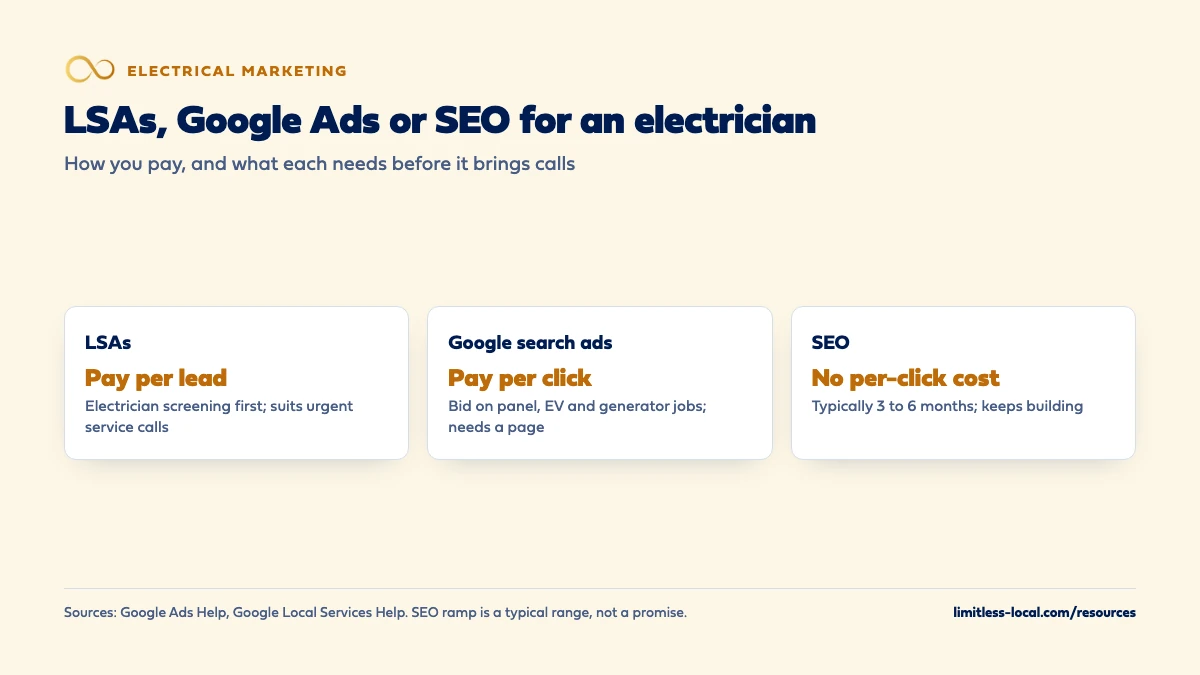
- Local Services Ads (LSAs) show prominently on Google Search and Maps. You pay for valid leads, such as calls and messages, not clicks, and targeting is based on the service categories and areas you pick instead of keywords. The customer calls or messages you straight from the ad.
- Google search ads charge per click. You choose the searches you want to show up for, write the ad and send the click to a page on your website. That lets you go after one kind of job, like a panel upgrade.
- SEO covers your Google Business Profile, which drives the map pack, and your website, which drives the regular results under it. You can’t buy those spots: Google says there’s no way to request or pay for a better local ranking. What you pay for is the work, and it takes time to show.
Sources: Google Ads Help and Tips to improve your local ranking on Google.
What does Google's electrician screening mean for starting with LSAs?
It’s the biggest thing that sets electricians apart on this decision. Google lists the electrician category as an urgent category, because people often call electricians for time-sensitive problems like exposed wiring, and says that for this reason electricians go through an additional level of screening that includes background checks. Depending on the business, Google’s list for electricians can include business and owner background checks, business registration, general liability insurance, and state-level licenses, plus a public, verified Google Business Profile.
That takes time. Google says the process takes 3–4 weeks on average after you submit your documents, and recommends starting as soon as you’ve created your account. It does offer pre-badge ads once you pass the preliminary checks, but those listings are placed below providers who have finished every check.
The upside is that the checks show. Google validates licenses against state databases and displays the ones it verified on your provider profile, which is a real advantage when homeowners are choosing between a licensed contractor and a handyman. Sources: Business screening and verification requirements, Understand the screening and verification process and Getting started with Local Services Ads.
What changed for electrical Local Services Ads in 2026?
Google is moving Local Services Ads into Google Ads as Performance Max campaigns with pay-per-lead goals. Electrical is one of the categories named in the first phase, which began in August 2026 for select home and storefront service advertisers. Service-area businesses without a storefront, which describes many electricians, are scheduled for late 2026, so check which group you’re in.
You still pay per lead, with no keywords, on Search and Maps only. New advertisers still sign up through Local Services, because new pay-per-lead campaigns can’t yet be created inside Google Ads. After the move, your name, address and hours sync one way from your Google Business Profile, and budgets are daily. If you’re already verified, the Google Verified badge carries over, and Google says insurance and license reverification are no longer required.
Source: Local Services Ads transition to Performance Max campaigns with pay-per-lead goals. Whether the channel pays off once it’s running is its own question, covered in whether LSAs are worth it.
Which one brings in calls fastest?
Paid search is the fast lane. Once search ads or LSAs are live, calls can start within days, because you’re buying a spot at the top of the page instead of earning it. SEO is a ramp: it typically takes 3 to 6 months to show meaningful growth, then keeps building.
The catch for electricians is the word live. A search campaign can be built in days once you have a page to send clicks to; LSAs wait on screening that averages 3–4 weeks. If the schedule needs filling this month and your checks haven’t started, search ads are, in our judgement, the quicker first step while the screening runs.
Which channel fits emergency calls, and which fits planned jobs like panel upgrades?
Urgent service calls are what Google had in mind when it called the electrician category urgent; its own examples are exposed wiring and critical electronic failures. LSAs suit them: the call comes straight from the ad, with your rating and verification next to your name.
Planned jobs (panel upgrades, EV charger installs, generators, rewires, service upgrades) are researched and often quoted against other contractors. The U.S. Department of Energy notes that some homes don’t have enough electrical capacity for a Level 2 EV charger and that a qualified electrician can add circuits, so the homeowner often has questions before asking for a price. In our judgement, that’s where search ads earn their place: you bid on those exact searches and send them to a page that answers them.
Source: Charging Electric Vehicles at Home (Alternative Fuels Data Center). For the campaign side, see which Google Ads campaigns work best and getting more panel and EV jobs.
Curious what your marketing is actually booking?
Get a free visibility audit — no obligation, no sales pitch.
What should I start with on a tight budget?
With a small budget, ask where each dollar gets closest to a booked job. LSAs charge only for valid leads, and Google doesn’t charge for leads it decides are invalid or low quality, such as spam or duplicate contacts. Search ads charge for every click, and a thin budget spread across broad searches goes fast. So, in our view, LSAs are usually the easier small-budget start, as long as your screening is done, your reviews are in shape and someone answers the phone.
If the budget can’t cover either yet, do the free groundwork: a verified, complete Google Business Profile, real photos of your crews and work, and a review ask after every job. Google needs a verified profile before LSAs can run at all, and the map pack draws on the same profile.
Sources: How leads work and Understand the screening and verification process.
What if I only have a few Google reviews?
Then LSAs probably shouldn’t be your first move. Google ranks Local Services Ads partly on profile quality, which includes your rating and how many reviews you have, and reviews can be a requirement before you go live, depending on your category. Reviews feed the map pack too: Google says prominence is partly based on how many reviews you have, and that more reviews and positive ratings can help your local ranking.
With a thin review count, search ads are the better paid start, because they don’t lean on your star rating to show. Ask every finished job for a review in the meantime, and revisit LSAs once the count and rating are solid. Sources: About ad rankings, Getting started with Local Services Ads and Tips to improve your local ranking on Google.
What if nobody can answer the phone while we're on jobs?
Fix that before paying for any of them, and especially before LSAs. Electricians are often in an attic or a crawl space when the phone rings, and on LSAs a missed call can still be a charged lead: Google counts a call you miss during business hours as valid once the caller stays on the line more than 20 seconds. Google also says that if you regularly fail to answer calls or respond to messages, your ad ranking may be affected, and it lists responsiveness as part of how ads are ordered.
Search ads and SEO don’t charge for the missed call, but the homeowner with half the house dark still dials the next company. Forwarding calls to the office, an answering service, or message leads all help; Google says message and booking leads give customers more ways to reach you, especially nights and weekends.
Sources: How leads work, Getting started with Local Services Ads and About ad rankings.
Does being licensed help me in any of these channels?
Yes, but in different ways. On LSAs, Google checks it for you where your category and state call for it: it verifies applicable state-level licenses against state databases and shows the ones it verified on your profile. Businesses also have to confirm they hold any county or city licenses that apply and that all their service professionals are appropriately licensed. Licensing rules differ from state to state, so go by what your Local Services dashboard asks for, not a general checklist.
On search ads and SEO, your ad text, website and Google profile description have to say it. In our judgement, a license number and a line on permits and inspections near the call button do more for an electrician than another paragraph about quality, because homeowners comparing quotes are often weighing you against an unlicensed handyman. Source: Understand the screening and verification process.
When is each one the wrong first move?
- Don’t start with LSAs if you can’t finish Google’s screening yet, calls go to voicemail during business hours, you only have a few reviews, or you’d have to draw the service area wider than your trucks really go to get volume. You’d rank low or pay for leads you can’t use.
- Don’t start with Google search ads if you have no page worth sending a click to, nobody to check search terms weekly, or no way to tell which clicks became jobs.
- Don’t start with SEO alone if the schedule has holes this month. It’s the right foundation, but it won’t fill next week’s calendar.
Each of these is something to fix, not a permanent no. Since paying for ads doesn’t buy you a local ranking, the map pack still needs its own work; getting into the map pack covers that side.
How will I know I picked the right one?
Judge every channel on the same number: what each booked job cost. LSAs report an average cost per lead (the Cost / conv. column in Google Ads), search ads report cost per click, and SEO has no per-anything cost, so tag where each call came from, mark which ones booked, and divide each channel’s spend by the jobs it booked.
Split it by job type too. A month of LSA service calls and a month of search ads that booked two panel upgrades can’t be judged on job count alone. Give each channel a fair window before deciding: a few weeks of steady spend for paid search, a few months for SEO. Tracking which marketing brings real jobs covers the setup. Source: Google Ads Help.
Not sure which of these is costing you jobs?
A free visibility audit checks the Google profile, reviews, site and tracking, and shows what to fix first.
What's different for electrical contractors
Service calls and projects pull in different directions. Small service calls keep the trucks moving; panel upgrades, EV chargers, generators and rewires carry the bigger tickets. LSAs bring whatever mix your categories and job types attract, while search ads let you put money behind one kind of job. If projects are where your margin is, include search ads early.
Trust is part of the sale. LSAs show your verified licenses for you; on every other channel you have to show them yourself.
Commercial work finds you differently. In our judgement, property managers and general contractors lean more on your website, reputation and relationships than on a single ad, which makes SEO and a credible site matter more there. If you do solar too, Google lists solar energy contractor as its own Local Services category.
A worked example: service calls versus panel upgrades
These numbers are made up to show the math, not a benchmark for your market. Say you have $1,800 for one month and you’re choosing between LSAs and Google search ads aimed at panel upgrades.
- LSAs: at a made-up $60 per charged lead, $1,800 buys 30 leads. If 1 in 3 books, that’s 10 booked jobs, or $180 per booked job, mostly service calls.
- Search ads: at a made-up $15 per click, $1,800 buys 120 clicks. If 1 in 8 clicks calls, that’s 15 calls, and if 1 in 3 of those books, 5 booked jobs, or $360 per booked job, mostly panel upgrades.
On cost per job alone, LSAs win. But if a panel upgrade is worth several times a service call to you, the search ads month can be the better deal. That’s why the comparison is cost per booked job and what each job is worth, never cost per lead against cost per click. SEO has no per-click cost, but it’s a monthly cost on a ramp of 3 to 6 months, so judge it on booked jobs once it’s had time.
On our side, Essentials ($3,500 a month) includes Google Ads management up to $2,500 a month in ad spend, plus the Google profile, listings, content and review work local SEO is built on. Growth ($4,500 a month) adds SEO for up to two locations, Local Services Ads management and Google Ads up to $5,000 a month in spend. Ad spend is paid to Google separately.
Frequently asked questions
Can I get LSA leads before Google's screening is finished?
Sometimes. Google offers pre-badge ads once you’ve passed the preliminary checks, but it places those listings below providers who have completed every onboarding requirement and earned the Google Verified badge.
Does Google run background checks on electricians for LSAs?
It can. Google treats electrician as an urgent category with an additional level of screening, and its list for electricians includes business and owner background checks for select users. Your Local Services dashboard shows what your business needs.
Does paying for Google Ads help my Maps ranking?
No. Google says there’s no way to request or pay for a better local ranking, so ads and the map pack have to be worked on separately.
Can I set up a brand-new LSA campaign inside Google Ads?
Not yet. Google says new pay-per-lead campaigns can’t be created directly in Google Ads at this time; new ones still go through Local Services, with creation in Google Ads coming later.
Can I pause paid ads when the schedule is full?
Yes. After the move into Google Ads, you can set a pay-per-lead campaign to Paused and switch it back to Enabled when you want leads again. SEO doesn’t switch off and on the same way.
Key takeaways
- Paid search can bring calls within days of going live; SEO typically takes 3 to 6 months, so start it early, not instead.
- Electricians face extra LSA screening, which averages 3–4 weeks, so start it early if LSAs are the plan.
- LSAs suit urgent service calls when you’re verified, well reviewed and answering; you pay per lead.
- Search ads suit planned jobs like panel upgrades and EV chargers when you have a page that converts; you pay per click.
- Compare every channel on cost per booked job and what each job is worth, not cost per lead or per click.
Want a second set of eyes on your setup?
We'll look at how you show up locally and where calls are leaking, then send you a plain-English breakdown.
More in this section
- Are Google Local Services Ads worth it for electricians?
- What Google Ads campaigns work best for electricians?
- How do I know if my electrical marketing agency is getting results?
- How do I get my electrical company into the Google map pack?
- How do I optimize my electrician Google Business Profile?
Sources
- Local Services Ads transition to Performance Max campaigns with pay-per-lead goals — Google Ads Help
- Business screening and verification requirements – United States — Google Local Services Help
- Understand the screening and verification process — Google Local Services Help
- Getting started with Local Services Ads – United States — Google Local Services Help
- How leads work — Google Local Services Help
- About ad rankings — Google Local Services Help
- Tips to improve your local ranking on Google — Google Business Profile Help
- Charging Electric Vehicles at Home — U.S. Department of Energy, Alternative Fuels Data Center