
How do I know if my electrical marketing agency is getting results?

- How can an electrician tell whether a marketing agency is actually working?
- What should a monthly report from my agency show?
- Why can a busy month of calls still be a bad month for an electrician?
- How do I check whether the calls in the report are real leads?
- How do I check the agency's numbers against my own software?
- Is my agency going after the electrical jobs I actually want?
- How long should I give my agency before judging the results?
- What questions should I ask my agency at the next review?
- Do I own my Google Ads account and Google Business Profile?
- What are the red flags that my agency isn't getting results?
- Is it the agency, or is something on my end?
- What's different when you judge electrical marketing
- A worked example: lower cost per job, less money in the bank
- Frequently asked questions
- Key takeaways
- More in this section
- Sources
The short version
- Judge the agency on booked jobs, cost per booked job and the revenue those jobs brought in.
- Ask for results split by job type, because a month of small service calls and a month of panel upgrades aren't the same month.
- Check the agency's numbers against the lead source report in your own field software.
- Ads can bring calls within days; SEO usually takes months; quoted projects take longer to close.
For electrical contractor owners already paying an agency who want to know whether it’s producing booked jobs, and the right kind of jobs.
Get a free visibility audit · Book a growth call
How can an electrician tell whether a marketing agency is actually working?
Your electrical marketing agency is getting results if it can show you each month how many calls and booked jobs its work produced, what each booked job cost including its fee and your ad spend, and what kind of jobs they were: small service calls, panel upgrades, EV chargers, generators or commercial work. A report you can’t check against the jobs and invoices in your own field software isn’t proof of anything. Give ads a few weeks and SEO a few months before judging, and keep ownership of your Google Ads account, Google Business Profile and website.
We’re an agency too, so this is the standard we hold ourselves to. Every one of our packages includes call tracking with recording and transcription, form and chat lead tracking, source tagging, a real-time dashboard and a monthly report with a cost-per-lead breakdown, all laid out on our packages page. Our electrical marketing page shows how that applies to service calls and bigger projects, and the rest of the electrical marketing questions library goes question by question.
What should a monthly report from my agency show?
One thing above all: what the money produced. For an electrical contractor that means these numbers, broken out by channel (Google Ads, Local Services Ads, Maps and organic search):
- Calls and form leads, with junk marked: spam, sales calls, existing customers calling about a scheduled job, and requests for work you don’t do.
- Booked jobs from those leads, split by job type: service calls, panel and service upgrades, EV chargers, generators, rewires and remodels, commercial work.
- Quotes out for the bigger jobs, because a panel upgrade or a generator often gets quoted one month and sold the next.
- Total cost: the agency’s fee plus your ad spend.
- Cost per booked job and revenue from those jobs, side by side.
- What changed and why: what the agency did, what it plans next, and what it stopped because it wasn’t working.
If a report can’t get you from spend to booked jobs, you can tell the agency is busy but not whether it’s working. How to set up the counting behind those numbers is covered in tracking which marketing brings in real jobs.
Why can a busy month of calls still be a bad month for an electrician?
Because electrical calls vary so much in what they’re worth. In our judgement, these are the usual reasons a full call log doesn’t show up in the bank account:
- Small jobs crowd out big ones. A string of single-outlet and light-fixture calls can fill the schedule while the panel upgrades and EV chargers you wanted go to someone else.
- Handyman-level requests. Ads and pages written too broadly pull in people shopping for the cheapest possible fix, who may never book a licensed electrician at your rate.
- Work you don’t do. If you don’t do low-voltage, solar or service in the next county, every call about them is wasted spend.
- Existing customers. Past customers who search your name and call through an ad are worth having, but they aren’t new customers the agency found.
None of this means the agency failed. It means the report needs to show job type and revenue, not just a call count, so you can both see it and fix the targeting.
How do I check whether the calls in the report are real leads?
Listen to some. Call tracking tools record calls by source, and most let you or the agency mark which ones were real leads. CallRail, for example, lets you qualify leads automatically with automation rules based on call transcripts, score a call from your phone keypad right after it ends using Keypad Scoring, or mark a lead qualified by hand in the activity log (CallRail Help).
In our judgement, you or your office manager listening to a handful of calls each month, or reading their transcripts, answers three questions faster than any chart: was it a real customer, was it work you do and want, and did it book? Ask your agency who marks calls as qualified, and on what rule. If it’s the agency marking its own homework, you should be able to spot-check it.
How do I check the agency's numbers against my own software?
Your field service software is the scoreboard, because the jobs and invoices live there, not in the agency’s dashboard. Most of the common tools can report by lead source:
- Jobber‘s Lead Source Report shows, for each source, the number of leads and how many have a request, a quote, a job and an invoice, plus the value of the first invoice tied to each lead (Jobber Help).
- Housecall Pro has a Lead Source field that can be tracked on customers, jobs and estimates, so you can see which sources bring you good jobs (Housecall Pro Help).
If you use ServiceTitan or another tool, use its lead source or campaign reporting the same way. Pull that report for the same month as the agency’s report and compare the two. If they’re far apart, ask why; the cause is often fixable, like duplicate leads or calls that never got a source. If the agency runs your Google Ads, also ask whether sold jobs are sent back into the ad account. Google’s offline conversion import exists for exactly that, and Google now recommends that new setups start with enhanced conversions for leads.
Curious what your marketing is actually booking?
Get a free visibility audit — no obligation, no sales pitch.
Is my agency going after the electrical jobs I actually want?
Ask to see what the ads and pages are aimed at. If your best margins are in panel upgrades, EV charger installs, generators or commercial service, the agency should be able to show campaigns, keywords or pages built for those jobs, and a booked-job count for each. If everything is running under one broad “electrician near me” campaign, the agency can’t tell you which work it’s producing, and neither can you.
In our judgement, two checks are worth doing at least once a quarter: search the main terms in your towns and see what shows up for your company, and read the ad text and landing pages yourself to confirm they describe the work, service area and licensing you actually have. Getting more panel upgrade and EV charger jobs covers what that targeting should look like.
How long should I give my agency before judging the results?
It depends on the channel. Ads can bring in leads within days of launching, because you’re paying to show up right away. SEO is a ramp: it typically takes 3 to 6 months to show meaningful growth in organic search. Nobody can honestly promise a date for either.
Electrical work adds one more clock: quoted projects. A panel upgrade, generator or commercial job may need a site visit, a quote, a permit and sometimes utility scheduling before it’s a booked job, so in our judgement the jobs an agency produced in a given month may not show as sales until the following month or later. Judge service calls on a monthly basis and quoted work on a rolling few months. What to expect in the first 90 days lays out the early milestones.
What questions should I ask my agency at the next review?
Google’s advice for hiring an SEO includes asking what results to expect and in what timeframe, how success is measured, and whether they’ll share all the changes they make (Google Search Central). Those work just as well for an agency you already pay. For an electrical company, add these:
- How many booked jobs came from your work last month, by job type, and what did each cost me, fee and ad spend included?
- How much revenue did those jobs bring in?
- How many panel upgrade, EV charger and generator quotes came from your work, and how many have closed?
- Which campaign produces the cheapest booked jobs, and which produces the most revenue?
- What did you change this month, and what happened because of it?
- Who owns the ad account, the Google Business Profile, the website and the call tracking numbers?
A good agency answers these without getting defensive. If the answers keep coming back as more charts, that tells you something.

Do I own my Google Ads account and Google Business Profile?
You should, and you can check today.
- Google Ads. Google Ads has five access levels: Email-only, Billing, Read-only, Standard and Admin, and only Admin users can unlink manager accounts (Google Ads Help). Make sure at least one Admin login belongs to you, not only to the agency.
- Google Business Profile. A profile can have several owners but only one primary owner, and managers can do almost everything owners can except add or remove users or remove the profile (Google Business Profile Help). You should be the primary owner; the agency can be a manager.
- Website and domain. The domain should be registered to your company, with your own logins to the hosting and the site.
In our judgement an agency working from accounts it owns isn’t automatically doing anything wrong, but it puts your reviews, ad history and phone numbers in someone else’s hands. Fixing that is easiest while the relationship is good.
What are the red flags that my agency isn't getting results?
- Reports made only of impressions, clicks and rankings, with no line for booked jobs, job type or revenue.
- No way to hear or read the calls, or a lead count you can’t match to your own software.
- One broad campaign for everything, so nobody can say which kinds of jobs it’s producing.
- You don’t own the accounts. No Admin access to Google Ads, not the primary owner of your Google Business Profile, or the domain isn’t in your name.
- Promised rankings or lead counts. Google’s own advice says no one can guarantee a #1 ranking on Google, and to be careful if a company is secretive or won’t clearly explain what it intends to do (Google Search Central). Google also notes you’re responsible for the actions of any company you hire.
One red flag is a question to raise. Three or four together usually mean it’s time to plan a change.
Is it the agency, or is something on my end?
Sometimes the leads are fine and the problem is after the phone rings. Check what happens next: are calls answered while your electricians are on jobs, do web requests get a call back the same day, and does every quote for a panel upgrade or generator get a follow-up? An agency can’t book a job your office never called back.
Look at each step separately for one month: leads in, leads answered, quotes sent, quotes sold. If leads are healthy but quotes stall, following up on electrical quotes automatically is the fix to look at before you blame or change the agency.
Want to see where your company stands?
A free visibility audit shows where you show up on Google, Maps and AI answers, and what it's costing you in calls.
What's different when you judge electrical marketing
Job mix matters more than job count. A service call and a panel upgrade both count as one booked job. Ask for revenue next to every job count, or the cheapest month on paper can be the weakest month in the bank.
Outages and storms distort the numbers. A storm or a long power outage can flood you with emergency and generator calls that no agency created. Compare against the same period last year, or set those weeks aside, before you credit or blame the marketing.
Local Services Ads screening is stricter for electricians. Google treats electrician as an urgent category, so electricians go through an additional level of screening that includes service professional background checks, alongside the business registration, insurance and license checks some advertisers need (Local Services Help). If your agency runs your Local Services Ads, ask whether every check on your account is complete. Whether those ads are worth running at all is covered in whether LSAs are worth it for electricians.
A worked example: lower cost per job, less money in the bank
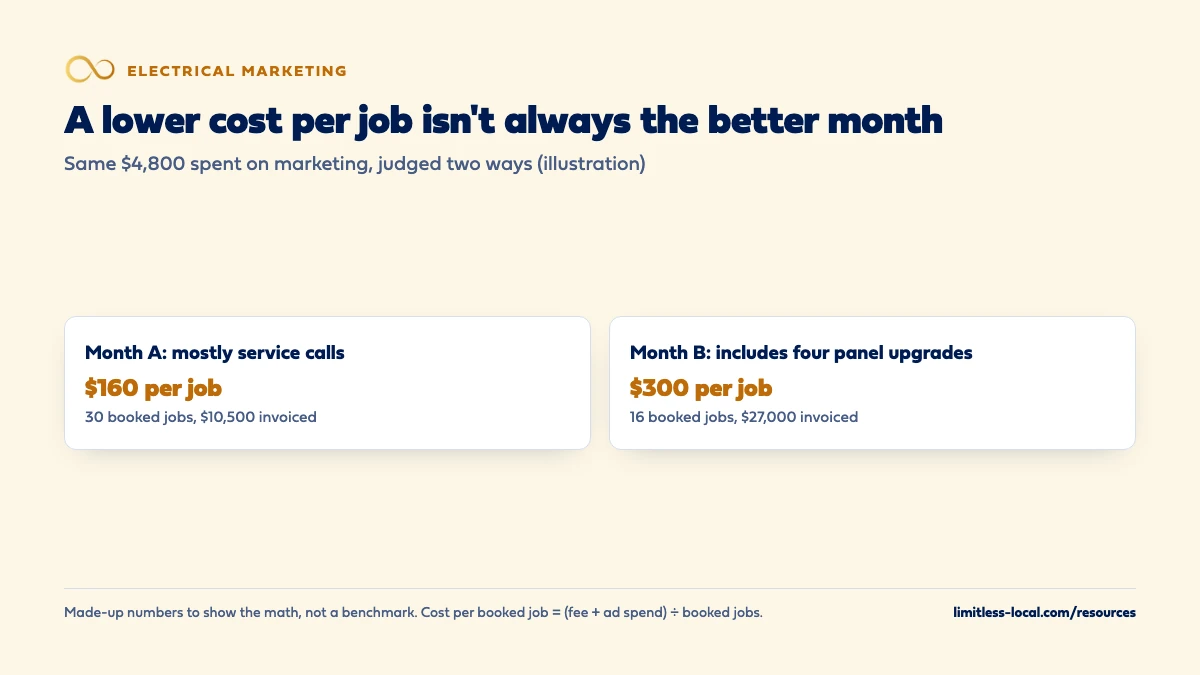
These numbers are made up to show the math, not a benchmark for your market. Say you spend $4,800 in each of two months on the agency’s fee and ad spend combined.
- Month A: 30 booked jobs, nearly all small service calls, with $10,500 invoiced. Cost per booked job: $4,800 divided by 30, or $160.
- Month B: 16 booked jobs, including four panel upgrades, with $27,000 invoiced. Cost per booked job: $4,800 divided by 16, or $300.
On cost per booked job alone, Month A wins. On money in the bank, Month B is far better. That’s why an electrical contractor should ask for revenue by job type next to cost per booked job.
For reference, our Essentials package is $3,500 a month and includes call, web and form tracking with basic attribution, a real-time dashboard and a monthly report; ad spend is paid to Google separately. Whether that’s worth it comes down to this same math, which is what a free visibility audit is for.
Frequently asked questions
Should my marketing agency have Admin access to my Google Ads account?
It can, as long as you also have your own Admin login. Only Admin users can unlink manager accounts, so the business should never depend on the agency’s login to get back in.
Can I look at my Google Ads account without risking changes?
Yes. Google Ads has a Read-only access level, which suits an owner or bookkeeper who just wants to check the numbers.
Is it a bad sign if my agency won't guarantee results?
No, it’s the honest answer. Google says no one can guarantee a #1 ranking on Google, and how many jobs you book also depends on things no agency controls, like weather, outages and how fast your office answers.
Should existing customers count in my agency's results?
Count them, but separately. A past customer who searches your name and calls through an ad is worth having, but the agency didn’t find them, so they shouldn’t be mixed in with new customers.
How many booked jobs should an agency get an electrician each month?
No honest agency can promise a number before it sees your market, your budget and how your office handles calls. What it can promise is a report that shows exactly what it produced, so you can judge the trend.
How often should my agency report to me?
A monthly report and a dashboard you can check any time are a reasonable minimum, with a strategy call at least once a quarter. More important than how often is whether each report ties spend to booked jobs and revenue.
Key takeaways
- Judge your agency on booked jobs, cost per booked job and the revenue those jobs brought in, with its fee and your ad spend both counted.
- Ask for results by job type, because service calls and panel upgrades aren’t worth the same.
- Check the agency’s numbers against the lead source report in Jobber, Housecall Pro or ServiceTitan.
- Ads can bring leads within days; SEO typically takes 3 to 6 months; quoted projects can take longer to show as sales.
- Own your Google Ads account, Google Business Profile, website and domain.
Not sure what's working right now?
Start with a free visibility audit: rankings, Google profile, reviews and tracking, checked against your service area.
More in this section
- How do I track which electrical marketing brings in real jobs?
- What should I expect from electrical marketing in the first 90 days?
- How much should an electrical contractor spend on marketing?
- How should an electrical contractor market to commercial customers?
- Should my electrical company start with LSAs, Google Ads or SEO?
Sources
- Do you need an SEO? — Google Search Central
- About access levels in your Google Ads account — Google Ads Help
- Manage your Business Profile owners & managers — Google Business Profile Help
- About offline conversion imports — Google Ads Help
- How to qualify leads in CallRail — CallRail Help Center
- Lead Source Report — Jobber Help Center
- How to Use Lead Sources — Housecall Pro Help Center
- Business screening and verification requirements – United States — Google Local Services Help