
How do I get more referrals from past electrical customers?
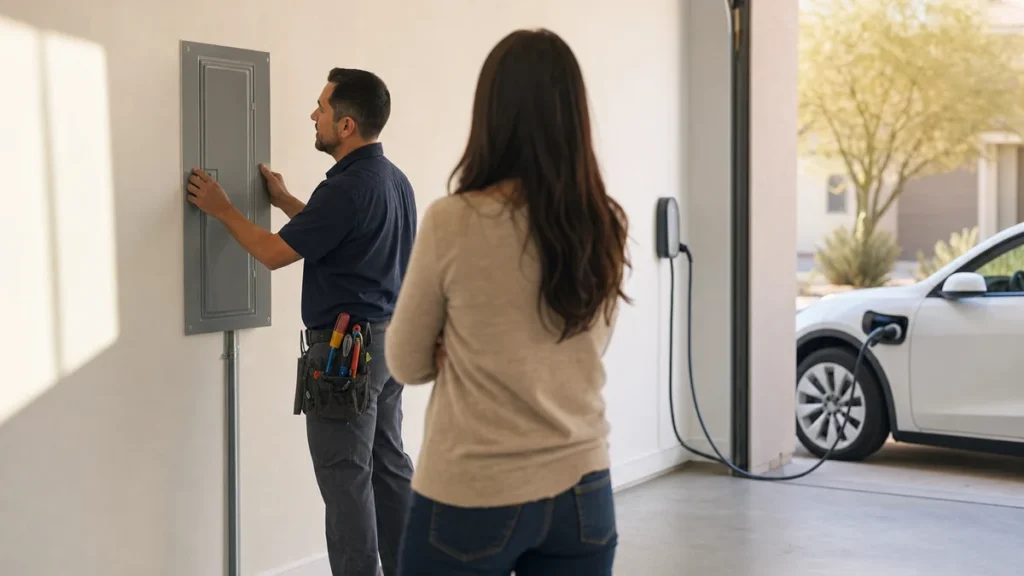
- How can an electrician turn past customers into a steady source of referred jobs?
- Why don't happy electrical customers send me more referrals?
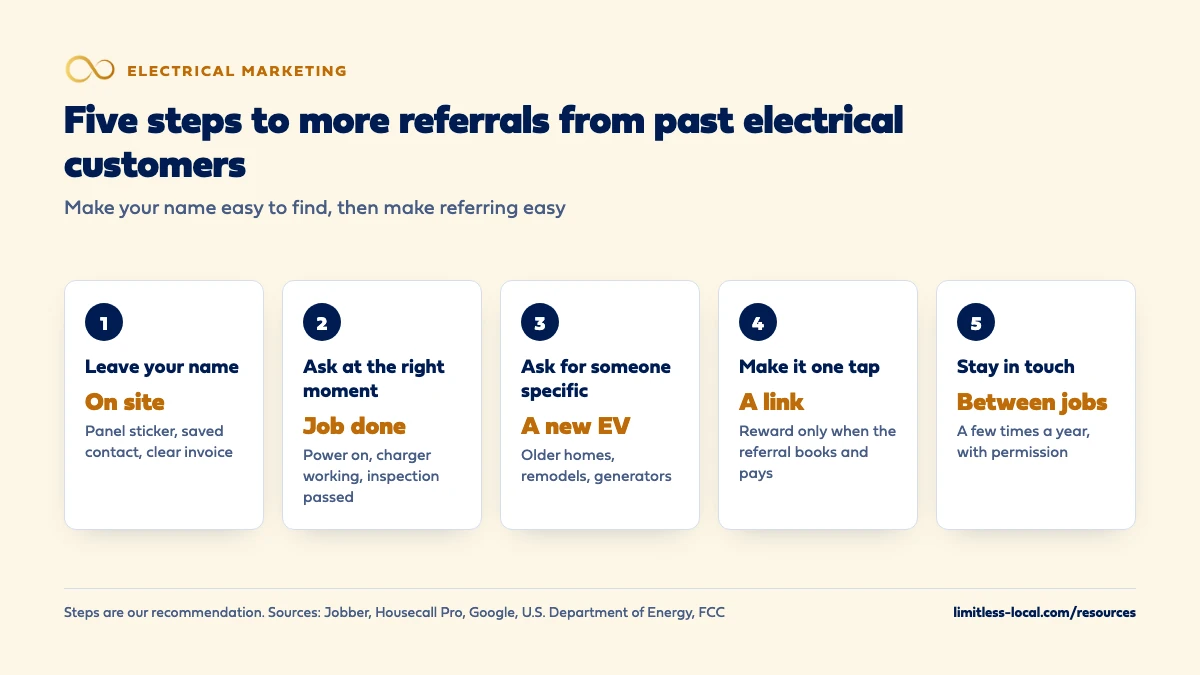
- Step 1: Leave your name where they'll find it next time
- Step 2: Ask at the moment the job is clearly done right
- Step 3: Ask for someone specific, not "anyone"
- Step 4: Make referring you one tap
- Should I give customers a reward for referrals?
- Can I offer customers something for a Google review instead?
- Step 5: Stay in touch between jobs without being a pest
- What should happen when a referred customer calls?
- How do I track which customers send referrals?
- Do past commercial customers refer differently?
- What's different about referrals for electricians
- A worked example: what a referral program can cost per job
- Frequently asked questions
- Key takeaways
- More in this section
- Sources
The short version
- Leave your name and number where the customer will find it next time.
- Ask right after the job is clearly done right, and ask for someone specific.
- Make referring one tap with a link, and pay any reward only on a booked, paid job.
- Never tie a reward to a Google review, and tag every referred job so you can track it.
For electrical contractors whose customers were happy with the work but rarely send anyone else their way.
Get a free visibility audit · Book a growth call
How can an electrician turn past customers into a steady source of referred jobs?
Make sure past customers can still find your name years later, ask for a referral at the moment the job is clearly done right, and ask for someone specific, like a neighbor buying an EV or a friend remodeling an older house, instead of “anyone who needs an electrician.” Give them a referral link or card that makes passing your name along one tap, and if you offer a reward, pay it only when the referred customer books and pays. Keep any referral reward completely separate from Google reviews, because Google prohibits offering incentives for reviews, and tag every referred job in your software so you can see which customers send work.
Follow-up that doesn’t depend on someone remembering is what our automation work is for: we configure it and connect it to the tools you already use. It’s one part of how we approach electrical contractor marketing, because in our judgement a referred customer usually costs far less to win than one from an ad. The rest of the electrical marketing questions library covers the other ways electricians bring in work.
Why don't happy electrical customers send me more referrals?
Usually it’s not because they didn’t like the work. In our judgement, electrical referrals stall for a few reasons that have little to do with quality:
- Electrical work is occasional. A homeowner might need an electrician once every few years, so by the time a friend asks, they can’t remember your company’s name.
- Good electrical work is invisible. A panel upgrade disappears behind a door. Nobody admires it at a barbecue the way they admire a new kitchen.
- Nobody asked. Most customers don’t think of referring unless someone suggests it.
- It’s hard to describe. “He did something with our breakers” isn’t much of a recommendation. “He added a charger circuit for our EV and handled the permit” is.
Each step below fixes one of those problems. None of them takes a big budget; they take a habit and, ideally, software that does the reminding.
Step 1: Leave your name where they'll find it next time
Since the next electrical need might be years away, make your name easy to find when it comes. In our judgement the simplest moves work best:
- A service sticker near the panel with your company name and phone number, placed so it doesn’t cover any labels or markings that need to stay visible. Whoever opens that panel next, including a future owner, sees who to call.
- A contact card by text from the tech before leaving, so your number is saved in the customer’s phone under your company name, not as an unknown number.
- An invoice that says what you did in plain words: “Replaced the old panel with a larger one, pulled the permit, passed inspection.” That’s the sentence the customer will repeat to a friend.
A magnet on the fridge still works too. The point is that when someone asks “who did your electrical?”, the answer is within reach.
Step 2: Ask at the moment the job is clearly done right
Ask when the customer can see the result: the power is back on, the EV is charging, the generator just ran its test, or the inspector signed off. In our judgement that’s when a referral request feels like part of finishing the job, not a sales pitch.
Keep it short and say it the same way every time. For example: “Glad we got this sorted. Most of our work comes from people telling their neighbors, so if anyone you know needs an electrician, we’d appreciate you passing our name along.” Then hand over a card or send the referral link by text.
Don’t stack requests. A tech who asks for a review, a referral and a maintenance agreement in the same breath usually gets none of them. Many shops send the review request automatically after the invoice is paid and keep the referral ask for the conversation on site; our page on getting more Google reviews covers the review side.
Step 3: Ask for someone specific, not "anyone"
“Know anyone who needs an electrician?” gets a polite nod. A specific question gets a name. In our judgement the best prompts tie the referral to a change in someone’s life that creates electrical work:
- A new EV. The Department of Energy’s Alternative Fuels Data Center says EV owners may install Level 2 (240 V) charging equipment at home for a faster charge, that some homes might not have enough electrical capacity for it, and that a qualified electrician can add circuits to provide it. “Anyone on your street getting an electric car?” is a good question after a charger install.
- An older house. Friends who just bought an older home often need a panel, wiring or outlet update.
- A remodel, an addition or a hot tub. New loads usually mean new circuits.
- Storm worries. After an outage, neighbors start asking about generators.
These are also the higher-ticket jobs. Our page on getting more panel upgrade and EV charger jobs covers the marketing side of that work.
Step 4: Make referring you one tap
The easier it is to pass your name along, the more often it happens. A business card works in person; a link works everywhere else. Jobber’s referral program, for example, gives each client a unique referral link they can find in the client hub or in a referral email. When a friend uses that link to request service, Jobber adds the new client to your list automatically and shows the referring customer as the lead source.
If your software doesn’t have a referral feature, a simple version still works: a text template the customer can forward with your name, number and booking link, and a line on your website’s contact form asking “Who referred you?” so you can thank them.
In our judgement, the message the customer forwards should describe the job they had done, in their words if possible. “They upgraded our panel and were in and out in a day” carries more weight than your slogan.
Curious what your marketing is actually booking?
Get a free visibility audit — no obligation, no sales pitch.
Should I give customers a reward for referrals?
You don’t have to, but a small, simple reward can help, as long as it’s paid for a booked job rather than a name. Jobber’s referral program shows one common way to set it up: the referring customer earns a credit, either a fixed amount or a percentage, the credit is awarded when the referred client pays, and it’s applied automatically to the referring customer’s next invoice. Jobber applies one credit per referral.
A credit toward the customer’s next electrical job has a second benefit: it gives them a reason to call you again. Whatever you choose, write the rule down, apply it to every customer the same way, and say plainly what it is in the referral message.
Can I offer customers something for a Google review instead?
No, and don’t blur the two. Google’s help page on review links says that offering incentives, like free or discounted goods or services, to customers in exchange for reviews is considered fake engagement and is strictly prohibited, including for posting, changing or removing reviews. Google’s Maps content policy defines incentivized reviews as ones influenced by a payment, discount, free goods or services, or any other benefit offered to the reviewer.
So keep the programs separate. A referral credit is earned when someone you referred books and pays. A review is asked for, from every customer, with nothing offered for it. Never write a message that says “leave a review and refer a friend to earn a credit,” because it reads as paying for the review. Google does let you share a review link or QR code, which belongs on invoices and thank-you texts.
Step 5: Stay in touch between jobs without being a pest
A referral often comes years after the job, so a few well-timed messages keep your name current. Most field service software can send them. Housecall Pro’s Campaigns, for example, include one-time text and email campaigns and automated campaign flows. Jobber’s referral emails can go to segments like past clients, which it defines as clients whose last job was completed more than 12 months ago with no upcoming jobs scheduled.
Follow the rules for marketing messages. Housecall Pro’s own guide points to the CAN-SPAM Act and the Telephone Consumer Protection Act, and the FCC’s consumer guide to robocalls and robotexts says commercial texts require written consent and that people can opt out at any time in any reasonable manner. Get permission to text when you take the job, and honor every opt-out. This is general guidance, not legal advice.
In our judgement, a few useful messages a year beats a monthly newsletter nobody reads: a note before storm season about generators, a reminder about older-home safety checks, a heads-up when you start offering a new service. Our page on selling maintenance agreements to past customers covers a more structured way to stay in touch.

What should happen when a referred customer calls?
Treat it like the warmest lead you’ll get all week, because it usually is. In our judgement, a referred caller who hits voicemail and gets no callback is a double loss: you lose the job, and the customer who recommended you looks bad. Answer quickly, ask who referred them, and use that name on the call.
Then close the loop with the referrer. A short thank-you text the day the referred job is booked, and the credit if you offer one, tells them the recommendation landed and makes the next one more likely. If calls are slipping through, our page on how fast your office should answer sets the target.
How do I track which customers send referrals?
Make “Referral” a lead source in your software and fill it in on every new customer, along with the name of the person who referred them. Housecall Pro’s lead source field lets you track where customers found your business on customers, jobs and estimates, so you can report on which sources bring in good jobs. Jobber’s Referrals dashboard shows how many referrals your clients have generated, the jobs created from them and the revenue those jobs brought in, and you can see the same figures for each referring client.
Look at three numbers a few times a year: referred jobs, referred revenue and what you paid in rewards. Put them next to your other channels, which our page on tracking which marketing brings real jobs walks through.
Do past commercial customers refer differently?
Yes. A property manager or business owner who was happy with your service call can refer you to other property managers, owners and contractors, and those referrals tend to bring repeat work rather than a single job. In our judgement the ask is the same, just more direct: “Do you manage other buildings, or know another manager who needs a reliable electrician?”
Builders and remodelers are a different relationship again, built on schedule and bids more than on a single good experience. Our page on getting steady work from general contractors covers that side.
Not sure which of these is costing you jobs?
A free visibility audit checks the Google profile, reviews, site and tracking, and shows what to fix first.
What's different about referrals for electricians
Long gaps between jobs. An HVAC company may see a customer every season; an electrician may see the same household once every few years. Referrals depend more on your name being easy to find later than on regular visits.
Safety is part of the recommendation. Homeowners worry about hiring someone unqualified to work on their wiring. A referral that says “licensed, pulled the permit, passed inspection” answers that worry before the new customer calls. Licensing and permit rules vary by state, so describe your own credentials accurately rather than making claims about the law.
New loads create new referrals. EV chargers, generators, heat pumps and hot tubs spread through neighborhoods, and each one usually needs an electrician. The customer who just had one installed is the best person to tell the neighbors who did it.
A worked example: what a referral program can cost per job
These numbers are made up to show the math, not a benchmark. Say an electrician starts asking for referrals on every job and offers a $50 credit when a referred customer books and pays. Over a year, 14 referred customers book jobs that average $900, for $12,600 in referred work. The credits cost $700 in total, which works out to $50 per referred job, plus a few minutes of the tech’s time on each ask.
Compare that with what a booked job costs you from ads or lead services, using your own numbers, and the case for asking every time usually makes itself. On our side, automation add-ons such as CRM and lead tracking and automated follow-up plug into any of our packages, with pricing shared on the discovery call. Every package also includes reporting with source tagging, so referred jobs show up next to every other channel. A free visibility audit is a good place to start.
Frequently asked questions
How much should I give a customer for a referral?
There’s no standard amount, and the reward matters less than the asking. Keep it simple, the same for everyone, and paid only when the referred customer books and pays, which is how Jobber’s referral credit works.
Can I ask for a referral and a Google review in the same message?
You can ask for both, but never attach a reward to the review, and in our judgement one request per message works better. Google prohibits offering incentives in exchange for reviews.
Should my techs ask for referrals or should the office?
Both, at different times. The tech asks on site when the customer can see the finished work; the office or your software follows up with the referral link and the thank-you.
Can I text past customers about referrals?
Only with their permission. The FCC says commercial texts require written consent and that people can opt out at any time in any reasonable manner, so get permission when you take the job and honor opt-outs.
Do realtors and home inspectors make good referral sources for electricians?
They can, because they meet homeowners right when electrical issues come up in a sale. In our judgement, treat them like any partner: be reliable on their clients’ jobs first, and ask after a few have gone well.
How do I know if referrals are worth the effort?
Tag every referred job with its source and the referrer’s name, then compare referred jobs and revenue with what you paid in rewards. Jobber’s Referrals dashboard and Housecall Pro’s lead sources both support this.
Key takeaways
- Electrical customers need you rarely, so leave your name where they’ll find it years later.
- Ask on site when the result is obvious, and ask for someone specific, like a neighbor with a new EV.
- Make referring one tap with a link, and pay any reward only when the referred customer books and pays.
- Never offer anything for a Google review, and keep referral rewards completely separate.
- Tag every referred job and thank the referrer the day the job is booked.
Want a second set of eyes on your setup?
We'll look at how you show up locally and where calls are leaking, then send you a plain-English breakdown.
More in this section
- How should a new electrical contractor get its first customers?
- How do I get more Google reviews for my electrical business?
- How do I sell maintenance agreements to past electrical customers?
- How should an electrical contractor market to commercial customers?
- How can I get general contractors to send me steady electrical work?
Sources
- Referrals | Marketing Tools — Jobber Help Center
- How to Use Lead Sources — Housecall Pro Help Center
- Campaigns: Overview and FAQ — Housecall Pro Help Center
- Create a Google link or QR code to request reviews — Google Business Profile Help
- Incentivized or Biased Reviews — Maps User Generated Content Policy Help
- Charging Electric Vehicles at Home — U.S. Department of Energy, Alternative Fuels Data Center
- Stop Unwanted Robocalls and Texts — Federal Communications Commission