
How can I get general contractors to send me steady electrical work?
- How does an electrician become the go-to sub for local builders and general contractors?
- Why do general contractors keep using the same electrician?
- Which builders and general contractors should I go after?
- Step 1: Find out who's actually building in your area
- Step 2: Get on the bid lists and keep your bid profiles current
- Step 3: Show up where builders and contractors meet
- Step 4: Treat the first job as your sales pitch
- Step 5: Make it easy to send you the next bid
- What will a general contractor check before inviting me to bid?
- How do I keep a builder sending work during slow stretches?
- How much of my work should come from general contractors?
- How do I know which general contractor relationships are paying off?
- What's different for electricians working with general contractors
- A worked example: finding the relationships worth keeping
- Frequently asked questions
- Key takeaways
- More in this section
- Sources
The short version
- Choose a short list of builders and general contractors whose work fits your crews.
- Get on their bid lists with your paperwork ready and a complete bid-platform profile.
- Win the repeat invitations by bidding fast, keeping the schedule and passing inspections.
- Track bids, wins and repeat work per contractor, and keep your own customer marketing running.
For electrical contractors who want a few builders and general contractors sending them work all year, instead of chasing one job at a time.
Get a free visibility audit · Book a growth call
How does an electrician become the go-to sub for local builders and general contractors?
Pick a handful of general contractors, builders and remodelers whose jobs fit your crews, get on their bid lists with your license, insurance and project history ready, and then earn the repeat invitations by bidding fast and accurately, keeping their schedule and passing inspections the first time. Steady work comes from being the electrician a general contractor doesn’t have to manage, not from one sales visit. Find who’s building through local permit activity, builder and contractor associations and bid platforms like BuildingConnected and Procore, and track bids invited, bids won and repeat work for each contractor so you know which relationships deserve your time.
Builder and general contractor work is mostly won in person, but those contractors still look you up before they send a bid package, and that’s where we help. Our marketing packages cover the website, Google profile and call and form tracking that make you look like the established sub you are, alongside the residential and service marketing that keeps your crews busy between projects. It’s part of how we approach electrical contractor marketing, and the rest of the electrical marketing questions library covers the other ways electricians fill the schedule.
Why do general contractors keep using the same electrician?
Because switching subs is a risk they’d rather not take. A general contractor is juggling a schedule, an owner, an inspector and a dozen trades. In our judgement, the electrician who gets the steady work is rarely the cheapest one. It’s the one who:
- Prices fast and clean. A bid that shows up on time, with clear inclusions and exclusions, is easier to carry than a lower number full of questions.
- Keeps the schedule. Rough-in done when promised means the insulation and drywall crews aren’t waiting.
- Passes inspection. A failed electrical inspection pushes everyone behind you.
- Speaks up early. A problem raised at the plan stage is a change order; the same problem found at final is a fight.
- Leaves a clean site and finished paperwork. Panel schedules labeled, closeout documents sent without being asked.
None of that is marketing in the usual sense, but it is what a general contractor tells the next builder about you. Everything else on this page is about getting the first chance to prove it.
Which builders and general contractors should I go after?
Not all of them. Start by writing down the work your crews do well and profitably, then match it to the contractors who produce that kind of work:
- Custom home builders want an electrician who can handle owner walk-throughs, lighting changes and smart home or generator add-ons without drama.
- Remodelers need service upgrades, panel replacements and old-wiring surprises handled on short notice.
- Production builders run on volume and a tight schedule, and usually on a tight price.
- Commercial general contractors award tenant improvements, build-outs and new construction, mostly through formal bids.
In our judgement, a small shop does better with three to five well-chosen relationships than with its name on fifty bid lists. Pick contractors whose job size fits your crew count, who build in the towns you already serve, and who have a reputation for paying on time. Ask other trades and your supply house about that last part before you chase anyone.
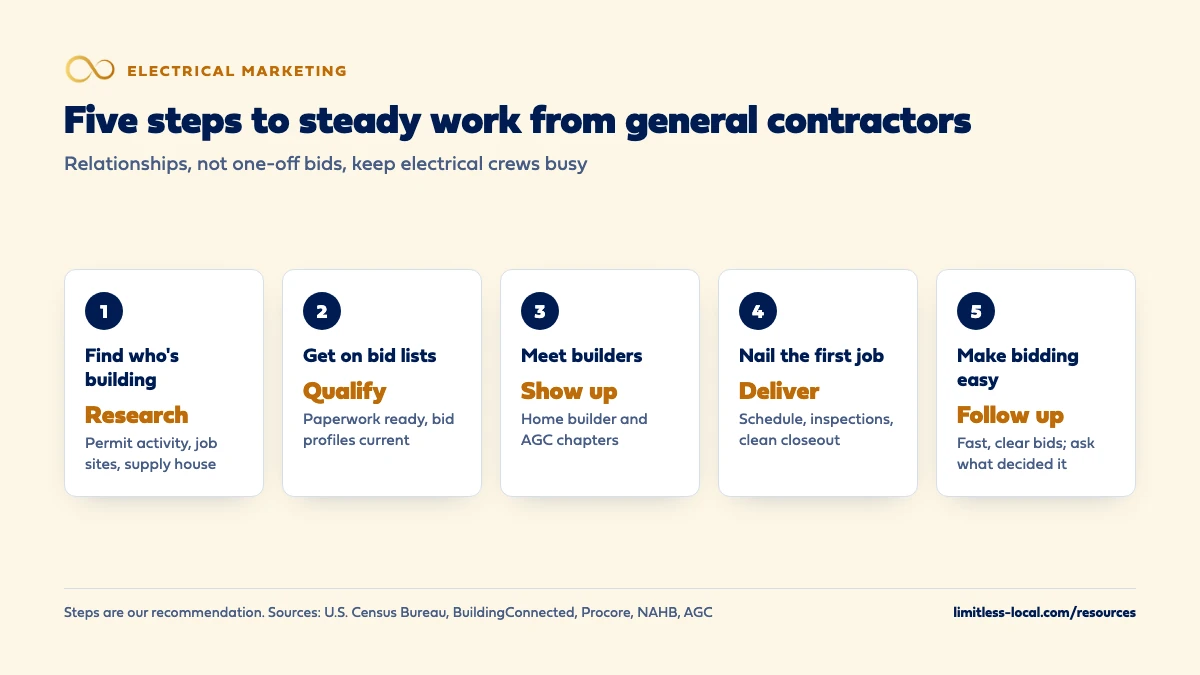
Step 1: Find out who's actually building in your area
Before you call anyone, find out where the work is. The U.S. Census Bureau’s Building Permits Survey publishes statistics on new privately owned residential construction, monthly, year-to-date and annually, down to the county and permit-issuing place level. That tells you which towns around you are adding homes and whether the pace is rising or falling.
To find the builders themselves, look closer to the ground:
- Your local permit office. Many cities and counties make issued permits searchable, which shows you which contractors pull the most building permits nearby.
- Job site signs and subdivisions under construction in the towns you want to work in.
- Your supply house counter. The people there know which builders are busy, which are growing and which pay their bills.
- Other trades. Plumbers, HVAC and framing subs who already work for a builder know whether it’s worth working for.
Turn that into a short target list with a name, a phone number and the type of work each contractor does.
Step 2: Get on the bid lists and keep your bid profiles current
Most commercial and many residential general contractors manage subs through a bid list, and many of them run it on software. Procore’s Prequalifications tool lets a general contractor or owner set up a prequalification form, invite companies to prequalify and review what they submit; subs fill it out through the Prequalification Portal. Have your license, insurance certificate, safety information and recent project list ready so you can answer the same day. Our page on marketing to commercial customers lists what to put in that packet.
BuildingConnected works a little differently: general contractors search its network for subs to invite to bid. Its help center’s article on not getting bid invites says a complete company profile, an accurate “Work Performed” list and the right service area affect how often you show up in those searches. It also warns that adding too many work keywords outside your scope may hurt which invites you get. List what you actually do, set the counties you’ll actually drive to, and if invites still don’t come, the same article suggests contacting general contractors you’ve worked with about their upcoming projects.
Step 3: Show up where builders and contractors meet
Bid platforms get you invited. Relationships get you remembered. Two places to start:
- Your local home builders association. The National Association of Home Builders says membership runs through the local association in your area, and that associate members, the industry’s suppliers and service providers, get opportunities to network with builders and remodelers.
- A local Associated General Contractors chapter if you want commercial work. AGC’s membership FAQ says companies join through one of its 87 local chapters, that membership is held at the company level, and that dues vary by chapter.
In our judgement, joining is the easy part. The work comes from showing up to the same events for a year, volunteering for a committee and being the electrician people can ask a quick code or load question without getting a sales pitch. Bring business cards, not a brochure.
Curious what your marketing is actually booking?
Get a free visibility audit — no obligation, no sales pitch.
Step 4: Treat the first job as your sales pitch
The first project with a new general contractor is an audition, and in our judgement it deserves your best crew lead even if it’s a small job. A few habits that get noticed:
- Walk the plans before you start and send your questions in writing, early.
- Confirm the schedule for rough-in, inspections and trim, and tell the superintendent the day anything slips, not the day after.
- Coordinate the service and meter work with the utility early, since that’s a date nobody on the job controls.
- Keep change orders clean: written, priced and approved before the work, so there are no surprises on the final bill.
- Finish with labeled panels, a clean site and closeout paperwork the general contractor doesn’t have to chase.
Then ask: “What would make us easier to work with next time?”
Step 5: Make it easy to send you the next bid
General contractors invite the subs who make bidding painless. In our judgement that means a named estimator who answers, a bid that comes back before the deadline, and a scope letter that lists what’s included and excluded in plain language. Where it helps the owner, offer an alternate, like an EV-ready circuit in the garage or a larger service for a future heat pump, priced separately so the general contractor can choose.
Follow up after every bid date, win or lose. Ask how your number compared and what decided it. A short, polite check-in is how you learn whether you’re losing on price, scope or schedule, and automatic quote follow-up can handle the reminders so they don’t depend on someone remembering. One caution if you rely on BuildingConnected: its guide to finding and accessing bids says it has no feature for searching public projects and recommends reaching out to general contractors directly to request bid invites. New relationships still start with you asking.
What will a general contractor check before inviting me to bid?
Expect them to look you up. In our judgement a superintendent or estimator who hasn’t worked with you will check three things in a few minutes: your website, your Google reviews and whether your license and insurance match what you told them.
Make that check easy. Give your website a page for builder, remodel and new construction work, with photos of finished panels, service upgrades and finished projects, the towns you cover and how to send a bid package. Show your license number where your state requires or allows it, and keep your Google Business Profile current with the same name, address and phone number. Our page on what an electrician website needs covers the rest.
How do I keep a builder sending work during slow stretches?
Stay in touch when there’s nothing to bid. In our judgement a short call or visit every few months, asking what they have coming up, keeps you in mind before the bid list is drawn up. BuildingConnected’s own advice for subs who aren’t getting invites is the same: reach out to general contractors you’ve worked with and ask about upcoming projects.
Offer help that isn’t a sales call: a quick look at a load question for a project they’re pricing, or a service upgrade estimate for a remodel client. And ask satisfied builders whether they know another builder or remodeler who needs an electrician. Builders talk to builders the same way homeowners talk to neighbors; our page on getting more referrals from past customers covers how to ask without making it awkward.
How much of my work should come from general contractors?
That’s a business decision, but in our judgement no single general contractor should be able to empty your schedule by changing subs. Builder work tends to follow construction cycles, and a contractor who’s sending you most of your work also has a lot of say over your price.
Two safeguards help. First, spread the work across several contractors and job types, residential and commercial. Second, keep a stream of direct customers coming in, service calls, panel upgrades, EV chargers and generators, so the crews have something to do when new construction slows. Our page on channels for residential vs commercial work looks at how to run both.
How do I know which general contractor relationships are paying off?
Track every contractor separately. For each one, keep a simple record: bids invited, bids you sent, bids won, revenue from those wins, how long they took to pay, and whether they invited you back. After six months, the pattern is usually obvious: one or two contractors bring in most of the profitable work, and one or two eat estimating time without awarding anything.
Spend more time on the first group and politely less on the second. The same discipline applies to your other marketing; our page on tracking which marketing brings real jobs shows how to tie every job back to where it came from.
Not sure which of these is costing you jobs?
A free visibility audit checks the Google profile, reviews, site and tracking, and shows what to fix first.
What's different for electricians working with general contractors
Your work is inspected in the middle of the job, not just at the end. Electrical rough-in usually has to pass before walls close, so your schedule holds up every trade behind you. Permit and inspection rules vary by state and city, so learn each jurisdiction you work in and plan the inspection dates with the superintendent.
You’re the trade that talks to the utility. Service size, temporary power and the meter set involve a utility schedule neither you nor the general contractor controls. The electrician who raises those dates early becomes the one general contractors call first.
You can add value before the bid. EV chargers, generators, heat pumps and smart home systems all change the electrical load. A sub who flags the service size or panel space at the plan stage saves the builder a costly surprise, and that’s the kind of help builders remember.
A worked example: finding the relationships worth keeping
These numbers are made up to show the math, not a benchmark. Say an electrical contractor sent 30 bids to five general contractors last year and won 8 of them, a 27% win rate overall. That looks fine until it’s split by contractor:
- Contractor A invited 10 bids and awarded 5: a 50% win rate and the most repeat work.
- Contractor B invited 8 bids and awarded none.
- Contractors C, D and E shared the other 12 bids and 3 wins.
If each bid takes about six hours of estimating, Contractor B used 48 hours of estimating for no work. That time is better spent on Contractor A, on finding another contractor like A, or on asking B what decided the bids. On our side, this is your relationship work, not something we sell. Where we help is the website, Google profile and call and form tracking that make you easy to check and show where your direct customers come from; every package includes reporting, and a free visibility audit is the place to start.
Frequently asked questions
Do I need to be on BuildingConnected or Procore to get general contractor work?
No, but many commercial general contractors use them to invite and prequalify subs. If the contractors you want use one, keep your company profile, work performed and service area accurate, which BuildingConnected says affects how often you appear in their searches.
Should I bid low to win the first job with a new general contractor?
In our judgement, bid a fair, complete number instead. A low first bid sets the price you’ll be held to, and a missing scope item causes a change-order fight on your first job together.
Is joining the local home builders association worth it for an electrician?
It can be, if you’ll show up. NAHB says associate members, the industry’s suppliers and service providers, get opportunities to network with builders and remodelers. The value comes from attending regularly, not from the membership alone.
How long does it take to become a general contractor's regular electrician?
There’s no set timeline. In our judgement it usually takes a few completed jobs that go smoothly before a contractor stops shopping your trade on every project.
Can I ask a builder to recommend me to other builders?
Yes, after a job that went well. Ask by name, such as “Do you know another remodeler who needs a reliable electrician?”, and thank them when the introduction turns into work.
What if a general contractor pays slowly?
Track days to pay for every contractor and factor it into whether you keep bidding for them. Payment terms and lien rights vary by state, so talk to an attorney before a dispute, not after.
Key takeaways
- Go after a few builders and general contractors whose work fits your crews, not every bid list in town.
- Find who’s building through permit activity, job sites, your supply house and other trades.
- Keep prequalification paperwork ready and bid-platform profiles accurate to your real scope and service area.
- Win the repeat invitations on the first job: schedule, inspections, early questions and clean closeout.
- Track bids, wins, revenue and days to pay per contractor, and keep direct-customer marketing running.
Want a second set of eyes on your setup?
We'll look at how you show up locally and where calls are leaking, then send you a plain-English breakdown.
More in this section
- How should a new electrical contractor get its first customers?
- How should an electrical contractor market to commercial customers?
- How do I follow up on electrical quotes automatically?
- How do I get more referrals from past electrical customers?
- What should an electrician's website have to get more calls?
Sources
- Why am I not getting bid invites and what can I do about it? — BuildingConnected Support
- How to find and access bids — BuildingConnected Support
- Prequalifications — Procore Support
- Prequalifications Portal — Procore Support
- Building Permits Survey (BPS) — U.S. Census Bureau
- Builders, Associates and Affiliates — National Association of Home Builders
- AGC Membership FAQ — Associated General Contractors of America