
Should I fix my HVAC website and reviews before paying for ads?
- Does my HVAC company need a better website and more reviews before running ads?
- Do I really need to fix my website before running HVAC ads?
- What does Google look at on the page my ads send people to?
- Which website problems can get my ads rejected?
- What's the minimum landing page an HVAC ad needs?
- How many reviews do I need before running ads?
- What if my rating is low or I have a few bad reviews?
- What should I fix first if both need work?
- Can I run ads while I fix the rest?
- When should I wait instead of starting ads?
- How do I know if my website is hurting my ads after launch?
- What's different about ad readiness for HVAC companies
- A worked example: same ad spend, better page
- Frequently asked questions
- Key takeaways
- More in this section
- Sources
The short version
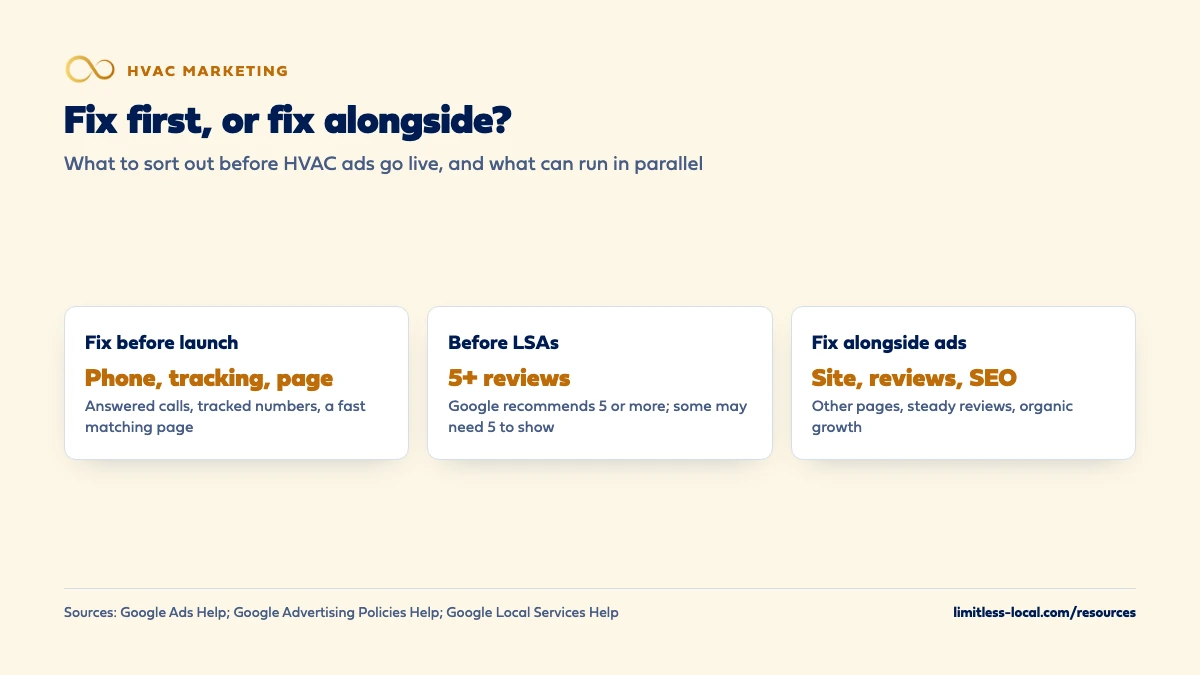
- Must fix first: a working, fast landing page, an answered phone and call tracking.
- Fix alongside the ads: the rest of the website, review count and your Google profile.
- Local Services Ads need reviews first; Google recommends 5 or more.
- After launch, Google's Landing Page Exp. column tells you if the page is holding the ads back.
For HVAC owners who want to turn on ads but suspect the website or the review count will waste the money.
Get a free visibility audit · Book a growth call
Does my HVAC company need a better website and more reviews before running ads?
Fix only what would waste the ad money, then start ads while you keep improving the rest. Before Google search ads go live you need one fast, mobile-friendly page that matches the ad and makes calling easy, because landing page quality is part of how Google ranks ads and a page that breaks Google’s destination rules can get ads disapproved. Reviews matter most for Local Services Ads, where Google recommends 5 or more and, depending on business type, a business may need 5 before the ad shows; for search ads, a thin review count is something to build alongside the ads, not a reason to wait.
That split, fix what wastes money now and build the rest alongside, is how we start every ad account: the landing page, call tracking and Google profile come first, then the ads, then the slower work. It’s part of our local ads work for HVAC companies. The HVAC marketing guide shows how the website, reviews and ads fit together, and the rest of the HVAC marketing questions library goes question by question.
Do I really need to fix my website before running HVAC ads?
It depends on which ads. Google search ads send every click to a page on your website, so the page has to work before you pay for the click. Local Services Ads lean on the website much less, because the homeowner calls, messages or books straight from the ad, but they lean hard on reviews. Choosing between LSAs, Google Ads and SEO covers that trade-off in full.
So the honest answer is rarely “rebuild everything first.” In our judgement it’s “fix the few things that would waste ad money, launch, and keep improving the rest while the phone rings.” A full rebuild can take months; one solid landing page can be ready in days. The sections below sort the must-fix items from the ones you can work on in parallel.
What does Google look at on the page my ads send people to?
Google’s ad auction weighs the quality of your ad and landing page alongside your bid. That includes how useful and relevant the page is, whether it matches what people expect after clicking the ad, and how easy it is to navigate (About Ad Rank). Google says higher-quality ads typically cost less per click, and that with low-quality ads your actual cost per click may sit close to your maximum bid even when competition is low (About ad quality).
Google sums this up in Quality Score, a diagnostic on a scale of one to ten built from three parts: expected clickthrough rate, ad relevance and landing page experience. Each part is rated Above average, Average or Below average against other advertisers whose ads showed for the exact same search over the last 90 days. Google is clear that Quality Score itself isn’t an input in the auction; it’s a tool for spotting where your ads, pages or keywords could improve (About Quality Score).
Which website problems can get my ads rejected?
Google’s destination experience policy requires the page an ad sends people to be functional, useful and easy to navigate. Examples it gives that can lead to disapproval (Destination experience):
- Pop-ups or interstitials that get in the way of the content the person asked for.
- Pages that disable or interfere with the browser’s back button.
- Sites that don’t load quickly on most popular browsers and devices.
- Ad links that start a file download or open an email address instead of a page.
Google says violations won’t lead to immediate account suspension without warning, and a warning comes at least 7 days before any suspension. For an HVAC site, the usual suspects are a full-screen coupon pop-up, a chat widget that covers the page on a phone, or a slow page loaded with sliders and video. Those are fixes measured in hours, and they’re worth doing before launch.
What's the minimum landing page an HVAC ad needs?
One page per main service you advertise, built for a homeowner on a phone. In our view, it needs:
- A headline that matches the ad. An ad for furnace repair lands on a furnace repair page, not the homepage.
- A tap-to-call number at the top, the same tracked number every time.
- Your service area in plain words, so people outside it don’t call.
- A short form for people who can’t talk right now.
- Proof: your rating, a few real reviews, real photos of your techs and trucks, and license details.
- Speed on mobile. Google says improving landing page speed is one of the best and easiest ways to get better results from mobile ads, and gives a retail example: “in retail, we’ve seen that a 1-second delay in mobile can impact mobile conversions by up to 20 percent” (Evaluate the performance of your landing pages). That example is from retail, but a homeowner with no heat is no more patient.
If you also sell system replacements, they deserve a page of their own; marketing replacements differently from repairs explains why.
Curious what your marketing is actually booking?
Get a free visibility audit — no obligation, no sales pitch.
How many reviews do I need before running ads?
For Local Services Ads, Google says it recommends 5 or more reviews, and depending on your business type you may need 5 before the ad shows at all (Improve your Local Services Ads performance). Reviews also feed LSA ranking: Google lists your rating and number of reviews as part of profile quality, and says higher-quality profiles may rank higher and may pay lower costs per lead (About ad rankings).
For Google search ads, the Ad Rank factors Google lists (your bid, ad and landing page quality, minimum thresholds, the competition, the context of the search and your ad assets) don’t name reviews. In our judgement, that makes a low review count a reason to start with search ads and grow reviews alongside them, not a reason to wait. Your reviews still matter to the homeowner reading your page, which is why they belong on it. Getting your techs to ask for reviews covers building the count.
What if my rating is low or I have a few bad reviews?
Don’t hide from them, and don’t try to buy your way out. Google says reviews must reflect a genuine experience and that offering incentives, like a free or discounted service, in exchange for posting, changing or removing reviews is strictly prohibited (Tips to get more reviews).
What Google suggests instead: ask every customer with a direct link or QR code, reply to reviews, and value all of them, since a mix of positive and negative feedback often feels more trustworthy. For negative reviews it recommends replies that are honest, apologize where appropriate, and invite the reviewer to sort out complex issues by phone or email. A thoughtful reply under a bad review can do more for a homeowner deciding between you and the next company than another five-star review would. That’s our judgement, but it follows Google’s own advice. Optimizing your Google profile covers replies in more depth.
What should I fix first if both need work?
In order of how much ad money each one wastes, in our judgement:
- Phone answering. A paid call that rings out is the most expensive mistake in local ads. How fast to respond to new leads covers the standard.
- Call tracking. Without it you can’t tell which ads booked jobs, so you can’t fix anything else with confidence.
- The landing page for each service you’ll advertise, built as described above.
- Your Google Business Profile: accurate name, hours, categories and service area, especially before Local Services Ads, which draw on it.
- Reviews, as an ongoing habit after every job.
- The rest of the website: other service pages, city pages, the blog. That’s SEO work, and it can run alongside the ads.

Can I run ads while I fix the rest?
Yes, and in our judgement that’s usually the right call once the first four items above are done. Ads can bring calls within days of launch, while SEO typically takes 3 to 6 months to show meaningful growth. Waiting for a perfect website before turning on ads means months of missed calls for work that would have improved the results only at the margins.
Running both also helps the fixes. The ads tell you which services and towns bring booked jobs, the search terms show the words homeowners actually use, and those become the pages you build next. The website work then lowers what each ad click costs you and, over time, brings in calls you don’t pay per click for.
When should I wait instead of starting ads?
Hold off, in our judgement, if any of these is true:
- Nobody can answer the phone during the hours your ads run, and no answering service or message option is in place.
- Your site is down, very slow on phones, or covered by pop-ups that could get ads disapproved.
- You can’t tell which calls came from which source, and can’t fix that before launch.
- You want Local Services Ads but have fewer reviews than Google recommends.
- Your Google Business Profile is unverified, suspended or wrong, and you’re planning LSAs.
Each of these is a fix of days or weeks, not months. Fix it, then launch.
How do I know if my website is hurting my ads after launch?
Google tells you, if you look. In the Keywords view you can add the Quality Score columns, including Landing Page Exp., and a status of Average or Below average may point to an opportunity to improve (About Quality Score). The Landing pages report shows clicks for each page your ads send traffic to and flags pages that aren’t mobile-friendly every time through the Mobile-friendly click rate column (Evaluate the performance of your landing pages).
Then check your own numbers: plenty of clicks but few calls or forms points at the page; plenty of calls but few booked jobs points at the phone or the follow-up. Telling whether ads, website or follow-up is the problem walks through the full check.
Not sure which of these is costing you jobs?
A free visibility audit checks the Google profile, reviews, site and tracking, and shows what to fix first.
What's different about ad readiness for HVAC companies
Fix before the rush, not during it. The first heat wave is the worst time to discover the landing page doesn’t load on a phone or the tracked number forwards to a voicemail box nobody checks. In our judgement, the weeks before each peak season are when readiness work pays off most.
Emergency pages and install pages are different pages. A no-heat caller wants a phone number and an arrival window; a replacement buyer wants options, financing and proof. One generic services page serves neither well.
Say only what you can deliver. If the page says 24/7 emergency service, the phone has to be answered at night. A page that promises around-the-clock service and a voicemail at midnight costs you the click and, often, a review.
A worked example: same ad spend, better page
These numbers are made up to show the math, not a benchmark for your market. Say you spend $1,000 on search ads at $25 a click, which buys 40 clicks.
- Old page (slow, generic, number hidden at the bottom): 1 in 10 clicks calls, so 4 calls, and 1 books. That’s the whole $1,000 for one booked job.
- New page (fast, matches the ad, tap-to-call at the top): 1 in 5 clicks calls, so 8 calls, and 4 book. That’s $250 per booked job.
Same ads, same budget, a quarter of the cost per job. And because Google weighs landing page quality in the auction, a better page can also bring the price of each click down over time, which these numbers don’t even count.
On our side, Essentials ($3,500 a month) includes Google Ads management up to $2,500 a month in ad spend, one landing page, Google Business Profile management, and review response with basic review generation. Growth ($4,500 a month) adds Local Services Ads management and advanced review generation. Ad spend is paid to Google separately. A free visibility audit is the simplest way to see what’s worth fixing before you spend.
Frequently asked questions
Does a higher Quality Score directly move my ad up?
No. Google says Quality Score is a diagnostic and not an input in the ad auction. The auction uses its own real-time quality measures, such as expected clickthrough rate, ad relevance and landing page experience, which Quality Score summarizes.
Can I send my ads to my homepage?
You can, but Google’s ad quality looks at whether the page matches what people expect after clicking the ad. A homepage that covers every service usually matches a specific repair ad less well than a page built for that repair.
Will a coupon pop-up on my site hurt my ads?
It can. Google’s destination policy lists pop-ups and interstitials that interfere with the content as grounds for disapproval. Interstitials are allowed if they don’t make it hard for someone to leave the site.
Can I give customers a discount for leaving a Google review?
No. Google says offering incentives such as free or discounted services in exchange for reviews is strictly prohibited. Ask every customer instead, with a direct link or QR code.
What happens if my site breaks Google's destination rules?
The affected ads can be disapproved. Google says it warns at least 7 days before suspending an account under this policy, and the fix it gives is to make the page functional, useful and easy to navigate.
Key takeaways
- Fix what would waste ad money first: an answered phone, call tracking and one fast landing page per service.
- Landing page quality is part of Google’s Ad Rank, and pages that break destination rules can get ads disapproved.
- Local Services Ads need reviews first; Google recommends 5 or more.
- For search ads, a thin review count is something to build alongside the ads, not a reason to wait.
- After launch, check the Landing Page Exp. column and the Landing pages report to see whether the page is holding ads back.
Want a second set of eyes on your setup?
We'll look at how you show up locally and where calls are leaking, then send you a plain-English breakdown.
More in this section
- How do I tell if my HVAC ads, website or follow-up is the problem?
- Are Google Local Services Ads worth it for an HVAC company?
- Does my HVAC company need landing pages for Google Ads?
- How do I get HVAC calls without paying for ads?
- Which HVAC services should I advertise first?
Sources
- About Ad Rank — Google Ads Help
- About Quality Score for Search campaigns — Google Ads Help
- About ad quality — Google Ads Help
- Evaluate the performance of your landing pages — Google Ads Help
- Destination experience — Advertising Policies Help
- About ad rankings — Google Local Services Help
- Improve your Local Services Ads performance — Google Local Services Help
- Tips to get more reviews — Google Business Profile Help