
Should an electrician use a website chatbot to book estimates?
- Can an AI chat widget on an electrician's website qualify leads and book estimates?
- What does a website chatbot actually do for an electrician?
- How is a website chatbot different from an AI receptionist?
- Can a chatbot really book electrical estimates on its own?
- Which electrical jobs should it book, and which should go to a person?
- What should the chatbot ask before it books an estimate?
- Should the chatbot answer price questions?
- Will a chatbot bring me more electrical leads?
- When is a chatbot a waste of money for an electrician?
- Should the chatbot tell customers it's AI?
- What about chat on my Google Business Profile?
- How do I know if the chatbot is booking real jobs?
- What's different about website chat for electricians
- A worked example: is the chatbot paying for itself?
- Frequently asked questions
- Key takeaways
- More in this section
- Sources
The short version
- Worth it when your site gets steady traffic and many visits come when nobody can answer.
- Let it book simple estimates; hand urgent, unsafe or unusual requests to a person.
- Give it exact answers for prices, service area and hours, or tell it to pass those on.
- Judge it on booked estimates and jobs, not on chat counts.
For electrical contractors whose websites get steady traffic, and who wonder whether an AI chat box could turn more of those visitors into booked estimates.
Get a free visibility audit · Book a growth call
Can an AI chat widget on an electrician's website qualify leads and book estimates?
It can be worth it if your website already gets steady traffic and many visitors arrive when nobody can answer, because current AI chat tools can answer common questions, collect job details and, if you allow it, book estimates into your schedule. It works best for planned work like panel upgrades, EV chargers and generators, with anything urgent or unusual handed straight to a person. A chatbot doesn’t bring new visitors to your site, so if traffic is low or leads already get a fast callback, fix those first.
AI website chat is one of the automation add-ons we set up for owners, connected to the rest of the lead tracking so chat leads show up next to calls and forms in the monthly report. Our automation page shows how the add-ons fit any package, and our electrical contractor marketing page shows how it applies to electrical work. The rest of the electrical marketing questions library covers the other channels.
What does a website chatbot actually do for an electrician?
It answers the chat box on your website, at any hour, when nobody in the office can. Newer tools built into field-service software go well past the old scripted widgets that only asked for a name and an email:
- Housecall Pro’s CSR AI Chat Answering responds to website chats in real time, can book jobs, manage existing appointments and use custom scripts, escalates the chat when the customer asks for a human, and leaves a summary in your inbox.
- Jobber’s Receptionist lists website chat among the channels it handles, and can learn about your business from your Jobber business profile and the FAQ section of a Jobber website.
So the real question for an electrician isn’t whether chat works in general. It’s whether enough people visit your site at times nobody can respond, and whether the bot is allowed to do something useful with them.
How is a website chatbot different from an AI receptionist?
An AI receptionist answers your phone. A website chatbot answers people who are already on your website and would rather type than call: someone at work, someone comparing three electricians at night, someone who wants a photo of their panel looked at before they commit to a visit.
Some tools do both, and the setup decisions overlap: what it may book, what it should never answer, and who gets the hand-off. If after-hours phone calls are your bigger gap, whether an electrician should use an AI receptionist covers that side. In our judgement, most small shops should fix the phone before adding chat, because more of their urgent work starts with a call.
Can a chatbot really book electrical estimates on its own?
Some can, if you let them. In Housecall Pro, CSR AI has permission settings you control, including whether it can book jobs and estimates, reschedule and cancel, according to its CSR AI overview. Housecall Pro says its chat answering supports booking jobs and managing appointments, and Jobber’s Receptionist lists booking jobs in your schedule among its actions.
Our suggestion is to start narrow. Let it book estimate visits that are simple to schedule, and have it collect details and hand off anything that needs judgement. Widen its permissions once you’ve read enough transcripts to trust how it treats your customers.
Which electrical jobs should it book, and which should go to a person?
In our judgement, a sensible split for most electrical shops looks like this:
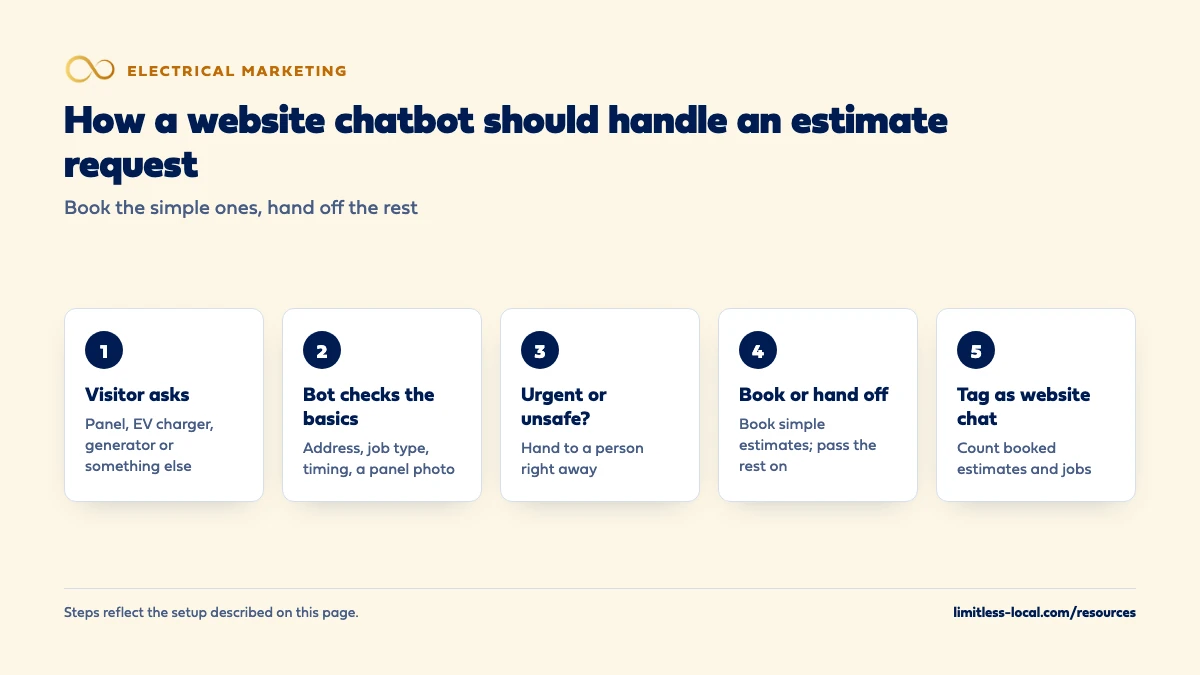
- Fine to book: estimate visits for panel upgrades, EV charger installs, generator installs, lighting upgrades and other planned work, inside your service area and during your normal estimate hours.
- Collect details, then hand off: commercial work, multi-unit buildings, whole-home rewiring, anything outside your service area, and anyone asking about financing, permits or a firm price.
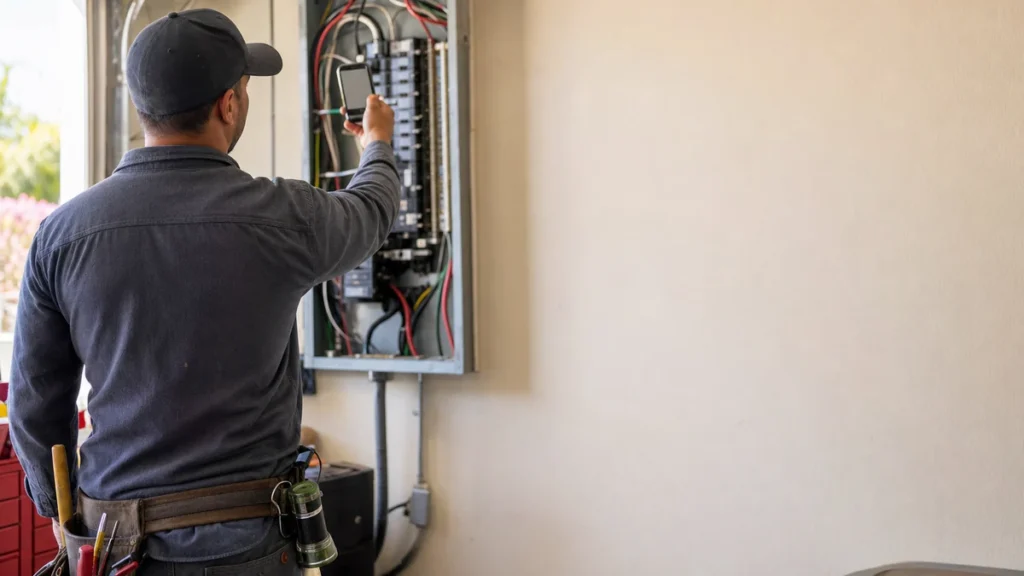
- Hand to a person right away: anything that sounds urgent or unsafe, such as burning smells, sparks, buzzing panels, partial power loss or a breaker that won’t reset.
Set those triggers before you switch it on. Jobber’s Receptionist, for example, lets you set an escalation policy: terms you choose, such as “emergency” or “urgent,” pass the conversation to a team member you pick, by text alert or call transfer. Jobber describes this for calls and texts, so check how your own tool handles website chat. For anything that sounds like immediate danger, the bot should tell the person to contact emergency services or their utility, not offer a slot next week.
What should the chatbot ask before it books an estimate?
Enough to send the right person prepared, and no more. A short list works better than a long form. In our judgement, for most electrical estimates that’s:
- Name, phone and the job address (which also confirms your service area).
- What kind of work: panel, EV charger, generator, lighting, outlets, something else.
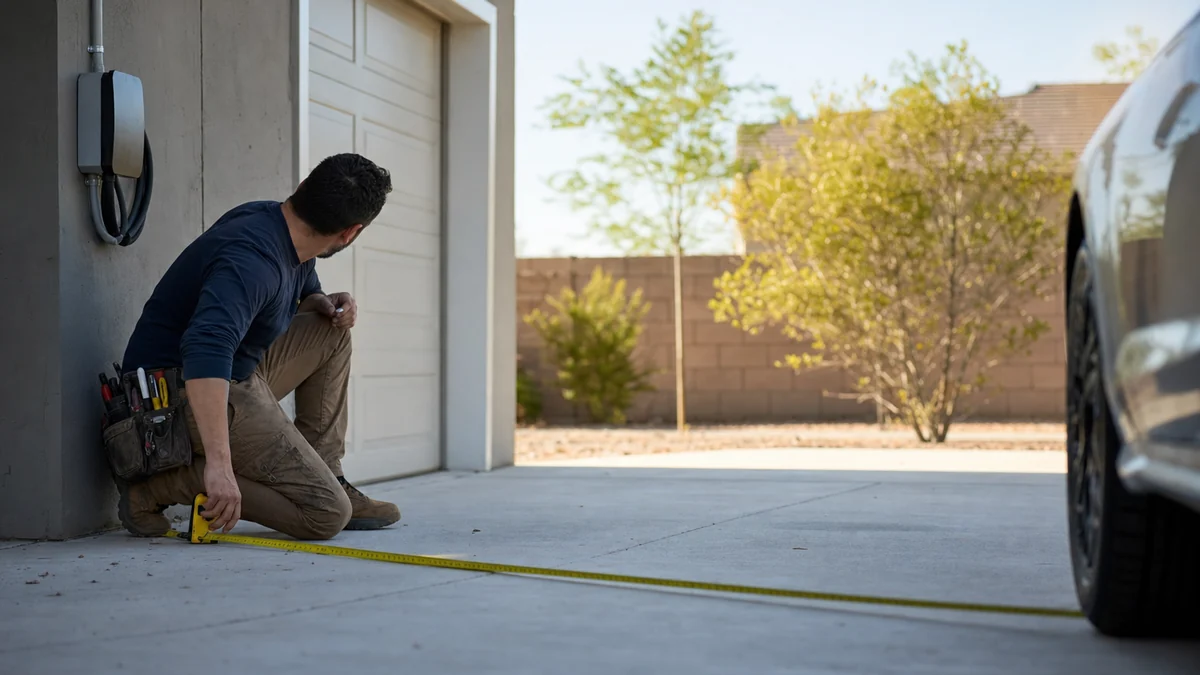
- For EV chargers: where the car parks and roughly how far that is from the panel.
- Whether they can send a photo of the panel and its label, if your tool accepts photos.
- Homeowner or tenant, and how soon they want the work done.
Each extra question loses some people, so ask what changes the visit and leave the rest for the estimate. Stopping price shoppers from wasting your estimates covers how far to qualify before you send someone out.
Curious what your marketing is actually booking?
Get a free visibility audit — no obligation, no sales pitch.
Should the chatbot answer price questions?
Only with answers you’ve written and are willing to stand behind. In a 2024 case, Moffatt v. Air Canada, a British Columbia tribunal held an airline responsible after its website chatbot gave a customer wrong information about a bereavement fare. The tribunal said the chatbot was still part of the company’s website and the company hadn’t taken reasonable care to make sure it was accurate.
That was a Canadian small-claims decision about an airline, not a ruling on U.S. law or electricians, and this isn’t legal advice. But the lesson travels: customers will reasonably believe what your bot tells them. For an electrician, the risky topics are prices, permit and code questions, warranties, financing, rebates and arrival times. Give the bot exact wording, such as your service-call fee if you publish one, or tell it to pass those questions to a person. Whether electricians should show prices on their website covers what to publish in the first place.
Will a chatbot bring me more electrical leads?
Not new visitors. A chatbot doesn’t move you up on Google or put your name in front of homeowners who haven’t found you; your Google Business Profile, ads, SEO and reviews do that. What chat can do is turn more of the people already on your site into contacts and booked estimates.
In our judgement, the visitors it helps most are after-hours visitors, people who can’t make a phone call right now, comparison shoppers who want a quick answer before calling, and existing customers who want to reschedule. If your website doesn’t get much traffic, what an electrician’s website needs to get more calls is a better place to start.
When is a chatbot a waste of money for an electrician?
When the problem it solves isn’t your problem. In our judgement, it adds little when:
- Your site gets only a trickle of visits, so there’s no one to chat with.
- Your office answers live during the day and calls back web forms within minutes.
- It’s set up halfway: no information about your services, no permission to book, no hand-off and transcripts nobody reads.
- Leads it captures sit until someone gets around to them.
A chatbot that captures a lead nobody follows up on is a contact form with extra steps. If quotes are what go cold, following up on electrical quotes automatically may be the better first buy.
Should the chatbot tell customers it's AI?
We think so. Jobber, for one, encourages businesses to let callers know when the phone is answered by AI, though it says that isn’t required, and it points owners to local and state rules about recording calls. A homeowner who later realizes they were talking to a bot that pretended otherwise is less likely to trust the rest of what you told them.
A short opening line does it, such as “I’m an automated assistant. I can book an estimate or get you to a person.” It sets expectations and tells the customer how to reach a human, which is what most people want to know.
What about chat on my Google Business Profile?
That’s a separate channel. Google’s help page on chatting with customers from your Business Profile says a verified business can add a WhatsApp or text messaging option to its contact info, and that chat options are currently available for select regions and might not be available for your profile. If you add both, only the text message option is shown.
Messages that arrive that way go to the number or WhatsApp link you entered, not to your website chatbot. In our judgement, whoever watches your website chat should watch that number too, so both kinds of message get the same fast answer.
How do I know if the chatbot is booking real jobs?
Count booked estimates and sold jobs, not conversations. A bot that handles hundreds of chats and books nothing is a cost.
- Use the tool’s reporting. Housecall Pro’s CSR AI dashboard, for example, shows chats handled, jobs and estimates booked, the booking conversion rate and revenue attributed to jobs it booked.
- Tag the lead source. Mark jobs that started in chat as “Website chat” in your field software so they sit next to calls, forms and ads.
- Read transcripts weekly for the first couple of months to catch wrong answers and missed hand-offs.
- Compare before and after: after-hours estimate bookings per month before the bot, and after.
Tracking which electrical marketing brings in real jobs covers how to tie every source to booked work.
Want to see where your company stands?
A free visibility audit shows where you show up on Google, Maps and AI answers, and what it's costing you in calls.
What's different about website chat for electricians
Safety calls can’t wait in a chat queue. Some electrical problems are dangerous. The bot’s first job on any message about burning smells, sparks or overheating is to get a person involved, not to book a slot.
Planned work suits chat best. Panel upgrades, EV chargers, generators and lighting upgrades are researched online, often in the evening, and usually need an estimate visit. That’s where a bot that books estimates earns its keep.
Photos save trips. A picture of the panel and its label, or of where an EV charger would go, helps you send the right person with the right questions. If your tool accepts photos, ask for them.
Code, permit and price questions need care. Rules vary by location, and a wrong answer from a bot is still your answer. Have it pass those to a person.
A worked example: is the chatbot paying for itself?
These numbers are made up to show the math. They aren’t a benchmark or a forecast.
Say your website chat gets 60 conversations a month, and 20 of them come in after hours, when nobody would have answered. From those 20, the bot books four estimate visits, and two of those turn into jobs: an EV charger install and a panel upgrade averaging $1,800 each.
- Revenue from after-hours chat jobs: two times $1,800, or $3,600 a month.
- The cost to compare it against: the tool’s monthly price plus the office time spent reading transcripts and confirming bookings.
If you’d have won some of those jobs anyway through a call the next morning, count only the extra ones. That’s why the before-and-after comparison matters more than the chat count.
Frequently asked questions
Do I need a chatbot if I already have a contact form?
Not necessarily. A form works if someone answers it within minutes. A chatbot helps most when visitors arrive after hours or want a quick answer before deciding to call.
Can the chatbot give a firm price for a panel upgrade?
We’d advise against it. Panel upgrades vary with the home and local requirements. Have the bot share only prices you publish, and book an estimate for the rest.
Will customers be annoyed by a chatbot?
Some will, which is why the bot should say it’s automated and offer a person early. Most people mind slow or wrong answers more than the bot itself.
Does a chatbot help my Google ranking?
We know of no Google statement saying it does. It works on visitors already on your site; your Google profile, reviews and website content are what affect how you show up.
Does Limitless Local offer AI website chat?
Yes, as an automation add-on to any of our packages. It answers common questions, captures contact details and can book appointments. Pricing is shared on the discovery call.
Key takeaways
- A chatbot turns existing website visitors into leads; it doesn’t bring new ones.
- It earns its keep when traffic is steady and many visits come when nobody can answer.
- Let it book simple estimates; send urgent, unsafe or unusual requests to a person.
- Give it exact answers for prices and policies, or tell it to pass those on.
- Judge it on booked estimates and jobs, tagged as website chat in your software.
Not sure what's working right now?
Start with a free visibility audit: rankings, Google profile, reviews and tracking, checked against your service area.
More in this section
- Should an electrician use an AI receptionist for after-hours calls?
- Should electricians show prices on their website?
- What should an electrician's website have to get more calls?
- How do I follow up on electrical quotes automatically?
- Should electricians pay for leads from Angi or Thumbtack?
Sources
- CSR AI Chat Answering — Housecall Pro Help Center
- CSR AI Overview — Housecall Pro Help Center
- Receptionist–powered by Jobber AI — Jobber Help Center
- Moffatt v. Air Canada, 2024 BCCRT 149 — Civil Resolution Tribunal of British Columbia (via CanLII)
- Chat with customers from your Business Profile — Google Business Profile Help