
Should electricians pay for leads from Angi or Thumbtack?

- Are pay-per-lead sites like Angi and Thumbtack worth it for an electrical contractor?
- How do Angi and Thumbtack actually charge electricians?
- What's the difference between a shared lead and one that comes only to me?
- When does paying for marketplace leads make sense for an electrician?
- When is paying for leads a bad deal?
- How much should I spend on pay-per-lead sites each month?
- Can I get money back for bad leads?
- How do I win more of the marketplace leads I pay for?
- How do pay-per-lead sites compare with Local Services Ads and Google Ads?
- Should I stop paying for leads once my own marketing is working?
- What's different for electricians buying leads
- A worked example: is a marketplace paying off?
- Frequently asked questions
- Key takeaways
- More in this section
- Sources
The short version
- You pay per lead, not per job: you're charged whether or not you win the work.
- They fit best for filling schedule gaps on small service work, if someone answers every lead within minutes.
- Judge them only by cost per booked job and profit per job, from your own records.
- Leads that come to you alone, from your Google profile, website and ads, are the better long-term base.
For electrical contractor owners deciding whether to buy leads from home-service marketplaces, how those sites charge, and when the money is better spent on leads that come to you alone.
Get a free visibility audit · Book a growth call
Are pay-per-lead sites like Angi and Thumbtack worth it for an electrical contractor?
Paying for leads from Angi or Thumbtack can make sense for an electrician who needs to fill gaps in the schedule quickly, can answer every lead within minutes, and tracks what each lead actually turns into. The catch is in how they charge: on both, you pay for the lead itself, not for a booked job, and HomeAdvisor (powered by Angi) says you’re charged whether or not you win the work. Treat these sites as a short-term filler you measure by cost per booked job, not as the foundation of your marketing.
That’s the comparison we’d run with any electrical contractor before adding a lead source: what each booked job costs from each channel, side by side. We manage Google Ads and, on our Growth package, Local Services Ads, with call tracking on every package so the numbers are yours, not a marketplace’s. Our local ads management page shows how that works, our electrical contractor marketing page shows the full plan, and the electrical marketing questions library covers the rest question by question.
How do Angi and Thumbtack actually charge electricians?
Both charge for leads, but the details differ, and the details decide whether the numbers work.
Thumbtack. Thumbtack’s help center says you pay for leads, meaning customers who reach out to you directly from search results. When a customer’s job matches the job preferences you’ve set, you pay for that lead automatically, at the lead price you’ve chosen. Thumbtack says prices vary with the type and size of the job, how many pros are available and your market (Thumbtack Help). There’s also a second kind, Opportunities: you send a quote to a customer who has already contacted other pros, it’s free to send, and you’re only charged if the customer responds (Thumbtack Help).
HomeAdvisor, powered by Angi. HomeAdvisor’s pro page says you choose the services you offer and the areas you serve, and it matches you with homeowners in those areas. What you pay per lead varies by the type of work and by region, and you set a spend target for a 28-day period that it says is an estimated goal, not a hard cap; it’s possible to go over it. Most important: it states that it does not provide or guarantee jobs, and that you’re charged for each lead whether or not you win the job, and whether or not the customer hires anyone at all (HomeAdvisor).
So in both cases the thing you’re buying is a chance at a job. Everything else on this page follows from that.
What's the difference between a shared lead and one that comes only to me?
A marketplace lead is a homeowner who asked a platform for help. Depending on the platform and the lead type, other electricians may be contacting the same person. Thumbtack’s Opportunities, for example, are described as customers who’ve reached out to other pros but haven’t hired anyone yet (Thumbtack Help).
A call from your own Google Business Profile, your website or your own ad is different: the homeowner picked you. In our judgement that changes everything downstream. On a lead several shops are chasing, the first to call usually gets the conversation, the homeowner is often comparing on price, and your close rate is lower. On a call that came only to you, the homeowner has already seen your reviews and photos and usually wants to book.
That doesn’t make marketplace leads worthless. It means the price you can afford to pay for one is lower than what you’d pay for a call that comes only to you, because fewer of them turn into jobs.
When does paying for marketplace leads make sense for an electrician?
In our judgement, these situations are where pay-per-lead sites most often earn their place:
- You’re new and the phone is quiet. A brand-new shop with no reviews and no search presence needs work now. A marketplace can bring the first jobs, and the first reviews, while slower channels build. Getting your first electrical customers covers the other early moves.
- You have empty slots on the schedule. If a tech has open hours, a lead that books small service work is better than an idle truck, as long as the lead price is well under the profit on the job.
- You’re testing a new service or area. Turning on one service, such as EV charger installs, in one area for a few weeks tells you whether demand is there before you build pages and ad campaigns for it.
- Someone can answer fast, every time. Thumbtack’s own guidance says the faster you respond, the better your chances of getting hired (Thumbtack Help). If leads sit until the evening, you’re paying for jobs that went to someone else.
When is paying for leads a bad deal?
In our judgement, the warning signs are:
- Nobody tracks what each lead became. If you can’t say how many paid leads booked last month and what those jobs were worth, you can’t tell whether the spend is working.
- Leads arrive while you’re on a roof or in an attic. Paying for a lead and calling back two hours later is often paying for a competitor’s job.
- The work you want most is high-ticket and slow. Panel upgrades, generators and rewires take site visits, permits and longer decisions. A homeowner shopping several pros for that work is weighing more than price, and your own reviews, photos and service pages tend to carry more weight there than a marketplace profile.
- The site has become your only source. If the platform changes prices or rules, your phone changes with it. The customer relationship started on their platform, not yours.
Curious what your marketing is actually booking?
Get a free visibility audit — no obligation, no sales pitch.
How much should I spend on pay-per-lead sites each month?
There’s no right number to copy, and neither platform publishes a typical electrical lead price; both say it depends on the job and the market. The useful approach is to set a cap you can afford to test with and let your own numbers decide whether to raise it.
Both platforms give you a control to do that. Thumbtack lets you set a lead price per service plus a weekly budget across all services; when you hit the budget you can raise it or stop appearing in search results until it resets the following Monday (Thumbtack Help). HomeAdvisor’s spend target is an estimate for a 28-day period, not a hard cap, and it says some lead types are charged outside it, so it tells you to review your invoices regularly (HomeAdvisor).
In our judgement, give a test six to eight weeks with a fixed cap, then compare the cost per booked job with your other channels. How to set that benchmark is covered in what a good cost per booked job is, and how it fits the total budget in how much to spend on marketing.
Can I get money back for bad leads?
Sometimes, within limits the platforms set themselves. Read the rules before you sign up, because they’re narrower than most owners expect.
- Thumbtack says some refunds are automatic, for example when its Trust and Safety team flags a lead. For other cases you can request a refund within 45 days of the charge, and situations likely to qualify include a job that’s drastically different from the original lead, a disconnected or invalid phone number, and a duplicate lead for an identical job. All refunds are at its sole discretion (Thumbtack Help).
- Angi Leads, in the lead credit guidelines posted on HomeAdvisor’s pro site, says credits are at its sole discretion, must be requested within thirty days of the charge, are issued as store credit toward future charges, and expire six months after they’re issued. Its list of situations that may qualify includes duplicate requests, the wrong zip code or job type, and contact details that are all wrong or disconnected (Angi Leads lead credit guidelines).
Neither list covers a homeowner who simply hired someone else. That’s the normal cost of a shared lead, and it belongs in your math.
How do I win more of the marketplace leads I pay for?
The platforms all point the same way: respond fast and make your profile worth choosing. Thumbtack says customers see the pros who fit their project best, and suggests building your profile with reviews from past customers before leads arrive (Thumbtack Help).
In our judgement, the practical habits that help most are:
- Answer every lead within minutes during business hours, by phone where the platform allows it, not just a message.
- Have one short script for the first call: confirm the job, ask two or three questions that size it, and offer a time.
- Set job preferences tightly so you’re not paying for work you don’t do or areas you don’t serve.
- Log every paid lead in your field service software with the platform as the source, so the booked job and invoice tie back to it.
Speed is a whole topic on its own; how fast your office should answer covers it.

How do pay-per-lead sites compare with Local Services Ads and Google Ads?
They’re not the same kind of channel. On Angi or Thumbtack, the homeowner is on someone else’s platform and you’re one of the pros shown. With Google’s own ads, the homeowner searched Google and the call or form comes to you. Google’s Local Services Ads also charge per lead, and Google says the first phase of moving Local Services Ads into Performance Max campaigns with pay-per-lead goals begins in August 2026 for select home-service advertisers in the United States, including electrical (Google Ads Help). Regular search ads charge per click instead.
Which works better depends on your market, so in our judgement the only fair test is the same yardstick for all of them: cost per booked job. Whether Local Services Ads are worth it for your shop is covered in Local Services Ads for electricians.
Should I stop paying for leads once my own marketing is working?
Not necessarily all at once. In our judgement, the healthy pattern is to treat marketplace spend as a dial. While your Google Business Profile, reviews and website are building, it can carry more of the load. As more calls come to you directly and those calls book at a lower cost per job, turn the marketplace budget down, service by service, and keep it only where it still beats your other channels on your own numbers.
Search work is a ramp: ads can bring calls within days of launch, while SEO typically takes three to six months to show meaningful organic growth. That’s why a short-term lead source and a long-term one can sit side by side for a while.
What's different for electricians buying leads
Your jobs range from a quick swap to a five-figure service upgrade. A lead price that’s fine for a panel upgrade can eat the whole profit on replacing a few outlets. Set lead prices and job preferences by service, not one blanket setting, and in our judgement turn off the small, low-margin services on a marketplace if they never pay back.
Licensing is a selling point you should show. Homeowners comparing pros on a platform may also be looking at people who aren’t licensed electricians. Put your license and the work you’re licensed for in your profile; showing your license number in marketing covers how.
Commercial work rarely comes this way. In our judgement, marketplaces are built around homeowner projects. Commercial and contractor work comes from relationships and bids, which is a different plan.
Not sure which of these is costing you jobs?
A free visibility audit checks the Google profile, reviews, site and tracking, and shows what to fix first.
A worked example: is a marketplace paying off?
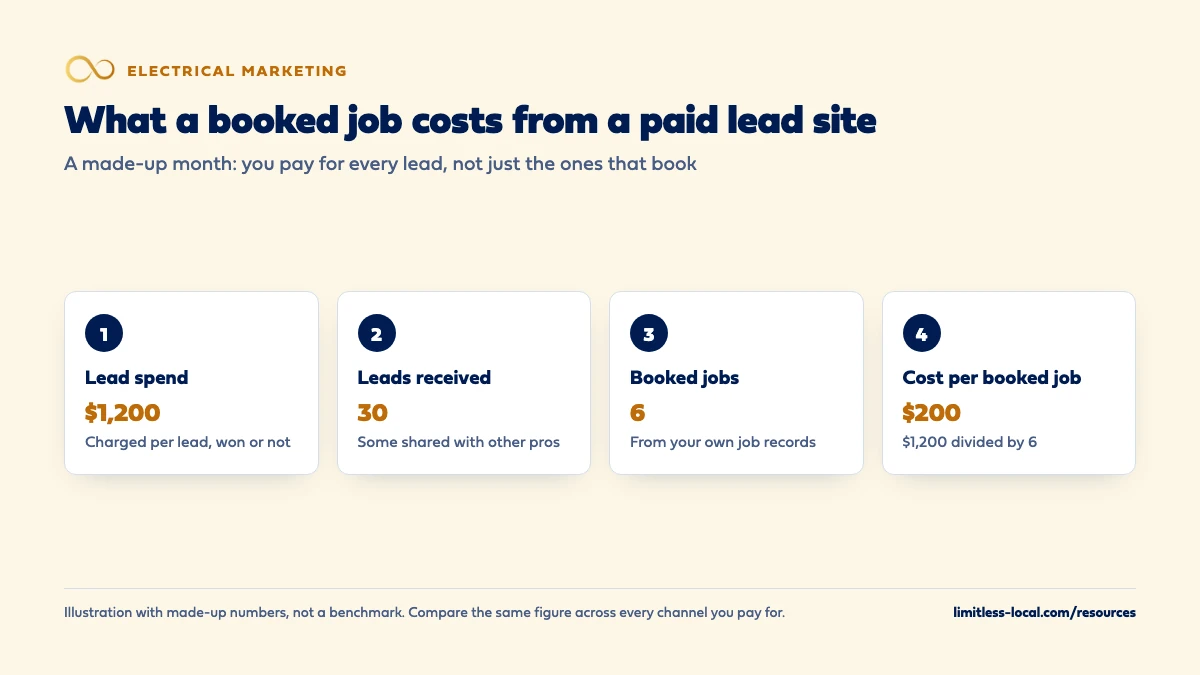
These numbers are made up to show the math, not a benchmark for your market. Say you spend $1,200 on a marketplace in a month and receive 30 leads. You reach most of them quickly, and 6 turn into booked jobs. Your cost per booked job is $1,200 divided by 6, or $200.
Those 6 jobs average $650 in revenue, so they bring in $3,900. If your gross margin on that work is 40%, they produce $1,560 of gross profit, and after the $1,200 lead spend you’re left with $360. Positive, but thin.
Now compare a month where your Google profile and website brought in 20 calls that came only to you, and 9 booked. If that month’s ad spend and site costs for those calls came to $1,350, your cost per booked job is $1,350 divided by 9, or $150. On these made-up numbers, the direct channel is cheaper per job, so it’s the one to grow, and the marketplace is the one to cap.
Frequently asked questions
Do Thumbtack Opportunities count against my weekly budget?
No. Thumbtack says that if a customer responds to a quote you sent through Opportunities, that cost is separate from your weekly budget, so track it separately too.
Do I pay for a Thumbtack lead if the customer never replies?
It depends on the lead type. Leads that match your job preferences are paid automatically when they arrive; for Opportunities, sending a quote is free and you’re only charged if the customer responds.
Can I pause my leads when I'm too busy?
Thumbtack lets you hide your business or turn job preferences off so you don’t get leads when you’re unavailable. Check each platform’s settings before a busy stretch so you’re not paying for leads you can’t take.
Are marketplace reviews worth collecting?
They help you win on that platform, but in our judgement your Google reviews matter more for calls that come to you directly. Ask happy customers for a Google review too.
Should I put my marketplace profile link on my website?
In our judgement, no. Your website’s job is to get the homeowner to call you, not to send them to a platform that also shows other electricians.
Key takeaways
- On Angi and Thumbtack you pay for leads, not jobs, and HomeAdvisor says you’re charged whether or not you win the work.
- Marketplaces fit best for filling schedule gaps or testing a service, when someone can answer every lead within minutes.
- Set lead prices and budgets by service, and know each platform’s refund or credit rules before you start.
- Track every paid lead to a booked job and compare cost per booked job with your other channels.
- Build calls that come only to you, from your Google profile, website and ads, and turn marketplace spend down as they grow.
Want a second set of eyes on your setup?
We'll look at how you show up locally and where calls are leaking, then send you a plain-English breakdown.
More in this section
- Should electricians show prices on their website?
- Are Google Local Services Ads worth it for electricians?
- Is social media worth it for getting electrical leads?
- How can I get general contractors to send me steady electrical work?
- How much does a marketing agency cost for an electrician?
Sources
- How much do I pay for leads and opportunities? — Thumbtack Help
- What are leads, preset jobs, and opportunities? — Thumbtack Help
- How Thumbtack works — Thumbtack Help
- Refund policy for pros — Thumbtack Help
- How to edit my budget — Thumbtack Help
- HomeAdvisor Leads | Growing Your Business — HomeAdvisor (powered by Angi)
- Lead credit guidelines — Angi Leads
- Local Services Ads transition to Performance Max campaigns with pay-per-lead goals — Google Ads Help