
Is social media worth it for getting electrical leads?
- Should an electrician spend time or money on Facebook and Instagram for leads?
- Do homeowners actually find electricians on social media?
- What's the difference between posting and running social ads?
- What should an electrician post that's worth the time?
- Which platform should I start with: Facebook, Instagram or Nextdoor?
- When are paid Facebook and Instagram ads worth it for an electrician?
- Should I use Facebook lead forms or send people to my website?
- What is social remarketing, and why do many shops start there?
- Can social media help me get more referrals and repeat work?
- How do I tell if social media is bringing in real jobs?
- What's different about social media for electricians
- A worked example: testing a social ad for EV chargers
- Frequently asked questions
- Key takeaways
- More in this section
- Sources
The short version
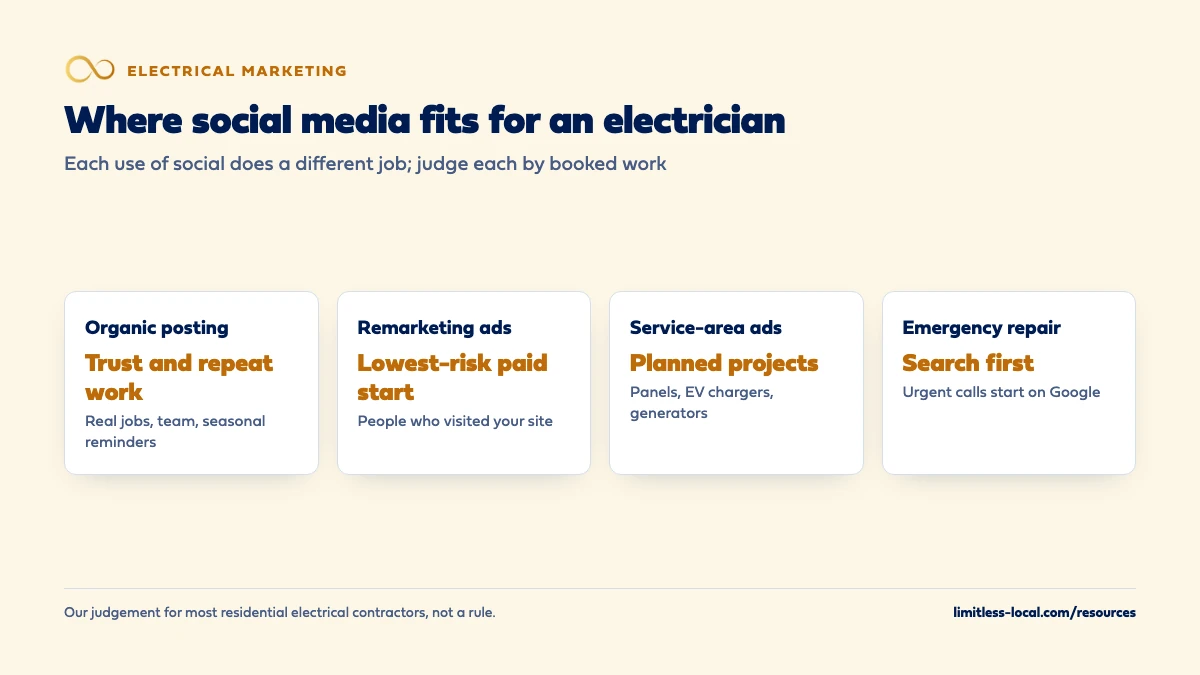
- Urgent electrical calls start on Google, so social is rarely the first channel to fund.
- Organic posting builds trust and repeat business; keep it simple and consistent, not daily.
- Paid social fits planned projects like panel upgrades, EV chargers and generators, and remarketing to site visitors.
- Judge any social spend by booked jobs and revenue, never by likes or followers.
For electrical contractor owners deciding how much time and money Facebook, Instagram and other social platforms deserve next to Google, and what each one realistically does for the phone.
Get a free visibility audit · Book a growth call
Should an electrician spend time or money on Facebook and Instagram for leads?
Social media is worth some effort for most electricians, but usually as a trust and repeat-business channel, not the main source of new emergency or service calls. Homeowners with a dead circuit search Google; they rarely scroll Facebook for an electrician. Where social earns its place is keeping past customers and neighbors aware of you, showing proof of your work, and running paid ads for planned projects like panel upgrades, EV chargers and generators, measured by booked jobs rather than likes.
That’s how we place social in a plan for a local trade: Google first, because that’s where homeowners with an electrical problem look, and social ads where they can reach the right people. Our Growth package adds Meta remarketing, showing ads on Facebook and Instagram to people who already visited your site, alongside Google Ads, Local Services Ads and call tracking. Our local ads management page explains how it works, our electrical contractor marketing page shows the full plan, and the electrical marketing questions library covers the rest.
Do homeowners actually find electricians on social media?
Some do, but mostly not in the moment that matters most. When a breaker keeps tripping or half the house loses power, the homeowner usually picks up their phone and searches. That puts Google’s map results, ads and website listings first in line for urgent calls, which is why the channel pages in this library start there.
Social media works at a different point in the decision, in our judgement. People see a neighbor’s post recommending an electrician, notice a familiar truck in a reel, or remember your name from a local group. That familiarity rarely produces the call by itself, but it makes the homeowner more likely to pick you when your name shows up in search later. If you’re weighing channels by type of work, which channels work best for residential versus commercial lays out the bigger picture.
What's the difference between posting and running social ads?
They’re two separate channels that happen to live on the same apps.
- Organic posting is free to publish but costs time. Your posts mostly reach people who already follow your page or engage with it. In our judgement it builds trust with past customers and neighbors more than it reaches strangers.
- Paid ads cost money but let you choose who sees them, such as homeowners in your service area or people who’ve already visited your website. You set the budget.
Most owners who say “social media doesn’t work” tried posting occasionally and expected the phone to ring. Most who say it does work are either running ads with a clear offer and follow-up, or have a strong local following built over years. Know which one you’re testing.
What should an electrician post that's worth the time?
In our judgement, posts that show real work and real people do better than generic tips or stock images. Ideas that suit an electrical shop:
- Before and after of a messy panel replaced with a clean one, a new EV charger, or a lighting upgrade.
- Short explainers on questions customers ask you every week: why a breaker trips, what a whole-home surge protector does, what an EV charger install involves.
- Your team: a new hire, a training day, a tech who’s been with you for years.
- Seasonal reminders: generator checks before storm season, outdoor lighting before the holidays.
Keep safety in mind in every photo and video, since homeowners and inspectors notice. And keep customer addresses and faces out unless you have permission. You don’t need to post every day. Meta Business Suite lets you schedule Facebook and Instagram posts, Stories and Reels in advance from the mobile app (Meta Business Help Center), so one hour a month can cover a steady schedule.
Which platform should I start with: Facebook, Instagram or Nextdoor?
In our judgement, start where your customers already are and where you can keep up. For most residential electrical contractors that means a Facebook business page first, because it’s where many homeowners in a service area already look up local businesses, and its Recommendations can work like reviews. Facebook says that turning Recommendations and reviews on lets anyone logged in publish a Recommendation on your page, and that Recommendations help customers learn about your business and may make your page easier to find in Facebook search (Facebook Help Center).
Instagram suits shops that do visual work, such as lighting design, smart home installs or clean panel work, and Meta lets you manage and advertise on both from one place. In our judgement, neighborhood platforms like Nextdoor are mostly about neighbors recommending local businesses, so the best way to show up there is to ask happy customers to mention you, not to post ads in every group. Commercial customers are a different case: they’re more likely to find you through relationships and bids than any social app.
Curious what your marketing is actually booking?
Get a free visibility audit — no obligation, no sales pitch.
When are paid Facebook and Instagram ads worth it for an electrician?
In our judgement, paid social works best for planned, higher-ticket work where the homeowner isn’t searching yet but might act on a good reason: panel upgrades in older neighborhoods, EV charger installs, standby generators, and battery backup. You can show those ads to homeowners in your service area and point them to a page about that service.
It works poorly for emergency repair, because someone with a problem right now is searching, not scrolling. It also works poorly with no follow-up: a lead from a social ad is often earlier in the decision than a caller from Google, so it needs a fast, friendly response and often a second contact.
Run a test with a fixed budget, one service, one offer and one landing page, and judge it on booked jobs. If you’re thinking about generator work in particular, getting more generator installation leads covers the timing.
Should I use Facebook lead forms or send people to my website?
Both can work; they trade volume for quality. Meta’s lead ads with instant forms let people fill out a form without leaving Facebook or Instagram, with contact details that may be prefilled for them (Meta Business Help Center). That makes the form easy to submit, which means more leads but also more people who were only half interested.
Meta offers a choice of form type. The default “more volume” form is built for a larger number of leads; the “higher intent” form adds a review screen so people confirm their details, and Meta says that if each lead needs follow-up or further qualification, a higher intent form may make more sense (Meta Business Help Center). In our judgement, an electrician selling panel upgrades or generators should start with the higher intent form and ask one or two qualifying questions, such as the age of the home and the work wanted.
Sending people to your website instead lets them see your reviews, license and service details before they reach out, at the cost of fewer submissions.
What is social remarketing, and why do many shops start there?
Remarketing shows ads to people who already visited your website. Meta calls these website custom audiences: you use the Meta Pixel to track site visitors and can then show ads to them, for example people who visited your site in the last 30 days but didn’t contact you (Meta Business Help Center).
For an electrician, that might mean someone read your EV charger page last week, didn’t call, and then sees your charger ad while scrolling Facebook. In our judgement, remarketing is the lowest-risk way to start with paid social, because everyone in the audience has already shown interest in you specifically. The audience is only as big as your website traffic, so it works best once Google is already sending people to your site.
Can social media help me get more referrals and repeat work?
Yes, and in our judgement this is where organic social pays off most for a trade with long gaps between jobs. A homeowner who hired you for a panel upgrade may not need an electrician again for years, but if they follow your page, they see your name when a friend asks for a recommendation, or when they finally decide on that EV charger.
Make that easy: ask customers to follow or recommend your page at the end of a job, share their recommendations with permission, and reply to comments quickly. It works best alongside a real referral system, which getting more referrals from past customers covers. Your Google reviews still matter more for new calls, so if you can only ask for one thing, ask for that; getting more Google reviews explains how.
How do I tell if social media is bringing in real jobs?
Likes, followers and reach tell you whether people see your posts, not whether the phone rings. Instagram’s insights, for example, show account and content performance for up to the past 90 days (Instagram Help Center). That’s useful for deciding what to post, but it’s not a lead count.
To see real results, in our judgement you need three things:
- A separate tracking phone number or tagged link on your social profiles and ads, so calls and form fills are labeled by source.
- A habit of asking “how did you hear about us?” and recording the answer in your field service software.
- A monthly look at booked jobs and revenue by source, with social measured the same way as every other channel.
How to set that up is in tracking which marketing brings real jobs.
What's different about social media for electricians
Most of your calls are urgent. Many electrical calls are a problem that needs fixing now, which puts search first. Social is a supporting channel for most electrical shops, in our judgement, not the lead engine it can be for trades selling purely planned projects.
Your best social content is also a safety message. Clean panel work, proper permits and inspections are proof of quality that a homeowner can’t easily judge. Showing them builds the trust that separates a licensed electrician from a handyman.
Financing ads have extra rules. If you promote financing for big jobs in a Meta ad, Meta’s policy may require you to choose the Financial Products and Services special ad category for ads about credit opportunities in the US, which limits targeting, and it says ads may be rejected if you don’t (Meta Business Help Center). That’s Meta’s ad policy, not legal advice; financing advertising also has its own legal rules, so check with your own advisor.
Not sure which of these is costing you jobs?
A free visibility audit checks the Google profile, reviews, site and tracking, and shows what to fix first.
A worked example: testing a social ad for EV chargers
These numbers are made up to show the math, not a benchmark for your market. Say you spend $900 over a month on a Facebook and Instagram ad for EV charger installs, shown to homeowners in your service area, with a higher intent lead form.
The ad brings in 24 form leads. Your office reaches 18 of them, 7 book a site visit, and 3 sign for an install. Your cost per lead is $900 divided by 24, or $37.50. Your cost per booked install is $900 divided by 3, or $300.
If those installs average $1,800 in revenue, the month brought in $5,400. Whether $300 per install is good depends on your margin and what an install costs you from Google, which is the comparison that matters. Note what would have happened if you’d judged by cost per lead alone: $37.50 looks cheap, but only 3 of 24 leads became jobs.
Frequently asked questions
How often should an electrician post on Facebook?
Consistency matters more than volume. In our judgement, one or two real posts a week, scheduled ahead, beats a burst of daily posts that stops after a month.
Are TikTok or YouTube worth it for electricians?
They can build a following if you enjoy making video, but in our judgement they’re a long-term brand play rather than a local lead source. Get Google and your core channels working first.
Should I boost posts or run proper ads?
In our judgement, a proper ad campaign with one service, one audience and a clear next step usually beats boosting random posts, because you can control who sees it and measure what it brings in.
Can I respond to people asking for electrician recommendations in local groups?
You can, if the group’s rules allow it, but a recommendation from a happy customer carries more weight than you recommending yourself. Ask past customers to speak up for you.
Do Facebook Recommendations help my Google ranking?
There’s no source saying they do. Facebook says Recommendations may make your page easier to find in Facebook search; your Google reviews are what show on your Google Business Profile.
Key takeaways
- Urgent electrical calls start on Google, so social is usually a supporting channel, not the first one to fund.
- Organic posting builds trust and repeat business; schedule a steady, simple routine.
- Paid social fits planned work like panel upgrades, EV chargers and generators, plus remarketing to site visitors.
- Lead forms trade volume for quality; higher intent forms and fast follow-up help.
- Track social like every other channel: by booked jobs and revenue, not likes.
Want a second set of eyes on your setup?
We'll look at how you show up locally and where calls are leaking, then send you a plain-English breakdown.
More in this section
- Are Google Local Services Ads worth it for electricians?
- How do I track which electrical marketing brings in real jobs?
- Should I hire an agency or DIY my electrical marketing?
- Should electricians pay for leads from Angi or Thumbtack?
- How do I get more electrical leads in a slow season?
Sources
- Learn about website custom audiences — Meta Business Help Center
- About Lead Ads with Instant Form — Meta Business Help Center
- About Instant Form Types — Meta Business Help Center
- Schedule Facebook and Instagram Content on Meta Business Suite Mobile App — Meta Business Help Center
- Turn Recommendations on or off for your business Page — Facebook Help Center
- View account and content insights on Instagram — Instagram Help Center
- About ads for housing, employment or financial products and services — Meta Business Help Center