
How many booked calls does my HVAC company need to hit its goal?

- How do I work out how many booked calls and leads my HVAC company needs each month?
- Why work backward from a revenue goal?
- Step 1: How much revenue do I need from new customers?
- Step 2: What's my average ticket for each kind of job?
- Step 3: How many sold jobs does that revenue take?
- Step 4: How many booked calls is that?
- Step 5: How many leads do I need to get those booked calls?
- Step 6: What will those leads cost?
- Where do I get my own conversion rates?
- What if the math says I need more calls than I can get?
- Can my crews actually run that many jobs?
- How often should I redo the math?
- What's different for HVAC companies
- A worked example: from a $50,000 month to a lead target
- Frequently asked questions
- Key takeaways
- More in this section
- Sources
The short version
- Revenue goal ÷ average ticket = sold jobs needed (by job type).
- Sold replacements ÷ close rate = estimates you need to book.
- Booked calls ÷ booking rate = leads you need.
- Leads × cost per lead = what the plan should cost; check it against the revenue.
For HVAC owners who have a revenue target and want to turn it into a number of booked calls, leads and a marketing budget they can actually check.
Get a free visibility audit · Book a growth call
How do I work out how many booked calls and leads my HVAC company needs each month?
Work backward from your goal: take the monthly revenue you need from new customers, divide it by your average ticket to get sold jobs, and divide replacement sales by your close rate to get the estimates you need to book. That total is your booked-call target. Divide it by your booking rate to get the leads you need, and multiply leads by your cost per lead to see what the plan should cost. Use your own numbers from your field software at every step, because national averages won’t match your market.
We recommend an ad budget after a quick audit, and every one of our packages includes call tracking, source tagging and a monthly report with a cost-per-lead breakdown, so the inputs to this math are measured rather than guessed. Our HVAC marketing page shows how that fits together, the HVAC marketing cost guide explains why cost per booked job is the number that matters, and the HVAC marketing questions library goes question by question.
Why work backward from a revenue goal?
Because “more calls” isn’t a plan. Most owners set a marketing budget first and hope the calls cover it. Working backward flips that: you start from the revenue you need, and each step tells you how many sold jobs, booked calls and leads it takes to get there. The last step tells you roughly what that should cost.
It’s the same idea as the break-even analysis the U.S. Small Business Administration calls an important calculation in a new business’s plan: the SBA’s planning guide describes it as finding the point where total costs and total revenue are equal, and notes that it helps you make decisions on facts rather than feelings. Here, the question is narrower. How much work does the phone have to bring in each month, and what does it take to make the phone do that?
Step 1: How much revenue do I need from new customers?
Start with a monthly number, and only count revenue your marketing has to win. Take your goal for the month and subtract what you’d earn without any marketing at all: maintenance agreement visits, repeat customers who call you directly, warranty work and referrals that come in on their own.
What’s left is the new-customer revenue marketing needs to produce. Set it by month rather than by year, because an HVAC company’s year isn’t flat. A July goal and an April goal shouldn’t be the same number, and in our judgement planning off a yearly average is how shops end up short-staffed in the first heat wave and overspending in spring.
Step 2: What's my average ticket for each kind of job?
Split the goal by job type, because repair, maintenance and replacement work bring in very different amounts per job. Pull the average invoice for each from your field software over the last year.
- Jobber’s Lead Source Report shows the value of the first invoice tied to each lead, by source.
- Housecall Pro lets you assign lead sources to customers, jobs and estimates for reporting.
- ServiceTitan ties revenue to marketing campaigns, and recommends a unique tracking number per campaign for accurate return-on-investment numbers.
Use your own averages, not an industry figure. An average replacement ticket depends on your market, your equipment mix and how you sell, and any national number you read is someone else’s business.
Step 3: How many sold jobs does that revenue take?
Divide the revenue you want from each job type by its average ticket. That gives you the number of sold jobs you need.
For replacements, go one step further. You don’t book a sale, you book an estimate, and only some estimates close. Divide the sold replacements you need by your close rate (sold estimates divided by estimates run) to get the number of estimates you need to book. If you close one in four, every sold replacement takes four estimates on the calendar.
Repairs and maintenance are simpler, because a booked service call usually becomes an invoice the same day. If a meaningful share of your service calls cancel or turn into no-charge visits, account for that too, using your own numbers.
Step 4: How many booked calls is that?
Add up the booked appointments from Step 3: estimates for replacements plus service calls for repairs and maintenance. That’s your booked-call target for the month, the number your office has to put on the schedule.
A booked call is a lead with a date and time on your calendar. It’s a different thing from a click or a lead, and mixing them up is the most common way this math goes wrong. The difference between a click, a lead and a booked job lays out the definitions if your office and your agency count them differently.
Curious what your marketing is actually booking?
Get a free visibility audit — no obligation, no sales pitch.
Step 5: How many leads do I need to get those booked calls?
Divide your booked-call target by your booking rate: the share of real leads your office turns into appointments. If your office books half the leads it gets, you need twice as many leads as booked calls.
Booking rate is the number most owners have never measured, and it’s often the cheapest one to improve. Call recordings and your field software will tell you where you stand; how many calls your office should be booking covers how to measure it. Speed matters here too; in our judgement, leads that wait for a callback book less often, which is why how fast you respond to new leads belongs in the same conversation.
Step 6: What will those leads cost?
Multiply the leads you need by what a lead costs you on each channel. If you’ve been tracking, you have this number already. If you haven’t, there are ways to estimate it, with the caution that estimates are only estimates:
- Google’s Keyword Planner forecasts use historical search data, your bid and your budget to estimate clicks and cost for a set of keywords. Multiply forecast clicks by your website’s click-to-lead rate to get a rough lead count.
- For Local Services Ads, Google says lead prices vary with your location, the job type, the type of lead and your bidding, so your first month of real data beats any estimate.
Then sanity-check the answer against your revenue goal. Dividing total marketing spend by booked calls gives you cost per booked job, the number the HVAC marketing cost guide treats as the one that matters. If the spend this math produces is more than the jobs are worth to you after the cost of doing them, the plan needs a different input, not a bigger hope.
Where do I get my own conversion rates?
From the same three places you track everything else: call tracking for leads by source, your field software for booked and sold jobs, and invoices for revenue. Pull at least a few months, and ideally the same months last year, because rates shift with the season.
If some of those numbers don’t exist yet, use cautious guesses for a month or two and replace them as soon as real data comes in. Tracking whether your marketing is paying off covers the setup that produces them. In Google Ads, assigning conversion values lets the account report the business value it generated rather than just a count of conversions, which closes the loop between the ad spend and the revenue in this math.

What if the math says I need more calls than I can get?
Then change an input before you change the budget. In our judgement there are four levers, roughly in order of cost:
- Booking rate. Answering more calls and booking more of them costs less than buying more leads.
- Close rate on replacements. Better follow-up on open estimates turns booked calls you already paid for into sales.
- Average ticket. Maintenance agreements, accessories and better options on replacement quotes raise revenue per job without another call.
- Lead volume. More channels, more budget or a wider service area. This is the most expensive lever, and a wider area means longer drives.
Sometimes the honest answer is that the goal is bigger than your market or your crews can support this year. That’s worth knowing before you spend, not after.
Can my crews actually run that many jobs?
Check capacity before you buy the leads. Count how many service calls a tech can run in a day, how many days an install crew needs per system, and how many working days are in the month. If the booked-call target is more than your techs and crews can cover, more marketing just produces callbacks you can’t schedule and reviews you don’t want.
Capacity also changes the math by season. In peak weeks, a full schedule means more leads won’t turn into more booked jobs; in shoulder months, you may have room for far more than you’re getting. Planning the target month by month lets you put marketing money where you have room to use it.
How often should I redo the math?
Once a month for the actuals, and once a season for the plan. Each month, compare the leads, booked calls and sold jobs you got with the targets, and see which step fell short. If leads hit the target but booked calls didn’t, the problem is on the phones; if booked calls hit it but revenue didn’t, look at close rate and average ticket.
Before each peak season, rebuild the plan with fresh averages, so the budget is set before the phones get busy rather than in the middle of it. Scaling up ads for peak season covers the timing.
Not sure which of these is costing you jobs?
A free visibility audit checks the Google profile, reviews, site and tracking, and shows what to fix first.
What's different for HVAC companies
Two very different kinds of job. A few replacements can carry a month’s revenue, while repairs and maintenance fill the schedule. Running the math separately for each, as in the example below, keeps a handful of big installs from hiding a thin service schedule, or the other way round.
Peak season breaks yearly averages. Demand jumps in the first heat wave and the first cold snap, and in our experience booking rates often drop when the office is swamped. Set targets month by month, and use last year’s same month for your rates where you have it.
Maintenance agreements change the starting number. Plan members bring in revenue and replacement opportunities without new marketing. Subtract that work from the goal first, so you only ask marketing to produce what it actually has to.
A worked example: from a $50,000 month to a lead target
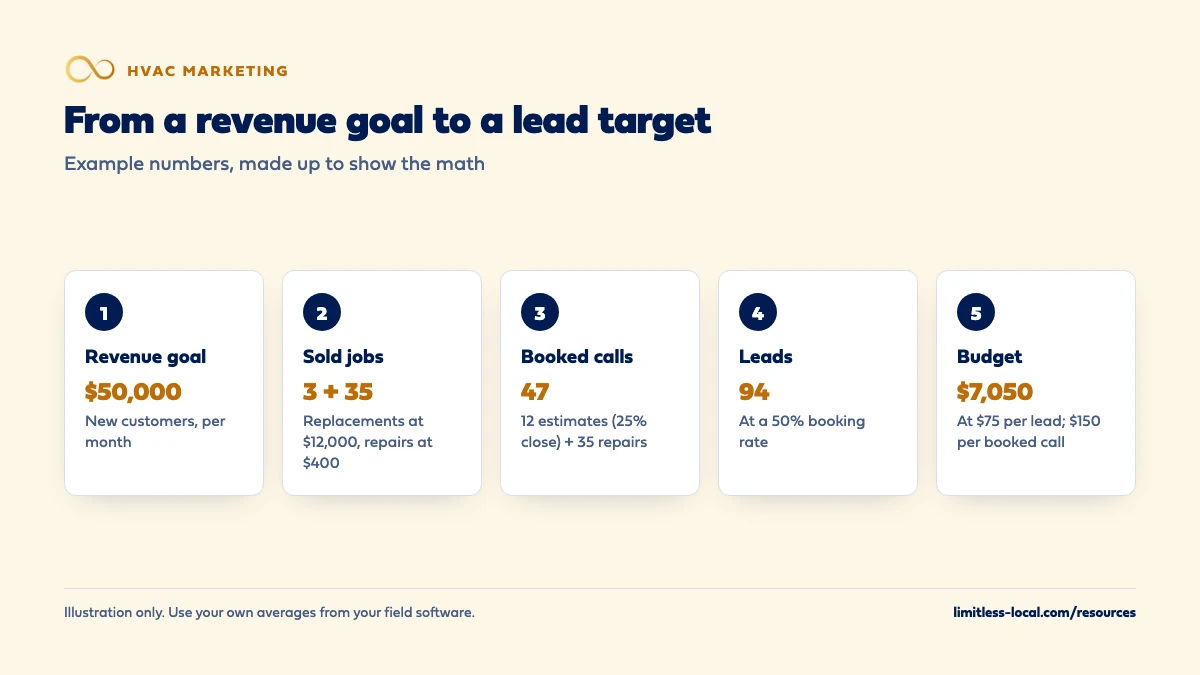
These numbers are made up to show the math, not a benchmark for your market. Say an HVAC company wants $50,000 a month from new customers, after taking out maintenance agreements and repeat business.
- Split the goal. $36,000 from replacements and $14,000 from repairs.
- Sold jobs. At an average replacement of $12,000, that’s 3 sold replacements. At an average repair ticket of $400, it’s 35 repair calls.
- Estimates. The company closes 25% of replacement estimates, so 3 sales take 12 booked estimates.
- Booked calls. 12 estimates plus 35 repair calls is 47 booked calls a month.
- Leads. The office books 50% of real leads, so 47 booked calls take 94 leads.
- Budget. At $75 per lead, 94 leads cost $7,050. That’s $150 per booked call, or about 14% of the new-customer revenue it’s meant to produce.
Now improve one input. If the office books 60% of leads instead of 50%, the same 47 booked calls take 79 leads, which cost $5,925 at the same price per lead: $1,125 a month less for the same work on the schedule. That’s why booking rate is usually the first lever to pull.
If you work with an agency, add its fee to the spend before you judge the result; our packages start at $3,500 a month with ad spend paid separately.
Frequently asked questions
What's a normal booking rate for an HVAC office?
There’s no single number we’d stand behind for every market. Measure your own from call recordings and your field software, and work on raising it before you buy more leads.
Should I count maintenance agreement visits in the goal?
Leave them out of the part marketing has to produce. They’re revenue you’d earn without new marketing, so subtract them first and plan marketing around what’s left.
What if I don't know my close rate on replacements?
Use a cautious guess for a month or two while you start tracking estimates booked and sold by lead source, then replace the guess with your real rate.
Does this work for Local Services Ads too?
Yes. Local Services Ads charge per lead, so you can plug their cost per lead straight into the last step, keeping in mind that Google says lead prices vary by location, job type and lead type.
Is cost per booked call the same as cost per booked job?
On this page, yes: a booked call is an appointment on the calendar. For replacements, also track cost per sold job, because a booked estimate isn’t a sale.
How do I know if the budget the math gives me is too high?
Compare cost per booked job with what an average job brings in after the cost of doing it. If marketing eats most of that margin, change an input, such as booking rate or average ticket, before you spend more.
Key takeaways
- Start from the monthly revenue marketing has to produce, not from a budget.
- Run repairs and replacements separately, and divide replacement sales by your close rate to get estimates.
- Booked calls divided by booking rate gives you the leads you need; leads times cost per lead gives the budget.
- Raising your booking rate is usually cheaper than buying more leads.
- Check crew capacity and redo the math each month and before each season.
Want a second set of eyes on your setup?
We'll look at how you show up locally and where calls are leaking, then send you a plain-English breakdown.
More in this section
- What percentage of calls should my HVAC office be booking?
- How do I keep HVAC calls coming in during slow months?
- How long does it take an HVAC lead to turn into a booked job?
- How long does HVAC SEO take to bring in calls?
- How fast should an HVAC company respond to new leads?
Sources
- Plan your business — U.S. Small Business Administration
- Lead Source Report — Jobber Help Center
- How to Use Lead Sources — Housecall Pro Help Center
- Add marketing campaigns in ServiceTitan — ServiceTitan Help
- About Keyword Planner forecasts — Google Ads Help
- About conversion values — Google Ads Help
- How leads work — Google Local Services Help