
Which HVAC marketing work should I outsource or keep in-house?

- Which HVAC marketing jobs should my own team do, and which should I hand off?
- How should I decide which marketing work to keep and which to hand off?
- What should stay in-house no matter what?
- Should the office answer calls, or should I use an outside service?
- Should I outsource reviews and review replies?
- Can I run my own Google Business Profile?
- Should I run Google Ads myself or outsource it?
- Can I do SEO in-house?
- Should my website be built in-house?
- Who should set up call tracking and reporting?
- What does an in-house marketer cost compared with an agency?
- When does a mix of in-house and outsourced work make sense?
- What's different about splitting marketing work at an HVAC company
- A worked example: splitting the work at a four-truck HVAC company
- Frequently asked questions
- Key takeaways
- More in this section
- Sources
The short version
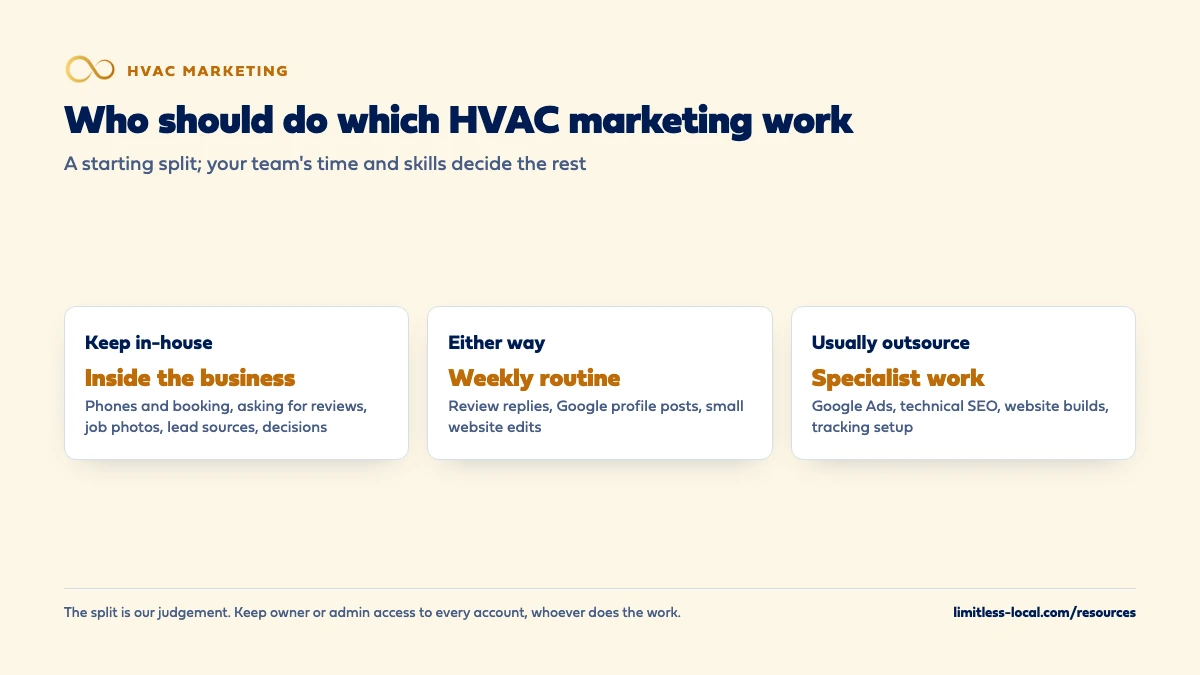
- Keep in-house: phones and booking, asking for reviews, job photos, lead sources and the big decisions.
- Usually outsource: Google Ads, technical SEO, website builds and tracking setup.
- Either way: review replies, profile posts and small site edits, if someone will do them every week.
- Whatever you hand off, keep owner or admin access to every account.
For HVAC owners splitting marketing work between the office, the techs and an outside agency or freelancer, one task at a time.
Get a free visibility audit · Book a growth call
Which HVAC marketing jobs should my own team do, and which should I hand off?
Keep in-house the marketing work that depends on being inside your business every day: answering and booking calls, asking every customer for a review, taking job photos, and the decisions about budget, towns and which jobs to chase. Outsource the work that needs specialist skills, paid tools or constant attention, such as running Google Ads, technical SEO, website builds and call tracking setup, while you keep owner-level access to every account. Review replies, Google profile posts and small website edits can go either way, depending on whether someone in your office will really do them every week.
That split is close to how our marketing packages are built: we take the specialist work (Google Ads, local SEO, Google profile management, tracking and reporting), and the jobs only your business can do, like booking calls during the day and the tech’s review ask at the end of a job, stay with your team. The HVAC marketing page shows what that covers for HVAC companies, the guide to hiring an HVAC marketing agency covers choosing one, and the rest of the HVAC marketing questions library goes question by question.
How should I decide which marketing work to keep and which to hand off?
In our judgement, three questions sort almost every task:
- Does it need someone inside the business? Asking a customer for a review at the end of a job, or booking a no-cool call, can’t be done well from outside.
- Does it need specialist skill or paid tools? Ad accounts, website code and tracking setups punish mistakes, and people who do them all day make fewer.
- Does it have to happen every week, without fail? If nobody in your office has the time, a task that’s easy on paper still won’t get done in July.
Whatever you hand off, one job never leaves: deciding what the marketing is for. Which towns, which jobs, how much to spend and when to pull back are owner decisions. How much time an HVAC owner should spend on marketing covers what that takes each week.
What should stay in-house no matter what?
In our judgement, these belong to your own team, even if you hire out everything else:
- Answering and booking calls. Every dollar of marketing ends at the phone.
- Asking for reviews. The tech who just fixed the system is the best person to ask. Google suggests asking customers to visit a Google link or scan a QR code, and it prohibits offering incentives in exchange for reviews.
- Job photos. Real photos of your crews and work come from the field.
- Lead sources. Someone in the office has to mark where each customer came from in your field software, such as ServiceTitan, Housecall Pro or Jobber.
- Ownership. Your Google Business Profile, Google Ads account, website domain and tracking numbers should be in your name.
Should the office answer calls, or should I use an outside service?
During business hours, in our judgement, your own office should answer. Your people know the service area, the schedule and the price of a diagnostic, and they can book the job on the first call. An outside service is more useful after hours and during overflow, when the alternative is voicemail on a 100-degree night.
If you use one, give it the same rules your office uses: which jobs you take, which towns you cover and how emergencies get dispatched. How an HVAC office should handle incoming calls covers the scripts and the booking steps.
Should I outsource reviews and review replies?
Split them. Asking stays with your techs and office, because the request lands best right after the job. Replying can go either way. Google’s tips for replies are to keep them short, professional and polite, and to focus on reviews where you can share a helpful update or answer a question instead of sending the same thank-you to everyone. For negative reviews, it adds: personalize the reply and respond in a timely manner.
An office manager can do that in a few minutes a week. If nobody will, it’s a reasonable task to hand off, as long as whoever writes the replies knows not to share a customer’s private information and knows when to pass a bad review back to you. How to get HVAC techs to ask for Google reviews covers the asking side.
Can I run my own Google Business Profile?
Yes, and many owners should do at least part of it. Google’s profile roles make a split easy. As the owner, you have full control: you can add or remove users, manage profile info and delete the profile. Managers have mostly the same access, except they can’t add or remove users or remove the profile.
That means you can make an agency or a freelancer a manager for weekly posts, photos and updates while you stay the owner. In our judgement, the in-house part of the profile is the raw material: photos from jobs, accurate hours, and new services as you add them. The outsourced part, if any, is the routine: posting, checking for edits Google made, and keeping categories and services tidy.
Curious what your marketing is actually booking?
Get a free visibility audit — no obligation, no sales pitch.
Should I run Google Ads myself or outsource it?
In our judgement, Google Ads is the task most worth outsourcing for most HVAC companies, for two reasons. It spends your money every day whether or not anyone is watching, and the settings that waste it, like broad targeting, the wrong service areas or untracked calls, aren’t obvious from the dashboard. Running it well takes regular hours, not a monthly glance.
If you outsource it, keep admin access in your own name. Google’s help on access levels warns that if an account has only one administrator, you may lose access to your tags if that person becomes unavailable, and that adding at least one more administrator may help. What to look for in an HVAC marketing agency contract covers account ownership in writing.
Can I do SEO in-house?
Much of it, according to Google. Its page on hiring an SEO says that if you run a small local business, you can probably do much of the work yourself, and recommends starting with its SEO starter guide. It also says hiring a professional can save you time and potentially improve your site’s visibility, but that an irresponsible SEO can damage your site and reputation, and that a great time to hire is when you’re considering a site redesign or planning to launch a new site.
In our judgement, the in-house parts are writing about the jobs you know (service pages in the words your customers use) and earning links from suppliers and local groups you already deal with. The parts worth outsourcing are technical: site speed, how pages are built and linked, and fixing what Search Console flags. What you can do yourself to improve your HVAC company’s Google ranking lays out the do-it-yourself list.
Should my website be built in-house?
In our judgement, build it with a professional and maintain it in-house. A website build is a one-time project that needs design, code and setup skills most HVAC offices don’t have, while day-to-day changes, like new photos, a seasonal offer or updated hours, are small enough for anyone with a login.
Two things to settle before anyone starts: the domain is registered to your company, and you get an admin login to the site itself, not just a promise that the builder will make changes for you.

Who should set up call tracking and reporting?
Setup is worth outsourcing, in our judgement, because it’s technical and a mistake can put the wrong phone number on your listings or credit calls to the wrong source. Reading the numbers isn’t. Once tracking works, the monthly look at calls, booked jobs and cost per booked job by source is an owner’s job, even if someone else builds the report.
The test of any report, from your office or an agency, is whether it ties marketing to booked jobs. A report that stops at clicks and calls is only half the picture.
What does an in-house marketer cost compared with an agency?
For a rough national reference, the Bureau of Labor Statistics puts the median annual wage for market research analysts, the occupation group that includes marketing specialists, at $78,760 in May 2025. That’s across all industries in the U.S., not an HVAC figure, and pay in your area may be higher or lower.
Wages aren’t the whole cost. For full-time private industry workers, BLS found that wages and salaries accounted for 68.5 percent of employer compensation costs in June 2026, with benefits making up the remaining 31.5 percent. If benefits made up the same share for this job, which is our assumption, a hire at that median would cost roughly $115,000 a year. Software, ad spend and training come on top.
In our judgement, the bigger question is coverage: one person rarely does Google Ads, SEO, website work and tracking equally well. An in-house marketer tends to make sense once there’s enough coordination work to fill the job, often alongside an agency rather than instead of one.
When does a mix of in-house and outsourced work make sense?
For most HVAC companies, in our judgement, the mix is the answer, and it shifts as you grow. A one- or two-truck shop keeps the phones, reviews and photos and outsources nearly everything technical. A larger company often adds an in-house marketing coordinator who owns the calendar, the photos, review replies and the relationship with outside specialists.
What shouldn’t change is who owns the accounts and who makes the decisions. How HVAC marketing changes once you have 10 or more trucks covers that later stage.
Not sure which of these is costing you jobs?
A free visibility audit checks the Google profile, reviews, site and tracking, and shows what to fix first.
What's different about splitting marketing work at an HVAC company
Heat waves don’t wait for a monthly meeting. Whoever runs your ads, in-house or outsourced, needs to be able to change budgets the same day the forecast turns. Put that response time in writing if you outsource.
Your techs are your best marketing staff. They take the photos, ask for the reviews and hear what customers ask for. In our judgement, that work stays in-house at any size; build it into the end-of-job routine.
Maintenance plans are an in-house asset. Tune-up reminders and plan renewals run off your customer list and field software. They’re marketing, but the data lives with you.
A worked example: splitting the work at a four-truck HVAC company
This split is made up to show the idea. It isn’t a rule, and your own team’s time and skills should decide it.
- Techs: ask for a review at the end of each job, send the Google link, take before-and-after photos.
- Office manager: answers and books calls, marks the lead source on every job, replies to reviews twice a week, uploads photos to the Google profile.
- Owner: a monthly review of booked jobs and cost per booked job by source, and the seasonal budget call before summer and winter.
- Outsourced: Google Ads and Local Services Ads, SEO pages and links, call tracking setup and the monthly report.
For comparison, our Growth package is $4,500 a month, or $54,000 a year, and includes Local Services Ads management, Google Ads management up to $5,000 a month in spend, SEO for up to two locations and a dedicated account manager. Ad spend is paid to Google separately. Against the rough $115,000 a year for an in-house hire at the national median above, the question isn’t only price; it’s whether one hire would cover all of that work.
Frequently asked questions
Can I outsource marketing and still keep control?
Yes, if the accounts are in your name. Stay the owner of your Google Business Profile and keep admin access to Google Ads, your website and your tracking, and give the agency manager or standard access to do the work.
Is a freelancer a good middle ground?
It can be for one task, like a website build or a Google Ads setup. In our judgement, freelancers are harder to rely on for work that has to happen every week through peak season, so plan for cover when they’re away.
Should I pay an agency fee or put that money into ads?
It depends on whether more ad spend would be managed well. Whether to pay an HVAC agency fee or spend more on ads works through that trade-off.
Can my office manager handle all the marketing?
Usually not all of it, in our judgement. An office manager can own the routine work, like review replies, photos and lead sources, but Google Ads and technical SEO need hours and skills on top of running the office.
What should I hand off first?
In our judgement, the work that costs you the most when it’s done badly, which for most HVAC companies is Google Ads, because it spends money every day.
Key takeaways
- Keep phones, booking, review requests, job photos, lead sources and the big decisions in-house.
- Outsource the specialist work that punishes mistakes: Google Ads, technical SEO, website builds and tracking setup.
- Review replies, profile posts and small site edits go to whoever will really do them every week.
- Stay the owner or admin of every account, whoever does the work.
- An in-house hire costs more than a salary, and one person rarely covers every skill.
Want a second set of eyes on your setup?
We'll look at how you show up locally and where calls are leaking, then send you a plain-English breakdown.
More in this section
- What should I do with the marketing after buying an HVAC business?
- Which HVAC services should I advertise first?
- What should I look for in an HVAC marketing agency contract?
- Should I market more before or after hiring another HVAC tech?
- How much time should an HVAC owner spend on marketing each week?
Sources
- Do you need an SEO? — Google Search Central
- Manage your Business Profile owners & managers — Google Business Profile Help
- Tips to get more reviews — Google Business Profile Help
- About access levels in your Google Ads account — Google Ads Help
- Market Research Analysts (Occupational Outlook Handbook) — U.S. Bureau of Labor Statistics
- Employer Costs for Employee Compensation Summary — U.S. Bureau of Labor Statistics