
What can I do myself to improve my HVAC company’s Google ranking?

- What SEO can an HVAC owner do without hiring anyone?
- Can I really improve my HVAC company's ranking without hiring anyone?
- Step 1: How do I check where my HVAC company ranks right now?
- Step 2: What should I fix on my Google Business Profile?
- Step 3: How do I get more Google reviews without paying for a program?
- Step 4: How do I make sure Google can find my website's pages?
- Step 5: What pages should I write, and how?
- Step 6: What should my page titles and descriptions say?
- Step 7: How do I get other websites to link to my company?
- What can I skip when I'm doing SEO myself?
- How do I know whether my changes are working?
- When does doing SEO myself stop making sense?
- What's different about DIY SEO for HVAC companies
- A worked example: a weekly DIY SEO routine
- Frequently asked questions
- Key takeaways
- More in this section
- Sources
The short version
- Finish and verify your Google Business Profile first; it's what shows up in Maps and the map pack.
- Make asking for reviews part of every job, and reply to them.
- Give each main service its own page with a clear title, in homeowner words.
- Use free Search Console and Business Profile reports to see what's working.
For HVAC owners who’d rather put in a few hours a week than pay for SEO yet, and want to know which jobs matter and which free Google tools to use.
Get a free visibility audit · Book a growth call
What SEO can an HVAC owner do without hiring anyone?
Quite a lot: verify and complete your Google Business Profile, get reviews from every job and reply to them, give each main service its own page in the words homeowners use, and set up Google Search Console to check that Google can find those pages. Then earn a few links from local businesses and groups you already work with, and keep pages up to date. Google says a small local business can probably do much of this work itself, and both Search Console and a Business Profile cost nothing.
This is the same groundwork we do for HVAC companies, done in the order that gets closest to calls. If you’d rather hand it off, our local SEO service covers the profile, pages, reviews and links for HVAC companies. If you’re weighing doing it yourself against hiring someone, whether to hire a marketing agency walks through that decision, and the rest of the HVAC marketing questions library goes question by question.
Can I really improve my HVAC company's ranking without hiring anyone?
Yes. Google’s own guide to hiring an SEO says that if you run a small local business, you can probably do much of the work yourself, and it points to its SEO Starter Guide as the place to begin. It adds that even if you hire someone later, knowing the basics helps you spot a technique that isn’t recommended.
Two things you can’t do, no matter who does the work: pay Google for a better spot, or skip the wait. Google says it never accepts money to include or rank sites in its organic results, and that there’s no way to request or pay for a better local ranking. The Starter Guide also says some changes take effect in a few hours and others take several months. Doing it yourself saves money, not time.
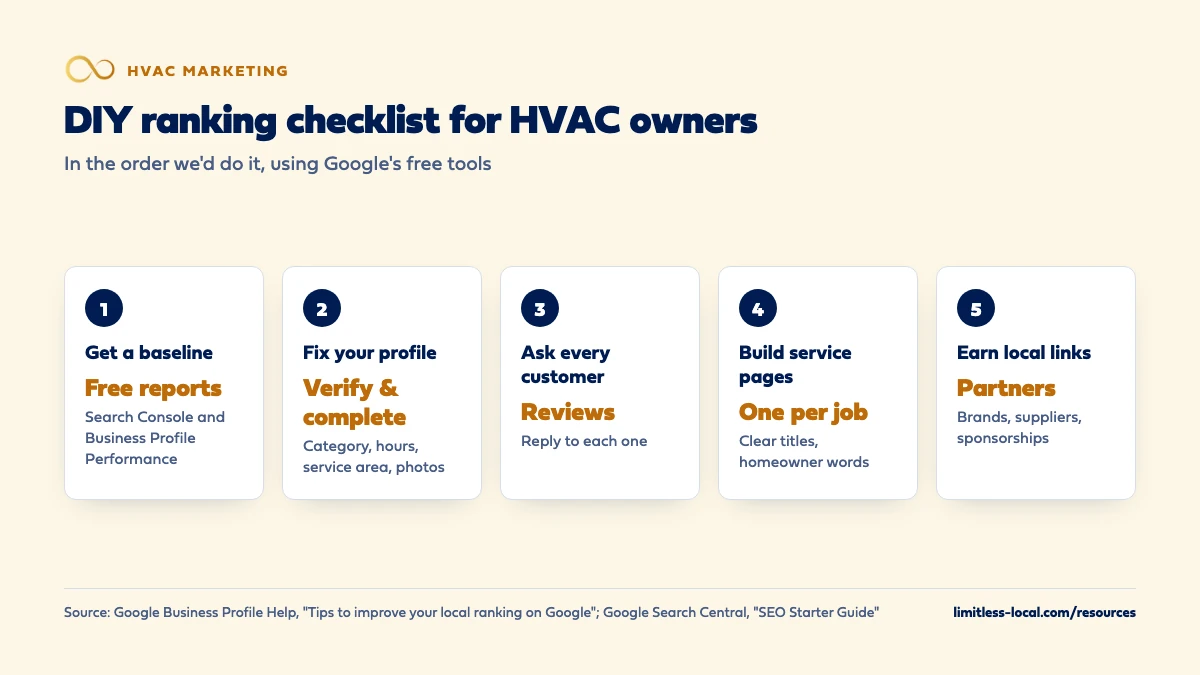
The steps below are in the order we’d do them for a typical HVAC shop. Sources: Do you need an SEO?, Tips to improve your local ranking on Google and SEO Starter Guide.
Step 1: How do I check where my HVAC company ranks right now?
Not by searching from your own office. Google’s Search Console help notes that results are specific to the time, place, device and recent history of the person searching, so what you see at your desk isn’t what a homeowner across town sees.
Better ways to get a baseline, all free:
- Your Business Profile’s Performance report shows calls from the call button, website clicks, views and the search terms people used to find you. It includes interactions from Google Ads as well as organic search, so separate them if you run ads.
- Search Console’s Performance report shows clicks, impressions, click-through rate and average position for your website, and which search queries bring people in. It shows the last three months by default.
- Searches from the towns you want. Ask a few customers there what comes up.
Write the numbers down before you change anything. If a particular competitor keeps beating you, why other HVAC companies rank above you shows how to compare yourself line by line. Sources: Performance report (Search results) and Understand your Business Profile performance.
Step 2: What should I fix on my Google Business Profile?
Start here, because your profile is what shows up in Google Maps and the map pack. Google’s tips for local ranking come down to a short list:
- Verify the business. Google says this tells it you’re authorized to represent the business, so it’s more likely to show up in results.
- Complete and correct the details. Address or service area, hours and category. Google says businesses with complete and accurate info are more likely to show up, and inaccurate info can keep you out of relevant searches.
- Reply to reviews. Google says it shows you value feedback.
- Add photos and videos of your real crews, trucks and work.
Google sums up local ranking as mainly relevance, distance and popularity, and it explains the last one as prominence: how well-known a business is. You control relevance through your profile details and prominence through reviews and links; distance from the searcher you can’t change. The detailed version, from picking a primary category to setting a service area, is in optimizing your HVAC Google profile. Source: Tips to improve your local ranking on Google.
Step 3: How do I get more Google reviews without paying for a program?
Make asking part of closing out every job. Google says prominence is based partly on how many reviews you have, and that more reviews and positive ratings can help your local ranking. In our judgement, the steady pace matters more than a one-time push: a company that asks after every job keeps adding reviews all year.
Doing it yourself takes three things: a review link your techs can text or hand over, the same short ask from every tech, and someone in the office who replies to new reviews each week. Keep it within Google’s rules for Maps reviews, which don’t allow offering incentives for reviews or selectively asking only happy customers. The script, the timing and how to make it stick with a crew are covered in getting your techs to ask for reviews. Source: Tips to improve your local ranking on Google.
Step 4: How do I make sure Google can find my website's pages?
Set up Google Search Console. It’s a free service from Google that helps you monitor, maintain and troubleshoot how your site shows up in search. Google says it can confirm that Google can find and crawl your site, help you fix indexing problems and request re-indexing of new or updated pages, show which queries bring people to your site, alert you to spam or other issues, and show which sites link to you.
A quick first check from the Starter Guide: search Google for site: followed by your domain. If your pages show up, you’re in Google’s index. If they don’t, the guide points you to Google’s technical requirements to look for anything blocking your site.
You don’t need Search Console to show up in Google, but it’s where Google tells you directly what it sees. Sources: About Search Console and SEO Starter Guide.
Curious what your marketing is actually booking?
Get a free visibility audit — no obligation, no sales pitch.
Step 5: What pages should I write, and how?
One page for each main service you want more of: AC repair, AC replacement, furnace repair, furnace installation, heat pumps, maintenance plans. Then make each one worth reading. Google’s Starter Guide says creating content people find compelling and useful will likely influence your presence in search more than any of its other suggestions.
For an HVAC service page, in our judgement, that means:
- Homeowner words. The Starter Guide notes people new to a topic search differently from experts. Write “AC not cooling”, not “low refrigerant charge”.
- Your own detail. The towns you cover, how fast you can come, the brands you service, real photos of real jobs. The guide warns against copying others’ content.
- A clear next step. Your phone number and a short form on every page.
There’s no word count to hit; the Starter Guide says length alone doesn’t matter for ranking. Which pages a site needs is covered in more depth in getting HVAC service pages to rank. Source: SEO Starter Guide.
Step 6: What should my page titles and descriptions say?
What the page is about and where you do it. Google’s Starter Guide says a good title is unique to the page, clear and concise, and accurately describes the contents, and it suggests a title could include your business name, its location and what that page offers. “Furnace Repair in [Town] | [Your Company]” says all three. “Home” or “Services” says none.
The snippet under the title is usually drawn from the page itself, and sometimes from the meta description, which the guide describes as a short, unique summary of the page. Most website builders have a field for both, and filling them in is one of the quickest jobs on this list. Source: SEO Starter Guide.
Step 7: How do I get other websites to link to my company?
From the people you already do business with. Google says prominence in local results is also based on how many websites link to your business, and its Starter Guide says Google primarily finds pages through links from other pages. For an HVAC company, the natural sources are the equipment brands you’re a dealer for, your supply houses, trade associations, your chamber of commerce and the teams or events you sponsor.
Ask each of them to list your company with a link to your site. Don’t buy links or trade them in bulk; the Starter Guide warns that overdoing promotion can look like manipulation of search results. The full list of local sources, and the offers to avoid, is in how an HVAC company earns backlinks. Sources: Tips to improve your local ranking on Google and SEO Starter Guide.
What can I skip when I'm doing SEO myself?
More than most checklists suggest. Google’s Starter Guide lists things it believes you shouldn’t focus on, and several come up in HVAC sales pitches:
- Meta keywords. Google Search doesn’t use the keywords meta tag.
- Keyword stuffing. Repeating the same words over and over is against Google’s spam policies.
- Keywords in your domain. The guide says they have hardly any ranking effect beyond appearing in breadcrumbs.
- Word counts and heading counts. No magical target for either.
- E-E-A-T as a ranking factor. The guide says plainly that it isn’t one.
Google’s guide to its generative AI features adds a few more you can ignore for Google Search: llms.txt files and other special AI markup, breaking content into small “chunks”, and rewriting pages just for AI systems. And be careful with paid tools that look official. Google says it doesn’t evaluate third-party services, that third-party tools don’t have access to its internal ranking data, and that their predictions are their own. Sources: SEO Starter Guide, Optimizing for generative AI features on Google Search and Guidance on third-party SEO tools, services, and advice.
How do I know whether my changes are working?
Give each change a few weeks; the Starter Guide suggests waiting that long before judging whether your work had an effect. Then look at three things, in this order:
- Search Console. Rising impressions and better average position for searches like “furnace repair” plus your town come first.
- Business Profile performance. Calls from the call button, website clicks and the search terms that found you. Google notes the searches figure updates at the start of each month and can take up to 5 days to show.
- Booked jobs. Ask every caller how they found you, or use a tracking number on your website, and write it on the job.
The last one is the only one that pays the bills. Rankings that move without more booked jobs mean you’re showing up for the wrong searches or losing callers on the phone. Sources: SEO Starter Guide, Performance report (Search results) and Understand your Business Profile performance.
When does doing SEO myself stop making sense?
In our judgement, when one of these is true:
- The hours aren’t happening. A plan that needs two hours a week and gets none is costing you more than it looks.
- The basics are done and you’ve stalled. Your profile is complete, reviews are steady, the service pages exist, and the competitors above you still have more of everything.
- The site’s technical side is in the way. Pages that won’t index, a slow site or a rebuild coming. Google itself says a redesign or new site is a great time to bring in an SEO, the earlier the better.
SEO also isn’t quick: in our experience it typically takes 3 to 6 months to show meaningful organic growth, while ads can bring calls within days. If you need calls sooner, whether SEO is worth it for a small HVAC company covers how to weigh the two. Source: Do you need an SEO?.
Not sure which of these is costing you jobs?
A free visibility audit checks the Google profile, reviews, site and tracking, and shows what to fix first.
What's different about DIY SEO for HVAC companies
Do the work before the season, not during it. Search changes can take weeks or months to show, so service pages and profile updates for cooling belong in late winter and spring, and heating work in late summer. When you check results, compare against the same month last year, because the weather moves HVAC searches more than anything you change.
Win near the shop first. Emergency calls go to whoever is close and easy to reach. Since Google weighs the searcher’s distance, in our judgement the towns closest to your base are where DIY work pays off first.
Repairs and replacements are different searches. Someone with a dead AC wants a company that can come today; someone pricing a new system wants options and financing. Give each its own page so Google has something to match each search to.
A worked example: a weekly DIY SEO routine
These times are made up to show the shape of a routine, not a requirement. Say you set aside two hours a week:
- 20 minutes: reply to the week’s new reviews and check every tech is still asking.
- 60 minutes: write or improve one service page.
- 20 minutes: add photos from the week’s jobs to your Business Profile.
- 20 minutes: check Search Console and your profile’s Performance report, and write down the numbers.
That’s 20 + 60 + 20 + 20 = 120 minutes. At one page a week, five service pages take five weeks, and a once-a-season check for expired coupons and old prices fits in the same slot. Links come in between, whenever you renew a membership or sign a sponsorship.
If those two hours keep losing to the schedule, that’s when outside help is worth pricing. Our Essentials package is $3,500 a month and covers Google Business Profile management, a content sprint of up to 10 pages, link building and review response, with ad spend paid separately if you run ads. Onboarding takes your team about 2-3 hours. We don’t guarantee rankings, because nobody honestly can; whether it pencils out is what a free visibility audit is for.
Frequently asked questions
Does running Google Ads help my organic ranking?
No. Google says advertising with it won’t have any effect on your site’s presence in its search results, and it never accepts money to include or rank sites in them.
Do I need to pay for SEO tools to do this myself?
Not to start. Search Console and your Business Profile’s performance reports are free. Google notes that third-party tools don’t have access to its internal ranking data, so treat their scores as estimates.
Do I need a new website before I start?
Usually not. Google’s Starter Guide says search engines will likely understand your pages as they are, so don’t drop everything to reorganize. If a rebuild is already planned, do the SEO work as part of it.
Can I get penalized for doing something wrong?
Honest mistakes like duplicate pages aren’t a spam violation, according to Google’s Starter Guide. Problems come from practices meant to manipulate search, such as keyword stuffing, which the guide notes is against Google’s spam policies.
How often should I check my rankings?
In our judgement, once a month is enough for most HVAC shops. Google suggests waiting a few weeks before judging any change, and daily checks mostly show normal ups and downs.
Key takeaways
- Google says a small local business can probably do much of its own SEO; nobody can pay Google for a better ranking.
- Start with a verified, complete Business Profile and a steady flow of reviews you reply to.
- Give each main service its own page with a clear, unique title in homeowner words.
- Use free Search Console and Business Profile reports for a baseline, then judge changes after a few weeks.
- Skip meta keywords, word-count targets, keyword domains and AI-only markup; they aren’t worth the hours.
Want a second set of eyes on your setup?
We'll look at how you show up locally and where calls are leaking, then send you a plain-English breakdown.
More in this section
- Why are other HVAC companies ranking above me on Google?
- How do I optimize my HVAC Google Business Profile for more calls?
- How do I get my HVAC company back into the Google Map Pack?
- How do I make my HVAC company look trustworthy online?
- How do I get HVAC service pages to rank for repair and install?
Sources
- Do you need an SEO? — Google Search Central
- Tips to improve your local ranking on Google — Google Business Profile Help
- Search Engine Optimization (SEO) Starter Guide — Google Search Central
- About Search Console — Search Console Help
- Performance report (Search results): Overview and basic setup — Search Console Help
- Understand your Business Profile performance & insights — Google Business Profile Help
- Google's guide to optimizing for generative AI features on Google Search — Google Search Central
- Google Search's guidance on using third-party SEO tools, services, and advice — Google Search Central