
Why are other HVAC companies ranking above me on Google?
- Why does another HVAC company outrank mine in Google Maps and search?
- Are they beating me in Maps, the regular results or the ads?
- Am I really ranking lower, or searching from the wrong spot?
- Mistake: a profile that doesn't match the search
- Mistake: falling behind on reviews
- Mistake: few other websites linking to you
- Mistake: one page trying to cover every service
- Mistake: thin town pages copied from one template
- Mistake: a site that's slow or awkward on a phone
- Does the competitor have "HVAC" and my city in their name or domain?
- What can I do if a competitor is breaking Google's rules?
- How do I compare my company with the one above me?
- What's different for HVAC companies
- A worked example: measuring a review gap
- Frequently asked questions
- Key takeaways
- More in this section
- Sources
The short version
- Maps, the regular results and ads rank by different rules, so first work out where they beat you.
- In Maps it comes down to relevance, distance and popularity; reviews and links feed popularity.
- In the regular results, a dedicated page for the job and links from trusted sites matter.
- Nobody can pay Google for a better ranking, and a rule-breaking competitor can be reported.
For HVAC owners who keep seeing the same competitor above them on Google and want to know what that company has that they don’t.
Get a free visibility audit · Book a growth call
Why does another HVAC company outrank mine in Google Maps and search?
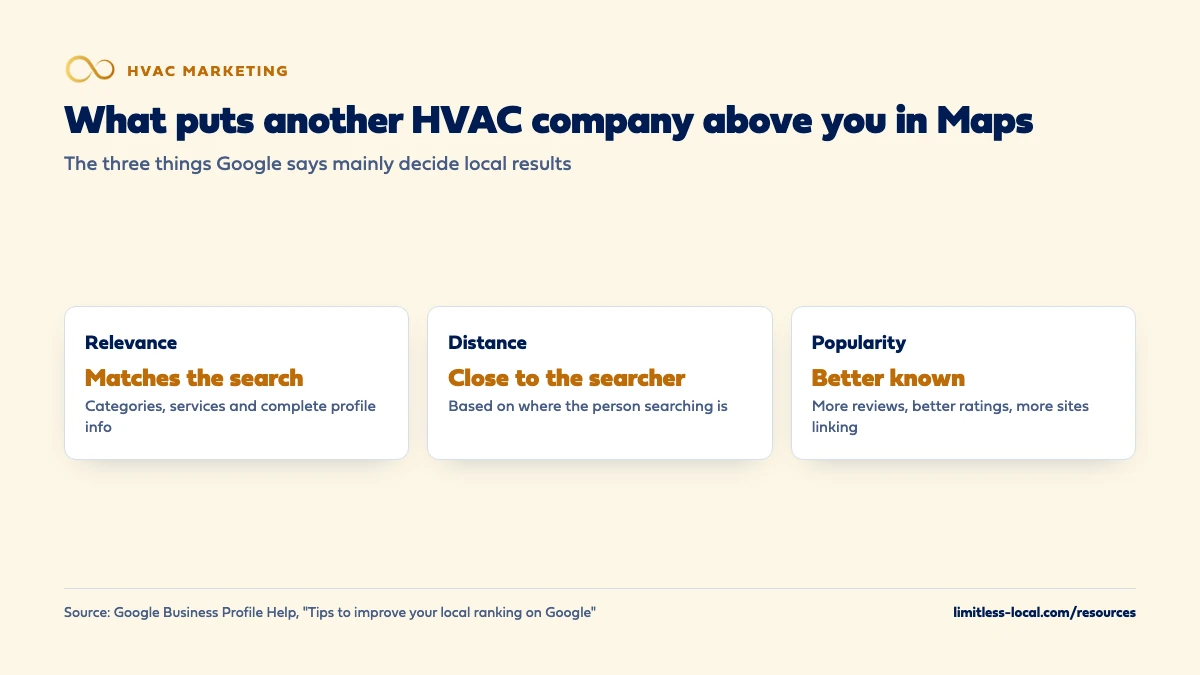
Usually because the other company’s profile or pages match the search better, it’s closer to the person searching, or it’s better known, with more reviews and more websites linking to it. Google says those three things, relevance, distance and popularity, mainly decide local results, and its regular results also weigh how relevant, useful and easy to use each page is. Compare yourself on the exact search and town where you’re losing, fix the gaps you control, and report a competitor only if they’re actually breaking Google’s rules.
Closing a ranking gap is mostly steady work on the parts you control, and that’s what our local SEO service does for HVAC companies: profile management, service and town pages, review generation and link building, reported in calls and booked jobs. For how Maps fits with ads and your website, see the HVAC marketing guide, and the HVAC marketing questions library takes the rest one question at a time.
Are they beating me in Maps, the regular results or the ads?
Start by pinning down where the other company shows up above you, because Google ranks these three places in different ways.
- The ads at the top are labeled “Sponsored” or “Ad”. That company is paying for the spot. Google says the regular results are not influenced by whether a business buys ads, and that nobody can pay to rank higher in them.
- The Maps results (the map pack) come from Business Profiles. Google says they’re mainly based on relevance, distance and popularity.
- The regular results below are websites. Google says its systems look at the meaning of the search, the relevance and quality of each page, its usability, and the searcher’s context, such as location.
A competitor can be above you in one place and below you in another. If it’s only the ads, checking how competitive your area is is a better use of your time than reworking your profile. Sources: How Google determines ranking results and Tips to improve your local ranking on Google.
Am I really ranking lower, or searching from the wrong spot?
Check this before anything else. Google says it uses information such as your location, past search history and search settings to decide what’s most relevant to you, and that it can recognize when you’ve visited a page several times and move it up. For local searches, it uses where the searcher is: if a customer doesn’t share their location, Google uses what it knows about it.
So a search from your shop, on your own phone, is a poor test. The homeowner searching “AC repair” fifteen miles away sees a different map, centered on them. In our judgement, the useful check is to search the jobs you want from the towns you want, or ask a few customers in those towns what they see. If the competitor is only ahead near their own shop, that’s distance, and it isn’t something you can fix with profile edits. Sources: How Google determines ranking results and Tips to improve your local ranking on Google.
Mistake: a profile that doesn't match the search
Relevance is how well your Business Profile matches what someone searched, and Google says complete, detailed information helps it match you. It also says a profile with inaccurate information might not show up for relevant searches in your area. If the company above you lists heat pump installation as a service and you don’t, they have a better match for “heat pump installer” even if you do more of that work than they do.
The fixes are categories, services, service area, hours and description, and they’re covered step by step in optimizing your HVAC Google profile. Look at the competitor’s profile side by side with yours and note what they list that you leave out. Source: Tips to improve your local ranking on Google.
Mistake: falling behind on reviews
Popularity is how well-known a business is, and Google says it’s based partly on how many reviews you have, and that more reviews and positive ratings can help your local ranking. Google also says replying to reviews shows you value feedback.
The gap that matters is usually the pace, not this month’s total. A company that asks after every job adds reviews every week; one that asks when it remembers falls further behind each season. Count both: how many reviews each of you has, and how many each added in the last few months. If they’re adding them faster, that gap grows until you change how your crews ask. How much reviews affect HVAC calls goes into what reviews do beyond ranking. Source: Tips to improve your local ranking on Google.
Mistake: few other websites linking to you
Links are the other half of popularity. Google says popularity is also based on how many websites link to your business, and for the regular results, it says one factor in judging quality is whether other prominent websites link to the content. Its ranking systems guide says it uses link analysis systems to work out what pages are about, and that PageRank, one of them, is still part of its core ranking systems. Google’s Starter Guide adds that it mainly finds pages through links from pages it has already crawled.
For an HVAC company, the natural sources are local and real: the manufacturers and distributors you’re a dealer for, the trade associations you belong to, the teams and events you sponsor, and local news that covers your work. An established competitor may have collected those for years. What doesn’t work is buying them: Google’s spam policies list buying or selling links for ranking, excessive link swaps and automated link building as link spam. Sources: How Google determines ranking results, A guide to Google Search ranking systems, SEO Starter Guide and Spam policies for Google web search.
Curious what your marketing is actually booking?
Get a free visibility audit — no obligation, no sales pitch.
Mistake: one page trying to cover every service
In the regular results, Google says the most basic sign that a page is relevant is that it contains the same words as the search, for example in its headings or body text. Its systems also look for relevant content beyond the keyword itself. A single “Services” page that lists AC repair, furnace repair, heat pumps, ductwork and maintenance plans in one line each gives Google little to match against “furnace repair” plus your town.
If the company above you has a full page for each job, with what the job involves, the equipment you service, photos of the work and common questions, that page is the better match, and Google’s guidance on helpful content asks whether a page gives a substantial, complete description of its topic. Getting HVAC service pages to rank covers how to build them. Sources: How Google determines ranking results and Creating helpful, reliable, people-first content.
Mistake: thin town pages copied from one template
Plenty of HVAC sites try to rank in every nearby town with near-identical pages that swap out the city name. Google’s spam policies describe this pattern. Doorway abuse includes having multiple domains or pages targeted at specific regions or cities that funnel users to one page. Scaled content abuse is generating many pages mainly to manipulate rankings, with little value to the reader. Keyword stuffing includes blocks of text listing the cities and regions a page is trying to rank for.
If a competitor’s town pages actually describe their work in that town, and yours don’t, that’s a fair gap. If theirs are thin and still ranking, don’t copy them; that kind of shortcut carries the risk Google’s policies describe. Building HVAC city pages without looking like spam shows the difference. Source: Spam policies for Google web search.
Mistake: a site that's slow or awkward on a phone
Google says its systems consider the usability of content, and that when all other signals are relatively equal, content people find more accessible may perform better. It names mobile-friendly pages that load quickly as one example. Its helpful-content guidance says its core ranking systems look to reward pages that give a good overall page experience.
By Google’s own wording, this matters most when other signals are close. A fast site won’t outrank a better-matched, better-known competitor on its own. But a homeowner with no cooling is usually searching on a phone, and in our judgement a site that’s hard to use there loses the call even when it ranks. Sources: How Google determines ranking results and Creating helpful, reliable, people-first content.
Does the competitor have "HVAC" and my city in their name or domain?
On Google, a business name should be the real-world name used on signage, stationery and branding. Google says adding unnecessary information to the name isn’t permitted and could get a profile suspended. If a competitor has stuffed “AC Repair” and your city into a name that doesn’t match their trucks, they’re outside the guidelines.
For websites, Google says words in a domain name are one of many factors it considers, but its exact match domain system works so that a domain built to match a search doesn’t get too much credit. Buying a keyword domain is not the shortcut it looks like. Sources: Guidelines for representing your business on Google and A guide to Google Search ranking systems.
What can I do if a competitor is breaking Google's rules?
Google gives you ways to report it on Maps:
- Wrong information that isn’t about conduct, such as an address: use Suggest an edit on the listing.
- Misleading info that makes you think the business may not exist: Suggest an edit, then Place is closed or not here, then Offensive, harmful, or misleading.
- Misleading names, phone numbers or website addresses that look fraudulent: Google points to its Business Redressal Complaint form, and you can report several businesses at once.
- Paying or discounting for reviews: Google says reviews posted in exchange for a payment, deal or discount are prohibited, and you can report the business’s conduct from the Maps app.
Report what’s clearly against the rules, once, with specifics, then get back to your own profile. In our judgement, a report is never a substitute for closing the gaps you control, because a competitor who loses a stuffed name can still have more reviews and better pages than you. Source: Report a business on Google Maps.
How do I compare my company with the one above me?
Pick one search you’re losing, such as “AC repair” in a town you want, and write down both companies side by side:
- Where they beat you: ads, Maps or the regular results.
- Distance: whose shop is closer to that town.
- Relevance: categories and services on each profile, and whether each website has a page for that exact job.
- Popularity: review count, rating, and how many new reviews each added recently; local sites linking to each of you.
- Rules: anything on their profile that breaks Google’s guidelines.
Most of the time, one or two rows explain the gap. Work on those first. Getting back into the Map Pack covers the different case where your profile disappeared rather than slipped.
Not sure which of these is costing you jobs?
A free visibility audit checks the Google profile, reviews, site and tracking, and shows what to fix first.
What's different for HVAC companies
Emergency searches favor whoever is close. A homeowner with no heat wants someone nearby now, so distance does a lot of the work in Maps. In our judgement, a competitor based in the middle of a town will usually beat a shop based on the edge of it for searches made there, and the honest response is to win the towns near your base first.
Multi-location companies show up in more places, legitimately. Google allows one profile per location only when each location has its own staff and service area. A competitor with three staffed shops can appear in three sets of Maps results; a one-shop company can’t match that with extra profiles, and trying to would break the guidelines.
Heating and cooling are different searches. A competitor can lead for “AC repair” and trail you for “furnace repair” in the same town. Check both seasons’ searches before deciding who’s ahead.
A worked example: measuring a review gap
These numbers are made up to show the math, not a benchmark. Say the company above you in Maps has 212 Google reviews and you have 38. That’s a gap of 174. Over the last three months they added about 12 a month and you added about 3.
At those paces, the gap grows by 9 reviews a month. If you start asking after every job and reach 15 a month while they stay at 12, you close 3 a month, and the 174-review gap takes 58 months to close. That’s why review pace matters more than this month’s count, and why reviews are rarely the only lever: distance, relevance and links are often quicker places to gain ground.
Review response and review generation are included in our packages: basic review generation in Essentials at $3,500 a month, and advanced review generation in Growth at $4,500 a month, which also covers SEO for up to 2 locations. Neither comes with a promised ranking, because nobody can honestly promise one.
Frequently asked questions
Can I pay Google to rank above a competitor?
No. Google says there’s no way to request or pay for a better local ranking, and that nobody can pay to rank higher in its regular results. Ads appear in separate, labeled spots.
Does running Google Ads help my website rank higher?
Google says its regular search results aren’t influenced by whether a business buys ads, and that advertisers get no special treatment in how their websites rank. Ads can bring calls, but they don’t buy you a higher spot in the regular results.
Why does the competitor rank above me with fewer reviews?
Reviews are only part of popularity, and popularity is one of three factors. A competitor closer to the searcher, or with a profile that matches the search better, can rank above a company with more reviews.
Is it worth buying a domain name with HVAC and my city in it?
Rarely. Google says domain words are one of many relevance factors, and its exact match domain system keeps domains built to match a search from getting too much credit.
Should I copy what the top-ranking HVAC company is doing?
Copy what’s legitimate and useful, like a dedicated page for each service or asking every customer for a review. Don’t copy shortcuts Google’s spam policies describe, such as near-identical town pages or bought links.
How often should I check where I rank?
In our judgement, monthly is enough for most HVAC shops, checked from the towns you want to work in, for the same handful of searches each time. Daily checks mostly show normal day-to-day movement.
Key takeaways
- Work out whether a competitor beats you in the ads, Maps or the regular results; each runs on different rules.
- Searching from your own shop is a poor test; Google tailors results to the searcher’s location and history.
- In Maps, compare relevance, distance and popularity; review pace and local links are the gaps owners most often control.
- In the regular results, a full page for each job beats a single services page.
- Report a competitor only for clear rule-breaking, and don’t copy shortcuts Google’s spam policies describe.
Want a second set of eyes on your setup?
We'll look at how you show up locally and where calls are leaking, then send you a plain-English breakdown.
More in this section
- What can I do myself to improve my HVAC company's Google ranking?
- How much do Google reviews affect calls to my HVAC company?
- How do I get my HVAC company back into the Google Map Pack?
- How do I make my HVAC company look trustworthy online?
- How do I get my HVAC company recommended by ChatGPT and AI search?
Sources
- Tips to improve your local ranking on Google — Google Business Profile Help
- How Does Google Determine Ranking Results — Google Search: How Search Works
- A Guide to Google Search Ranking Systems — Google Search Central
- Creating Helpful, Reliable, People-First Content — Google Search Central
- Spam Policies for Google Web Search — Google Search Central
- SEO Starter Guide: The Basics — Google Search Central
- Guidelines for representing your business on Google — Google Business Profile Help
- Report a business on Google Maps — Google Maps Help