
How much do Google reviews affect calls to my HVAC company?

- Do more Google reviews really mean more calls for an HVAC company?
- Do Google reviews really change how many calls my HVAC company gets?
- How do reviews affect where I show up in the map pack?
- Which matters more, my star rating or my number of reviews?
- Is a perfect 5.0 rating better than a 4.7?
- Do reviews matter more for replacements than repairs?
- How do reviews affect my Local Services Ads?
- What do homeowners see from my reviews before they call?
- Do a few bad reviews cost me calls?
- How can I tell if reviews are actually moving my calls?
- When are reviews not what's holding my calls back?
- What's different about reviews and calls for HVAC companies
- A worked example: separating more views from more calls per view
- Frequently asked questions
- Key takeaways
- More in this section
- Sources
The short version
- Reviews help you get seen: Google counts them toward prominence in local ranking.
- Reviews help you get chosen: rating and count are what homeowners see before they call.
- The first few reviews matter most; a near-perfect rating can look too good to be true.
- Track profile views and calls together to see which effect you're getting.
For HVAC owners trying to decide how much weight to put on reviews compared with ads, the website and the phones.
Get a free visibility audit · Book a growth call
Do more Google reviews really mean more calls for an HVAC company?
Google reviews affect your calls in two ways: Google says more reviews and positive ratings can help your local ranking, which decides how often homeowners see you, and your rating and review count shape whether the homeowners who do see you decide to call. No published source gives a reliable number of extra calls per review for HVAC, but retail research on products sold online found the biggest jump in purchases comes from the first handful of reviews, and that buyers are more likely to purchase at ratings in the mid-4s than at a perfect 5.0. To see the effect for your own company, compare profile views and calls in your Google Business Profile Performance report as your reviews grow.
Reviews are one of the few things on your Google profile that work on both being seen and being chosen, which is why they sit inside our local SEO work rather than off to the side. Review response and review generation are part of our Essentials package (basic) and our Growth package (advanced), and every package includes call tracking and a monthly report, so you can see whether more reviews turned into more calls and booked jobs. See how that fits our HVAC marketing. The HVAC marketing guide covers reviews alongside every other channel, and the rest of the HVAC marketing questions library goes question by question.
Do Google reviews really change how many calls my HVAC company gets?
Yes, but through two separate doors, and it helps to keep them apart:
- Getting seen. Reviews are one of the inputs Google uses to decide which HVAC companies show in Maps and the local results. If you don’t show, nobody calls.
- Getting chosen. Once a homeowner sees three or four HVAC companies side by side, your star rating, your number of reviews and what the reviews say are a big part of what they compare before they tap Call.
What nobody can honestly give you is a fixed exchange rate, such as “every ten reviews adds five calls a month.” Google doesn’t publish one, and in our judgement the effect depends too much on your market, your competitors’ profiles and how far down the list you start. The rest of this page covers what the sources do say, and how to measure your own number.
How do reviews affect where I show up in the map pack?
Google says local results are based mainly on relevance, distance and popularity. Prominence is how well known a business is, and Google says it’s based partly on how many websites link to you and how many reviews you have. Its exact words on reviews: more reviews and positive ratings can help your business’s local ranking.
Two limits keep that in proportion. Reviews are one input to one of the three factors, so they can’t make up for a profile that doesn’t match the search or a shop that’s too far from the person searching. And Google says there’s no way to request or pay for a better local ranking. The other levers on the profile itself, from categories to service areas, are covered in optimizing your HVAC Google Business Profile. Source: Tips to improve your local ranking on Google.
Which matters more, my star rating or my number of reviews?
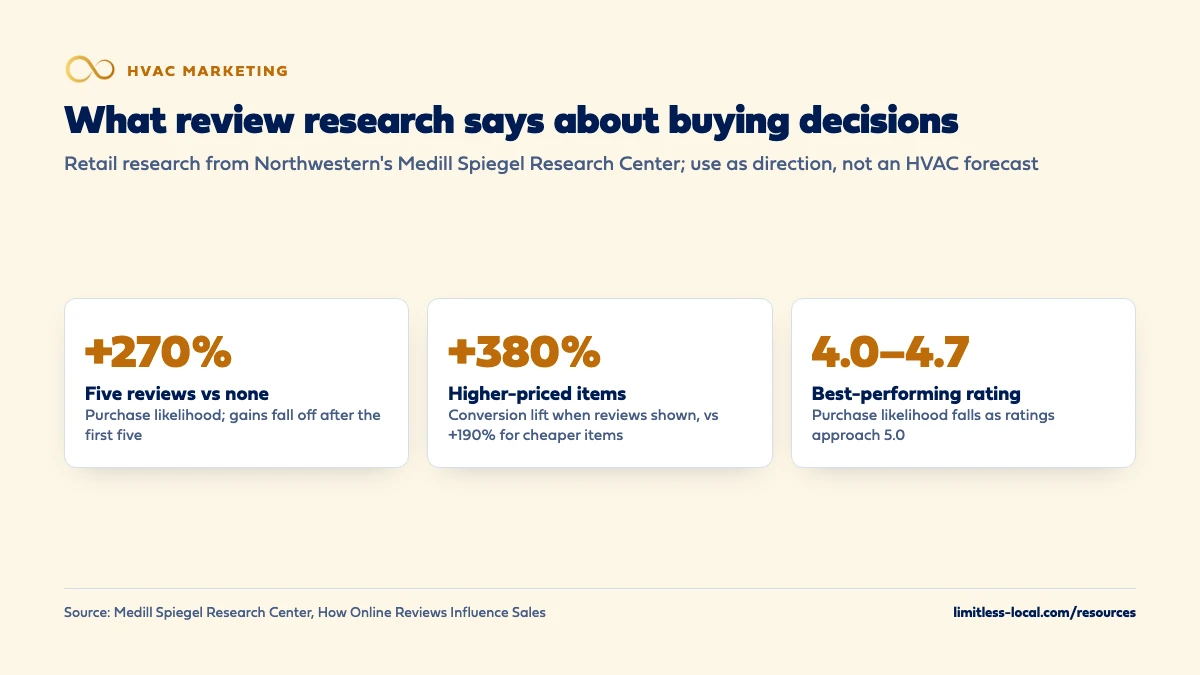
Early on, the count. Research from Northwestern’s Medill Spiegel Research Center found that purchase likelihood for a product with five reviews was 270% greater than for a product with no reviews, and that the extra benefit of more reviews starts falling off quickly after the first five. A separate Spiegel analysis also found that when reviews are short, having more of them matters more.
That research was on products sold online, not HVAC companies, so treat it as direction, not a forecast. In our judgement, it lines up with what owners see in Maps: going from three reviews to thirty changes how a profile looks far more than going from three hundred to three hundred and thirty. Once you have a solid base, the rating and what recent reviews say carry more of the weight. Sources: How Online Reviews Influence Sales and Star Ratings and Review Content.
Is a perfect 5.0 rating better than a 4.7?
Not necessarily. The same Spiegel research found that purchase likelihood typically peaks for ratings in the 4.0 to 4.7 range and then starts to fall as ratings approach 5.0. Its analysis across more than 40 product categories put the peak between 4.2 and 4.5 stars. The researchers’ explanation is that negative reviews establish credibility and authenticity, so a spotless record can look too good to be true.
Google says something similar in its own advice to businesses: honest and balanced reviews help customers decide, and a mix of positive and negative feedback often feels more trustworthy. For an HVAC owner, our takeaway is to stop chasing a perfect score and put the effort into steady volume and good replies. Sources: How Online Reviews Influence Sales, Star Ratings and Review Content and Tips to get more reviews.
Curious what your marketing is actually booking?
Get a free visibility audit — no obligation, no sales pitch.
Do reviews matter more for replacements than repairs?
Probably, based on the research. Spiegel found that reviews move purchase likelihood more for higher-priced items: when reviews were displayed, the conversion rate rose 190% for a lower-priced product and 380% for a higher-priced one. It also found star ratings matter most in high-consideration categories, which it describes as items that are expensive, involve safety, or come from a brand the buyer doesn’t know.
A full system replacement checks all three boxes for most homeowners. In our judgement, that means a homeowner pricing a new system will read your reviews more closely than someone whose AC quit at 4 p.m. and who calls the first company that looks open and solid. If installs are where you want growth, reviews that mention installs, written by install customers, are worth extra attention; marketing replacements differently from repairs covers the rest. Source: How Online Reviews Influence Sales.
How do reviews affect my Local Services Ads?
Directly. Google lists your rating and number of reviews among the profile-quality signals for Local Services Ads ranking, along with response time, photos and completed verification checks, and says higher-quality profiles may rank higher and may also pay lower costs per lead. Google also recommends 5 or more reviews, and says some business types need 5 reviews before the ad will show at all.
So the same reviews can help you in Maps, in the ad slots and in the homeowner’s decision. Whether the ads themselves are worth it is a separate question, covered in whether Local Services Ads are worth it for HVAC. Sources: About ad rankings (Local Services Help) and Improve your Local Services Ads performance.
What do homeowners see from my reviews before they call?
On Google Search and Maps, Google shows your review score, your total number of reviews and your top reviews. The score is the average of all ratings published on Google for your business, on a scale of 1 to 5 stars. Your profile may also show reviews from other local review sites that Google gathers from the web.
For some service businesses, Google also collects ratings on specific parts of the experience and shows them in a review summary, where a homeowner can filter reviews by an aspect such as price. Customers may also be asked what job you did, so a review can show that it was a furnace repair or an AC install. That means the content of your reviews, not just the stars, is part of what a shopper reads. Sources: Understand review scores for local places & businesses and About reviews for service businesses.
Do a few bad reviews cost me calls?
Less than most owners fear, if they’re handled well. The Spiegel research found negative reviews can have a positive effect because they establish credibility, and Google says negative reviews aren’t necessarily a sign of poor business practices. What a homeowner reads is the pattern, and your reply.
In our judgement, the reviews that cost calls are the ones that repeat the same problem, such as no-shows, surprise prices or a tech who didn’t explain the work, and the ones left without an answer. A pattern is an operations problem to fix, not a marketing one. A single angry review with a calm, specific reply often reads as proof that someone at the company cares. Sources: Star Ratings and Review Content and Tips to get more reviews.
How can I tell if reviews are actually moving my calls?
Use the Performance report in your Google Business Profile. Two numbers tell most of the story:
- Views: how many people viewed your profile on Search and Maps. This is the getting-seen side.
- Calls: how many times someone tapped the call button on your profile. This is the getting-chosen side.
Divide calls by views to get a rough call rate for the profile, and track it month by month next to your review count and rating. If views climb as reviews grow, reviews may be helping you rank; if the call rate climbs, they may be helping you win the comparison. Google notes that performance data includes activity from both organic results and Google Ads, so account for any ad changes, and remember a new review can take up to 2 weeks to show in your score. Compare the same months year to year where you can, so a heat wave doesn’t pass for a review effect. Sources: Understand your Business Profile performance & insights and Understand review scores.
When are reviews not what's holding my calls back?
If your profile views are low, reviews may not be the first fix. Relevance and distance count too, so a profile with the wrong category or a service area drawn around the wrong towns won’t be rescued by another twenty reviews. Why other HVAC companies rank above you walks through the other causes.
If calls are coming in but jobs aren’t booking, reviews have already done their part, and the leak is after the phone rings. Telling whether it is your ads, website or follow-up is the better next step in that case. And if you need more reviews, getting your techs to ask for reviews covers how to do it inside Google’s rules.
Want to see where your company stands?
A free visibility audit shows where you show up on Google, Maps and AI answers, and what it's costing you in calls.
What's different about reviews and calls for HVAC companies
Emergencies compress the decision. A homeowner with no heat on a cold night scans the list fast. In our judgement, that’s when the star rating and review count next to your name do most of the work, because few people read ten reviews at midnight.
Replacements stretch it out. A homeowner pricing a new system may compare several companies over days, reading what reviews say about the install crew, cleanup and whether the price matched the estimate. That’s the high-consideration buying the research describes.
Peak season shows the effect fastest. When search volume jumps in the first heat wave or cold snap, small differences in how your profile compares with the companies next to you get multiplied by a lot more homeowners looking. That’s our judgement, not a measured figure.
Maintenance members are your quiet reviewers. Customers you see twice a year know your techs best, and their reviews tend to talk about consistency, which is what a shopper wants to hear.
A worked example: separating more views from more calls per view
These numbers are made up to show the math, not a benchmark for your market. Say last July your profile had 900 views and 27 calls, a call rate of 3%. Over the year you added a steady stream of new reviews, and this July the profile shows the same 900 views but 36 calls, a call rate of 4%.
Views didn’t move, so your ranking probably didn’t change much. The call rate did, which points to the getting-chosen side: more homeowners who saw you decided to call. If instead views had grown and the call rate had stayed flat, the gain would more likely be from showing up more often. Either way, the next check is your call log and job software, because a call isn’t a booked job.
Remember the limits: the Performance report also counts activity from Google Ads, and weather moves HVAC demand, so this tells you where to look, not proof of cause.
Frequently asked questions
How many Google reviews does an HVAC company need?
There’s no number Google publishes for Maps. For Local Services Ads, Google recommends 5 or more reviews. In our judgement, the practical target is to look comparable to the companies that show next to you, then keep a steady flow coming in.
Do my replies to reviews help my ranking?
Google doesn’t say replies are a ranking factor. It does say positive reviews and helpful replies can help your business stand out, which is the getting-chosen side. Source: Tips to improve your local ranking.
Do my Yelp or Facebook reviews count toward my Google rating?
Your Google review score is the average of ratings published on Google. Google says your profile may also show reviews from other local review sites, gathered from the web, but the score itself comes from Google ratings.
Why didn't my rating change after a new review?
Google says it can take up to 2 weeks after a new review for your review score to update.
Can I buy reviews to catch up with a competitor faster?
No. Google removes paid or fake reviews and can restrict the profile, including blocking new reviews and showing a warning to customers. Source: Business Profile restrictions for policy violations.
Do reviews matter if most of my work comes from referrals?
Usually, yes. In our judgement, many referred homeowners still look up the company on Google before calling, and a thin or unanswered review profile can make them hesitate.
Key takeaways
- Reviews work on two things: whether homeowners see you and whether they call once they do.
- Google says more reviews and positive ratings can help local ranking, as part of prominence.
- The first handful of reviews matters most; a near-perfect 5.0 isn’t the goal.
- Reviews likely weigh more on replacement decisions than on midnight repair calls.
- Track profile views, calls and call rate alongside your review count to see your own effect.
Not sure what's working right now?
Start with a free visibility audit: rankings, Google profile, reviews and tracking, checked against your service area.
More in this section
- How many Google reviews does my HVAC company need?
- How do I get my HVAC techs to ask customers for Google reviews?
- Why are other HVAC companies ranking above me on Google?
- What can I do myself to improve my HVAC company's Google ranking?
- What decides how much my HVAC company pays per click on Google Ads?
Sources
- Tips to improve your local ranking on Google — Google Business Profile Help
- Understand review scores for local places & businesses — Google Business Profile Help
- About reviews for service businesses — Google Business Profile Help
- Understand your Business Profile performance & insights — Google Business Profile Help
- About ad rankings — Google Local Services Help
- Improve your Local Services Ads performance — Google Local Services Help
- How Online Reviews Influence Sales — Medill Spiegel Research Center, Northwestern University
- Star Ratings and Review Content — Medill Spiegel Research Center, Northwestern University