
How does an HVAC company earn backlinks?
- How can an HVAC contractor get other websites to link to it without breaking Google's rules?
- What is a backlink, and does it matter for an HVAC company?
- Step 1: How do I see which sites already link to my HVAC company?
- Step 2: Which business relationships should be linking to me already?
- Step 3: Do sponsorships and community work earn links?
- Step 4: How do I get local news and community sites to mention my company?
- Step 5: What pages on my site are worth linking to?
- Which link offers break Google's rules?
- Is it OK to trade links with a partner company?
- What if a past SEO company bought links to my site?
- How many backlinks does an HVAC company need?
- What's different about earning links for HVAC companies
- A worked example: a link audit from your own relationships
- Frequently asked questions
- Key takeaways
- More in this section
- Sources
The short version
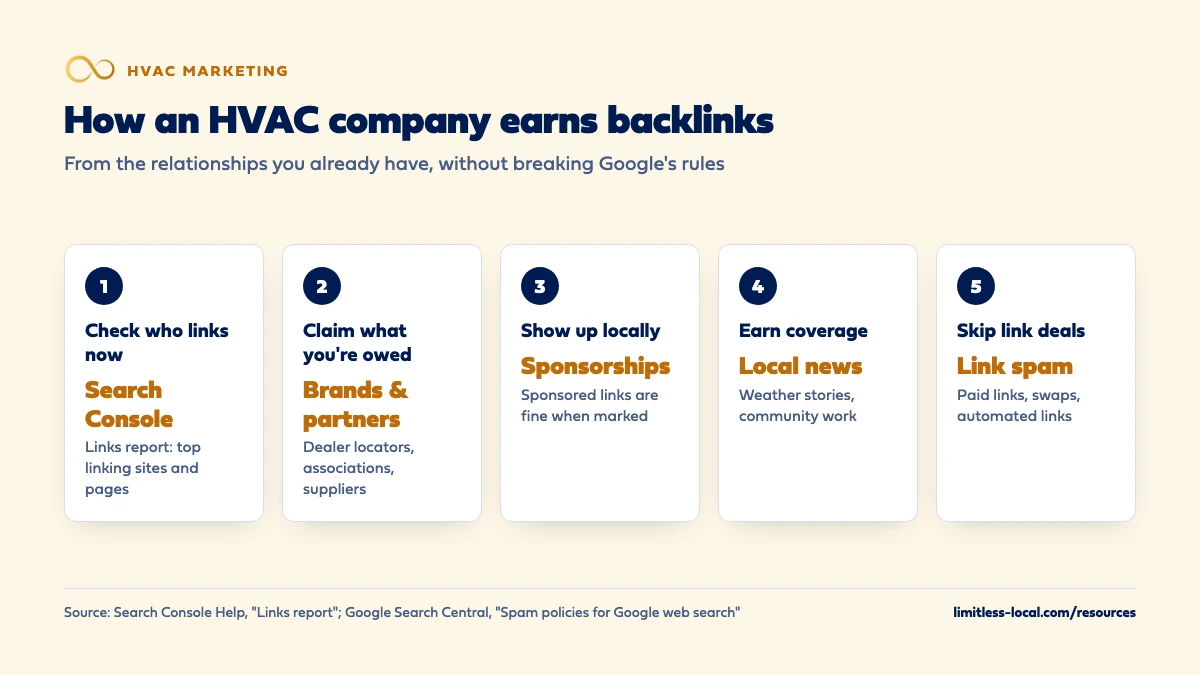
- Check Search Console's Links report to see who already links to you.
- Ask suppliers, brands, associations and sponsorships to list and link to you.
- Give local news and community sites a real story or useful page to point to.
- Skip paid link packages, excessive link swaps and automated link building; Google lists them as link spam.
For HVAC owners who’ve heard links matter for Google and want a list of real, local sources, not a link package from a cold email.
Get a free visibility audit · Book a growth call
How can an HVAC contractor get other websites to link to it without breaking Google's rules?
An HVAC company earns backlinks mostly from the relationships it already has: the equipment brands and distributors it works with, trade associations, local sponsorships, community groups and local news that covers its work. Start by checking which sites already link to you in Search Console, ask the partners who should list you to do it, and give local sites a real reason to mention you. Don’t pay for links or join link swaps; Google’s spam policies treat buying links for ranking as link spam.
That’s how we approach it for HVAC companies too: links come from real local relationships, and they’re judged by what they do for calls, not by a count. Link building is part of our local SEO service for HVAC companies, alongside the Google profile, reviews and service pages. For where SEO sits next to ads and follow-up, see the HVAC marketing guide, and the rest of the HVAC marketing questions library goes question by question.
What is a backlink, and does it matter for an HVAC company?
A backlink is a link on another website that points to a page on yours. Google’s Search Console help puts it simply: it links back to your site.
They matter in two places. For Google Maps and the map pack, Google says prominence, how well-known a business is, is based partly on how many websites link to your business, along with reviews. For the regular results, Google’s Starter Guide says Google primarily finds pages through links from pages it already crawled, often other websites linking to yours. It also keeps links in proportion: PageRank, which uses links, is one of Google’s fundamental algorithms, but it’s just one of many ranking signals.
So links help, but they don’t replace a complete Business Profile, steady reviews and a page for each job you want. If another company keeps showing up above you, why other HVAC companies rank above you shows how to tell whether links are even the gap. Sources: Links report, Tips to improve your local ranking on Google and SEO Starter Guide.
Step 1: How do I see which sites already link to my HVAC company?
Open the Links report in Google Search Console. It shows the sites that link to you the most and the pages on your site with the most links from other sites. Write down what you find; it’s your starting list.
Read it with Google’s own caveats in mind:
- It isn’t a complete list of every link. It shows a sample to help you understand your overall link profile.
- It includes links Google found over time, so some may since have been removed.
- It doesn’t say whether a link is marked nofollow.
Google suggests using the top linked pages view to confirm your most linked pages are the ones you expect. For most HVAC sites the home page leads; if a page you’ve never heard of is near the top, find out why. Source: Links report.
Step 2: Which business relationships should be linking to me already?
Most HVAC companies have more link sources than they realize, because they’re already doing business with sites that list contractors. In our judgement, check each of these:
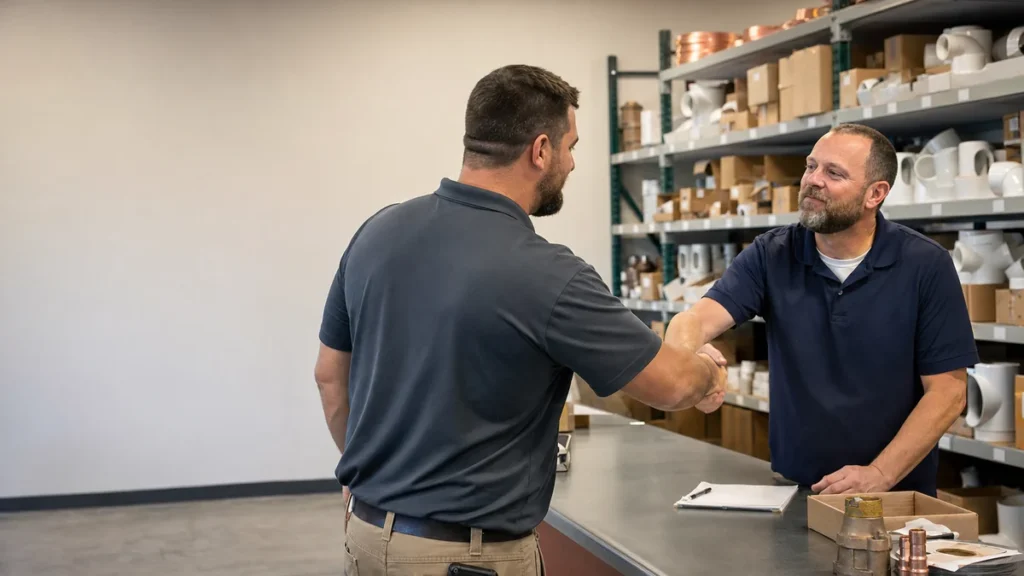
- Equipment brands you’re a dealer for. Many manufacturers run dealer locators. Make sure you’re listed, the details are right and your website address is filled in.
- Distributors and supply houses. Some list contractor customers or feature them in local news.
- Trade associations. State and local HVAC contractor associations often have member directories.
- Your local chamber of commerce or business association. Member listings usually include a website.
- Utility or local rebate programs. If a program lists participating contractors and you qualify, ask how to be added.
- Partners you refer work to. The electrician, plumber or builder you trade jobs with.
While you’re at it, check that each listing has your right name, phone and website; fixing your name, address and phone online covers why that consistency matters.
One rule keeps this honest: join or pay for each of these for what it does for the business, not for the link. Google’s spam policies list exchanging money, goods or services for links, for ranking purposes, as link spam. If the only reason you’d pay a group is to get a link, that’s the arrangement the policy describes. Source: Spam policies for Google web search.
Step 3: Do sponsorships and community work earn links?
They can, and they’re some of the most natural links a local contractor gets. Sponsoring a youth team, a school fundraiser or a charity event usually puts your name, and often a link, on that group’s website.
Expect some of those links to be marked as sponsored, and don’t ask the group to change it. Google says buying and selling links is a normal part of the web for advertising and sponsorship, and it isn’t a violation as long as those links are qualified with a nofollow or sponsored attribute. Its outbound link guidance says links marked that way will generally not be followed, though the pages can still be found other ways.
In our judgement, a sponsorship is worth doing for the people who see your name at the field and on the event page, and any search benefit is a bonus. Google’s Starter Guide makes a similar point about promotion in general: community engagement and word of mouth are among the ways to promote a site, and word of mouth takes time. Sources: Spam policies for Google web search, Qualify your outbound links to Google and SEO Starter Guide.
Curious what your marketing is actually booking?
Get a free visibility audit — no obligation, no sales pitch.
Step 4: How do I get local news and community sites to mention my company?
Give them something worth writing about. Local reporters and community sites need stories, and an HVAC company has more than it thinks, in our judgement:
- Heat waves and cold snaps. Offer to explain how to keep a home safe when the AC or furnace fails. Reporters need someone to quote, and you can be the person they call each season.
- Community work. A donated furnace for a family in need, free safety checks for seniors, a training program for local apprentices.
- Company milestones. A new location, a long-serving tech, a family business changing hands.
Keep it real. Google’s generative AI guide says seeking inauthentic “mentions” across the web isn’t as helpful as it might seem, because its systems focus on high-quality content and block spam. A paid article placed to look like news is a different thing: Google’s spam policies list advertorials where payment is received for articles that include links that pass ranking credit. Sources: Optimizing for generative AI features on Google Search and Spam policies for Google web search.
Step 5: What pages on my site are worth linking to?
People link to pages that help them. A home page is easy to link to; a page that answers a local question is easier to justify linking to. For an HVAC company, that could be:
- A page that explains the utility rebates or local incentives homeowners in your area can actually use, kept up to date.
- A page about a real project: a historic home’s ductless install, a commercial rooftop replacement, with photos.
- Seasonal safety guidance written by your own techs.
Google’s Starter Guide says creating content people find compelling and useful will likely influence your presence in search results more than any of its other suggestions, and its AI guide says unique, first-hand, non-commodity content is likely to do more for you than common knowledge. Those are the pages a reporter, a neighborhood group or a supplier is willing to point to. Strong service pages count too; getting your HVAC service pages to rank covers how to build them. Sources: SEO Starter Guide and Optimizing for generative AI features on Google Search.
Which link offers break Google's rules?
Google’s link spam policy covers links created primarily to manipulate rankings. The examples that show up in contractor inboxes most often:
- Paying for links, whether with money, goods or services, or sending someone a product in exchange for a post with a link.
- Excessive link swaps (“link to me and I’ll link to you”), or partner pages that exist only to cross-link.
- Automated programs or services that create links to your site.
- Paid guest posts, articles or press releases with links that pass ranking credit or optimized link text.
- Low-quality directory and bookmark links, and links built into widgets, footers or templates across many sites.
- Forum comments with optimized links in the post or signature.
Google says sites that violate its policies may rank lower or not appear at all, and it detects violations both automatically and through human review. If a cold pitch offers any of these, telling whether an SEO offer is a scam covers the rest of the warning signs. Source: Spam policies for Google web search.
Is it OK to trade links with a partner company?
A real relationship is fine; a link-trading scheme isn’t. Google’s policy names excessive link exchanges and partner pages made exclusively for cross-linking as link spam. It doesn’t ban linking to people you work with.
In our judgement the test is whether a homeowner would find the link useful. If you regularly send customers to an electrician for panel upgrades and they send you heat pump jobs, a short “who we recommend” mention on each other’s sites helps customers. A page of forty swapped links with companies you’ve never worked with only exists for Google, and that’s the pattern the policy describes. Source: Spam policies for Google web search.
What if a past SEO company bought links to my site?
Check the Manual actions report in Search Console first. Google says a manual action means a human reviewer found pages that don’t comply with its spam policies, and that it notifies you in that report and the Search Console message center. If there’s nothing there, Google’s disavow help says that in most cases Google can assess which links to trust on its own, so most sites never need to act.
Google recommends disavowing links only if both are true: you have a considerable number of spammy, artificial or low-quality links pointing to your site, and they’ve caused a manual action or likely will. If you do get an unnatural links action, Google’s steps are to download your links from Search Console, ask site owners to remove the bad ones or mark them nofollow, disavow only what you can’t get removed, and then request a review. It warns that disavowing everything without trying to get links removed may lead to your request being rejected. Sources: Manual actions report and Disavow links to your site.
How many backlinks does an HVAC company need?
There’s no number. Google doesn’t publish one, and its Starter Guide calls PageRank just one of many ranking signals. What matters, in our judgement, is how your links compare with the companies you’re competing against in the towns you want, and whether they come from local, relevant sites.
A few dozen links from your dealer program, your association, the teams you sponsor and a local news story can matter more for a local HVAC company than hundreds from sites with nothing to do with your area or your trade. And because links build slowly, they’re part of why HVAC SEO takes months, not weeks. Source: SEO Starter Guide.
Not sure which of these is costing you jobs?
A free visibility audit checks the Google profile, reviews, site and tracking, and shows what to fix first.
What's different about earning links for HVAC companies
Dealer programs are a ready-made source. HVAC companies that install a manufacturer’s equipment often qualify for a dealer listing. It’s a link from a site homeowners use when they’ve already picked a brand, which makes it useful whether or not it helps rankings.
Weather makes news. Heat waves and cold snaps send local reporters looking for someone to explain what homeowners should do. An owner or senior tech who answers the phone and gives a straight answer can become the local source they call back every season.
Rebates and incentives change often. A page that keeps local rebate and incentive information current is something neighborhood groups and community sites can point to, and it’s useful to homeowners comparing replacement quotes.
Commercial work has its own circles. If you want commercial jobs, property management and building owner associations are where those buyers look, and their member directories are worth a listing.
A worked example: a link audit from your own relationships
These numbers are made up to show the method, not a target. Say you list every business relationship you have: 3 equipment brands, 2 supply houses, 1 state contractor association, 1 chamber of commerce, 4 sponsorships and 2 referral partners. That’s 13 places that could reasonably mention you.
You compare that list with Search Console’s Links report and find 5 of them already link to you. Of the other 8, three have no listing page at all, which leaves 5 to ask. If 3 of those say yes, you’ve added 3 links from sites with a real reason to know you, without paying anyone for a link. Repeat the check every few months as you add sponsorships and partners.
Link building is included in our Essentials package at $3,500 a month, alongside the Google profile, service pages and review work; Growth at $4,500 a month adds SEO for up to 2 locations. We don’t guarantee rankings from it, because nobody honestly can; what it’s worth comes down to cost per booked job, which is what a free visibility audit is for.
Frequently asked questions
Should I ask sites to use specific keywords in the link?
No. Google’s link spam examples include links with optimized anchor text in articles, guest posts or press releases. In our judgement, let people link with your company name or whatever reads naturally.
Are nofollow or sponsored links worthless?
Not to your business. Google says links marked that way will generally not be followed, but they can still send homeowners to your site, and the linked page can still be found other ways.
Do guest posts and press releases get me backlinks?
Google lists paid articles with links that pass ranking credit, and links with optimized anchor text in guest posts or press releases distributed on other sites, as link spam. A real news story about your company is a different thing.
Can a competitor hurt my ranking by pointing spam links at my site?
Google says it works very hard to make sure actions on third-party sites don’t negatively affect a website, and that in most cases it can assess which links to trust. Check the Manual actions report if you’re worried.
How long before new backlinks show up in my rankings?
There’s no set time. Google’s Starter Guide says some changes take effect in a few hours and others take several months, and suggests waiting a few weeks before judging a change.
Key takeaways
- Links from other sites feed prominence in Maps and help Google find your pages, but they’re one signal among many.
- Start with Search Console’s Links report, then ask the brands, suppliers, associations and partners you already work with.
- Sponsorships and real local news coverage are natural links; sponsored links marked as such are within Google’s rules.
- Paid links, excessive link swaps, automated links and low-quality directory links are link spam under Google’s policies.
- Disavowing links is rarely needed; Google reserves it for spammy links that caused, or will likely cause, a manual action.
Want a second set of eyes on your setup?
We'll look at how you show up locally and where calls are leaking, then send you a plain-English breakdown.
More in this section
- How do I make my HVAC company look trustworthy online?
- What can I do myself to improve my HVAC company's Google ranking?
- How do I get more repeat customers and referrals for my HVAC company?
- How do I get HVAC service pages to rank for repair and install?
- How long does HVAC SEO take to bring in calls?
Sources
- Spam policies for Google web search — Google Search Central
- Qualify your outbound links to Google — Google Search Central
- Links report — Search Console Help
- Manual actions report — Search Console Help
- Disavow links to your site — Search Console Help
- Search Engine Optimization (SEO) Starter Guide — Google Search Central
- Tips to improve your local ranking on Google — Google Business Profile Help
- Google's guide to optimizing for generative AI features on Google Search — Google Search Central