
Should I pay an HVAC agency fee or spend more on ads?

- Is an HVAC marketing agency's fee worth more than a bigger Google Ads budget?
- What does an agency fee actually pay for?
- How do I tell whether my ads need more money or better management?
- When does spending more on ads make sense?
- When does better management beat a bigger budget?
- Is a management fee worth it on a small ad budget?
- Should an agency charge a flat fee or a percentage of ad spend?
- Does spending more on ads help my SEO?
- What if I run the ads myself and put the fee into the budget?
- How do I compare the two options fairly?
- Who should own the Google Ads account if I pay an agency?
- What's different about this decision for HVAC companies
- A worked example: the same money, two ways
- Frequently asked questions
- Key takeaways
- More in this section
- Sources
The short version
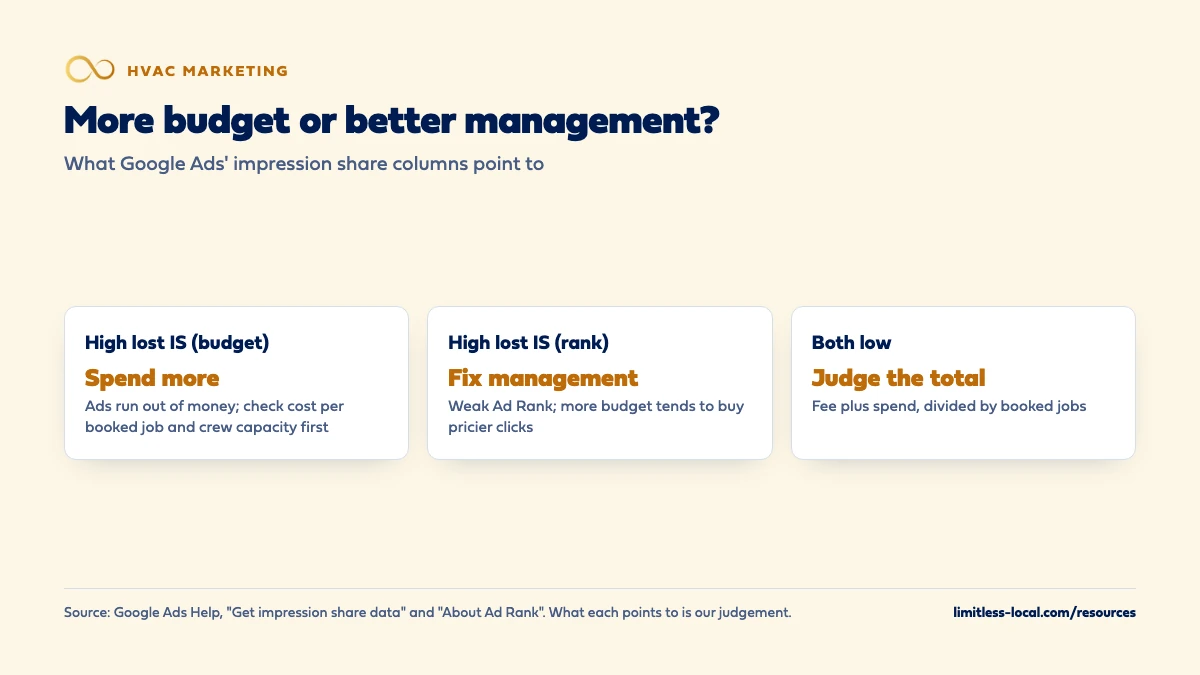
- High lost impression share (budget) with a healthy cost per booked job points to spending more on ads.
- High lost impression share (rank) points to fixing how the ads are run, which more budget won't solve.
- A fee is worth paying only if it lowers cost per booked job, or adds work like SEO, by more than it costs.
- Compare options on total cost (fee plus spend) divided by booked jobs.
For HVAC owners with a fixed marketing budget, deciding whether the next dollar should go to management or straight to Google.
Get a free visibility audit · Book a growth call
Is an HVAC marketing agency's fee worth more than a bigger Google Ads budget?
Pay for management when the problem is how your ads are run, and spend more on ads when well-run ads keep running out of money. Google Ads shows you which: Search lost impression share (budget) is the share of time your ads didn’t show because the budget ran out, while Search lost impression share (rank) is time lost to a weak Ad Rank, which a bigger budget doesn’t fix. Either way, judge the fee plus the ad spend together by what each booked job ends up costing, not by how much of the money reached Google.
Our fees are flat and listed on our packages page, and ad spend is never included; you pay it directly to Google, so you can always see both numbers. Essentials manages up to $2,500 a month in Google Ads spend and Growth up to $5,000, alongside local SEO, Google profile work and tracking for HVAC companies. The HVAC marketing cost guide breaks down what each channel tends to cost, and the rest of the HVAC marketing questions library goes question by question.
What does an agency fee actually pay for?
The fee pays for people and their time; the ad spend pays Google for clicks or leads. In our judgement, a management fee for ads should buy the work that decides what each dollar of spend gets you: which searches and towns you show up for, what the ads and landing pages say, which searches to block, how bids are set, whether calls are tracked, and a report that ties it to booked jobs.
Many agency fees also cover work that has nothing to do with ads, like SEO, your Google profile and review requests. Before comparing a fee with more ad spend, split the fee into what it buys for ads and what it buys elsewhere. A contract should make the split between fee and spend clear, which what to look for in an HVAC marketing agency contract covers.
How do I tell whether my ads need more money or better management?
Look at impression share. Google defines it as the impressions your ads got divided by the estimated number of impressions they were eligible to get, and says it’s a good way to understand whether your ads might reach more people if you increase your bid or budget. Two columns split the missing share by cause:
- Search lost IS (budget): the percentage of time your ads weren’t shown on the Search Network because of insufficient budget. It’s available at the campaign level only.
- Search lost IS (rank): the percentage of time your ads weren’t shown on the Search Network because of poor Ad Rank in the auction.
In our judgement, a campaign losing a lot to budget, with a cost per booked job you’re happy with, is asking for more money. A campaign losing a lot to rank is asking for better management first. Google also notes that impression share is an estimate, and small swings over time don’t necessarily mean you need to act.
When does spending more on ads make sense?
When three things line up, in our judgement: the campaign is losing impressions to budget, the calls it already gets turn into booked jobs at a cost you can afford, and your schedule has room for more work.
Google also flags the first one for you. It marks a campaign “Limited by budget” when the campaign is underperforming because of a limited budget, and offers a recommended budget when it has enough data. Google says applying the recommended budget will help you increase clicks and impressions, which isn’t the same as booked jobs, so check the second condition before you raise it. What cost per booked call an HVAC company should aim for shows how to set that ceiling.
When does better management beat a bigger budget?
When the ads lose to rank, not budget. Google says Ad Rank is based on your bid, the quality of your ads and landing page, the minimum thresholds an ad must meet, the competitiveness of the auction, the context of the search, and the expected impact of your ad assets. Only the first of those is money. Google also says higher-quality ads can often lead to lower costs per click.
That’s why, in our judgement, pouring more budget into a weak setup tends to buy the same clicks at a higher price, or more of the searches you didn’t want. The fixes are management work: tighter targeting, ads that match the job, and a page that matches the ad. Whether an HVAC company needs landing pages for Google Ads covers the last of those.
Curious what your marketing is actually booking?
Get a free visibility audit — no obligation, no sales pitch.
Is a management fee worth it on a small ad budget?
Often not for ads alone, in our judgement. A fee is a fixed cost, so the smaller the ad budget, the bigger the share of your money that goes to management instead of reaching customers. For a management fee to pay for itself, it has to lower your cost per booked job (or add booked jobs from other work, like SEO) by more than the fee costs.
If your budget is small, a simpler setup you run yourself, or Local Services Ads, which charge for each valid lead, may be the better first step. How much an HVAC company should spend on Google Ads works the budget out from the booked jobs you want.
Should an agency charge a flat fee or a percentage of ad spend?
Both exist. In our judgement, the thing to watch with a percentage of ad spend is that the agency earns more when you spend more, whether or not the extra spend books jobs. A flat fee tied to a written scope removes that pull, but you should still know the most ad spend the fee covers, because managing far more spend is more work.
Whichever you choose, ask for the fee and the ad spend as separate lines, with the ad spend going to Google on your own payment method where possible, so you can see exactly what reached the ads.
Does spending more on ads help my SEO?
No. Google says advertising with Google won’t have any effect on your site’s presence in its search results, and that it never accepts money to include or rank sites there. Ad spend buys ad visibility while you pay for it; it doesn’t build your organic rankings or your map listing.
That matters when an agency fee includes SEO. Moving that money into ads trades work that keeps paying after you stop for traffic that stops when the budget does. In our judgement, compare the SEO part of a fee with what SEO would cost on its own, which how much HVAC SEO costs per month covers.

What if I run the ads myself and put the fee into the budget?
It can work, if you or someone in the office has the hours and the know-how to check search terms, adjust bids and budgets, and keep tracking working every week, including in July. The fee you save is real money; the risk is that nobody notices when spend drifts to the wrong searches.
If you go that way, set up call tracking first, check the impression share columns monthly, and decide in advance what cost per booked job would make you hand it off. Which HVAC marketing work to outsource or keep in-house covers the rest of that split.
How do I compare the two options fairly?
Use the same yardstick for both: total monthly cost, fee plus ad spend, divided by booked jobs. Then give each option enough time. New campaigns take a while to settle, and any SEO in a fee takes longer still; SEO typically takes 3-6 months to show meaningful organic growth.
In our judgement, a fair test runs a full season or more, tracks booked jobs by source in your field software, and compares like months with like months, so a heat wave doesn’t make one option look better than it is.
Who should own the Google Ads account if I pay an agency?
You should. Agencies manage accounts through what Google calls a manager account. Google says a client account can have only one owner, and that if a manager creates a new account, the manager automatically becomes its owner, while linking an existing account doesn’t give the manager ownership unless the client account turns it on. Even an owner manager doesn’t take data ownership away from the client account, which can remove the manager’s access by unlinking.
In our judgement, the cleanest setup is that you create the account in your company’s name, add your own payment method, and link the agency to it. That way, moving the budget between fee and spend, or changing agencies, never means starting over.
Talk it through with someone who runs this every day
A 15-minute growth call: your market, your numbers, and what a realistic budget looks like. No pressure.
What's different about this decision for HVAC companies
Peak season changes the answer. In our judgement, campaigns are more likely to run out of budget in a heat wave, so lost impression share to budget tends to rise, and that’s the time more ad spend most often pays, as long as the crews can take the work.
Shoulder months reward management. When demand is thin, the money is in tighter targeting, tune-up and replacement campaigns, and landing pages, not in a bigger budget chasing fewer searches.
Replacement jobs justify more per call. A booked replacement estimate can be worth far more than a repair call. Check lost impression share separately for replacement campaigns before deciding they need more money.
A worked example: the same money, two ways
These numbers are made up to show the math. They aren’t a benchmark for HVAC ad costs or results, and they aren’t a forecast for any agency’s work, ours included.
Say you run your own Google Ads on $2,000 a month and book 8 jobs from them: $250 per booked job. You have another $3,500 a month to put to work, for $5,500 in all.
- Option 1: all of it into ads. If the extra spend booked jobs at the same $250, you’d get 22 booked jobs. That holds only if your campaigns are losing impressions to budget; if they aren’t, the extra money has few good searches to buy.
- Option 2: a management fee, same ad spend. Our Essentials package is $3,500 a month and manages up to $2,500 in Google Ads spend, plus local SEO, Google profile work and tracking. With your $2,000 in spend, you’d pay the same $5,500. To match option 1 on ads alone, the managed $2,000 would have to book 22 jobs, which is a lot to ask of management in the short run.
So, on ads alone, option 2 has to earn its fee another way: the SEO, profile and tracking work that keeps producing after the first few months. If you don’t need those, or your ads are simply running out of budget, option 1 may be the better use of the money.
Frequently asked questions
What's a normal management fee for HVAC Google Ads?
We don’t know of a published, checkable benchmark for HVAC. Compare fees by what they cover, how much ad spend they include and what cost per booked job you end up with.
Does the agency fee come out of my ad budget?
It shouldn’t. Ask for the fee and the ad spend as separate lines. Ours are separate: ad spend isn’t included in any package and is paid directly to Google.
Where do I find lost impression share in Google Ads?
Add the Search lost IS (budget) and Search lost IS (rank) columns to your campaigns report. The budget column is available at the campaign level only.
Should I cut the agency in the slow season and keep the ads?
In our judgement, only if someone will still manage the ads and the SEO work can pause. Slow months are when tighter management matters most, because there are fewer searches to waste money on.
Is it worth paying for both a bigger budget and an agency?
It can be, when ads are losing impressions to budget, booked jobs come in under your ceiling and the crews have room. In that case, both the management and the extra spend are working.
Key takeaways
- Lost impression share to budget points to more ad spend; lost impression share to rank points to better management.
- A bigger budget doesn’t fix weak ads, landing pages or targeting, and Google says higher-quality ads can often lead to lower costs per click.
- A management fee pays off only if it lowers cost per booked job, or adds work like SEO, by more than it costs.
- Ad spend doesn’t help organic rankings, so moving SEO money into ads is a trade, not a top-up.
- Own your Google Ads account, and compare options on fee plus spend divided by booked jobs.
Ready to compare options?
Book a short growth call and we'll walk through the math for your service area, including when we're not the right fit.
More in this section
- How do I get HVAC calls without paying for ads?
- Should I fix my HVAC website and reviews before paying for ads?
- How much should an HVAC company spend on Google Ads?
- Are Google Local Services Ads worth it for an HVAC company?
- Which HVAC services should I advertise first?
Sources
- Get impression share data — Google Ads Help
- About impression share — Google Ads Help
- Fix "Limited by budget" status — Google Ads Help
- About Ad Rank — Google Ads Help
- Manager Accounts (MCC): About ownership of client accounts — Google Ads Help
- Do you need an SEO? — Google Search Central
- How leads work — Google Local Services Help