
What cost per booked call should an HVAC company aim for?

- What's a good cost per booked call for an HVAC company to target?
- Is there a standard cost per booked call for HVAC companies?
- What counts as a booked call?
- How do I work out the most I can pay for a booked call?
- Why should I use gross profit and not the ticket price?
- Should repair calls, maintenance and replacement estimates have different targets?
- Should I count what a customer is worth over the years?
- How do I turn a cost per booked call into a monthly budget?
- How do I measure my actual cost per booked call?
- Can Google Ads bid toward my target cost per booked call?
- What should I check when my cost per booked call is over the ceiling?
- Should my target change with the seasons?
- What's different about cost per booked call for HVAC companies
- A worked example: setting a ceiling for repairs and replacement estimates
- Frequently asked questions
- Key takeaways
- More in this section
- Sources
The short version
- No published benchmark fits every HVAC market; work your ceiling out from your own numbers.
- Break-even cost per booked call is gross profit per paid job times the share of booked calls that become paid jobs.
- Aim below break-even by the profit you want to keep, with ad spend and fees counted together.
- Use separate targets for repairs, maintenance and replacement estimates.
For HVAC owners who want a number to hold their ads, SEO or agency to, worked out from their own job values instead of a national average.
Get a free visibility audit · Book a growth call
What's a good cost per booked call for an HVAC company to target?
The right cost per booked call for an HVAC company is a ceiling you work out from your own numbers, not a national benchmark. Take the average gross profit on a completed job, multiply it by the share of booked calls that turn into paid work, and that’s your break-even cost per booked call; aim far enough below it to keep the profit you want. Set separate targets for repair calls, maintenance visits and replacement estimates, because one blended number hides which kind of call is paying its way.
That ceiling is how we’d judge any channel: what each booked call cost against what it earns, with ad spend and fees counted together. Every one of our HVAC marketing packages includes call tracking with recording and a monthly report with a cost-per-lead breakdown, and our local ads work covers Google Ads in every tier and Local Services Ads from the Growth tier up. The HVAC lead generation guide covers where booked calls come from, and the rest of the HVAC marketing questions library goes question by question.
Is there a standard cost per booked call for HVAC companies?
Not one we can point you to with a checkable source. Figures get quoted online, but in our judgement any national number is an average across markets, seasons and job types that may look nothing like yours.
What you can work out is your own ceiling: the most a booked call can cost before it stops paying for itself. That number comes from three things you already know or can find in your field software: what a completed job earns you, how many booked calls turn into paid work, and how much profit you want left after the marketing is paid.
What counts as a booked call?
For this math, a booked call is a call, form, message or online booking that ends with a job or estimate on the schedule, with a date and a time. It isn’t every ring of the phone. Vendor calls, spam, existing customers checking on a part and wrong numbers all show up in a call log, and dividing your spend by all of them makes the number look better than it is.
Field software can do some of the sorting. Housecall Pro’s call reporting for Voice users, for example, separates total calls from opportunity calls, its name for customer calls that could turn into jobs (not vendors or spam), and shows the percentage of calls that turned into estimates or jobs. The full ladder from click to lead to booked job is laid out in the difference between a click, a lead and a booked HVAC job.
How do I work out the most I can pay for a booked call?
Start from break-even. The SBA’s break-even calculator uses a simple formula: fixed costs divided by price minus variable costs gives the number of units you need to sell to break even. Turned around for a single booked call (our adaptation, not the SBA’s), the most you can pay before a booked call loses money is:
- Gross profit per paid job: the average invoice minus parts, the tech’s time and anything else the job itself costs you.
- Times the share of booked calls that become paid jobs: some cancel, some aren’t home, some get a diagnosis and decline the repair.
- Equals your break-even cost per booked call.
Break-even isn’t the target. At break-even, the marketing has eaten the whole gross profit, so the job added nothing toward the trucks, the office or your own pay. Decide how much of that gross profit you want to keep, and the rest is what you can spend to book the call. In our judgement, an owner who doesn’t know where to start can aim for about half of break-even, then adjust once a few months of real numbers come in.
Why should I use gross profit and not the ticket price?
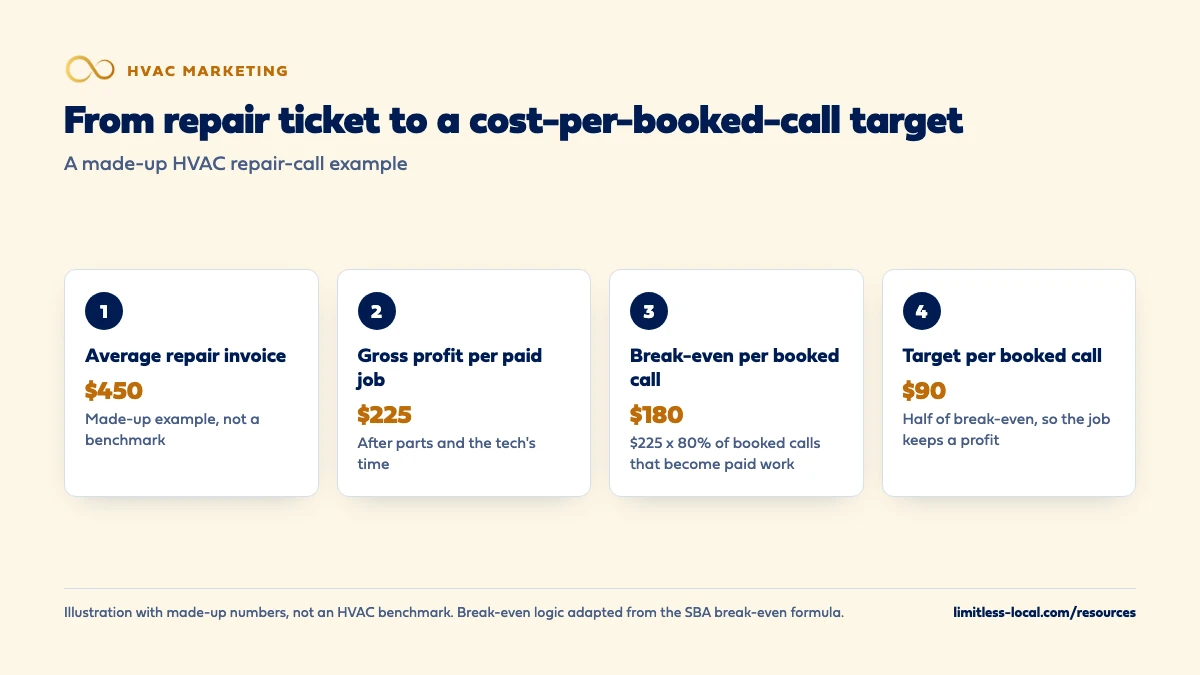
Because the ticket price includes money that was never yours to spend on marketing. A made-up $450 repair that uses $100 in parts and $125 of a tech’s time leaves $225 to cover marketing, overhead and profit. Use the $450 and you’d think you can pay twice what you really can.
Your bookkeeper or your field software’s job costing reports can give you an average gross profit by job type. If you can only get one average for the whole business, start with it, but in our judgement a split by repair, maintenance and replacement is worth the effort, for the reason in the next section.
Should repair calls, maintenance and replacement estimates have different targets?
Yes. They’re different jobs with different values, so they deserve different ceilings. In our judgement, a booked repair call is worth much less than a sold system but turns into paid work far more often, while a booked replacement estimate is worth a lot if it sells and nothing if it doesn’t. Blend them into one number and a month heavy on cheap tune-up calls can look great while replacement estimates quietly cost more than they’re worth, or the other way round.
For replacement estimates, the share of booked calls that becomes paid work is your close rate, so the ceiling is gross profit per sold system times your close rate. What a good close rate for HVAC replacement estimates looks like covers the second half of that math.
Curious what your marketing is actually booking?
Get a free visibility audit — no obligation, no sales pitch.
Should I count what a customer is worth over the years?
Carefully. A first repair can lead to a maintenance plan, more service calls and, years later, a replacement, so the first invoice understates what some customers are worth. But future work is a guess, and building your target on it is an easy way to justify spending more than you’re earning.
Some field software keeps it to the first job on purpose. Jobber’s Lead Source Report shows the total from the first invoice linked to a lead, because, in Jobber’s words, when a lead comes in from a lead source, it’s the first payment that counts, not any ongoing revenue. In our judgement, set the target from first-job gross profit and track maintenance-plan sign-ups by source separately. If a channel only works once you count years of future work, decide that on purpose before you fund it.
How do I turn a cost per booked call into a monthly budget?
Multiply. The number of booked calls you want a month, times your target cost per booked call, is roughly what the marketing for those calls should cost, ad spend and fees included. The hard part is the first number: it should be the work your techs can actually run, not the most calls you can buy. How many booked calls an HVAC company needs works that out from your trucks and goals.
If the budget that comes out is more than you’re comfortable spending, lower the number of calls you’re buying, not the target. In our judgement, cutting the target without changing anything else usually just means fewer calls, for the reason covered under Google Ads below.
How do I measure my actual cost per booked call?
Divide what a channel cost in a month (ad spend plus any fees for it) by the booked calls it produced that month. That needs two things working: a way to tell which channel each call came from, and a place where booked calls get marked with that source.
- Call source. Google Ads can track calls from your ads and calls to a Google forwarding number shown on your website, counting every call that lasts at least a minimum length you set. In our judgement, a separate tracking number for your Google profile, mailers and other sources does the same job outside Google Ads.
- Booked status. Your field software should carry the lead source on every job. Jobber’s Lead Source Report, for example, shows, for each source, the leads with a request, a quote, a job and an invoice.
The setup, step by step, is in how to track whether your HVAC marketing is paying off.
Can Google Ads bid toward my target cost per booked call?
It can bid toward a target cost per conversion, so the real question is what you count as a conversion. With Target CPA bidding, you set your desired average cost per conversion, and Google Ads sets bids to try to get as many conversions as possible at that average. Google says some conversions may cost more than your target and some may cost less, and that setting a target too low may cause you to forgo clicks that could result in conversions, resulting in fewer total conversions.
If a conversion is any call over the minimum length, Google is chasing calls, not booked calls. Google Ads lets you import call conversions you track in another system, such as a CRM, so you can count only the calls that included a sale; offline conversion imports do the same for clicks, measuring what happens after the ad, such as a signed contract. In our judgement, once booked calls flow back that way, a target means what you want it to mean. Google recommends measuring Target CPA performance over periods with at least 30 conversions, so a small account may need a while before the numbers settle.
What should I check when my cost per booked call is over the ceiling?
In our judgement, check the cheaper fixes before you touch the ad budget, in this order:
- Are calls getting answered and booked? If the office books a small share of the calls that come in, every booked call carries the cost of the ones that didn’t. What percentage of calls an HVAC office should be booking covers that number.
- Are they the right calls? Listen to the recordings. Calls about work you don’t do, or from towns you don’t serve, point to targeting or keywords.
- Does the page or profile the call came from match the job? A furnace ad that lands on a generic homepage loses people before they call.
- Only then, the bids and budget.
If you can’t tell which of those is the problem, whether it’s your ads, website or follow-up walks through it.
Should my target change with the seasons?
The ceiling itself moves only when your job values or booking rates move, but in our judgement how hard you push against it should follow the schedule. In a heat wave the phone rings on its own and the crews are full, so paying close to break-even for more calls buys work you can’t run. In the shoulder months, when the schedule has gaps, paying closer to the ceiling to keep techs busy can make sense, because an idle truck costs you too.
Not sure which of these is costing you jobs?
A free visibility audit checks the Google profile, reviews, site and tracking, and shows what to fix first.
What's different about cost per booked call for HVAC companies
Emergency calls are worth more and cost more to run. A no-heat call at night may carry a higher ticket, and also overtime or an after-hours rate for the tech, so in our judgement it’s worth figuring its gross profit separately if you take a lot of them.
Diagnostic fees change the math. If you charge a diagnostic or trip fee, a booked call that ends in a declined repair still earns something. Count it in the gross profit for that call type, not as zero.
Maintenance plans book without marketing. Plan customers schedule tune-ups without any new spend, so leave those visits out of the cost-per-booked-call math, or they’ll make paid channels look cheaper than they are.
A worked example: setting a ceiling for repairs and replacement estimates
These numbers are made up to show the math. They aren’t a benchmark for HVAC ticket sizes, margins or booking rates.
Repair calls. Say an average repair invoice is $450 and, as above, leaves $225 in gross profit after parts and the tech’s time. Say 80% of booked repair calls turn into paid work. Break-even is $225 times 80%, or $180 per booked call. Aim for half of that, and your target is $90 per booked repair call.
Replacement estimates. Say a sold system leaves $4,000 in gross profit, and one in four booked estimates closes. Break-even is $4,000 divided by four, or $1,000 per booked estimate. Half of that is a target of $500.
The full cost. For comparison, our Essentials package is $3,500 a month and manages up to $2,500 a month in Google Ads spend, which is paid to Google separately: $6,000 in all. If that month booked 40 repair calls and six replacement estimates, the targets allowed $3,600 for the repairs (40 times $90) and $3,000 for the estimates (six times $500), or $6,600, so the month came in under target. As one blended number, $6,000 over 46 booked calls is about $130 each, which tells you nothing on its own: it’s over the repair target and far under the estimate target.
Frequently asked questions
Is cost per booked call the same as cost per lead?
No. Cost per lead divides spend by every call or form, including ones that never book. Cost per booked call divides only by the ones that made it onto the schedule, so it’s always the same or higher, and it’s closer to what a job really costs you to win.
Should I include my agency's fee in cost per booked call?
Yes. Count everything you pay for that channel, ad spend plus management fees, or the number will look lower than what a booked call really costs.
How much data do I need before I trust the number?
In our judgement, at least a few months that include both busy and slow weeks. For Google Ads bidding, Google recommends measuring Target CPA performance over periods with at least 30 conversions.
What if my cost per booked call is well below the ceiling?
That’s room to spend more, if the schedule has space for more work. If the crews are already booked out, a low cost per booked call is a reason to keep things as they are, not to push harder.
Do Local Services Ads change the math?
Not the ceiling. With Local Services Ads you’re charged for each valid lead you receive, but you still divide what you paid by the leads that booked and compare the result with the same ceiling.
Should every town I serve have the same target?
Not necessarily. In our judgement, a town far from the shop, where drive time eats into each job’s profit, deserves a lower ceiling than one close by.
Key takeaways
- No published cost per booked call fits every HVAC market; set your own ceiling from your own numbers.
- Break-even per booked call is gross profit per paid job times the share of booked calls that become paid work.
- Aim below break-even by the profit you want to keep, and count ad spend and fees together.
- Use separate targets for repairs, maintenance and replacement estimates.
- When the number runs high, check call answering and booking before cutting bids.
Want a second set of eyes on your setup?
We'll look at how you show up locally and where calls are leaking, then send you a plain-English breakdown.
More in this section
- How many booked calls does my HVAC company need to hit its goal?
- What percentage of calls should my HVAC office be booking?
- How much should an HVAC company spend on Google Ads?
- How long does HVAC SEO take to bring in calls?
- How do I get HVAC calls without paying for ads?
Sources
- Break-even point calculator — U.S. Small Business Administration
- About Target CPA bidding — Google Ads Help
- About phone call conversion tracking — Google Ads Help
- About offline conversion imports — Google Ads Help
- Conversion Rate Reporting — Housecall Pro Help Center
- Lead Source Report — Jobber Help Center
- How leads work — Google Local Services Help