
Should an HVAC company run emergency ads while SEO builds?

- Is it smart to run no-heat and no-cool ads while my HVAC SEO is still ramping up?
- Why run emergency ads while SEO is still building?
- What counts as an emergency ad for an HVAC company?
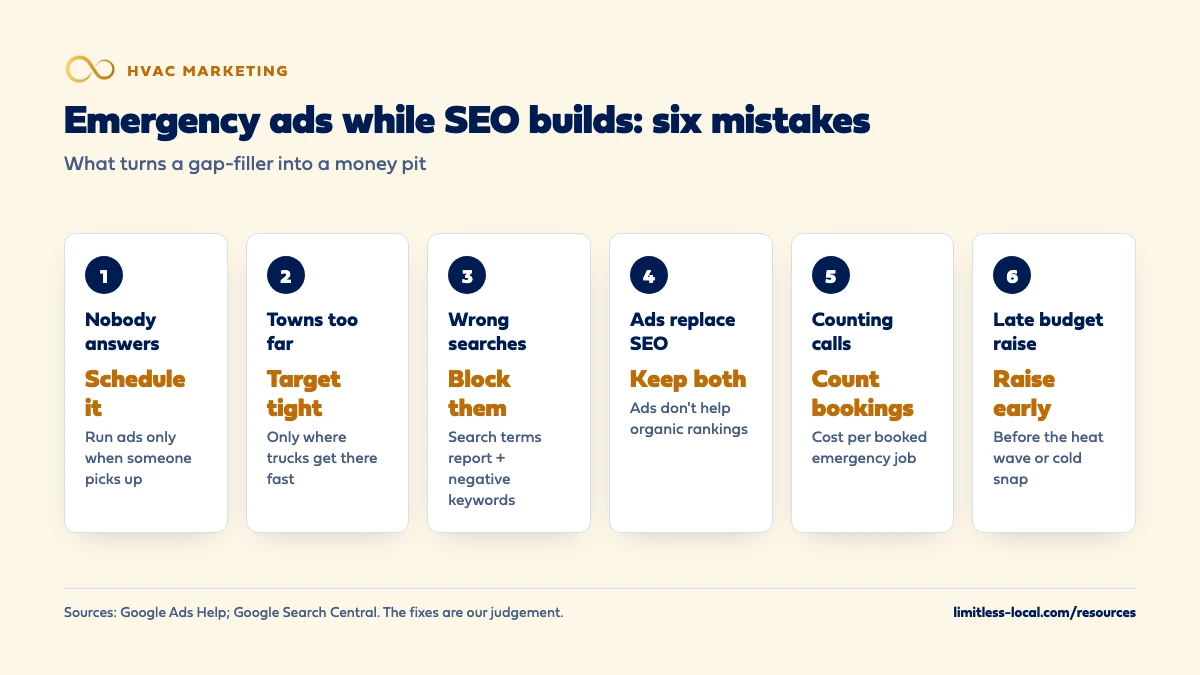
- Mistake 1: Running emergency ads when nobody answers
- Mistake 2: Showing ads in towns you can't reach quickly
- Mistake 3: Paying for searches that aren't emergencies
- Mistake 4: Letting the ads replace the SEO work
- Mistake 5: Judging emergency ads by call count
- Mistake 6: Raising the budget after the heat wave hits
- Should emergency calls come from Local Services Ads or search ads?
- When should I scale emergency ads back as SEO grows?
- What's different about emergency ads for HVAC companies
- A worked example: covering the SEO ramp with an emergency campaign
- Frequently asked questions
- Key takeaways
- More in this section
- Sources
The short version
- Ads can bring leads within days; SEO typically takes 3-6 months to show meaningful organic growth.
- Run emergency ads only during hours when someone will answer.
- Target the towns you can reach quickly, and block searches that aren't emergencies.
- Keep the SEO work going, and judge the ads by booked jobs, not calls.
For HVAC owners who’ve started SEO and need the phone ringing in the meantime, and want to avoid the mistakes that make emergency ads expensive.
Get a free visibility audit · Book a growth call
Is it smart to run no-heat and no-cool ads while my HVAC SEO is still ramping up?
For most HVAC companies, yes: emergency-intent ads are a sensible way to keep the phone ringing while SEO builds, because ads can bring in leads within days of launch and SEO typically takes 3-6 months to show meaningful organic growth. They pay off only if someone answers every call during the hours the ads run, and if they’re set to the towns, hours and emergency jobs you actually want. The common mistakes are running them around the clock with nobody on the phone, paying for searches that aren’t emergencies, letting the ads replace the SEO work instead of covering for it, and judging them by calls instead of booked jobs.
That’s the order we work in, too: ads to bring in calls while the slower SEO and Google profile work builds, with tracking from day one so you can see which booked jobs came from where. Google Ads management is in every one of our local ads packages, and Local Services Ads management starts at the Growth tier; the HVAC marketing page shows how it fits together for HVAC companies. The HVAC lead generation guide covers every channel that brings in calls, and the rest of the HVAC marketing questions library goes question by question.
Why run emergency ads while SEO is still building?
Because the two work on different clocks. Ads can generate leads within days of launch, while SEO typically takes 3-6 months to show meaningful organic growth. If the business needs calls this month, SEO alone leaves a gap, and in our judgement emergency searches are the most natural way to fill it, because someone searching for a no-heat fix wants a company today, not a company to research.
The point is to cover the gap, not to replace the long-term work. How long HVAC SEO takes to bring in calls covers what the ramp usually looks like and what moves it.
What counts as an emergency ad for an HVAC company?
In our judgement, an emergency campaign is built around searches from people with a broken system right now: AC not cooling, furnace not turning on, no heat, no AC, emergency or same-day service. It’s kept separate from your maintenance and replacement campaigns, so it can have its own budget, hours and towns.
Emergency ads also need to say what you actually offer. If you don’t run nights or weekends, don’t say 24/7. In our judgement, an ad that promises a tech tonight and a phone that goes to voicemail is worse than no ad at all, because you pay for the call and lose the customer to whoever answers next.
Mistake 1: Running emergency ads when nobody answers
This is the most expensive mistake on the list. By default, Google Ads campaigns are set to show ads all day. Google’s ad scheduling lets you specify the hours or days of the week when your ads show, and adjust bids up or down for specific days and times. In our judgement, match the schedule to the hours someone will really pick up, and add after-hours only when you have on-call coverage.
Local Services Ads are stricter still. Google charges for a missed call during your business hours when the customer stays on the line for more than 20 seconds, and says missed calls may hurt your responsiveness, which affects where your ad ranks. How fast an HVAC company should respond to new leads covers the office side.
Mistake 2: Showing ads in towns you can't reach quickly
An emergency call from a town an hour away is a call you either turn down or run at a loss. Google’s location targeting can show ads to people in, or regularly in, your chosen locations, and to people who’ve shown interest in them. Google says the default option uses physical location and location of interest, and that you can update the advanced location options at any time.
In our judgement, for emergency campaigns, target the towns your trucks can reach fast, and consider limiting the ads to people who are physically there. Someone across the country searching your city’s name isn’t the one with a broken furnace.
Curious what your marketing is actually booking?
Get a free visibility audit — no obligation, no sales pitch.
Mistake 3: Paying for searches that aren't emergencies
Emergency keywords attract searches you don’t want: people looking for parts, do-it-yourself fixes, HVAC jobs or training. Google’s search terms report shows the actual searches that triggered your ads and how they performed, and negative keywords let you exclude search terms from your campaigns so you focus on the ones that matter.
Google notes that negative keywords won’t match close variants, so you’ll need to add synonyms and singular or plural versions yourself. In our judgement, check the search terms report weekly in the first month of an emergency campaign, when the waste is usually highest, then monthly after that.
Mistake 4: Letting the ads replace the SEO work
Ads and SEO don’t feed each other. Google says advertising with Google won’t have any effect on your site’s presence in its search results, and that it never accepts money to include or rank sites there. If the emergency ads work and the SEO budget quietly moves into them, you end up paying for every call forever.
In our judgement, set the plan in writing before you start: ads cover the gap, and the SEO and Google profile work keeps going at the same pace. Once organic calls start coming in, the ads can shrink, as the last section covers.
Mistake 5: Judging emergency ads by call count
A ringing phone isn’t a booked job. Emergency campaigns often get calls asking for a price, a part or a quick tip. In our judgement, the number to watch is cost per booked emergency job: what the campaign cost, divided by the calls that ended with a tech on the schedule.
Emergency calls also tend to carry more value than routine work, since a no-heat call can turn into a repair today and a replacement estimate next week. Set your ceiling from what those jobs earn. What cost per booked call an HVAC company should aim for walks through that math.
Mistake 6: Raising the budget after the heat wave hits
Budget changes in Google Ads show in your account immediately, and Google says an increase in budget may be followed by an increase in spend. But the calls come with the weather, so in our judgement, raise emergency budgets a few days before a forecast heat wave or cold snap, not the afternoon the phones are already ringing.
Google also caps what a change can do: for most campaigns, you’ll never be charged more than 2 times your highest average daily budget on the day you change it, and for the rest of the month spend won’t exceed your new daily budget times the days remaining. How an HVAC company should scale up ads for peak season covers the timing.
Should emergency calls come from Local Services Ads or search ads?
Often both. With Local Services Ads you pay for valid leads, and Google says turning on message or booking leads gives customers more ways to reach you, especially at night and on weekends when you can’t answer the phone. Your reviews, rating and responsiveness affect how high you rank.
Search ads give you more control: you pick the emergency searches, the hours and the towns, and you can send people to a page about the exact problem. In our judgement, a company with strong reviews and someone always on the phone gets the most from Local Services Ads, while search ads suit a company that wants tight control over hours and job types. Whether Local Services Ads are worth it for HVAC covers them in detail.
When should I scale emergency ads back as SEO grows?
When the tracking says so, not on a date. In our judgement, watch booked jobs from your Google profile and organic search month by month. As they grow, cut emergency ad spend in the towns and hours where organic calls now cover the schedule, and keep ads running where they still book jobs below your ceiling.
In our judgement, there’s often no need to turn emergency ads off completely; a smaller campaign for peak weeks and after-hours coverage can keep earning its place. That’s a choice to make from cost per booked job, not habit. When to raise, lower or pause HVAC ad spend lays out the signals.
Not sure which of these is costing you jobs?
A free visibility audit checks the Google profile, reviews, site and tracking, and shows what to fix first.
What's different about emergency ads for HVAC companies
Weather drives the searches. In our judgement, no-cool and no-heat searches follow the forecast, so emergency budgets need to move with it. A mild month can make a good campaign look bad; compare like weather with like weather.
Emergencies lead to replacements. A no-heat call on an old furnace can become a replacement estimate. Track what each emergency call turned into over the following weeks, not only the first invoice.
After-hours coverage is a staffing decision first. In our judgement, decide who’s on call and what you charge after hours before you schedule ads for nights and weekends, not after the first midnight call.
A worked example: covering the SEO ramp with an emergency campaign
These numbers are made up to show the math. They aren’t a benchmark for HVAC ad costs or results.
Say you start SEO in March and want emergency calls in the meantime. You run an emergency search campaign at $1,500 a month, scheduled for the hours your office or on-call tech answers, in the towns within a short drive.
- Month one: the campaign books 10 emergency jobs: $150 per booked job. You add negative keywords from the search terms report.
- Month four: the same spend books 12 jobs, $125 each, and your Google profile and website start booking jobs of their own.
- Month seven: organic calls cover weekdays in your closest towns, so you trim the campaign to $900 a month for evenings, weekends and outer towns.
For comparison, our Essentials package is $3,500 a month and covers both halves of this plan: Google Ads management up to $2,500 a month in spend (paid to Google separately), plus local SEO, Google profile management and call tracking. Whether that’s worth it for you comes down to the same cost-per-booked-job math.
Frequently asked questions
Do emergency ads cost more than regular HVAC ads?
In our judgement they can, because urgent searches tend to draw more competition, but there’s no single honest number for your market. Judge them by what a booked emergency job costs against what it earns.
Should I run emergency ads 24 hours a day?
Only if someone answers 24 hours a day. Google Ads shows ads all day by default, so set an ad schedule that matches your real coverage.
Will running ads slow down my SEO?
No. Google says advertising with Google won’t have any effect on your site’s presence in its search results, in either direction. The risk is budget, not rankings: ads that eat the SEO money.
Can I use the same landing page for emergency and replacement ads?
You can, but in our judgement a page that speaks to the emergency, with the phone number and service hours up top, tends to fit urgent searches better than a general replacement page.
How long should I run emergency ads before judging them?
In our judgement, at least a full month of steady weather, with booked jobs tracked by source, and longer if the season is changing.
Key takeaways
- Emergency ads can cover the months SEO needs, because ads can bring leads within days and SEO typically takes 3-6 months.
- Schedule the ads for hours when someone answers; missed calls waste money and, with Local Services Ads, may hurt your ranking.
- Target towns you can reach fast and block non-emergency searches with negative keywords.
- Ads don’t help organic rankings, so keep the SEO work going instead of moving its budget into ads.
- Judge emergency ads by cost per booked job, and raise budgets before the weather turns, not after.
Want a second set of eyes on your setup?
We'll look at how you show up locally and where calls are leaking, then send you a plain-English breakdown.
More in this section
- Should my HVAC company start with LSAs, Google Ads or SEO?
- Is SEO worth it for a small HVAC company?
- Do Google Ads work for a brand-new HVAC company?
- Are Google Local Services Ads worth it for an HVAC company?
- Should I fix my HVAC website and reviews before paying for ads?
Sources
- About Ad Scheduling — Google Ads Help
- About targeting geographic locations — Google Ads Help
- About negative keywords — Google Ads Help
- About the search terms report — Google Ads Help
- How budget changes take effect — Google Ads Help
- How leads work — Google Local Services Help
- About ad rankings — Google Local Services Help
- Do you need an SEO? — Google Search Central