
What will I still pay for if I do plumbing marketing myself?

- What software, tools and ad budgets will I still pay for if I run my own plumbing marketing?
- Which plumbing marketing costs don't go away when I do it myself?
- What will I pay Google for ads either way?
- Which parts of plumbing marketing are free to do myself?
- What does my plumbing website keep costing after it's built?
- Do I need to pay for call tracking if I do it myself?
- What software am I probably already paying for?
- What about photos, design and printing?
- How much is my own time worth in this?
- What do beginner mistakes cost?
- How does the do-it-yourself total compare with paying for help?
- What's different about DIY costs for a plumbing company
- A worked example: one month of do-it-yourself costs
- Frequently asked questions
- Key takeaways
- More in this section
- Sources
The short version
- Ad spend and Local Services Ads lead charges stay the same whoever runs them.
- Website hosting, domain renewal and any software you use keep billing.
- Your Google Business Profile, review link and Google Ads call reporting are free to use.
- Your own hours are the biggest cost most owners leave out.
For plumbing owners weighing whether doing their own marketing really saves money, line by line.
Get a free visibility audit · Book a growth call
What software, tools and ad budgets will I still pay for if I run my own plumbing marketing?
Doing your own plumbing marketing removes a management fee, but most of the other costs stay: ad spend and Local Services Ads lead charges paid to Google, your website’s hosting and domain renewal, call tracking or software subscriptions, photos and printing, and your own hours. Some of the most useful pieces cost nothing, including your Google Business Profile, Google’s review link and its call reporting for ads. The real comparison is the fee you’d save against the hours you’d spend and the money a beginner’s mistakes can waste.
If you’re comparing doing it yourself with paying for help, keep ad spend out of the comparison: with us it isn’t included in any package and is paid directly to Google, the same as when you run it yourself. Our packages start at $3,500 a month for Essentials, which includes Google Ads management, call, web and form tracking with basic attribution, and a real-time dashboard and monthly report, so the call tracking line below is covered. The tiers are on our marketing packages page, how it fits a plumbing shop is on our plumbing marketing page, and the rest of the plumbing marketing questions library covers each channel.
Which plumbing marketing costs don't go away when I do it myself?
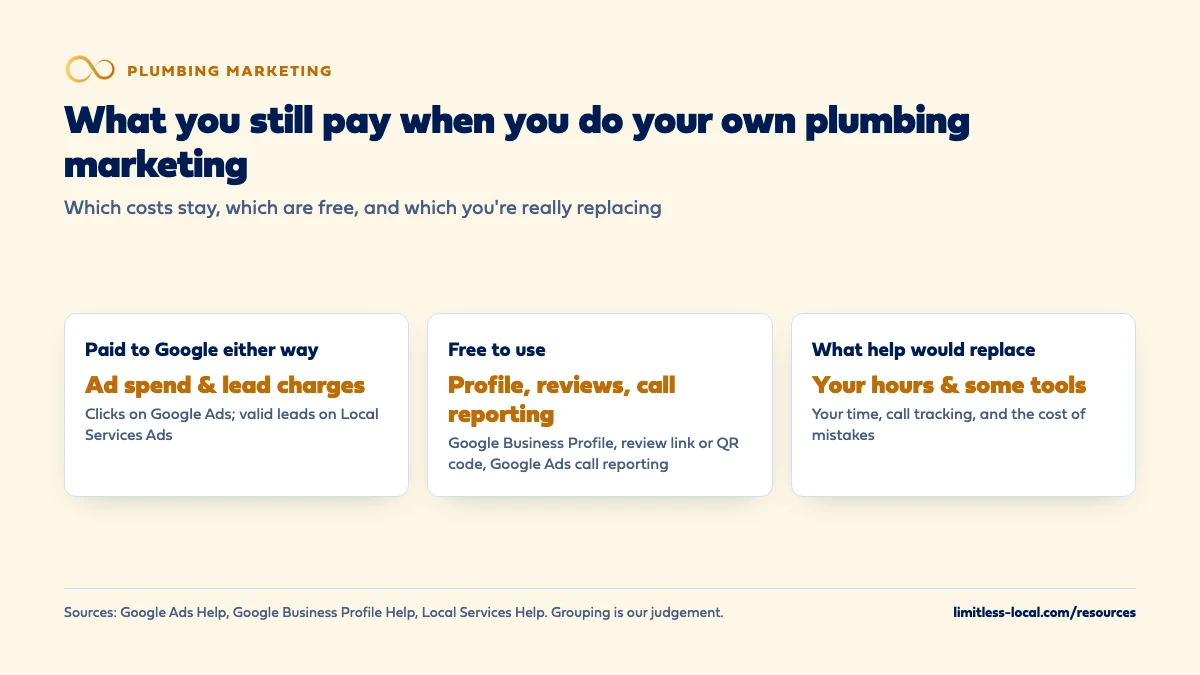
Doing it yourself removes one line: whatever you’d pay someone to run the work. Everything below stays, whoever is at the controls:
- Ad spend paid to Google for clicks, and lead charges for Local Services Ads.
- Your website: hosting or a builder subscription, domain renewal, and any paid plugins or forms.
- Tracking and software: call tracking numbers, and whatever field-service or CRM software you use.
- Photos, design and printing for ads, trucks, door hangers and mailers.
- Your time, or the time of whoever in the office takes it on.
Some costs drop to zero when you do the work yourself, because the tools are free. The rest of this page goes line by line. Whether to hire an agency or do it yourself covers the broader decision.
What will I pay Google for ads either way?
Ad spend doesn’t shrink because you run the account yourself. In Google Ads, you set an average daily budget, and for most campaigns Google won’t charge more than a monthly spending limit of 30.4 times that average daily budget in a month (Google Ads Help: About average daily budgets).
Local Services Ads charge per lead instead of per click. Google says you’re charged for each valid lead you receive, and lead prices may vary depending on your location, the job type, the type of lead and your bidding mode (Local Services Help: How leads work).
What does change is how well the money is spent. In our judgement, the biggest hidden cost of running your own ads isn’t a fee; it’s spend on searches and towns that never book. The marketing traps that waste the most money for plumbers lists the usual leaks.
Which parts of plumbing marketing are free to do myself?
More than most owners expect:
- Your Google Business Profile. Google says you can manage how your business shows up on Maps and Search at no charge, including your hours, phone number, service area, photos and reviews (Google Business Profile Help: Get started).
- Asking for reviews. Google lets you create a link or QR code to request reviews and suggests putting it on receipts and in thank-you emails (Google Business Profile Help: Create a Google link or QR code to request reviews). You don’t need a paid review tool to start.
- Call reporting on ads. Google Ads call reporting uses Google forwarding numbers to show call details and count calls as conversions, and Google doesn’t charge advertisers when someone manually dials a forwarding number; you pay the normal click price when someone taps to call from the ad (Google Ads Help: About call reporting).
- A speed check. Google describes PageSpeed Insights as a free-to-use tool to help you understand your site’s speed (Google Ads: Optimizing your mobile landing page).
These cost time, not money. How to get more Google reviews covers the review part.
What does my plumbing website keep costing after it's built?
A website has running costs even if nobody touches it:
- Hosting or a builder subscription, billed monthly or yearly.
- The domain name. ICANN explains that when you register a domain it’s yours for the period you registered, typically between one and 10 years, and to keep using it, including the website and email tied to it, you have to renew it with your registrar before it expires, or you risk losing it for a short time or for good (ICANN: Renewing Domain Names).
- Paid add-ons such as form, booking or chat tools, and security or backup services.
- Updates: new service pages, photos, prices and hours, which cost time if you do them and money if you don’t.
Keep the domain in your company’s name and on autorenew; losing it means losing your email and your site at once. How much a plumbing company website costs covers the build itself.
Curious what your marketing is actually booking?
Get a free visibility audit — no obligation, no sales pitch.
Do I need to pay for call tracking if I do it myself?
Not for Google Ads alone, since call reporting is built in. In our judgement, you’ll usually want a paid call tracking service once you need separate numbers for your website, Google Business Profile, mailers and truck wraps, so you can tell which one made the phone ring. Google notes you can turn its call reporting off if you’d rather use third-party tracking on your ads (Google Ads Help: About call reporting).
In our judgement, for a one- or two-truck shop running only Google Ads and a Google profile, built-in tools can be enough to start. Once you’re paying for three or more channels, paying for tracking usually costs less than guessing. How to track which plumbing marketing books jobs covers the setup.
What software am I probably already paying for?
If you run ServiceTitan, Housecall Pro or Jobber, some of the tracking is already in the subscription. Jobber’s Lead Source Report, for example, counts leads by source along with how many reached a request, quote, job and invoice, and shows the value of the first invoice tied to each lead (Jobber Help: Lead Source Report).
In our judgement, check what your field-service software already does before paying for a separate CRM, review tool or email platform. Many owners pay twice for the same feature: once in the software they run the business on, and again in a marketing add-on nobody set up fully.
What about photos, design and printing?
These are easy to forget because they come in bursts: a truck wrap, a batch of door hangers, a new logo file for the website, a photographer for a day. In our judgement, real photos of your techs, trucks and jobs from a good phone camera beat stock photos for a plumbing company’s Google profile and website, so this line can stay small.
Printing is different. Mailers and door hangers carry printing and postage costs every time they go out, so treat them like ad spend: give each batch its own tracking number or code and judge it on the jobs it books.

How much is my own time worth in this?
This is the line most owners leave off. Running ads, posting to the Google profile, asking for reviews, updating the site and reading the numbers takes hours every week, and those hours come from somewhere: estimates, field work, hiring, or evenings.
To count it, pick an honest hourly value for your time, such as what you’d pay someone to cover your work, and multiply it by the hours marketing actually takes. Track the hours for a month rather than guessing. In our judgement, the setup months take the most time, because that’s when you’re learning the tools as well as using them.
What do beginner mistakes cost?
Mistakes don’t show up as a line on a bill, which is why they’re easy to miss. In our judgement, the expensive ones for a plumber running their own marketing are ads showing for DIY and job-seeker searches, service areas drawn wider than the trucks go, calls nobody tracks back to a booked job, and a website that loads slowly on a phone.
None of these needs an agency to fix. Each needs someone to check the search terms, the settings and the numbers every month. If you’re doing it yourself, put that check on the calendar; the cost of skipping it is paid in ad spend.
How does the do-it-yourself total compare with paying for help?
Line up only the costs that change. Ad spend and lead charges are paid to Google either way, so leave them out. What you’re comparing is the management fee against your hours, the tools you’d pay for yourself and the money mistakes might waste.
For reference, our packages start at $3,500 a month for Essentials, which covers Google Ads management up to $2,500 a month in spend; Growth, at $4,500 a month, adds Local Services Ads management and up to $5,000 in Google Ads spend. For a small shop with time to learn, doing it yourself can honestly be the cheaper choice. What a plumbing marketing agency costs per month covers what other fees tend to include.
Talk it through with someone who runs this every day
A 15-minute growth call: your market, your numbers, and what a realistic budget looks like. No pressure.
What's different about DIY costs for a plumbing company
Ad spend jumps with the weather. A freeze or a week of storms can push emergency ad spend well past an ordinary week. Doing it yourself means watching budgets during the busiest days, often while you’re also running calls.
Someone has to answer at night. If your ads run after hours, the cost of answering those calls, whether that’s your own phone, an on-call tech or an answering service, belongs in the marketing budget too.
Big tickets change the math. One repipe or sewer line replacement can cover a month of tools and ad spend, so judge the total cost against booked revenue, not against the call count.
A worked example: one month of do-it-yourself costs
These numbers are made up to show the math, not prices or a benchmark for your market. Say a two-truck shop runs its own marketing for a month:
- Google Ads spend: $2,000.
- Local Services Ads lead charges after credits: $600.
- Call tracking and software subscriptions: $150.
- Website hosting and domain: $50.
- The owner’s time: 20 hours at $75 an hour, or $1,500.
The cash out the door is $2,800, and $4,300 once the owner’s time is counted. Of that, $2,650 (the ad spend, lead charges and hosting) is paid no matter who runs the account. The part that hiring help could replace is the owner’s $1,500 of time, plus some of the $150 in tools if tracking comes with the service: up to $1,650, measured against a management fee and whatever results each approach books. A free visibility audit can show where your own setup stands before you decide.
Frequently asked questions
Is a Google Business Profile really free?
Yes. Google says you can manage how your business shows up on Maps and Search at no charge. What it costs is the time to keep it accurate and active.
Do I need a paid review tool?
Not to start. Google lets you create a review link or QR code from your profile. Paid tools can automate the asking, but the asking itself is free, and Google prohibits offering incentives for reviews.
Does Google charge a fee on top of my ad spend?
You pay for clicks on Google Ads and valid leads on Local Services Ads, within your budget. Any management fee comes from whoever runs the account, not from Google.
What happens if my plumbing website's domain expires?
ICANN warns that if you don’t renew it before it expires, you risk losing it for a short time or possibly for good, along with the website and email tied to it.
Can I do some of it myself and pay for the rest?
Yes. In our judgement, the free basics like your Google profile, reviews and photos are the easiest to keep in-house, while ads and tracking are where a beginner’s mistakes cost the most.
Key takeaways
- Doing it yourself removes the management fee; ad spend and lead charges stay the same.
- Your website keeps billing for hosting and domain renewal, and the domain must be renewed before it expires.
- Your Google Business Profile, review link and Google Ads call reporting are free to use.
- Check what your field-service software already does before buying more tools.
- Count your own hours and the cost of mistakes when you compare doing it yourself with paying for help.
Ready to compare options?
Book a short growth call and we'll walk through the math for your service area, including when we're not the right fit.
More in this section
- Should I hire a plumbing marketing agency or do it myself?
- How much should a plumbing company spend on marketing each month?
- How much does a plumbing marketing agency cost per month?
- How much control do plumbers give up by outsourcing marketing?
- What needs fixing before I launch my plumbing marketing?
Sources
- About average daily budgets — Google Ads Help
- How leads work — Google Local Services Help
- Get started with Google Business Profile — Google Business Profile Help
- Create a Google link or QR code to request reviews — Google Business Profile Help
- About call reporting — Google Ads Help
- 5 things to consider when optimizing your mobile landing page — Google Ads
- Renewing Domain Names — ICANN
- Lead Source Report — Jobber Help Center