
How much control do plumbers give up by outsourcing marketing?

- How much control will I have to give up if I outsource my plumbing marketing?
- What do I actually hand over when I outsource plumbing marketing?
- Who should own my Google Ads account and Google profile?
- What level of access should a marketing company get?
- Who decides how much I spend?
- Who decides which plumbing jobs and towns we go after?
- Can I see every change the agency makes?
- What should I approve before it goes live?
- Who talks to my customers when marketing is outsourced?
- What should I get to see every month?
- What control do I keep if I want to leave?
- Can keeping too much control backfire?
- What's different about outsourcing marketing for plumbers
- A worked example: one hour a month of owner control
- Frequently asked questions
- Key takeaways
- More in this section
- Sources
The short version
- Keep ownership: Google Ads, Google Business Profile, domain and tracking numbers in your name.
- Keep the money: pay Google directly and approve any change to the total budget.
- Keep the strategy: which jobs, which towns, which promises.
- Hand over the hours, and check the work monthly in booked jobs.
For plumbing company owners thinking about handing marketing to an agency or freelancer, and worried about losing their grip on the business.
Get a free visibility audit · Book a growth call
How much control will I have to give up if I outsource my plumbing marketing?
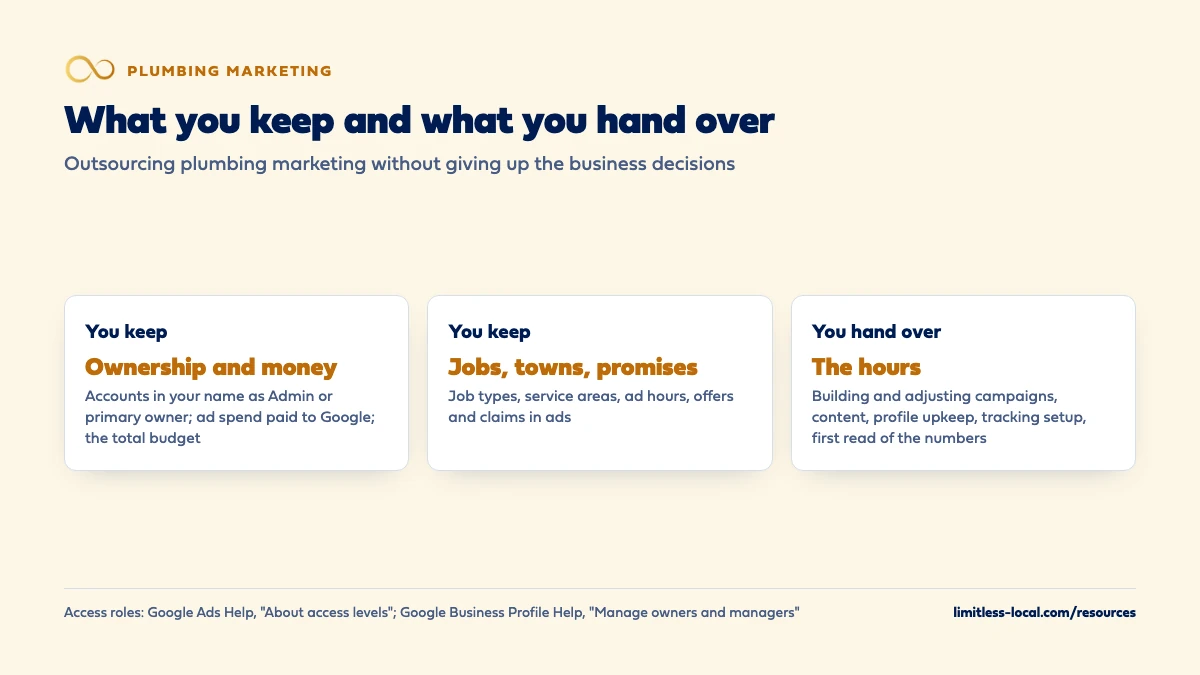
Outsourcing plumbing marketing should cost you control over the day-to-day work, not over the business decisions. A sound setup leaves you owning every account, setting the budget, choosing the jobs and towns you go after, approving anything that makes a promise to customers, and able to see every change and every call. What you hand over is the hours: building campaigns, adjusting them, writing content and reading the reports first.
That split is how we set up every account: the work is ours to do, and the accounts, the budget and the calls stay yours. Ad spend is paid directly to Google, every package includes reporting with a cost-per-lead breakdown and call recording, and the tiers are listed on our marketing packages page. How it fits a plumbing company is on our plumbing marketing page, and the rest of the plumbing marketing questions library goes channel by channel.
What do I actually hand over when I outsource plumbing marketing?
The hours, not the decisions. Done right, outsourcing moves the work off your desk: building and adjusting campaigns, writing ads and web pages, keeping your Google Business Profile current, setting up tracking, and reading the numbers first. Those take time and skill, and they’re what you’re paying for.
What stays with you is the short list of things only the owner should decide:
- Who owns the accounts and the data.
- How much you spend, and on what.
- Which jobs you want and which towns you’ll drive to.
- What your company promises customers, in ads, on the website and in replies to reviews.
- When to change course, based on booked jobs.
In our judgement, if an arrangement asks you to give up anything on that second list, it’s asking for more control than the work requires. If you’re still weighing whether to hand anything off at all, whether to hire a plumbing marketing agency or do it yourself covers that decision.
Who should own my Google Ads account and Google profile?
Your company, every time. Ownership is where control actually lives, and it’s decided when the account is created. Google says that if an agency’s manager account creates a new Google Ads account, the manager automatically becomes its owner, and an account can have only one owner. If the manager links to an account you already have, it doesn’t get ownership unless the account turns it on. Even when a manager owns it, Google says the client account still owns its data and can remove ownership by unlinking (Google Ads Help: About ownership of client accounts).
Your Google Business Profile works the same way. A profile can have several owners but only one primary owner, and owners have full control: they can add or remove users and even delete the profile (Google Business Profile Help: Manage owners and managers). You should be the primary owner. The same goes for your domain, website hosting and tracking phone numbers. Who owns your plumbing website and ad accounts has the full checklist.
What level of access should a marketing company get?
Enough to do the work, not enough to lock you out. Google Ads has five access levels: Email-only, Billing, Read-only, Standard and Admin. Standard access can edit campaigns. Only Admin can give account access, change access levels, accept or reject manager link requests, and unlink manager accounts (Google Ads Help: About access levels). In our judgement, the usual setup is that you hold Admin and the people running the ads work on their own logins.
Google also warns that if an account has only one administrator, you may lose access to your tags if that person becomes unavailable, and suggests adding at least one more. Make sure that second admin is someone at your company, not only the agency.
On your Google Business Profile, managers can edit info, respond to reviews and manage posts, but they can’t add or remove users or remove the profile. That’s the right role for outside help: they can do the daily work, and you keep the keys.
Who decides how much I spend?
You do. A marketing company should recommend a budget and show the math behind it; it shouldn’t set it without you. The cleanest way to keep that control is to pay Google directly, from a card or account in your company’s name, so ad spend and management fees are two separate bills. You can see exactly what Google charged, and a change in one doesn’t hide inside the other.
Google Ads lets you set an average daily budget per campaign, and Google’s access table shows that Standard access, the level you’d usually give the people running your ads, can edit billing information as well as campaigns. So the limit on spend is an agreement, not a setting. Agree up front on what the people running your ads can change on their own (moving money between campaigns inside your total, say) and what needs your yes (raising the total). When to raise or cut your plumbing marketing budget gives you the signals to judge their recommendations.
Who decides which plumbing jobs and towns we go after?
You should, because it’s a business decision, not a marketing one. You know which jobs pay, which ones your techs are good at, and how far a truck can go before the drive eats the margin. The person running your ads turns those decisions into settings.
Those settings live in specific places. In Local Services Ads, you set the job types and industries you provide and the areas you serve, by county, city or zip code, and Google says to update them if your services or locations change (Local Services Help: Edit your industries, service areas, and job types). In search ads, location targeting and an ad schedule control where and when ads show; by default, campaigns are set to show ads all day (Google Ads Help: About ad scheduling). Ask to see these settings once a quarter and confirm they still match the work you want. How many towns a plumbing company should target helps you draw that map.
Curious what your marketing is actually booking?
Get a free visibility audit — no obligation, no sales pitch.
Can I see every change the agency makes?
In Google Ads, yes. Change history lists changes made to your account, campaigns and ad groups during the past 2 years, including when a campaign was paused, who added a keyword and what your previous budgets were. If people use their own logins, the User column shows the email address of the person who made each change through the Google Ads interface (Google Ads Help: About change history).
That’s a strong reason to insist on individual logins rather than one shared password. It also means you don’t have to take a monthly report on faith: if the report says bids were adjusted or bad-fit searches were blocked, the change history should show it. You don’t need to read it every week. In our judgement, a quick look when something in the numbers surprises you is enough.
What should I approve before it goes live?
Anything that speaks for your company to customers. In our judgement, that means:
- Offers and prices in ads and on the website: trip fees, coupons, financing, “free estimate”.
- Promises like response times, around-the-clock service or warranties.
- New pages about your services and towns, at least the first few.
- The tone of review replies, so they sound like your company.
This matters beyond taste. The FTC’s guide for small business says advertising must be truthful and not deceptive, and that advertisers must have evidence to back up their claims before the ad runs (FTC: Advertising FAQs, A Guide for Small Business). If an ad says you arrive in an hour, it has to be true in your service area, and your company is the advertiser. This isn’t legal advice; ask an attorney about specific claims. Routine changes, like adjusting bids or adding negative keywords, shouldn’t need your sign-off.
Who talks to my customers when marketing is outsourced?
Usually your office still does, and in our judgement it should. Marketing brings the call; your team answers it, prices the job and books it. A marketing company can set up tools that help, like call tracking, review requests or automated follow-up, but the conversation with a homeowner is part of your service, not your advertising.
The gray areas are review replies, messages through your Google profile and follow-up texts or emails. Decide who handles each one and how fast. If outside help is replying to reviews, give them a short guide to your tone and a rule for what comes back to you, such as any complaint about a job or a bill. Your customer list and call recordings should sit in accounts you own, so the history stays with you if the help changes.

What should I get to see every month?
Enough to make the decisions you kept. That means results in calls and booked jobs by channel, not only clicks and impressions; what was spent, both on ads and on management; what work was done; and what’s planned next and why.
For what it’s worth, here’s what we commit to. Every package includes a monthly performance report with a cost-per-lead breakdown, call tracking with recording and transcription, form and chat lead tracking with source tagging, and a real-time dashboard. What we promise is transparency: you’ll know what we’re doing, why, and what it produced, and if something isn’t working, we’ll tell you and fix it. How to tell if your plumbing marketing agency is making progress covers what good progress looks like month by month.
What control do I keep if I want to leave?
All of it, if the accounts are in your name. Leaving then means removing someone’s access, not rebuilding from scratch. The things that make leaving hard are the ones to check before you sign: accounts created under the agency, tracking numbers that belong to their phone system, a website on their hosting with no handover clause, and long notice periods.
We work month-to-month. Our standard ask is three months, written into the contract, but we won’t make you stay. Whoever you hire, the contract should say how you leave and what gets handed back. What to look for in a plumbing marketing agency contract lists the clauses.
Can keeping too much control backfire?
Yes. Owners who approve every bid change or rewrite every ad tend to slow the work down, and in our judgement the cost shows up as weeks where nothing gets tested. Changing direction every week also makes the numbers impossible to read, because nothing runs long enough to judge.
The balance that tends to work: hold the decisions on ownership, money, jobs, towns and promises; set a few clear rules for what needs your yes; then judge the work monthly on cost per booked job. If you find you don’t trust the people doing the work enough to step back, that’s useful information about the relationship, not a reason to do their job for them.
Want to see where your company stands?
A free visibility audit shows where you show up on Google, Maps and AI answers, and what it's costing you in calls.
What's different about outsourcing marketing for plumbers
Your calls are urgent, so your phone setup is part of marketing. Whoever runs your ads will want to control where calls ring and when ads run. Keep the final say on both, because you’re the one who knows who’s on call tonight and whether anyone can take a burst-pipe call at 2 a.m.
Emergency and planned work need different instructions. Tell the people running your marketing which jobs are worth the most to you, like water heater replacements, repipes and sewer lines, and which ones you’d rather not chase. Without that, campaigns tend to chase whatever brings the most calls.
Your software holds the truth. Booked jobs live in ServiceTitan, Housecall Pro, Jobber or FieldPulse, not in the ad account. Decide who marks each call’s outcome and how the marketing reports get those numbers, or you’ll be judging the work on leads alone.
A worked example: one hour a month of owner control
The split below is made up to show what staying in control can look like once the work is handed off. It isn’t a rule. Say you outsource ads and SEO and keep one hour a month for yourself:
- 20 minutes on the monthly report. Cost per booked job by channel, total spend on ads and on management, and what’s planned next.
- 15 minutes on settings. Change history for anything surprising, plus a quick check that job types, towns and ad hours still match the work you want.
- 15 minutes on calls. Listen to a handful of recorded calls, to hear what customers asked and how your office answered.
- 10 minutes on approvals. Next month’s offers, any new promises in ads, and new pages.
That’s 60 minutes, and it covers every decision the owner should keep. If the hour regularly turns up surprises, that tells you more about the relationship than any report. A free visibility audit is a reasonable first step if you want an outside look at what you’d be handing over.
Frequently asked questions
Should I give my marketing company Admin access to Google Ads?
In our judgement, keep Admin yourself and give the people running your ads Standard access, which Google says can edit campaigns. Only Admin can manage users and unlink manager accounts.
Can an agency delete my Google Business Profile?
Only an owner can remove the profile. Google says managers can edit info, respond to reviews and manage posts, but can’t add or remove users or remove the profile.
Do I have to share my ServiceTitan or Housecall Pro login?
Not usually. The marketing side needs to know which calls became booked jobs and what they were worth, which can come from a report or a limited-access user rather than full access to your field software.
Can I keep doing my own Google posts and review replies?
Yes. You can keep the parts that are about your customers and hand off ads and SEO. Just agree who does what so nothing gets done twice or not at all.
Will an agency change my ads without asking?
Routine changes like bids and negative keywords usually happen without sign-off, and that’s normal. Agree in writing which changes need your approval, such as the total budget, new offers or new promises.
What if an agency set up my accounts in its own name?
Ask now, while the relationship is friendly, for primary ownership of the Business Profile to move to your company, and for Admin access to the Google Ads account with the agency’s manager ownership turned off. Google’s help pages explain both steps.
Key takeaways
- Outsourcing should hand over the hours, not the business decisions.
- Own every account; hold Admin in Google Ads and primary ownership of your Google profile.
- Pay Google directly and approve changes to the total budget.
- You choose the jobs, towns, ad hours and promises; others turn them into settings.
- Change history and call recordings let you check the work without doing it.
- Too much control slows the work down; set clear approval rules and judge monthly.
Not sure what's working right now?
Start with a free visibility audit: rankings, Google profile, reviews and tracking, checked against your service area.
More in this section
- How much should a plumbing company spend on marketing each month?
- Should I hire a plumbing marketing agency or do it myself?
- How much does a plumbing marketing agency cost per month?
- What marketing traps waste the most money for plumbers?
- What makes a good plumbing marketing company?
Sources
- Manager Accounts (MCC): About ownership of client accounts — Google Ads Help
- About access levels in your Google Ads account — Google Ads Help
- Manage your Business Profile owners & managers — Google Business Profile Help
- About change history — Google Ads Help
- Edit your industries, service areas, and job types — Google Local Services Help
- About Ad Scheduling — Google Ads Help
- Advertising FAQ's: A Guide for Small Business — Federal Trade Commission