
How many towns should my plumbing company target?

- How many service areas can a plumbing company cover without spreading too thin?
- Is there a right number of towns for a plumbing company?
- What limits does Google put on a plumbing service area?
- How far can my trucks really go on an emergency call?
- How do I tell which towns already pay off?
- How many towns can my crew size actually cover?
- Does listing more towns get my plumbing company more calls from Google Maps?
- Should my Google Ads target the same towns as my Google profile?
- When should I add another town?
- Should every town I target get its own page on my website?
- When is it time for a second location instead of more towns?
- What's different about service areas for plumbing companies
- A worked example: cutting a 22-town list to the towns that pay
- Frequently asked questions
- Key takeaways
- More in this section
- Sources
The short version
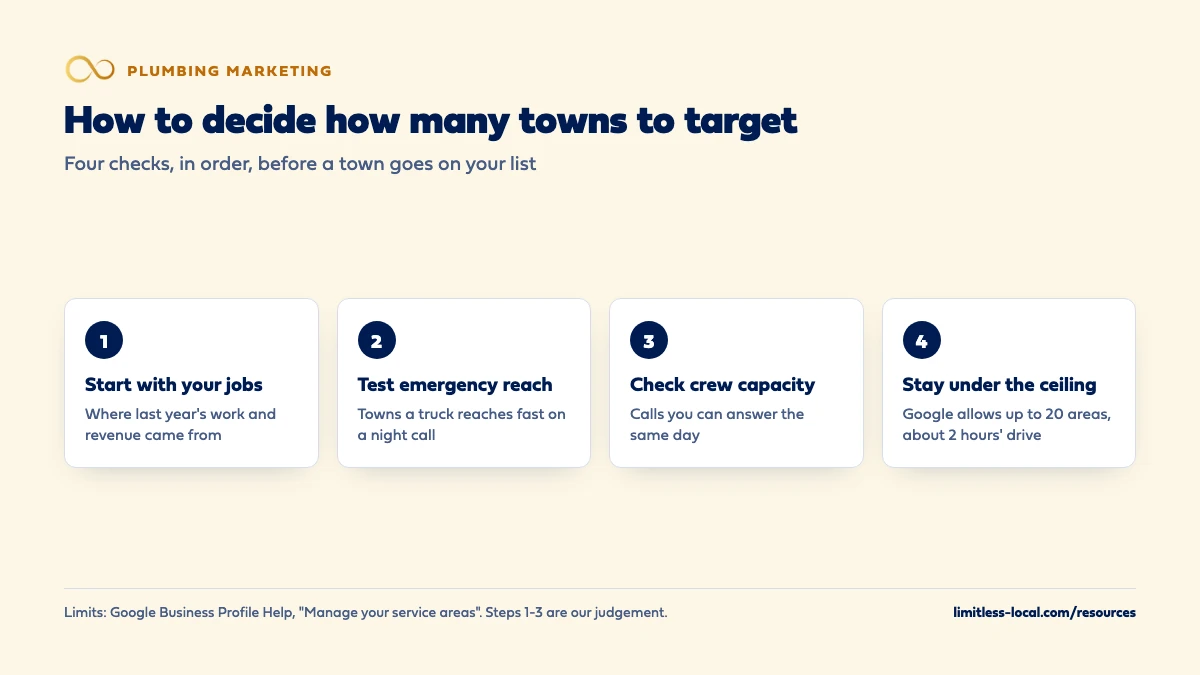
- Google's limit is up to 20 service areas, about 2 hours' drive at most; that's a ceiling.
- Start with the towns where last year's jobs came from and where a truck arrives fast at night.
- Cap the list at what your crew can answer the same day; extra towns you can't serve cost reviews.
- Add a town when the core is steady and you can staff it, not to look bigger.
For plumbing owners deciding how wide their Google service area, ads and website should reach before adding another town.
Get a free visibility audit · Book a growth call
How many service areas can a plumbing company cover without spreading too thin?
Fewer than most owners list: target the towns your trucks can reach quickly on an emergency call, where your jobs already come from, and that your crew can actually keep up with. Google lets a service-area business list up to 20 cities or ZIP codes, with the overall area no more than about 2 hours’ drive from where you’re based, but that’s a ceiling, not a goal. In our judgement, start with one tight core of towns and add growth towns only when the core is busy and you have a truck to send.
Choosing the towns comes before the Google profile, ads and city pages that are part of our local SEO work for plumbing companies: every one of those gets aimed at a list of towns, so the list has to be right first. The rest of the plumbing marketing questions library covers each channel one question at a time.
Is there a right number of towns for a plumbing company?
No single number fits every shop, because the answer depends on three things you already know better than any marketer: how far your trucks can get in a reasonable time, where your jobs come from today, and how many calls your crew can take in a day. A two-truck shop in a dense suburb may be stretched by eight towns that sit close together. A rural shop may need fifteen spread-out towns just to find enough work.
What we can say is where the number should come from. In our judgement, the right list is the overlap of three circles:
- Reach: towns a truck can get to fast enough for a burst pipe or a backed-up sewer line.
- Demand: towns where you’ve already done paying work, or where you have a clear reason to expect it.
- Capacity: the total area your plumbers can cover without pushing every call to tomorrow.
Towns outside that overlap aren’t off limits forever. They’re towns you take scheduled work in when it comes, without spending marketing money to pull more of it.
What limits does Google put on a plumbing service area?
For your Google Business Profile, the rules are short (Manage your service areas for service-area & hybrid businesses):
- You can set up to 20 service areas, by city, postal code or another type of area.
- You can’t set a radius around your business anymore.
- The boundaries of your overall area shouldn’t be more than about 2 hours of driving time from where your business is based.
- Google asks you to be as specific and accurate as possible.
Google’s guidelines repeat the 2-hour boundary and add that for some businesses larger service areas may be appropriate (Guidelines for representing your business on Google). Local Services Ads keep a separate list: in that account you include or exclude areas by county, city or ZIP code (Edit your industries, service areas, and job types).
None of those limits tells you how many towns to pick. They tell you the most you’re allowed to claim. Whether the profile itself should hide your address is covered in setting up as a service-area business.
How far can my trucks really go on an emergency call?
This is the test that matters most for a plumber, and it’s different from the test a remodeler or a pool builder would use. A homeowner with water coming through the ceiling calls whoever answers and can come soonest. If you take that call in a town forty-five minutes away, you either arrive late or turn it down, and in our judgement both outcomes cost more than the job is worth: a slow arrival invites a poor review, and a turned-down call is marketing money spent for nothing.
A practical way to draw the line:
- Mark where your trucks usually start the day and where your on-call plumber lives.
- Ask your dispatcher or yourself: which towns could we reach within the time you’d want to promise on a night call?
- Check that answer against rush hour, river crossings and highways that back up. A town that’s close on the map can be far at 5 p.m.
Towns inside that line can be marketed for emergency work. Towns outside it can still be listed for planned work like water heater installs or repipes, if you say so on your website, but in our judgement they shouldn’t get emergency ad spend.
How do I tell which towns already pay off?
Use your own job history before anyone’s opinion, including ours. Export a year of completed jobs from ServiceTitan, Housecall Pro, Jobber or whatever you run, and sort it by town or ZIP code. For each town, look at three numbers:
- Number of jobs. Where the work already comes from.
- Revenue. Some towns send fewer calls but bigger tickets: water heaters, sewer lines, repipes.
- Drive time per job. A town that pays well but eats half a day per call may be worth less than it looks.
In our judgement, most shops find that a small group of towns produces most of the revenue, and a long tail of towns produces a handful of jobs each. The core group is your starting service area. The tail is where you decide, town by town, whether you want more of that work or are happy taking it when it comes.
If you can’t tell which marketing brought those jobs in, that’s a separate problem worth fixing first, because the town list should rest on booked jobs, not on calls alone.
Curious what your marketing is actually booking?
Get a free visibility audit — no obligation, no sales pitch.
How many towns can my crew size actually cover?
Capacity is the limit owners skip. Every town you add is a promise that someone will answer and show up. If your plumbers are already booked out, a wider service area doesn’t bring more revenue; it brings more calls you push to next week, and in our judgement many of those callers simply ring the next plumber.
Two rough checks before you widen the list:
- Same-day rate. What share of calls in the last month got a plumber the same day? If it’s falling, your current towns already fill your schedule.
- Drive time share. How much of a plumber’s day is spent driving rather than working? Adding far towns usually pushes this up.
If both look healthy and you still have open slots, you have room for more towns. If not, the question isn’t how many towns to target; it’s whether to hire, which is covered in marketing before or after hiring another plumber.
Does listing more towns get my plumbing company more calls from Google Maps?
Not by itself. Google says local results are mainly based on relevance, distance and popularity, and that distance refers to how far each business is from the customer who’s searching (Tips to improve your local ranking on Google). Google describes the service area as showing customers where you can provide your services. Its help pages don’t say that adding a town to the list helps you rank there.
In our judgement, the practical result is that most plumbers show up best in Maps near where the business is based, whatever the service area says. Listing twenty towns doesn’t change where you’re based. It does tell customers you’ll come to them, so list only towns where that’s true.
What you can and can’t do about distance is covered in ranking on Google Maps outside your office area, and the wider ranking picture in getting into the Google map pack.
Should my Google Ads target the same towns as my Google profile?
In our judgement, yes, with one exception: ads can be narrower. The profile describes everywhere you work. Paid ads should go where a click is most likely to become a booked job you can serve fast, which is usually the core.
Two Google Ads settings matter here. First, location targeting by default reaches people who are in, regularly in, or have shown interest in your targeted locations; you can limit it to people in or regularly in those locations, which Google calls Presence (About advanced location options). For an emergency trade, in our judgement, Presence is usually the safer choice, because the person who needs a plumber is standing in the flooded house. Second, Google says that when you target an area, it may also show your ad in nearby, closely related areas (About targeting geographic locations), so check the locations report and exclude towns you don’t serve.
In our judgement, a smaller set of towns also makes a modest budget go further: the same daily spend covers fewer searches, so the ads are less likely to run out of money before lunch.

When should I add another town?
In our judgement, add a town when all of these are true, not just one:
- The core is steady. Calls in your existing towns have been reliable for a few months, not just one busy week.
- You have a reason to expect demand. You already get scattered calls from there, a builder or property manager you work with is active there, or it’s a growing area right next to your core.
- You can reach it. It passes the emergency drive-time test from where your trucks start.
- You can staff it. Someone can take the extra calls without pushing your core customers to tomorrow.
Add one or two towns at a time and watch them for a couple of months before adding more. Change the Google profile, the ads and the website together so they tell the same story. If you add six towns at once and calls change, you won’t know which town did it.
Should every town I target get its own page on my website?
No. In our judgement, a town earns its own page when you can say something specific and true about working there: the jobs you do in that town, local housing stock, the water or sewer issues you see, reviews from customers who live there. A page that swaps the town name into the same paragraph twenty times risks what Google’s spam policies call doorway abuse: sites or pages created to rank for specific, similar search queries (Spam policies for Google web search).
That’s another reason to keep the target list tight: a short list of towns you know well gives you real material for each page. Towns without their own page can still be named on your service-area page. The step-by-step version is in building plumbing city pages without spam.
When is it time for a second location instead of more towns?
When the towns you want are past what one base can serve. If the only way to reach a promising area is a long drive from your shop, adding it to the service area won’t fix the drive. Google’s guidelines allow one profile per location for a service business that has different locations with separate service areas and separate staff at each (Guidelines for representing your business on Google).
In our judgement, that means a real branch: trucks and plumbers based there, not a mailbox or a desk you rent to look local. A virtual office isn’t eligible for a profile under the same guidelines. If you’re at that point, the steps are in marketing a second plumbing location.
Not sure which of these is costing you jobs?
A free visibility audit checks the Google profile, reviews, site and tracking, and shows what to fix first.
What's different about service areas for plumbing companies
Emergencies set the boundary. A large share of plumbing work starts with something going wrong right now. That makes response time part of what you’re selling, and in our judgement it should draw the outer edge of your target towns more than any marketing consideration.
Two kinds of towns. Plumbers often have a tight emergency area and a wider area for planned, high-ticket work like water heaters, sewer replacements and repipes. It’s reasonable to treat them differently: market emergency service only where you’re fast, and mention planned work in the farther towns on your website without paying to push it.
On-call coverage matters. Where your on-call plumber lives at night can matter as much as where the shop is during the day.
A worked example: cutting a 22-town list to the towns that pay
These numbers are made up to show the method, not a benchmark for your market. Say a four-truck plumbing company lists 22 towns on its Google profile and runs ads in all of them. It exports last year’s completed jobs: 1,000 jobs.
Sorted by town, 12 towns within reach of a night call produced 850 jobs, which is 85% of the total. The other 10 towns produced 150 jobs between them, mostly planned work, and the office remembers several night calls from those towns it couldn’t reach in time.
The decision: keep the 12 core towns on the profile and in the ads, with location targeting set to people in or regularly in those towns. Keep the farther towns on the website as places the company does scheduled work, with no ad spend aimed at them. Leave room under Google’s limit of 20 to add one or two growth towns next to the core later, once a fifth truck is on the road.
Business listing cleanup and Google Business Profile management are part of our Essentials package at $3,500 a month for one location, and a free visibility audit is a reasonable way to check where your profile shows up across your towns today.
Frequently asked questions
Is it bad to list all 20 service areas Google allows?
Not against the rules, if they’re accurate and within about 2 hours’ drive. In our judgement it’s only a problem when you list towns you can’t serve quickly, because those calls turn into late arrivals or turned-down jobs.
Can I list a whole county instead of individual towns?
Google says you can set service areas by city, postal code or another type of area, and Local Services Ads let you add a county. Use whatever matches where you really go. Source: Manage your service areas.
Should I target a wealthy town farther away for bigger jobs?
Maybe for planned work, if your job data shows bigger tickets there and the drive is workable. In our judgement, don’t buy emergency ads there unless a truck can arrive fast.
Does a smaller service area hurt me in Google Maps?
Google doesn’t say it does. It says local results are mainly based on relevance, distance and popularity. Source: Tips to improve your local ranking on Google.
How often should I review my target towns?
In our judgement, once or twice a year with fresh job data, and whenever you add or lose a truck. Change the profile, ads and website together.
Key takeaways
- Google allows up to 20 service areas within about 2 hours’ drive; treat that as a ceiling, not a target.
- Start from last year’s jobs and revenue by town, then cut to towns a truck can reach fast on a night call.
- Cap the list at what your crew can answer the same day; towns you can’t serve cost reviews and ad money.
- Listing a town doesn’t make you rank there; Google bases local results mainly on relevance, distance and popularity.
- Add one or two towns at a time, and open a real second location when the towns you want are beyond one base.
Want a second set of eyes on your setup?
We'll look at how you show up locally and where calls are leaking, then send you a plain-English breakdown.
More in this section
- Should my plumbing company be set up as a service-area business?
- Which plumbing services should I advertise first?
- How do I market a second plumbing location?
- How should a plumbing company market to commercial customers?
- How should a new plumbing company get its first customers?
Sources
- Manage your service areas for service-area & hybrid businesses — Google Business Profile Help
- Guidelines for representing your business on Google — Google Business Profile Help
- Tips to improve your local ranking on Google — Google Business Profile Help
- Edit your industries, service areas, and job types — Google Local Services Help
- About advanced location options — Google Ads Help
- About targeting geographic locations — Google Ads Help
- Spam policies for Google web search — Google Search Central