
How do I get my plumbing company into the Google map pack?
- How does a plumbing company get into the top Maps results, and how long does it take?
- What is the map pack, and why does it matter for a plumber?
- What decides which plumbers show up in the map pack?
- Should my plumbing company show its address on Google?
- How should I set my service area so it helps?
- Why do I show up near my shop but not across town?
- How much do reviews matter for getting into the map pack?
- Can an old website and one truck still get into the map pack?
- What keeps plumbing companies out of the map pack?
- How long until my plumbing company shows up better in Maps?
- Can I pay to show up on Maps while my ranking builds?
- What's different about the map pack for plumbing companies
- A worked example: is map pack work paying off?
- Frequently asked questions
- Key takeaways
- More in this section
- Sources
The short version
- The map pack is Google's short list of local Business Profiles shown with a map, ranked mainly on relevance, distance and popularity.
- Most plumbers are service-area businesses: hide a home address and list up to 20 towns or ZIP codes you really serve.
- Distance favors plumbers near the searcher; reviews, links and a website that matches your profile are how you compete farther out.
- Profile fixes show in days to weeks, reviews and links take months, and nobody can buy an organic spot.
For plumbing owners who want to show up in the map results when someone nearby searches for a plumber, and want to know what actually moves that and how long it takes.
Get a free visibility audit · Book a growth call
How does a plumbing company get into the top Maps results, and how long does it take?
Google says local results on Search and Maps are mainly based on relevance, distance and popularity (how well known a business is), and that there’s no way to request or pay for a better local ranking. For most plumbing companies that means a verified Business Profile with the home address hidden and an honest service area, accurate categories, services and hours, a steady flow of genuine reviews, and a website that matches the profile. Verification and profile fixes take days to weeks, while the popularity that holds a spot in the map pack builds over months, so ads are the faster way to appear on Maps in the meantime.
Getting into the map pack is one of the three places we work on for owners, alongside the regular Google results and AI answers, as part of our local SEO work. It’s the same work we describe on our plumbing marketing page: a clean Google profile, consistent listings and a site that backs them up, judged on booked service calls rather than rankings. The rest of the plumbing marketing questions library goes question by question.
What is the map pack, and why does it matter for a plumber?
When someone searches for a business near them, Google shows local results on Search and in Google Maps (Tips to improve your local ranking on Google). On Search, owners and marketers call the short list of Business Profiles shown with a map the map pack. It isn’t Google’s own name for it.
For a plumber it matters more than for most trades, in our judgement, because so much of the work is urgent. A homeowner with water coming through the ceiling isn’t reading ten websites. They look at the few listings with stars and a call button, and they call one.
What decides which plumbers show up in the map pack?
Google says local results are mainly based on relevance, distance and popularity, and describes each one (Tips to improve your local ranking):
- Relevance: how well your Business Profile matches what someone searched for. Complete, detailed business info helps Google match you to the right searches.
- Distance: how far your business is from the person searching. If they don’t share their location, Google uses what it knows about where they are.
- Prominence (popularity): how well known your business is, based partly on how many websites link to you and how many reviews you have. Google says more reviews and positive ratings can help your local ranking.
Google adds two practical points on the same page. Verifying your business makes it more likely to show up, and a profile with inaccurate information might not show up for relevant searches in your area. The field-by-field profile work is covered in optimizing your plumbing Google profile; this page is about the map pack as a whole and how long getting there takes.
Should my plumbing company show its address on Google?
Usually not. Google uses a plumber as its own example of a service-area business: one that goes to customers and doesn’t serve them at its business address (Manage your service areas). Its guidelines are direct about it: if you’re a plumber and run your business from your residential address, clear the address from your Business Profile (Guidelines for representing your business on Google).
The rules that matter for plumbing shops:
- A service-area business gets one profile for the whole area it serves, tied to its central office or location.
- You can show an address only if customers can actually come there: a staffed location that receives customers during your stated hours, with permanent signage.
- A rented mailing address you don’t operate from, also called a virtual office, isn’t eligible. P.O. boxes and remote mailboxes aren’t acceptable either.
- If you hide your address and don’t enter a service area, Google chooses a local area for you (Manage your business address).
In our judgement, the riskiest mistake is renting a mailbox or desk in the town you wish you ranked in. It breaks the guidelines Google ties to suspensions and puts the whole listing at risk.
How should I set my service area so it helps?
Google’s service area rules are short (Manage your service areas):
- You can list up to 20 service areas, by city, ZIP code or other area.
- You can’t set a radius around your shop anymore.
- The overall area shouldn’t stretch more than about 2 hours of driving from where your business is based.
- Be as specific and accurate as possible. Approved service area edits can take up to 48 hours to show.
For a plumber, our test is simple: list the towns where you’ll actually send a truck at night for a burst pipe, not every town you’d take a big job in. A service area drawn wide doesn’t put you closer to anyone, and it can fill your phone with calls you’ll turn down. If you run Local Services Ads, the same honesty matters there, because their targeting is based on the service categories and areas you offer (Google Ads Help); whether LSAs are worth it for plumbers covers that side.
Curious what your marketing is actually booking?
Get a free visibility audit — no obligation, no sales pitch.
Why do I show up near my shop but not across town?
That’s distance doing what Google says it does. Your profile is tied to where your business is based, and searchers closer to another plumber’s base will often see that plumber first. Google doesn’t publish how far is too far, and it doesn’t say that hiding your address changes your distance. In our judgement, listing a town in your service area tells customers you work there; it doesn’t move you closer to someone searching from that town.
- Check from where your customers are. A search from your own kitchen tells you little about what a homeowner sees twenty minutes away. Search from a phone while you’re on a job in the towns you care about, and write down who’s in the map results each time.
- Compete on prominence farther out. You can’t change where your shop is, but reviews, links to your website and a profile that matches the search are the parts Google says it weighs that you can build.
For most one- and two-truck shops the honest goal is the towns closest to home first, then outward.
How much do reviews matter for getting into the map pack?
They’re one of the clearest levers Google names. Prominence is based partly on how many reviews you have, and Google says more reviews and positive ratings can help your local ranking. (Tips to improve your local ranking)
Google doesn’t publish a review count that gets a plumber into the map pack, and anyone quoting one is guessing. A more useful check: look at the plumbers who show up for your main searches in your best towns, and note their rating and how many reviews they have. In our view, a steady flow of reviews from real jobs beats a one-time push.
Getting more Google reviews covers how to ask on every job, and what Google doesn’t allow.
Can an old website and one truck still get into the map pack?
Yes, but the old website is usually the part to fix. Google builds profile information from several sources, including publicly available information such as content crawled from your official website (How Google sources info in Business Profiles). If your site lists fewer services than your profile, shows an old phone number, or spells your business name differently, Google and homeowners are getting mixed signals. Google’s guidelines ask you to represent your business the way it’s consistently represented in the real world, across signage, stationery and other branding.
In our judgement, the order is: make the name, phone and services on the website match the profile exactly, then add a clear page for each main service you want calls for (drain cleaning, water heaters, sewer lines, repipes) and mention the towns you serve. That gives the profile something to match against, and gives other sites something worth linking to.
One truck isn’t a problem in itself. Google’s ranking factors say nothing about the size of your fleet, and its video verification instructions for service-area businesses even suggest showing your tools or unlocking a van with your business branding as proof you run the business (Verify your business with a video recording).
What keeps plumbing companies out of the map pack?
Most of it is avoidable. From Google’s guidelines (Guidelines for representing your business on Google):
- Extra words in the name. Google says unnecessary information in the business name isn’t permitted and could get the profile suspended. Its examples rule out hours, service descriptions, location details and phone numbers. “Smith Plumbing” is fine if it’s on the truck; “Smith Plumbing 24/7 Emergency Drain Cleaning” is not.
- An address that isn’t a real place of business. Mailboxes and virtual offices, as above.
- More than one profile for the same business. Google says there should only be one profile per business. A second profile for your drain-cleaning side at the same shop counts. Google allows a separate profile for a second brand at one location only if the brands operate independently.
How long until my plumbing company shows up better in Maps?
It splits into fast parts and slow parts.
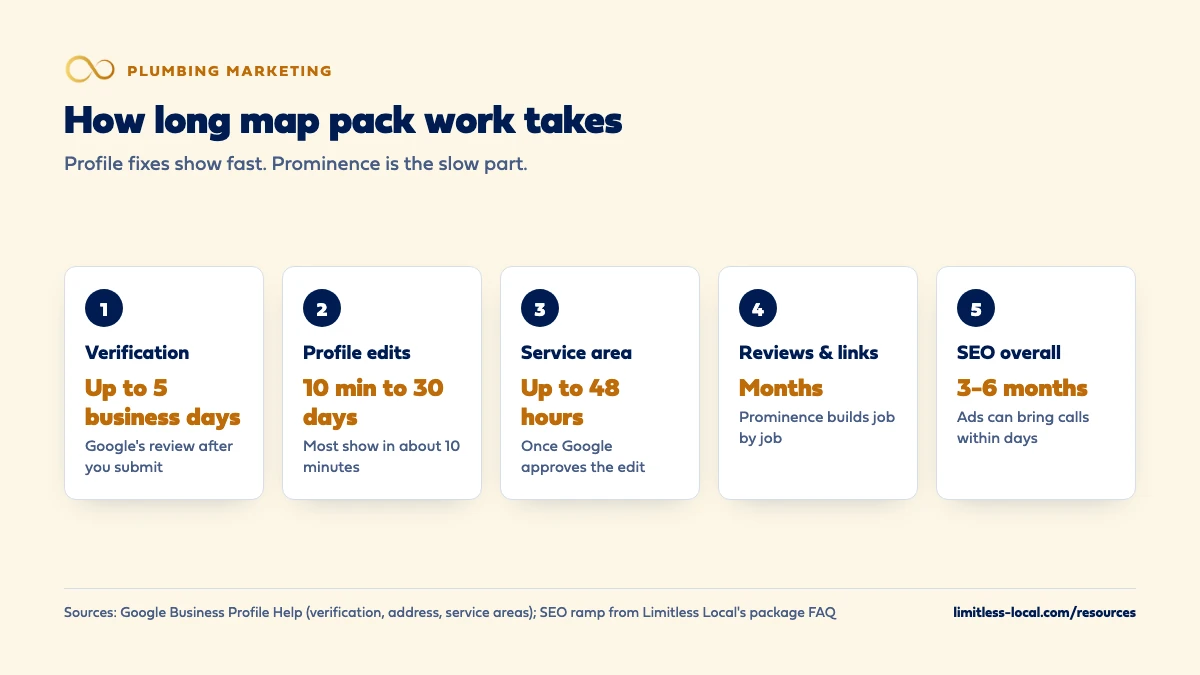
- Verification: after you complete the steps, Google’s review takes up to 5 business days, and occasionally longer. If you verify by postcard, most codes arrive within 14 days, and editing your name, address or category while you wait makes the code stop working (Verify your business on Google).
- Profile edits: changes usually take about 10 minutes to show, and in some cases up to 30 days (Manage your business address).
- Service area edits: up to 48 hours once approved.
- Prominence: reviews and links build one job and one mention at a time. There’s no published timeline, because it depends on how strong the plumbers around you already are.
Our general rule is that SEO typically takes 3-6 months to show meaningful growth, while ads can bring calls within days of launch. Map pack work follows the same ramp. Anyone promising a top spot by a date is promising something Google itself says nobody can buy. A brand-new shop has the longest road, which how a new plumbing company gets its first customers covers.
Can I pay to show up on Maps while my ranking builds?
Not inside the organic list, but next to it, yes. Local Services Ads show on Google Search and Google Maps, and they’re now moving into Google Ads as Performance Max campaigns with pay-per-lead goals. Google names plumbing in the first phase of that move, which began in August 2026 for select advertisers, and says the ads keep showing only on Search and Maps, in the same positions as before (Local Services Ads transition to Performance Max). Google also says the move expands to service-area businesses without storefronts in late 2026, so a home-based plumbing company may move later than a shop with a storefront.
In our judgement, that’s the sensible way to cover the gap: ads for calls now, profile and review work for the spot that doesn’t cost per lead later. Compare both on cost per booked job, and turn the ad budget down as organic calls come in.
Talk it through with someone who runs this every day
A 15-minute growth call: your market, your numbers, and what a realistic budget looks like. No pressure.
What's different about the map pack for plumbing companies
Emergency searches at all hours. Google’s own example of how business information is used is a business showing up for an “open now” search because it provided its hours (How Google sources info in Business Profiles). For plumbers, the night and weekend searches are where that counts. List the hours someone actually answers the phone. If after-hours calls go to voicemail, stopping lost after-hours calls matters more than any ranking change.
Home-based and single-truck shops. Plenty of plumbing companies run from the owner’s house. Google’s guidelines use exactly that case as the example: clear the residential address and set a service area. A home-based shop can still verify by video by recording the neighborhood, the tools and the branded van.
Emergency calls versus planned jobs. A burst pipe call goes to whoever is close and looks open. A repipe or a tankless water heater install gets compared. In our judgement, distance and hours carry the emergency searches, while reviews and a strong website carry the bigger jobs, so work on both.
A worked example: is map pack work paying off?
These numbers are made up to show the math, not a benchmark for your market. Say your Business Profile’s Performance report shows 40 calls in March. Your call log shows 26 of them were new customers asking for work you do, and 9 of those booked.
Six months later, after fixing the address, tightening the service area, cleaning up the website and asking for reviews on every job, the same month shows 58 calls, 39 new-customer calls and 15 booked jobs. That’s 6 more booked jobs a month. If your average ticket on those jobs is $450, it’s about $2,700 a month in extra revenue before the cost of doing the work.
Now the honest part. Our Essentials package is $3,500 a month and includes Business Profile management, listing cleanup and Google Ads management. If those 6 jobs were the only result, profile work alone wouldn’t pay for it. The math works when profile, website and ads together raise booked jobs, or when the extra calls include bigger tickets like water heaters and sewer lines.
Frequently asked questions
Is the map pack the same as Google Maps?
They draw on the same Business Profiles. Google shows local results both on Search, where the map pack appears, and in Google Maps, and says local results are mainly based on relevance, distance and popularity (Google Business Profile Help).
Will adding my city to my business name help me rank?
Not unless the town is part of your real-world name, the way it appears on your trucks and invoices. Google says unnecessary information in the business name isn’t permitted and could result in suspension, and it lists location information among the things a name must not include. Put towns in your service area instead.
Can I make a separate profile for each town I serve?
No. A service-area business gets one profile for the whole area it serves. Separate profiles are only for separate locations with their own service areas and their own staff.
Do I need a website to get into the map pack?
You can have a Business Profile without one, but Google compiles profile information partly from your official website, and prominence is based partly on how many websites link to you. In our judgement, a plumbing company without a decent site gives up part of what Google weighs.
Can someone guarantee me a spot in the map pack?
No. Google says there’s no way to request or pay for a better local ranking, and the plumbers around you keep changing too. Treat a promised position as a reason to keep looking.
Key takeaways
- Google ranks local results mainly on relevance, distance and popularity, and nobody can pay for an organic spot.
- Most plumbers should hide a home address and list only the towns they’ll really drive to, up to 20 areas.
- Distance favors whoever is closest; reviews, links and a website that matches the profile are how you compete farther out.
- Verification and edits take days to weeks; prominence takes months.
- Use ads to cover the gap, and judge every channel on cost per booked job.
Ready to compare options?
Book a short growth call and we'll walk through the math for your service area, including when we're not the right fit.
More in this section
- How do I get more Google reviews for my plumbing company?
- How do I optimize my plumbing Google Business Profile?
- Are Google Local Services Ads worth it for plumbers?
- Why are my plumbing Google Ads getting clicks but no calls?
- How do I get more plumbing leads?
Sources
- Tips to improve your local ranking on Google — Google Business Profile Help
- Guidelines for representing your business on Google — Google Business Profile Help
- Manage your service areas for service-area & hybrid businesses — Google Business Profile Help
- Manage your business address — Google Business Profile Help
- Verify your business on Google — Google Business Profile Help
- Verify your business with a video recording — Google Business Profile Help
- Understand how Google sources & uses info in Business Profiles & local search results — Google Business Profile Help
- Local Services Ads transition to Performance Max campaigns with pay-per-lead goals — Google Ads Help