
How do I get more plumbing leads?

- What actually brings a plumbing company more leads in 2026?
- Where do plumbing leads actually come from?
- Am I getting enough plumbing leads now?
- How do I get more leads from my Google Business Profile?
- How do reviews turn into more plumbing calls?
- Should I run Local Services Ads to get more plumbing leads?
- How do Google search ads bring in plumbing leads?
- How do I get more plumbing leads with an old website?
- How do I stop losing the plumbing leads I already get?
- How do I get more repeat customers and referrals?
- How do I know which lead sources are worth the money?
- What's different about getting more plumbing leads
- A worked example: answering calls before buying more leads
- Frequently asked questions
- Key takeaways
- More in this section
- Sources
The short version
- Start with the free channels: a complete, verified Google Business Profile and a habit of asking every customer for a review.
- Add Local Services Ads or Google search ads when you need calls faster than the free channels bring them.
- Answer every call, including after hours, before paying for more leads.
- Compare channels on cost per booked job, not lead count.
For plumbing company owners who want the phone to ring more, and want to know which channel to work on first.
Get a free visibility audit · Book a growth call
What actually brings a plumbing company more leads in 2026?
Most plumbing companies get more leads by fixing the free channels first, a complete Google Business Profile and a steady flow of Google reviews, then adding paid search, either Local Services Ads or Google search ads, which can bring calls within days. Just as important is answering every call, day and night, because many plumbing leads are emergencies that call the next plumber if nobody picks up. Judge every channel by what each booked job cost, not by how many leads it sent.
That last point is how we work too: the number that matters is what each booked job cost. Our process starts with the foundation (tracking, follow-up and a clean Google presence) before turning up lead flow with local SEO and ads, and it comes together in our marketing packages for plumbing companies. The rest of the plumbing marketing questions library takes each channel one question at a time.
Where do plumbing leads actually come from?
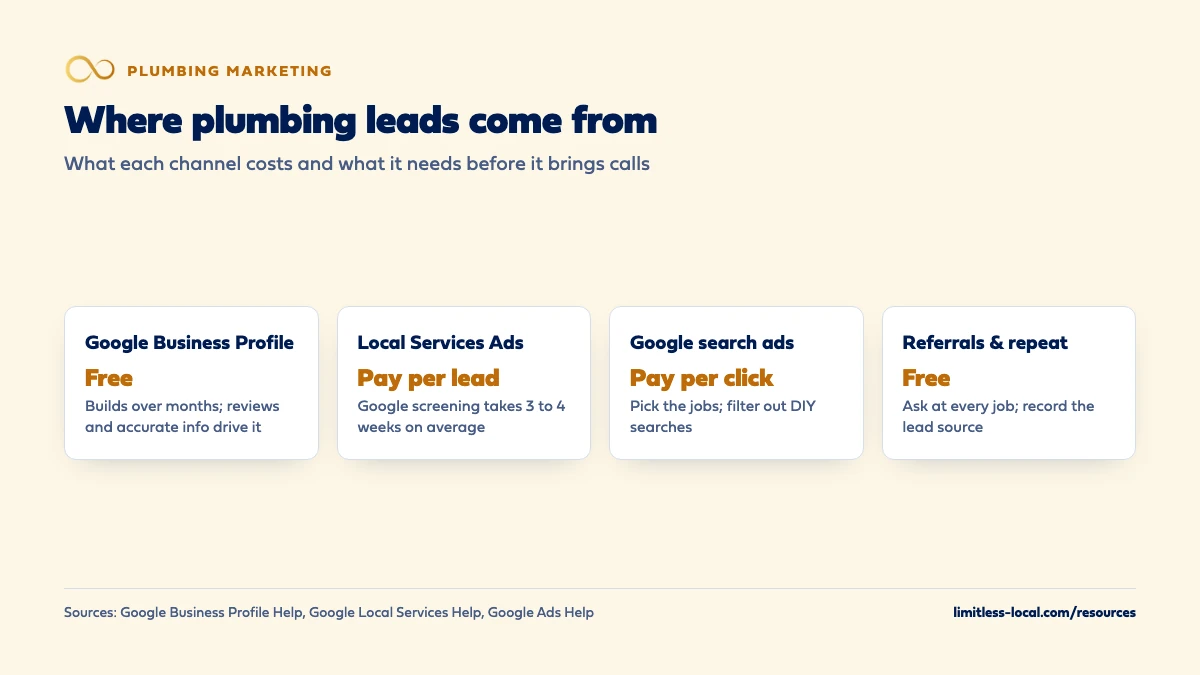
For most plumbing companies, new leads come from a handful of places, and they don’t cost the same or arrive at the same speed:
- Your Google Business Profile. The listing that shows in Google Maps and the map pack when someone searches for a plumber nearby. It’s free, and Google uses a plumber as its example of a service-area business, one that goes to the customer instead of having customers come in (Google Business Profile Help).
- Local Services Ads. Paid listings at the top of Search and Maps where you pay per lead, not per click.
- Google search ads. Paid ads where you pick the searches, pay per click and send people to your website.
- Your website and SEO. The regular search results under the map pack, which rank web pages.
- Past customers and referrals. The people who already trust you, and the neighbors and property managers they tell.
Underneath all five sit your reviews and the way your phone gets answered. In our judgement, most plumbing companies that feel short on leads have a gap in one of those two before they have a channel problem.
Am I getting enough plumbing leads now?
Count before you add anything. For the last month or two, list every new lead, where it came from and whether it booked, next to how many open slots the schedule had. Three patterns point to three different fixes:
- The schedule has holes and few leads are coming in. You need more leads, and the channels on this page are where they come from.
- Plenty of leads, few booked jobs. The problem is after the lead: missed calls, slow callbacks or requests for work you don’t do. More leads won’t fix that.
- Busy with small service calls, few big tickets. You don’t need more leads overall. You need more of the right ones, such as water heater replacements, repipes and sewer work.
The number to watch isn’t lead count. It’s booked jobs, and what each one cost you to get.
How do I get more leads from my Google Business Profile?
Start here, because it costs time rather than money. Google says local results are mainly based on three things: relevance (how well your profile matches the search), distance (how far you are from the person searching) and prominence (how well-known your business is, which includes how many reviews you have and how many websites link to you). Google also says there’s no way to request or pay for a better local ranking (Tips to improve your local ranking on Google).
What you control:
- Verify the profile. Google says a verified business is more likely to show up in search results.
- Fill it in completely and keep it accurate. Category, hours, service areas and services. Google says businesses with complete and accurate info are more likely to show up in local results, and inaccurate info can keep you out of relevant searches.
- Add real photos. Your trucks, your crew at work, a finished water heater install.
Distance is the one factor you can’t change, and in our judgement it’s where paid search earns its keep: the map pack is usually harder to win on the far side of a metro from where you’re based. Optimizing your plumbing Google Business Profile goes through each setting.
How do reviews turn into more plumbing calls?
Reviews work in three places at once. In Maps, Google says more reviews and positive ratings can help your local ranking. In Local Services Ads, your rating and number of reviews are part of the profile quality Google uses to order the ads (About ad rankings). And the homeowner reads them: someone with water on the floor is choosing between a few names on a screen, and in our judgement the rating and the most recent reviews are most of what they judge you on.
Google’s own advice for getting more is simple: remind customers to leave a review with a Google link or QR code, and reply to the reviews you get. Google also strictly prohibits offering incentives, such as a discount on the next service call, in exchange for a review (Tips to get more reviews).
The best moment to ask, in our judgement, is when the tech finishes and the water is running again, not in an email a week later. Getting more Google reviews covers how to make the ask a habit for every tech.
Curious what your marketing is actually booking?
Get a free visibility audit — no obligation, no sales pitch.
Should I run Local Services Ads to get more plumbing leads?
Local Services Ads are often the quickest paid way to get plumbing leads once you’re approved, because there are no keywords to manage and you pay per valid lead instead of per click. Google counts a lead as valid when you answer a call, get a message or voicemail, get a booking request, or miss a call during your business hours and the caller stays on the line for more than 20 seconds (How leads work).
Two things are different for plumbers:
- Plumbing gets extra screening. Google treats plumbing as an urgent category, because people often call plumbers for time-sensitive problems like a hot water outage, so plumbers go through an additional level of screening that includes background checks on service professionals. Depending on your business, the checks can also include business registration, general liability insurance and state-level licenses. Google says screening takes 3 to 4 weeks on average after you submit your documents, so start early (Business screening and verification requirements).
- Plumbing is in the first group moving into Google Ads. Google is moving Local Services Ads into Google Ads as Performance Max campaigns with pay-per-lead goals. Plumbing is named in the first phase, which began in August 2026 for select advertisers, but service-area businesses without a physical storefront, which describes many plumbers, are scheduled for late 2026. Either way, you still pay per lead and still show only on Search and Maps (Google Ads Help).
Whether the leads pay off for your shop is covered in whether LSAs are worth it for plumbers.
How do Google search ads bring in plumbing leads?
Search ads let you choose which searches you show up for, which matters in plumbing because a sewer line replacement and a running toilet are very different jobs. You pay per click and send the click to a page on your website, so that page has to make calling easy.
The plumbing-specific waste is the do-it-yourselfer. Plenty of people searching about a clogged drain want a how-to, not a plumber. Google’s tool for this is negative keywords, which keep your ads off searches you don’t want. Google’s advice is to look for searches that are similar to your keywords but come from people looking for something different (About negative keywords). For a plumber, in our judgement, that list usually starts with words like “how to”, “DIY” and “video”. Check the search terms in your account every week for the first month and keep adding to it.
If you’re deciding where your first ad dollar goes, starting with LSAs, Google Ads or SEO walks through the trade-offs.
How do I get more plumbing leads with an old website?
An old website can still bring in leads if it does a few things well. In our judgement, these matter more than how modern it looks:
- A page for each main job you want more of (drain cleaning, water heaters, repipes, sewer lines), instead of one page listing everything.
- Your phone number at the top of every page, tappable on a phone.
- Clear hours, and a plain statement of whether you take emergency calls after hours.
- The towns you serve, written out, with real photos and a few recent reviews.
Fixing the site is the SEO side, and SEO is a ramp: it typically takes 3 to 6 months to show meaningful growth, while ads can bring leads within days of launch. A plumbing company with an old or thin website will usually get its first leads faster from the Google profile, reviews and Local Services Ads, which lean on the website least, while the site gets fixed underneath. That order is our recommendation, not a rule.
How do I stop losing the plumbing leads I already get?
For a plumber, the cheapest new lead is the one already ringing your phone. Burst pipes don’t keep business hours, and in our judgement a homeowner with water on the floor rarely leaves a voicemail and waits.
Local Services Ads put a price on this. A call that goes to voicemail or rings out during your business hours is charged as a lead if the caller stays on the line for more than 20 seconds, and Google defines business hours as the hours set on your Google Business Profile (How leads work). If your profile says you’re open around the clock and nobody picks up at 2 a.m., you can pay for that call and still lose the job. Google also says missed calls may hurt your responsiveness, which is part of how it ranks the ads.
Fixes, roughly from cheapest: forward after-hours calls to whoever is on call, turn on message leads so customers can text, set listed hours you can actually cover, or use an answering service. Stopping lost after-hours calls covers the options in detail.
How do I get more repeat customers and referrals?
Past customers already know your work, and in our judgement they’re the most overlooked source of plumbing leads:
- Leave your number somewhere it’ll be found next time, such as a sticker on the water heater or inside the sink cabinet.
- Ask for a referral at the same moment you ask for a review, when the problem is fixed and the customer is relieved.
- Keep a list of customers with older water heaters or repeat drain problems, and reach out before their next problem turns into an emergency call to someone else.
- Get to know the people who send plumbing work: property managers, real estate agents, home inspectors and remodelers, and record “referral” as the lead source when they do.
How do I know which lead sources are worth the money?
Compare every source on the same number: what each booked job cost. Local Services Ads report a cost per lead, search ads a cost per click, and your Google profile has no cost at all, so the platform numbers don’t compare directly. Three steps get you there:
- Tag where each lead came from. A separate tracked phone number for each channel is the usual way.
- Mark which leads booked in whatever you run jobs in, whether that’s ServiceTitan, Housecall Pro or Jobber.
- Divide each month’s spend on a channel by the jobs it booked. Then look at what those jobs were worth.
A channel with a higher cost per booked job can still be the better deal if it brings in the repipes instead of the clogged drains. Give paid channels a few weeks of steady spend and SEO a few months before you decide.
Not sure which of these is costing you jobs?
A free visibility audit checks the Google profile, reviews, site and tracking, and shows what to fix first.
What's different about getting more plumbing leads
Emergencies set the clock. Google itself treats plumbing as an urgent category in Local Services Ads, because people call plumbers for time-sensitive problems (Google Local Services Help). In our judgement, that makes phone coverage part of lead generation for plumbers in a way it isn’t for trades where homeowners take a week to decide.
Google splits some plumbing work into its own categories. In Local Services Ads, Google describes plumbers as working on pipes, drains, sewers and the appliances that connect to them, but it also lists a separate sewage systems category and a drain expert category that is currently available only in California and Florida. Check which categories match the work you want before you set up, and switch on only the job types you actually do.
A worked example: answering calls before buying more leads
These numbers are made up to show the math, not a benchmark for your market. Say your marketing brings in 50 leads a month and you spend $2,100 on it. 12 of those leads come in after 6 p.m. or on weekends. The other 38 come in during the day, and your office books 1 in 2 of them: 19 jobs. After hours, calls go to voicemail and you book 2 of the 12 the next morning. That’s 21 booked jobs, or $100 per booked job.
Now say someone answers the after-hours calls and books them at the same 1 in 2 rate. Those 12 leads become 6 jobs instead of 2, and the month comes to 25 booked jobs on the same spend, or $84 per booked job. Getting those 4 extra jobs by buying more leads, at your old $100 a job, would have cost about $400 more a month.
On our side, Essentials ($3,500 a month) includes Google Business Profile management, review generation and Google Ads management up to $2,500 a month in ad spend, and Growth ($4,500 a month) adds Local Services Ads management. After-hours answering is an add-on, priced on the discovery call, and ad spend is always paid to Google separately. A free visibility audit shows which gap is costing you the most jobs.
Frequently asked questions
How fast can I get more plumbing leads?
Ads can bring leads within days of launch, though Local Services Ads first need Google’s screening, which takes 3 to 4 weeks on average once your documents are in. SEO and your Google profile typically take 3 to 6 months to show meaningful growth.
Can I pay Google to rank higher in Google Maps?
No. Google says there’s no way to request or pay for a better local ranking. Ads can put you above the map results, but they’re a separate, paid placement.
Should my plumbing company list itself as open around the clock?
Only if someone really answers. For Local Services Ads, your business hours are the hours on your Google Business Profile, and a missed call during those hours can be charged once the caller stays on the line more than 20 seconds.
Can I give customers a discount for leaving a Google review?
No. Google strictly prohibits offering incentives, like free or discounted services, in exchange for reviews. Ask every customer, make it easy with a review link or QR code, and reply to what they write.
Do I need a website to get plumbing leads?
Not to start. Your Google Business Profile and Local Services Ads can bring calls without a strong website. Google search ads and SEO both depend on it, so it becomes important as soon as you use either.
Key takeaways
- Work the free channels first: a verified, complete Google Business Profile and a review request at every job.
- Local Services Ads charge per valid lead; plumbing gets extra screening, and Google’s checks take 3 to 4 weeks on average.
- Search ads let you aim at specific jobs; negative keywords keep do-it-yourselfers from using up the budget.
- Answering after-hours calls can add booked jobs without adding spend.
- Compare every source on cost per booked job and what those jobs were worth.
Want a second set of eyes on your setup?
We'll look at how you show up locally and where calls are leaking, then send you a plain-English breakdown.
More in this section
- How should a new plumbing company get its first customers?
- How do I get more water heater and repipe jobs?
- How do I get more Google reviews for my plumbing company?
- How do I track which plumbing marketing books jobs?
- How do I work out my plumbing customer acquisition cost?
Sources
- Tips to improve your local ranking on Google — Google Business Profile Help
- Business Profile for service businesses overview — Google Business Profile Help
- Tips to get more reviews — Google Business Profile Help
- How leads work — Google Local Services Help
- About ad rankings — Google Local Services Help
- Business screening and verification requirements (United States) — Google Local Services Help
- Local Services Ads transition to Performance Max campaigns with pay-per-lead goals — Google Ads Help
- About negative keywords — Google Ads Help