
Should my plumbing company start with LSAs, Google Ads or SEO?
- LSAs, Google Ads or SEO: which should a plumber turn on first?
- What's the difference between LSAs, Google Ads and SEO for a plumber?
- Which one brings plumbing calls fastest?
- What changed for plumbing Local Services Ads in 2026?
- Are LSAs or Google Ads better for emergency plumbing calls?
- Which works better for water heater, repipe and sewer jobs?
- What should a plumber start with on a tight budget?
- What if my plumbing company is new or has only a few reviews?
- How much should I invest in SEO versus paid ads?
- When is each one the wrong first move for a plumber?
- How will I know I picked the right one?
- What's different about this choice for plumbing companies
- A worked example: same budget, two channels, different jobs
- Frequently asked questions
- Key takeaways
- More in this section
- Sources
The short version
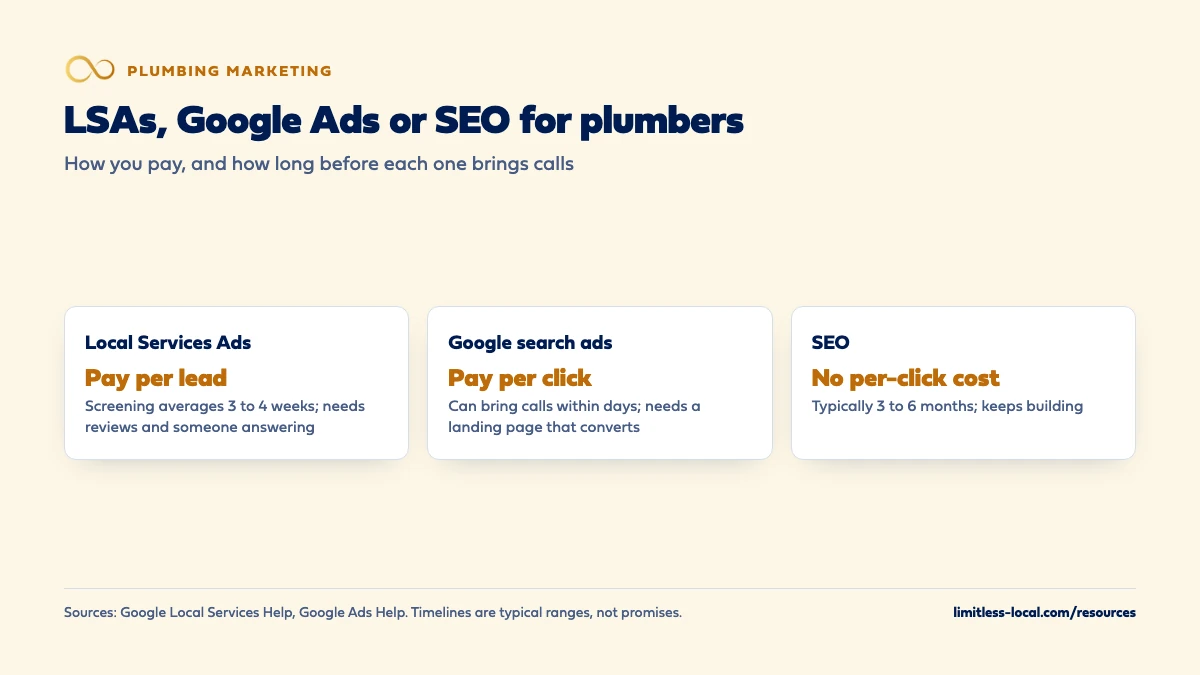
- Paid search brings calls fastest; SEO typically takes 3 to 6 months, so start it early, not instead.
- LSAs suit plumbers with solid reviews and reliable phone coverage, after a screening that averages 3 to 4 weeks.
- Google search ads suit plumbers chasing specific high-ticket jobs, with a landing page that converts.
- Compare every channel on cost per booked job, not cost per lead or per click.
For plumbing owners choosing a first marketing channel, now that Local Services Ads are moving into Google Ads and plumbing is one of the first trades to move.
Get a free visibility audit · Book a growth call
LSAs, Google Ads or SEO: which should a plumber turn on first?
Most plumbing companies should start with paid search for calls now and start SEO at the same time, because SEO typically takes months to pay off. Start with Local Services Ads if you have solid Google reviews, someone answers every call during your listed hours, and you can wait out Google’s screening, which averages 3 to 4 weeks. Start with Google search ads if you need calls sooner or want specific jobs like water heater replacements and sewer lines, and have a page that turns clicks into calls. Lead with SEO and your Google Business Profile only if you can’t fund ads yet.
That’s how we make this call with owners: start where a dollar gets closest to a booked job, then build the slower channel underneath it. Google Ads and Local Services Ads management are part of our local ads work, and both come together with local SEO in our plumbing marketing packages. The rest of the plumbing marketing questions library takes each channel one question at a time.
What's the difference between LSAs, Google Ads and SEO for a plumber?
All three put you in front of people searching for a plumber on Google. You pay for them differently, and they show up in different places.
- Local Services Ads (LSAs) sit at the top of Google Search and Maps. You pay per valid lead (a call, message or booking), not per click, and you choose service categories, job types and areas instead of keywords. The customer contacts you straight from the ad.
- Google search ads charge per click. You choose the searches, write the ad and send the click to a page on your website.
- SEO covers your Google Business Profile, which drives the map pack, and your website, which drives the regular results under it. Google says there’s no way to request or pay for a better local ranking (Tips to improve your local ranking). What you pay for is the work, and it takes time to show.
Which one brings plumbing calls fastest?
Google search ads, usually. Once the keywords, ads and landing page are built, calls can start within days, because you’re buying a spot rather than earning it.
Local Services Ads look just as fast on paper but have a longer runway for plumbers. Google treats plumbing as an urgent category, so plumbers go through an additional level of screening that includes background checks on service professionals, and Google says the screening and verification process takes 3 to 4 weeks on average after you submit your documents (Business screening and verification requirements). Google does offer pre-badge ads once you pass the preliminary checks, but it places those listings below providers who have finished every requirement and earned the badge (Getting started with Local Services Ads).
SEO is the slow lane. It typically takes 3 to 6 months to show meaningful growth, and it keeps building after that instead of stopping when the budget does. The map pack side is covered in getting into the Google map pack.
What changed for plumbing Local Services Ads in 2026?
Google is moving Local Services Ads into the main Google Ads platform as Performance Max campaigns with pay-per-lead goals. Plumbing is named in the first phase, which began in August 2026 for select advertisers. Service-area businesses without a physical storefront, which describes a lot of plumbing companies, are scheduled for late 2026, along with accounts using custom bidding or booking setups (Google Ads Help).
What matters for this decision:
- LSAs are still a different tool from search ads. You still pay per lead, the ads still show only on Search and Maps, and there are still no keywords, even inside a Google Ads account.
- New advertisers still sign up the old way. Google says you can’t yet create a new pay-per-lead campaign inside Google Ads; new campaigns are still set up through Local Services, with creation in Google Ads coming later.
- Your Google profile feeds the ad. After the move, your business name, address and hours sync one way from your Google Business Profile, budgets are daily instead of weekly, and setting your own maximum price per lead is no longer supported.
Are LSAs or Google Ads better for emergency plumbing calls?
For pure emergency calls, LSAs have a natural edge in our view: the customer taps to call straight from the ad, with no website in between, and you only pay when the contact counts as a valid lead. Google also says enabling message and booking leads can raise the chance of getting a lead at night and on weekends, when you can’t answer the phone (About ad rankings).
The catch is that LSAs punish missed emergency calls twice. A call you miss during your business hours is charged once the caller stays on the line for more than 20 seconds, and Google defines business hours as the hours on your Google Business Profile (How leads work). Missed calls can also lower your LSA ranking, because responsiveness is part of how Google orders the ads.
Search ads don’t charge for the missed call, but you’ve already paid for the click. If after-hours coverage is thin, fix that first; stopping lost after-hours calls covers how.
Curious what your marketing is actually booking?
Get a free visibility audit — no obligation, no sales pitch.
Which works better for water heater, repipe and sewer jobs?
Google search ads, in most cases. They let you bid on the searches for exactly the job you want and send each one to a page built for it, and Google’s auction weighs the usefulness and relevance of your ad and landing page alongside your bid (How the Google Ads auction works). A water heater replacement page with prices or financing options, photos of real installs and a phone number at the top does a job a general homepage can’t.
LSAs can still help, but they bring whatever mix your job types attract. LSAs automatically opt you into your industry’s general searches, such as “plumber near me”. Google says you can turn off this broad search setting if you only want leads from people searching for specific services, using “sink installation” and “shower repair” as examples, though it may cut your lead volume (Edit your industries, service areas, and job types). Getting more water heater and repipe jobs goes deeper on the big-ticket side.
What should a plumber start with on a tight budget?
With a small budget, the question is where each dollar gets closest to a booked job. LSAs charge only for valid leads, and Google doesn’t charge for leads it judges invalid or low quality, so a small budget isn’t spent on clicks that never call. That’s why, in our judgement, LSAs are usually the easier small-budget start, as long as your reviews and phone coverage are in shape and you can wait out the screening.
Search ads can work on a small budget too, but every click costs money whether the person calls or not, and a thin budget spread across broad plumbing searches, including do-it-yourselfers looking for a how-to, goes fast. If you run them, keep the keywords tight and the area small. If the budget can’t cover either right now, put your time into the free part of SEO: a verified, complete Google Business Profile and a review request at every job. How much to spend on marketing covers setting the number.
What if my plumbing company is new or has only a few reviews?
Then LSAs probably aren’t your first move. Google’s profile quality for LSAs includes your rating and number of reviews (About ad rankings), and reviews can be required before your ad shows at all, depending on your category (Getting started with Local Services Ads). Reviews also feed the map pack, where Google says more reviews and positive ratings can help your local ranking.
A new company also has the whole screening checklist ahead of it: business registration, insurance, licenses and background checks. Start that paperwork now even if you run search ads first. With a thin review count, search ads are, in our judgement, the better paid start, because where they show depends on your bid, the ad and the landing page rather than your star rating. Ask every finished job for a review in the meantime, and revisit LSAs once the count and rating are solid.
How much should I invest in SEO versus paid ads?
There’s no fixed split that fits every plumbing company. In our judgement, a sensible starting point looks like this:
- Paid search gets the budget that has to produce calls this month. It’s the part you can turn up, down or off.
- SEO gets steady, smaller, ongoing money or time. It doesn’t respond to a budget change next week, so it shouldn’t be the line you cut first in a slow month.
- The split shifts as organic calls grow. When the map pack and your website bring in a real share of booked jobs, you can lean less on paid clicks for the same work.
Judge both on cost per booked job, with a fair window for each: a few weeks of steady spend for paid search, a few months for SEO.
When is each one the wrong first move for a plumber?
- Don’t start with LSAs if calls go to voicemail during your listed hours, you only have a few reviews, you can’t clear Google’s screening yet, or you’d have to draw the service area wider than your trucks really go to get volume. You’d rank low or pay for leads you can’t use.
- Don’t start with Google search ads if you have no page worth sending a click to, nobody to check search terms every week for do-it-yourself searches, or no way to tell which clicks turned into calls and which calls turned into jobs.
- Don’t start with SEO alone if the schedule has holes this month. SEO is the right foundation, but on a ramp of several months it won’t fill next week’s schedule. Run it alongside paid search instead.
None of these is a permanent no. Each is something to fix, and the channel you skipped often becomes the right second step.
How will I know I picked the right one?
Judge every channel the same way: what each booked job cost, and what those jobs were worth. LSAs report a cost per lead, search ads a cost per click, and SEO has no per-anything cost, so the platform numbers don’t compare directly. Tag where each call came from, mark which ones booked in your field software, and divide what you spent on each channel by the jobs it booked.
If search ads are getting clicks but the phone isn’t ringing, the problem is usually the keywords or the landing page before it’s the channel; Google Ads clicks with no calls walks through the checks.
Not sure which of these is costing you jobs?
A free visibility audit checks the Google profile, reviews, site and tracking, and shows what to fix first.
What's different about this choice for plumbing companies
Plumbing gets extra LSA screening. Because Google treats plumbing as urgent, plumbers face service-professional background checks on top of the business, insurance and license checks other trades may see (Google Local Services Help). Budget the time, and start the paperwork before you need the leads.
Google splits plumbing work across categories. In LSAs, the plumber category covers pipes, drains, sewers and the appliances that connect to them, but Google also lists a separate sewage systems category and a drain expert category currently available only in California and Florida. If sewer or drain work is your focus, check which category fits before you set up.
Do-it-yourself searches cost search advertisers money. In our judgement, many plumbing searches come from people hoping to fix it themselves. LSAs don’t charge for the search, only for a valid lead, while search ads charge for every click, so plumbers running search ads need a tighter keyword list than most trades.
A worked example: same budget, two channels, different jobs
These numbers are made up to show the math, not a benchmark for your market. Say you have $1,800 for a month and you’re choosing between LSAs and Google search ads.
- LSAs: at a made-up $60 per charged lead, $1,800 buys 30 leads. If 1 in 2 books, that’s 15 booked jobs, or $120 per booked job, mostly service calls and drain work.
- Search ads aimed at water heater replacement: at a made-up $20 per click, $1,800 buys 90 clicks. If 1 in 9 clicks calls, that’s 10 calls, and if 4 of those book, $450 per booked job.
On cost per job, LSAs win easily. But if each water heater replacement leaves you several times what a service call does, four of them can be worth more than fifteen small jobs. That’s why the comparison is cost per booked job and what each job is worth, never cost per lead against cost per click. Remember the timing too: on a new LSA account, part of that first month may go to screening before any leads arrive.
On our side, Essentials ($3,500 a month) includes Google Ads management up to $2,500 a month in ad spend, plus the Google profile, listings, content and review work local SEO is built on. Growth ($4,500 a month) adds SEO for up to two locations, Local Services Ads management and Google Ads up to $5,000 a month in spend. Ad spend is paid to Google separately. A free visibility audit is the simplest way to see which channel your market points to first.
Frequently asked questions
Do I need a website to run Local Services Ads?
Not to take leads: customers call, message or book straight from the ad. You do need a verified Google Business Profile, and after the move to Google Ads your name, address and hours sync from it.
Does paying for Google Ads help my map pack ranking?
No. Google says there’s no way to request or pay for a better local ranking. Ads and the map pack have to be worked on separately.
Can I run LSAs and Google search ads at the same time?
Yes. You can use LSAs for general and emergency searches and search ads for specific high-ticket jobs. Just judge both on cost per booked job.
Can I choose which plumbing jobs my LSAs show for?
Partly. You select job types and service areas, and you can turn off the broad search setting so the ad doesn’t show for general searches like “plumber near me”, though Google says that may reduce leads.
Can I do plumbing SEO myself?
Much of it, yes. Verifying and completing your Google Business Profile, asking for reviews and keeping your hours and services accurate cost time rather than money.
Where do referrals fit in?
Alongside all three. Referrals and repeat customers are often your cheapest jobs, but you can’t turn them up on demand, so most plumbers still need at least one Google channel.
Key takeaways
- Paid search brings calls fastest; SEO typically takes 3 to 6 months, so start it early rather than instead.
- Plumbing gets extra LSA screening that averages 3 to 4 weeks, so start the paperwork before you need the leads.
- LSAs fit emergency calls when someone answers; a missed call during listed hours can still be charged.
- Search ads fit high-ticket jobs like water heaters, repipes and sewer lines, with a page built for each.
- Compare every channel on cost per booked job and what those jobs are worth.
Want a second set of eyes on your setup?
We'll look at how you show up locally and where calls are leaking, then send you a plain-English breakdown.
More in this section
- Are Google Local Services Ads worth it for plumbers?
- Should I hire a plumbing marketing agency or do it myself?
- Why are my plumbing Google Ads getting clicks but no calls?
- How much should a plumbing company spend on marketing each month?
- How do I get my plumbing company into the Google map pack?
Sources
- Local Services Ads transition to Performance Max campaigns with pay-per-lead goals — Google Ads Help
- Business screening and verification requirements (United States) — Google Local Services Help
- Getting started with Local Services Ads (United States) — Google Local Services Help
- Edit your industries, service areas, and job types — Google Local Services Help
- How leads work — Google Local Services Help
- About ad rankings — Google Local Services Help
- How the Google Ads auction works — Google Ads Help
- Tips to improve your local ranking on Google — Google Business Profile Help